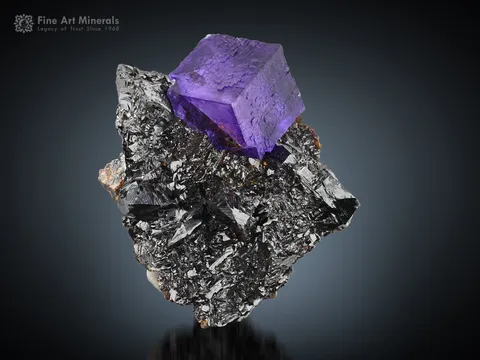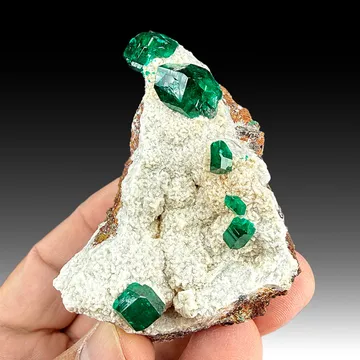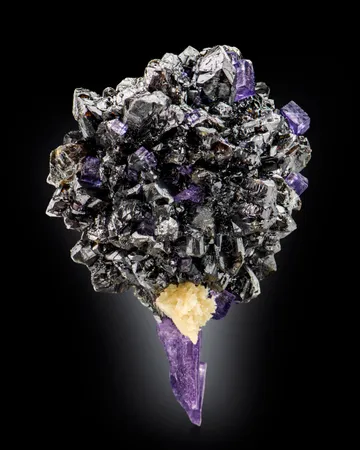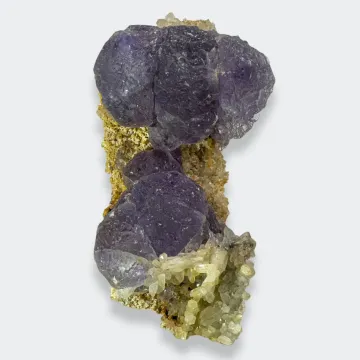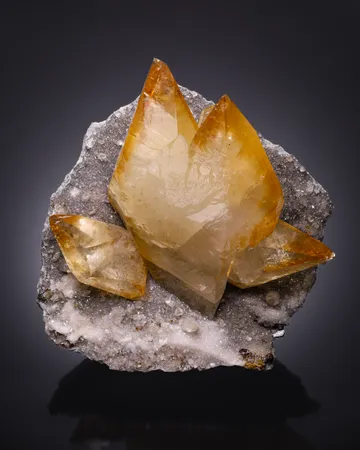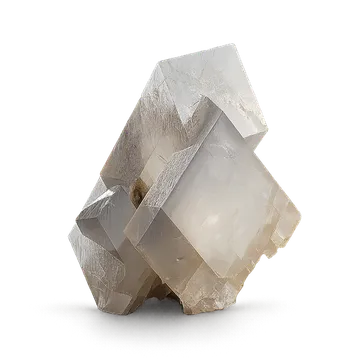
Dolomite from Elmwood Mine — pearly rhombs with drusy surfaces amid sphalerite and fluorite; Mississippi Valley-type formation, ideal for identification.
Key facts
Dolomite from the Elmwood Mine is not famous because it forms giant single crystals. It is famous because it provides one of the most recognizable stages in American mineral collecting: pale, pearly rhombs and drusy carpets carrying ruby-black sphalerite, purple fluorite, golden calcite, snowy barite, quartz, and occasional bitumen. In the best Elmwood combinations, dolomite is the quiet architectural mineral—the sparkling, cream to gray-white carbonate skin over silicified limestone or breccia matrix that makes the dark zinc sulfide and transparent fluorite look even more dramatic.

Photo: Rob Lavinsky, iRocks.com, via Wikimedia Commons
The geological story is classic Mississippi Valley-type mineralization, but Elmwood gives that model unusually vivid collector expression. Ore and gangue minerals formed in collapse breccias and dissolution cavities in the Mascot Dolomite of the upper Knox Group. Zinc was the economic target, with sphalerite as the ore mineral; dolomite, calcite, quartz, fluorite, barite, and lesser sulfides filled the open spaces and cemented breccia. The result was a mine that industrially belonged to zinc mining, but culturally belongs to mineral collecting.
For dolomite specialists, Elmwood pieces are most desirable when the dolomite is not merely “matrix,” but an active part of the composition: sharp, lustrous rhombs; pearly white or pale tan druse; attractive contrast against black to wine-red sphalerite; and clean, undamaged surfaces under calcite or fluorite. Dolomite-only specimens are usually modest, but dolomite-bearing combinations can be superb. A small patch of bright rhombs under a purple fluorite cube, or a crystalline dolomite base supporting a ruby-jack sphalerite cluster, is enough to place the specimen immediately in the Elmwood visual language.

Photo: Rob Lavinsky, iRocks.com, via Wikimedia Commons
Historically, Elmwood’s reputation was built by the dramatic species around the dolomite: large amber calcites, purple and colorless fluorites, lustrous sphalerites, hemispherical barite aggregates, and occasional galena. Yet the dolomite matters because it records the same cavity system that made those classics possible. It is part of the paragenetic fabric of the deposit, an early carbonate surface that often carries later, more flamboyant minerals. Serious collectors should look at Elmwood dolomite with that in mind: not as a generic carbonate, but as the textural foundation of one of North America’s great mine assemblages.
Search for specimens: View all dolomite specimens from Elmwood Mine, Tennessee, USA
Elmwood lies near Carthage in Smith County, north-central Tennessee, within the Central Tennessee Ba-F-Pb-Zn District. The mine is part of the Middle Tennessee Mines complex, historically associated with Elmwood, Gordonsville, Carthage, Stonewall, and Cumberland, with processing centered at the Gordonsville concentrator in later years. The workings are underground and industrial, not a public collecting locality.
The deposit is a Mississippi Valley-type zinc system hosted in carbonate rocks of the upper Knox Group, especially the Lower Ordovician Mascot Dolomite. The ore is stratabound but structurally and texturally controlled by dissolution cavities, collapse breccias, and open-space filling. In the Elmwood mine, much of the ore occurred in the Elmwood upper and lower limestone members within the Mascot interval. Limestone dissolution, collapse of overlying dolostone beds, and later mineralizing fluids produced the breccias and vugs that collectors know from specimen surfaces.
In practical specimen terms, that geology explains the Elmwood look. Dark sphalerite masses and crystals line breccia cavities; quartz druse and dolomite rhombs coat rock and breccia fragments; later fluorite, barite, and calcite occupy open spaces. Minor galena, marcasite, pyrite, celestine or barian celestine, and bituminous material appear locally. Dolomite is present but not dominant in the ore cement; its collector importance lies in the sharp, light-colored rhombic surfaces that host more conspicuous species.
The modern history begins with New Jersey Zinc Company exploration in the 1960s. The company’s early program in Middle Tennessee eventually intersected economic zinc mineralization near Elmwood, and follow-up drilling defined a major orebody. An exploratory shaft was sunk in the late 1960s, the Elmwood mill was built in 1973–1974, and mining began in 1975 under the Jersey Miniere Zinc joint venture. The Elmwood mill operated until the Gordonsville mill was commissioned in 1982; from then, Elmwood became part of a larger integrated Middle Tennessee mining complex.
Production and ownership changed repeatedly. Union Zinc, Savage Zinc, Pasminco, Mossy Creek Mining, Strategic Resource Acquisition, and Nyrstar all appear in the district’s mining history. Pasminco closed the mines in 2003 during corporate restructuring. SRA rehabilitated the operation in 2007–2008 but placed it on care and maintenance after zinc prices fell. Nyrstar acquired the operation in 2009; Elmwood-area zinc production resumed in phases, including renewed ore hoisting from Elmwood through the Gordonsville access system in 2010. Nyrstar paused Middle Tennessee production at the end of November 2023 amid weak market conditions and high costs. In April 2026, Nyrstar completed the sale of its U.S. assets, including the Mid Tennessee mining complex, to Korea Zinc.
Collectors should treat Elmwood as a closed or inaccessible industrial mine for field-collecting purposes. Fine specimens reached the market through mine-related recovery, old collections, and commercial mineral channels, not public dig access. That distinction matters: believable provenance is part of an Elmwood specimen’s value, especially now that new supply is uncertain and historic material continues to circulate through collections, shows, auctions, and dealer inventories.
Notable finds from Elmwood are usually discussed under calcite, fluorite, sphalerite, and barite, but dolomite is woven into many of them. Crystalline dolomite matrices carry “ruby-jack” sphalerite clusters, purple fluorite cubes, and small calcite crystals. Some specimen descriptions note pearlescent dolomite rhombs over silicified limestone, tiny purple fluorites scattered over dolomite, or sphalerite perched on dolomite-covered matrix. These are the combinations that make Elmwood dolomite collectible: the dolomite is rarely the loudest mineral, but it often completes the specimen.
Elmwood dolomite most commonly appears as small rhombs, drusy coatings, crystalline crusts, and pearly matrix surfaces rather than as large isolated crystals. The typical look is white, cream, pale tan, light gray, or faintly pinkish to beige, with a pearly to vitreous luster. On better specimens the rhombs are sharp enough to be read individually under hand lens magnification, producing a sparkling carbonate ground over chert, silicified limestone, or breccia matrix.
The crystal habit is the familiar rhombohedral habit of dolomite, but Elmwood examples are especially valued for texture and association. A good Elmwood dolomite surface should look crisp rather than chalky. The rhombs may form a clean carpet beneath sphalerite or fluorite, or appear as sparkling pockets between darker sulfide masses. Some pieces show dolomite with quartz druse, making the matrix glitter under low-angle light. Where dolomite is described as pearlescent, the effect can be extremely attractive beside black or red-brown sphalerite.
Size ranges vary widely because dolomite is usually part of a composite specimen. Individual rhombs are generally small, commonly millimetric to sub-centimetric. Display specimens range from thumbnails and miniatures to large cabinet combinations, depending on the associated minerals. A specimen may be sold as sphalerite with dolomite, fluorite on dolomite, or calcite and sphalerite on dolomite; in such cases the dolomite may occupy much of the matrix surface while the named display species provides the focal point.
The most characteristic associations are sphalerite, fluorite, calcite, quartz, and barite. Sphalerite ranges from lustrous black to dark reddish brown, sometimes with ruby-red internal reflections or “ruby-jack” highlights. Fluorite is most familiar in purple cubes and etched “Carthage Corner” forms, but clear to colorless examples also occur. Calcite appears as honey, amber, orange, pale cream, or white scalenohedra, including doubly terminated and twinned crystals. Barite forms white to ivory spherical or mound-like aggregates and bladed forms; celestine or barian celestine is a more specialized association. Galena, marcasite, pyrite, chalcopyrite, bitumen, and quartz round out the broader assemblage.
Quality in Elmwood dolomite is judged differently from quality in a freestanding dolomite crystal locality. The best pieces show strong contrast, clean composition, and unambiguous locality character. A white dolomite rhomb carpet supporting wine-red sphalerite is classic. A purple fluorite cube perched on dolomite with sphalerite is more valuable if the dolomite is bright, undamaged, and not visually overwhelmed by bruised matrix. Dolomite with calcite becomes more desirable when the calcite is sharp, lustrous, and undamaged, and when the carbonate-on-carbonate contrast remains legible rather than monotonous.
Condition is particularly important because the dolomite often forms the display surface. Abraded rhombs, bruised white matrix, iron-stained patches, and broken contacts can reduce the effect. However, collectors should distinguish mining and pocket contacts from later damage. Elmwood specimens were recovered from an active underground zinc operation; sawn bases, trimmed backs, and minor edge contacts are common and may be acceptable if the display face is strong.
Elmwood dolomite is collected mainly as an association mineral. Pure dolomite specimens from the mine are much less prominent than combinations with sphalerite, fluorite, calcite, barite, and quartz. That means the serious collector should evaluate the whole piece: is the dolomite sharp and attractive, does it support the composition, and does the association make geological sense for Elmwood?
The largest authenticity concern is locality attribution. Many Elmwood pieces have circulated for decades, and nearby Middle Tennessee mines—especially Gordonsville, Cumberland, Carthage, and Stonewall—share related geology and mineralogy. Some specimens are broadly labeled “Elmwood” because that name is better known, even when a more precise Middle Tennessee mine attribution may be uncertain. Old labels, collection history, dealer documentation, and consistency of association matter. A dolomite-rich matrix with sphalerite and fluorite is plausible, but “Elmwood” should not be accepted solely because the assemblage is attractive.
There is no famous, locality-specific epidemic of fabricated Elmwood dolomite comparable to the well-known fake problems in some other mineral categories. The common risks are ordinary but important: repaired fluorite or calcite on dolomite matrix, glued contacts hidden among rhombs, reattached sphalerite clusters, oiling or coating of fluorite to improve luster, and vague “old collection” claims without supporting labels. Use magnification and side lighting. Glue often catches in the tiny spaces between dolomite rhombs; repairs may show as glossy seams, dust-filled joints, or mismatched surface luster.
Condition problems are predictable. Dolomite rhombs can bruise to a dull white patch. Fluorite edges can be nicked, especially on large cubes and etched corners. Calcite tips are vulnerable, and even a small chip can dominate the eye on a transparent amber crystal. Sphalerite is comparatively robust but can show cleaved faces, contact bruises, and edge wear. White barite and pale dolomite surfaces may also show handling grime. Cleaning should be conservative; aggressive acids or mechanical cleaning can damage carbonate surfaces, loosen bituminous residues, or alter the specimen’s natural patina.
Rarity depends on what the dolomite is doing. Dolomite as matrix on an average sphalerite piece is not rare. Fine dolomite with balanced, undamaged sphalerite, purple fluorite, and calcite is much scarcer. Dolomite-rich specimens with strong aesthetics, old labels, and major associated species deserve attention because they preserve the complete Elmwood assemblage rather than isolating the more glamorous minerals from their geological setting.
Market availability remains steady but uneven. Elmwood specimens are common enough that collectors can usually find examples, but top-tier pieces are increasingly locked into collections or priced as classics. Small dolomite-sphalerite or dolomite-calcite combinations are still attainable. Large cabinet pieces with exceptional fluorite, dramatic calcite, or museum-quality sphalerite on bright dolomite matrix can command serious prices, especially with strong provenance.
The discovery story has the rhythm of a stubborn exploration campaign. New Jersey Zinc began drilling the Middle Tennessee area near Murfreesboro in April 1964, then spent the next four years in what later accounts called a “Random Walk” of exploratory drilling. The decisive path led not to an obvious hilltop outcrop or a gossan field but to buried carbonate ground near the small township of Elmwood. The 79th drillhole cut the first major economic-grade zinc mineralization. The 106th hole, logged as 4-43-9, was the one that made the case impossible to ignore: 5.1 meters running 18.5% zinc.
After that intercept, the exploration geometry tightened. A 3,000-meter grid was laid out around the discovery hole, and 100 more holes were drilled on 300-meter centers. The effort defined a large orebody, with an early press-release estimate of 45 million tons. By late 1968, the decision had been made to sink an exploratory shaft. For collectors, it is striking to remember that every pearly dolomite rhomb, every purple fluorite cube, every black sphalerite mound that later entered a cabinet began as the byproduct of a zinc search conducted blind through hundreds of feet of Tennessee cover rock.
The mine that followed was not a romantic hand-worked specimen mine. It was a modern underground zinc operation. The Elmwood mill was constructed in 1973–1974 with much used equipment from other New Jersey Zinc operations, and mining began in 1975. The mill could handle about 2,700 tons per day before the Gordonsville mill took over in 1982. Concentrate production was industrial and disciplined: crushing, heavy-media separation, grinding, flotation, filtration, and shipment of zinc concentrate. Yet in the cavities and breccias opened by that industrial work, mineral specimens emerged that would become American classics.
The scale was large enough to make specimen collecting feel almost accidental. By the time of the 2003 closure, the Elmwood Mine alone had yielded more than 11 million tons of ore since 1975, averaging about 3.38% zinc. In fiscal year 2002, even late in that phase of operation, Elmwood produced 83,000 tons of ore at an average grade of 3.24% zinc. Those numbers belong to mining economics, but they also explain why so many fine specimens entered the market: crystal pockets were encountered in the course of serious tonnage production, not from weekend collecting.
Another story runs through private collecting rather than mining. Lewis Elrod began collecting and researching Elmwood minerals in the 1980s. His collection later became the base of the Lewis Elrod Elmwood Mine Collection at the Middle Tennessee Museum of Natural History. After his death in 2016, the collection was donated to the museum, where much of it remained to be cataloged and displayed. For a locality so tied to underground industrial access, such collections matter enormously. They preserve not just attractive crystals but the range of finds, labels, habits, and associations that define Elmwood beyond the handful of famous showpieces.
The market has had its own cycles of hope and pause. After Pasminco closed the mines in 2003, SRA purchased the Middle Tennessee Mines in 2006 and began rehabilitation in 2007. Gordonsville restarted first, with concentrate production in April 2008 and commercial production that July. But by October 2008, falling zinc prices pushed the operation back onto care and maintenance. Nyrstar acquired the complex in 2009, and by November 2010 first ore from Elmwood was again being hoisted through the Gordonsville access system. To collectors, those restarts mattered because they raised the possibility of fresh specimens from a locality many already treated as historic.
The pause announced in 2023 felt different. Nyrstar’s Middle Tennessee production was scheduled to stop on November 30, 2023, with layoffs and only limited staff remaining for ramp-down and essential services. Then, on April 1, 2026, the U.S. assets passed to Korea Zinc. For the collector, the practical lesson remains unchanged: Elmwood specimens should be bought as classic material from a private industrial locality, not as something one can go collect. Every good dolomite-bearing Elmwood piece now carries a little more historical weight.
Lance E. Kearns and F. Howard Campbell, “Famous Mineral Localities: The Elmwood and Gordonsville Zinc Mines near Carthage, Tennessee,” The Mineralogical Record, 9(4), 1978, pp. 213–218. A classic collector-oriented article on the mines and their mineral specimens. Source listing: Mindat Elmwood Mine references
J. R. Kyle, “Brecciation, alteration and mineralization in the Central Tennessee zinc district,” Economic Geology, 71(5), 1976, pp. 892–903. Foundational paper on the breccia-controlled zinc mineralization of the district. DOI: 10.2113/gsecongeo.71.5.892
W. B. Gaylord and J. A. Briskey, “Summary of the geology of the Elmwood-Gordonsville mining complex, Central Tennessee zinc district,” in Tennessee Zinc Deposit Field Trip Guidebook 9, Virginia Polytechnic Institute, 1983, pp. 116–151. A key geological field-trip treatment of the mining complex. Source listing: Mindat Elmwood Mine references
W. B. Gaylord, “Geology of the Elmwood and Gordonsville Mines, Central Tennessee Zinc District—An Update,” in K. C. Misra, ed., Carbonate-Hosted Lead-Zinc-Fluorite-Barite Deposits of North America, Society of Economic Geologists Guidebook Series, Volume 22, 1995. Important updated treatment of the mine geology. Source listing: Mindat Elmwood Mine references
K. C. Misra, J. F. Gratz, and C. Lu, “Carbonate-hosted Mississippi Valley-type mineralization in the Elmwood-Gordonsville deposits, Central Tennessee zinc district: a synthesis,” in D. F. Sangster, ed., Carbonate-Hosted Lead-Zinc Deposits, Society of Economic Geologists Special Publication 4, 1996, pp. 58–73. Major synthesis of Elmwood-Gordonsville MVT mineralization. Product information: Society of Economic Geologists Special Publication 4
R. R. Seal II, B. J. Cooper, and J. R. Craig, “Anisotropic sphalerite of the Elmwood-Gordonsville deposits, Tennessee,” The Canadian Mineralogist, 23(1), 1985, pp. 83–88. Specialized mineralogical paper on the district’s sphalerite. PDF: RRUFF / Canadian Mineralogist
Martin Jensen, “Occurrence of Barian Celestine at the Elmwood Zinc Deposit, Smith County, Tennessee,” The Mineralogical Record, 27(3), 1996, pp. 171–173. Short but important note on an unusual sulfate association from the deposit. Source listing: Mindat Elmwood Mine references
John S. White, “The Odd Fluorite Crystal Points: From the Elmwood Mine, Smith County, Tennessee,” Rocks & Minerals, 84(1), 2009, pp. 26–31. Focuses on the distinctive Elmwood fluorite habits that often occur with dolomite, sphalerite, and other matrix minerals. DOI: 10.3200/RMIN.84.1.26-31
Robert B. Cook, “Fluorite Occurrences in the Southeastern United States,” Rocks & Minerals, 88(1), 2013, pp. 50–59. Regional context for Elmwood fluorite among southeastern U.S. localities. DOI: 10.1080/00357529.2013.747905
MREng LLC, NI 43-101 Technical Report: Middle Tennessee Mines, prepared for Electric Royalties Ltd., December 2021. Useful modern technical summary of ownership, history, mining methods, and geology of the Middle Tennessee Mines complex. PDF: Middle Tennessee Technical Report
Lewis Elrod Elmwood Mine Collection, Middle Tennessee Museum of Natural History. A locality-specific collection preserving Elmwood minerals assembled by Lewis Elrod beginning in the 1980s. Collection history: Middle Tennessee Museum of Natural History