






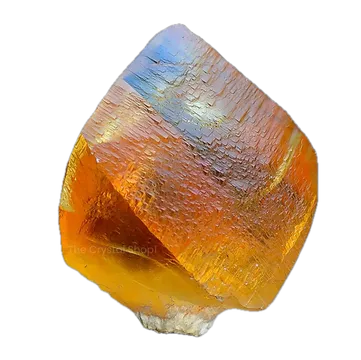
Elmwood Mine calcite — iconic amber scalenohedra from a historic Tennessee locality, prized for form, color, and cabinet display by collectors.
Key facts
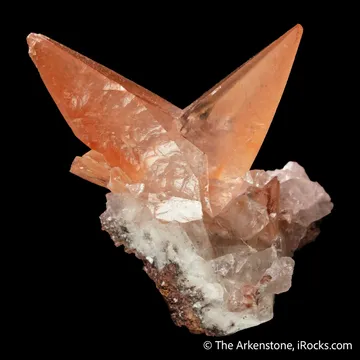
Elmwood Mine calcite is one of the great modern classics of American mineral collecting: honey, champagne, amber and cognac scalenohedra, often doubly terminated and twinned into sculptural “diamond” forms, set against black-brown sphalerite, purple fluorite, ivory barite, or gray carbonate matrix. The best crystals have a warm internal glow rather than merely surface color, with transparent terminations, bright vitreous luster, and enough size to dominate a cabinet. A fine Elmwood calcite does not look like generic calcite from a carbonate vein; it has a locality signature that experienced collectors recognize at a glance.

Photo: Wikimedia Commons
The geological setting is a classic Mississippi Valley-type zinc environment in the Central Tennessee zinc district. Mineralizing fluids moved through carbonate rocks of the Knox Group, especially solution cavities and collapse-breccia zones in the Mascot Formation. Sphalerite is the zinc ore mineral; calcite is the showpiece gangue mineral. In large open pockets, the chemistry and space combined to produce crystals not in millimeters but in hand-sized, forearm-sized, and occasionally extraordinary cabinet-scale dimensions.
Elmwood’s importance is also historical. The deposit was found through deep exploration rather than surface prospecting, entered production in the 1970s, and quickly became famous among collectors for a suite of minerals that seemed almost designed for display: golden calcite, purple fluorite, lustrous sphalerite, pale barite and occasional galena. The early publications on Elmwood and Gordonsville made the locality known internationally; decades later, the mine remains a benchmark against which large scalenohedral calcites are compared.

Photo: Wikimedia Commons
Collectors look for three things first: form, color and condition. The most desirable examples are sharp twinned scalenohedra, doubly terminated if possible, with saturated amber to cognac color concentrated toward the tips. Matrix pieces are especially prized when the calcite rises cleanly from sparkling sphalerite or contrasts with fluorite or white barite. Large, undamaged, gemmy crystals on matrix are now genuinely hard to replace.
Search for specimens: View all calcite specimens from Elmwood Mine, USA
Elmwood Mine is near Carthage in Smith County, Tennessee, in the Central Tennessee Ba-F-Pb-Zn District. The mine is part of the Middle Tennessee zinc complex that also includes Gordonsville and Cumberland. In collector usage, “Elmwood” is sometimes applied rather broadly to material from the closely related mine complex, but the classic locality name remains Elmwood Mine, Carthage, Smith County, Tennessee, USA.
The deposit is Mississippi Valley-type mineralization in carbonate rocks. Ore-grade zinc occurs in dissolution cavities and collapse breccias of the upper Knox Group, especially the Mascot Formation. The open spaces in those breccias are the collector’s story: fragments of carbonate host rock and earlier mineralization became pocket walls and platforms for sphalerite, fluorite, barite and calcite. Mineralizing fluids were low-temperature by ore-deposit standards, commonly reported in roughly the 85–130°C to 90–130°C range. That is exactly the sort of hydrothermal environment in which large, open-space calcite crystals can grow without the violent disruption typical of many vein systems.
The discovery history is one of the more unusual stories in American base-metal exploration. New Jersey Zinc began drilling in Middle Tennessee in the 1960s, guided partly by indications from oil and gas test-hole records rather than obvious mineralized outcrops. Widely spaced drill holes were used in what later became known as a “Random Walk” exploration strategy. The first major ore intercept came after years of drilling, and follow-up work confirmed a large buried zinc body. Production began in 1975 after years of exploration, shaft work and mill construction.
Industrial ownership changed through time. The early New Jersey Zinc and Jersey Minière Zinc period gave way to later operators, and Nyrstar acquired and consolidated the Tennessee operations in 2009. Elmwood was worked as part of an underground zinc-mining complex tied to the Gordonsville processing facilities. Production has not been continuous in the collecting sense; the mine and complex have had closures, restarts and pauses governed by zinc economics. Nyrstar announced a production pause for the Middle Tennessee Mines in late 2023, and locality records now treat Elmwood as closed as of the end of 2023.
Elmwood is not a public collecting site. It is private industrial mine property, underground, and access has always been controlled. The great specimens reached the mineral market through mine recovery during commercial operations, miners, commercial collector arrangements, old stocks and later dealer dispersals. For present-day collectors, legitimate acquisition is through reputable dealers, auctions, old collections and documented estate material, not field collecting.
Notable finds span the full size range: thumbnails and miniatures of gemmy single crystals; cabinet specimens with calcite on sphalerite or fluorite; large plates of calcite, barite and sphalerite on breccia; and museum-scale pieces. One published Elmwood calcite-on-limestone specimen is recorded at 49.5 cm, illustrating how large the best pocket material could become.
The classic Elmwood calcite habit is scalenohedral, frequently twinned, and often doubly terminated. Collectors often describe the best crystals as diamond-shaped, spear-like, or “dogtooth” forms, but the most diagnostic pieces are not simple dogtooth calcites: they are robust, lustrous, amber scalenohedra with complex terminations, forked or multiple points, and balanced twinning. Mindat records the locality habit as scalenohedral twinned crystals to 45 cm, which accords with the mine’s reputation for unusually large open-pocket growth.
Several generations of calcite are recognized from the district. Locality records distinguish simple scalenohedra surrounded by sphalerite, blunt scalenohedral crystals, and the amber twinned scalenohedra that made Elmwood famous. Geological work in the neighboring Gordonsville portion of the district also records early white calcite, main-stage white to lavender calcite, and late clear to amber calcite. For collectors, this explains why Elmwood calcite is not a single look: there are white, pale yellow, champagne, honey, orange, golden-brown and amber examples, with the warm amber late-stage material usually the most coveted.
Size is a major part of the locality’s identity. Small crystals are common on matrix, and thumbnail to miniature specimens can be very elegant, but Elmwood’s fame rests on cabinet and large-cabinet scalenohedra. Individual crystals of 5–10 cm are not unusual in the market; crystals over 15 cm are serious cabinet pieces; crystals above 20 cm with good form and condition are important; and large, clean, matrix-mounted crystals become increasingly rare with every added centimeter.
The best color is not flat yellow. It is layered, glowing and concentrated: pale champagne through the body, richer honey along edges, and cognac or orange at the terminations. Some crystals show red-orange tips. Internal veils, wispy inclusions, phantom-like zones and small included particles are common, but in good specimens they add depth rather than muddiness. The finest examples are translucent to transparent enough for light to move through the crystal, giving a cut-gem impression despite the size.
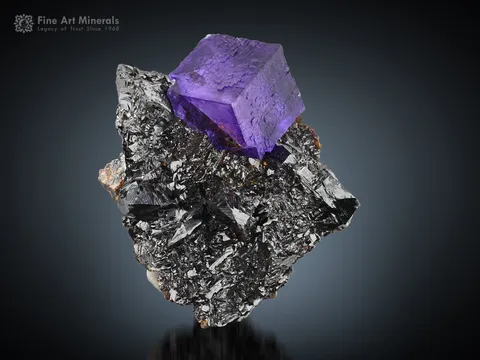
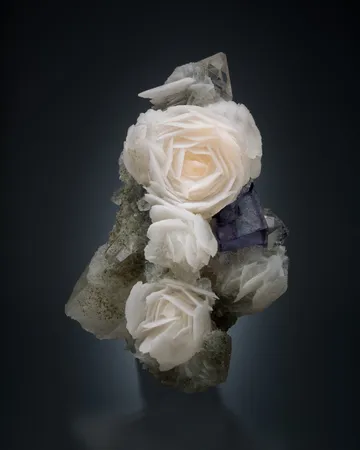
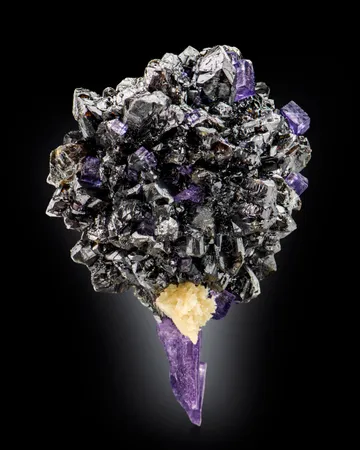
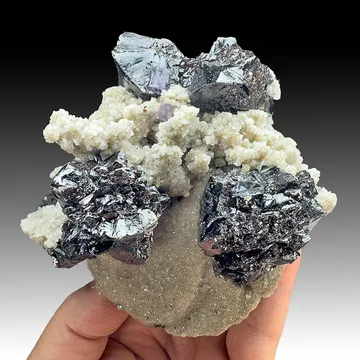
Associated minerals are central to the Elmwood aesthetic. Dark reddish-brown to black sphalerite provides the most dramatic contrast and is the most common prestige matrix. Purple to lavender fluorite can create superb combination pieces, especially when calcite is perched cleanly on a fluorite cube or near etched fluorite faces. Barite occurs as pale, often rounded or hemispherical aggregates and can be a strong locality clue. Galena, dolomite, quartz, marcasite, pyrite, chalcopyrite, celestine and bitumen are also recorded from the mine complex, though not all are common on fine calcite specimens.
Quality factors are strict. A top Elmwood calcite should have sharp terminations, bright luster, pleasing color, strong three-dimensional form and an undistracting point of attachment. Matrix should enhance, not bury, the calcite. Sphalerite matrix ideally sparkles with distinct crystals rather than appearing as dull massive ore. Fluorite combinations should be judged for balance: many are really fluorite specimens with calcite present; the best calcite-focused combinations let the calcite remain the visual anchor.
The chief condition issue is cleavage. Calcite has perfect rhombohedral cleavage and hardness 3, so Elmwood crystals can chip, bruise, cleave or detach during mining, trimming, shipping and handling. The pointed terminations of scalenohedra are especially vulnerable. Small dings on a large crystal may be acceptable if they are not visually disruptive, but broken tips, rehealed-looking glue lines, fresh cleaves across the front face, and detached-and-reset crystals should affect value sharply.
Repairs are not unusual in the broader world of Elmwood combinations because calcite and fluorite both cleave cleanly. A repaired specimen can still be collectible if the repair is disclosed and the aesthetics survive, but undisclosed repairs are a serious problem at the upper end of the market. Examine under strong side lighting and magnification. Look for glossy adhesive seams, tiny trapped bubbles, unnatural alignment between crystal and matrix, and breaks that fluoresce differently under UV.
The main authenticity concern is mislocality rather than widespread chemical treatment. Elmwood calcites are not commonly known as a dyed or irradiated product class; their warm colors are natural. The more common problem is a specimen being called Elmwood because it is honey-colored calcite on dark matrix, even when the habit or assemblage does not fit. Classic Elmwood pieces tend to show scalenohedral twinned habits, amber to champagne color, sphalerite, fluorite, barite or carbonate breccia associations, and an overall Central Tennessee look. Rhombic cleaved masses, polished “honey calcite” slabs, or generic yellow calcites without documentation should not be accepted as Elmwood merely on color.
Documented collector discussions have challenged alleged Elmwood calcites that did not match the mine’s known mineralogy or habit, including pieces with suspicious rhombic calcite masses and missing expected associated minerals. That does not mean every matrixless single crystal is suspect; many genuine Elmwood calcites were trimmed or collected as singles. It means provenance matters. Old labels, collection history, dealer reputation and visual consistency with known Elmwood material are all part of authentication.
Rarity is tiered. Small and medium Elmwood calcites remain available because the mine produced abundant material over decades and because old stocks continue to circulate. Good cabinet specimens are scarcer. Large, undamaged, richly colored, doubly terminated crystals on sphalerite or fluorite matrix are genuinely difficult. Museum-scale pieces and historically important old-stock specimens are in another category; when they appear, they tend to be pursued by both calcite specialists and American locality collectors.
Market availability in 2026 is still active but increasingly dependent on old collections, dealer inventories and occasional dispersals. The pause and closure history of the mine complex has changed collector psychology: buyers no longer assume that the next pocket will replace a sold piece. For serious purchases, insist on multiple photographs, condition disclosure, dimensions of the main crystal, and a clear statement about repairs or restoration.
Elmwood began not with a prospector splitting open a glittering boulder, but with a kind of geological faith. In the early 1960s, New Jersey Zinc geologists were looking at a region where the target rocks were deeply buried and surface clues were poor. Oil and gas test-hole records hinted that the upper Knox Group might carry zinc mineralization, but the Knox did not conveniently crop out where a geologist could walk up and swing a hammer. Under William H. Callahan’s exploration direction, geologists Al Hoagland, Fred Fisher, Ray Gilbert and Allan Stagg laid out widely spaced test holes, five to six miles apart.
The program kept going for years. Later technical summaries called it the “Random Walk,” a phrase that sounds casual until one remembers the cost of deep diamond drilling. Hole 79 gave the first major encouragement. Then hole 106, drilled about 1,000 feet west of No. 79, cut 17 feet of 18 percent zinc. A later technical report describes the same decisive intercept as 5.1 meters of 18.5 percent Zn. From that moment the anonymous countryside around Elmwood became a target. A 3,000-meter grid was laid out around the discovery hole, and about 100 additional holes were drilled on 300-meter centers.
The confirmation phase was not timid. One government summary describes the choice after further drilling: drill another 100 close-spaced holes, or sink an exploratory shaft to 1,325 feet and drive 10,000 feet of exploratory drifts. The shaft-and-drift plan won. By the time production began in 1975, 11 years had passed from the first diamond drill hole, and approximately $15 million had been spent. When the discovery became public in January 1969, rival companies rushed in. At the height of the play, 69 drill rigs were operating on the Nashville Dome.
Collectors were watching from the beginning. In 1969, The Picking Table congratulated Callahan and New Jersey Zinc and added a collector’s wish: perhaps the new deposits would be well crystallized and produce attractive display specimens. Eight years later, with the mine in production, John L. Baum reported that the wish had been answered. The cavities, he wrote, were sometimes larger than an adult collector and were lined with spectacular crystals of calcite, sphalerite, barite, galena and fluorite. They were “breathtaking in their perfection” and many were of gem quality. Arrangements had been made with a commercial collector, and Baum added a sentence that captures the underground reality of many great mining localities: “And, we may be sure that the miners will also help.”
That miner’s-eye world gave Elmwood calcites some of their nicknames. Dealers who handled late material have recorded that miners called the large orange calcite crystals “footballs,” while the clearer gemmy calcites were “jewels.” One late-2014 pocket produced enough material that a dealer later described sorting through about 50 flats of specimens. Most were damaged. Only a handful of high-quality pieces survived the gauntlet of growth, blasting, extraction, handling and trimming well enough to become fine specimens.
The locality also has a quieter museum story. Lewis Elrod began collecting and researching Elmwood minerals in the 1980s, building a focused suite from the mine’s great productive years. After his death in 2016, his collection was donated to the Middle Tennessee Museum of Natural History, where it formed the base of the museum’s Elmwood holdings. For a mine whose best crystals often disappeared into private cabinets and dealer inventories, that donation matters: it anchors part of the Elmwood legacy close to the Tennessee ground that produced it.

_.jpg)