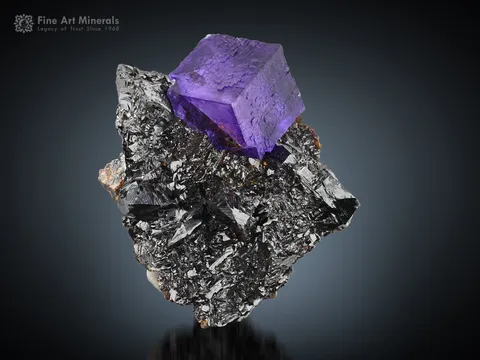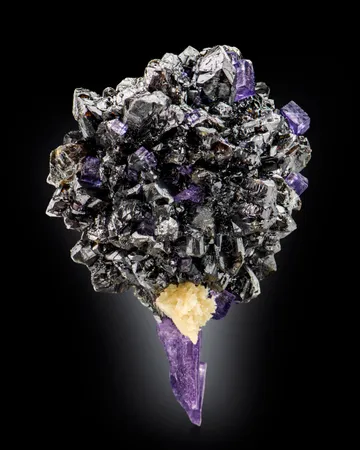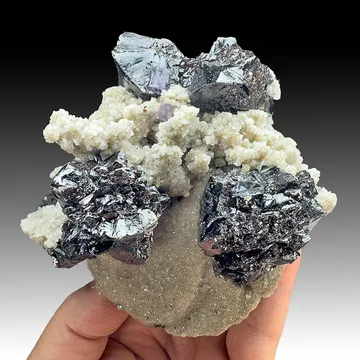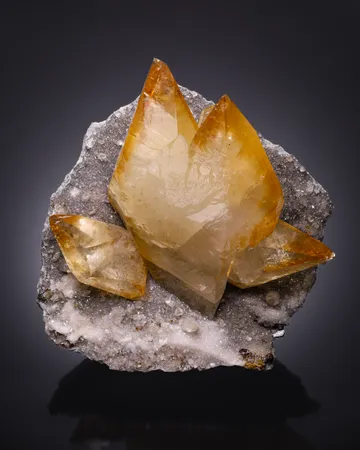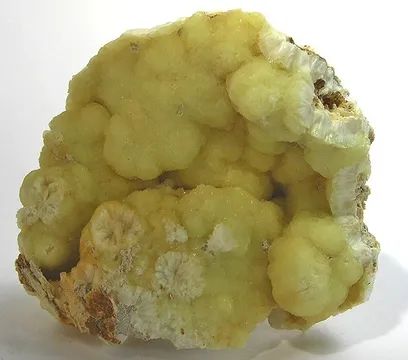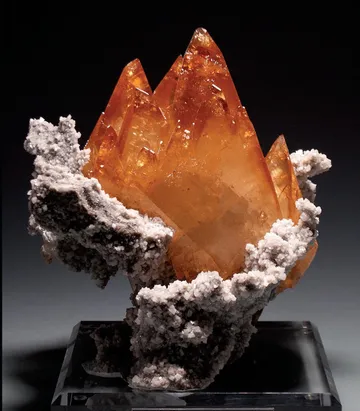
Gordonsville Mine, USA - a Central Tennessee Zn district locality famed for sculptural vug specimens, purple fluorite on sphalerite, and calcite and baryte.
Key facts
Gordonsville is the quieter but deeply important member of the Carthage zinc-mining family: an underground Mississippi Valley-type zinc mine in Smith County, central Tennessee, closely allied geologically and historically with Elmwood and Cumberland. For collectors, that association matters immediately. The Gordonsville ore system produced the same dramatic open-space carbonate-breccia mineralization that made the district famous: lustrous, dark red-brown sphalerite; purple to lavender fluorite; amber calcite; white baryte; galena; dolomite; quartz; celestine; and rare sulfides. Its best specimens are not “ore samples” in the ordinary sense, but sculptural vug pieces—purple fluorite cubes perched on black-red sphalerite, calcite groups rising from dark sparkling matrices, and complex breccia plates that preserve the open cavities of the orebody.
The geological setting is the key to the look. Gordonsville mineralization belongs to the Central Tennessee Ba-F-Pb-Zn district, hosted in Lower Ordovician carbonate rocks of the Knox Group, especially the Mascot Dolomite. Ore and gangue minerals filled collapse breccias, fractures, and vugs created in paleokarstic dolostone and limestone on the northeastern flank of the Nashville Dome. The resulting open spaces allowed crystals to grow freely, producing cabinet specimens with the sharpness, luster, and three-dimensionality that collectors associate with Carthage-area material.
Regional View
Country View
The mine’s fame is partly overshadowed by Elmwood, whose name became shorthand in the collector market for the whole Carthage suite. That has made Gordonsville-labelled specimens especially interesting. A fine Gordonsville fluorite on sphalerite may look, at first glance, like an Elmwood classic; the label is what gives it additional locality precision. Documented Gordonsville examples include large purple fluorite cubes, sharply formed calcite groups, lustrous sphalerite plates, baryte combinations, and rare small finds from named stopes.

Photo: Rob Lavinsky, iRocks.com via Wikimedia Commons
Search for specimens: View all specimens from Gordonsville Mine, USA
Gordonsville Mine is near Carthage in Smith County, Tennessee, within the Central Tennessee Ba-F-Pb-Zn Mining District. The recorded coordinates for the locality are approximately 36° 11' 48" N, 85° 56' 3" W. It is an underground zinc mine, and its modern industrial identity has been tied to the Middle Tennessee Mines complex, which has included the Gordonsville and Cumberland underground mines and a processing plant at the Gordonsville mine site.
The deposit is a carbonate-hosted Mississippi Valley-type system. Sphalerite is the principal zinc ore mineral, and the mineralization occurs as open-space fillings in breccias, fractures, and vugs in limestone and dolomite. In collector terms, that means the specimens are cavity-grown rather than simply massive: sphalerite crystals and crystalline masses line vugs, while fluorite, calcite, baryte, galena, dolomite, quartz, and celestine occupy later spaces and surfaces. The geological literature treats Elmwood and Gordonsville together because they are not merely neighboring mines with similar minerals; they are parts of the same broader mineralizing system.
The ore host is Lower Ordovician carbonate rock of the Mascot Formation or Mascot Dolomite in the upper Knox Group. The larger structural setting is the northeastern flank of the Nashville Dome, where paleokarst topography, brecciation, dolomitization, silicification, and fracturing helped localize zinc mineralization. Published paragenetic work on Elmwood-Gordonsville material describes multiple episodes of calcite and sphalerite deposition, with fluorite and baryte among the important gangue phases. The classic collector combinations—fluorite on sphalerite, calcite on sphalerite, baryte on dark ore matrix—are therefore a direct expression of the ore-forming sequence.
The Carthage zinc deposits were developed industrially in the second half of the twentieth century. Elmwood opened first and became the most famous specimen name, while Gordonsville became increasingly important as the mining complex expanded. Gordonsville was opened in the early 1980s, and the Gordonsville concentrator became central to processing ore for the Middle Tennessee operation. Operators over the history of the complex have included New Jersey Zinc/Jersey Minière interests, Union Zinc/Pasminco-era ownership, Savage Zinc-era collecting contracts, and Nyrstar, which acquired and consolidated the Middle Tennessee operations in 2009. Nyrstar restarted area production in 2010, placed the Middle Tennessee Mines on care and maintenance in late 2015, restarted production in 2017, and announced a temporary production pause beginning 30 November 2023. In April 2026, Nyrstar completed the sale of its U.S. assets, including the Mid Tennessee mining complex and Clarksville smelter, to Korea Zinc.
Specimen recovery has always depended on industrial mining rather than public collecting. The mine is an underground commercial operation, not a fee-dig site, and access is controlled. Collectors should treat Gordonsville labels as mine-site provenance, not an invitation to visit. The best historical material entered the market through miners, company-controlled disposition, dealers with collecting contracts, and later dispersals of private collections.
Several named or numbered Gordonsville finds have become useful to collectors. A Dallas Mineral Symposium description of Dr. Steve Neely’s Elmwood-area talk singled out Gordonsville 29s-#6 for large calcite groups and Gordonsville 261-1a and 229 for phantom fluorites and smaller crystals with clear corners. A rare enargite specimen has been recorded from the 08-14 stope. These pocket and stope identifiers are valuable because so much Carthage-area material circulates under the broader “Elmwood” name.
Gordonsville fluorite is best known as purple to lavender, locally with bluish tones, occurring as cubic crystals on dark reddish-brown to black sphalerite and dolomite-rich breccia matrix; the strongest pieces show transparent to translucent cubes, sharp form, color zoning or phantoms, and the distinctive etched or modified “Carthage corner” look seen in the Carthage district. Fluorite is less common than sphalerite and calcite in the ore system, so well-balanced Gordonsville combinations have always been scarcer than ordinary sphalerite plates. Documented fine specimens include crystals several centimeters on edge, with auctioned examples showing a main cube about 7 cm across and published collection material including still larger display fluorites. The best pieces here are judged by cube completeness, color saturation, clarity at the edges or corners, clean contrast against lustrous sphalerite, and honest condition; ordinary examples tend to be duller, more contacted, or visually lost in heavy ore matrix.
Gordonsville sphalerite is the ore mineral and the visual foundation of many specimens: deep reddish-brown to nearly black, resinous to brilliant, often forming coarse crystalline masses, plates, and intergrown crystals that may show ruby-red internal color along thin edges or backlit fractures. Published work on Elmwood-Gordonsville sphalerite describes very coarsely crystalline material and vugs lined with centimeter-scale crystals, generally dark reddish brown but locally ranging toward pale yellowish orange; polished and thin-section studies also revealed the district’s unusual optically anisotropic sphalerite, linked to growth defects and elevated cadmium and iron in small structural domains. Collector-quality Gordonsville sphalerite is lustrous, three-dimensional, and preferably associated with purple fluorite, amber calcite, white baryte, dolomite, or galena; ordinary material is massive, contacted, or too blocky to carry the sculptural sparkle that defines the best Carthage specimens.
Other documented Gordonsville minerals include baryte, calcite, celestine, dolomite, galena, petroleum or bitumen, quartz, and the rare sulfosalt enargite. Calcite from the interconnected Elmwood-Cumberland-Gordonsville system is celebrated for large amber scalenohedra and complex groups, and Gordonsville material is important enough to have been featured in collector literature on American Midwest calcites. Baryte occurs as pale white to ivory aggregates on ore matrix in the Carthage suite, while galena is much less common than sphalerite but prized when sharp or iridescent. Quartz is a minor species and may appear smoky because of petroleum inclusions. The standout rarity is enargite, recorded from Gordonsville and notable because copper-arsenic sulfosalts are not what collectors expect from a classic Tennessee MVT zinc deposit.
The main authenticity issue with Gordonsville is not a famous epidemic of manufactured fakes; it is locality precision. Much Carthage-area material has long been sold as “Elmwood” even when it came from the broader Elmwood-Gordonsville-Cumberland complex. Conversely, a specimen labelled Gordonsville should carry old labels, collection history, stope or pocket notes, dealer records, or other provenance strong enough to support the more specific attribution. Pieces from named Gordonsville finds, such as 29s-#6, 261-1a, 229, or the 08-14 stope, deserve their documentation kept with the specimen.
Condition is critical. Fluorite cleaves readily and large cubes often have edge nicks, repaired corners, or bruised faces. Etching and dissolution features can be entirely natural here, so learn to distinguish natural modified growth from fresh conchoidal breaks or cleaved chips. Calcite tips are vulnerable and small chips can dominate the appearance of a transparent amber crystal. Sphalerite is tougher in hand but commonly shows cleaved faces, broken terminations, bruised protruding edges, and contact marks where the piece separated from the pocket wall. Baryte and pale dolomite surfaces can hold dust or handling grime.
Repairs are plausible on any Carthage fluorite-calcite-sphalerite combination. Look for glue lines in shadowed junctions, glossy seams, mismatched luster across breaks, and pockets of adhesive trapped among dolomite rhombs or sphalerite crystals. Reattached fluorite cubes and calcite crystals should be disclosed. Oiling or coating to brighten fluorite is less often discussed publicly for Gordonsville than for some other fluorite localities, but collectors should still examine suspiciously glossy surfaces under magnification and strong side light.
Fluorescence is not the primary collecting reason for Gordonsville specimens, but fluorite and calcite should be tested cautiously if fluorescence matters to you; responses can vary and should not be assumed from the species alone. From a handling standpoint, these are zinc-ore specimens: avoid generating dust, wash hands after handling broken ore surfaces, and keep fragile fluorite or calcite combinations away from heat, vibration, and tight packing. High-grade Gordonsville fluorite on sphalerite, large calcite groups, and sharp multi-species combinations are much less available than generic Elmwood-labelled material, and the most desirable examples are increasingly provenance-driven.
One of the most revealing modern stories around Gordonsville is how easily the mine disappears behind the Elmwood name. Collectors use “Elmwood” as a visual language: purple fluorite, amber calcite, black-red sphalerite, white baryte. Yet Steve Neely’s 2016 Dallas Mineral Symposium listing broke the recent specimen era down pocket by pocket and made clear that Gordonsville was no supporting actor. The talk identified four great recent pocket groups from the Elmwood-area mines: Elmwood 20-78-12, Horseshoe Bend, Gordonsville 29s-#6, and Gordonsville 261-1a and 229. The Gordonsville entries were not minor footnotes. One was noted for huge calcite groups; the other for phantom fluorites and smaller crystals with clear corners. For a collector, those pocket names are the difference between a broad district label and a specimen with a recoverable story.
Neely himself became one of the human bridges between the mines and the collecting world. A Nashville-area surgeon, he lived close enough to the Carthage mines to build an unusually deep relationship with miners and specimens. The Dallas Symposium account says he assembled perhaps the country’s largest fine collection of specimens from Elmwood, Gordonsville, and Cumberland, only about 35 miles from his home. It also records the wonderfully local detail that he was sometimes known among miners for doing exchanges for medical services. In the world of high-end mineral collecting, where fine pieces often pass through dealers, auctions, and museum cases, that detail anchors the Carthage mines in a real community of miners, collectors, and personal trust.
The contract-collecting era has its own flavor. In 1996, Top Gem Minerals obtained a contract from Savage Zinc to collect within the Elmwood complex, including Elmwood, Gordonsville, and Cumberland. Mike Keim of Mine Rat Minerals recalls going in with Brian “Big B” Stefanec, Bryon “Medium B” Brookmyer, and Brian “Little B” Huntsman; the “killer B’s” spent three years working the various mines. That kind of organized underground specimen recovery is part of why so many Carthage pieces reached collectors in better condition than specimens casually rescued from ore. It also explains why proper labels matter: a specimen may have come from a precise mine or pocket even when later sellers reduced it to the more marketable district name.
A later collecting effort shows the economics behind the romance. In a 2008 Mindat discussion about the mine complex, Rock Currier described Collectors Edge working under contract to collect specimens encountered during normal mining. He had heard that four people were working underground for specimens and noted the practical costs: housing, food, salaries, and the general difficulty of keeping such an operation viable if enough high-quality pockets were not being found. He also mentioned that housing in the area was tight enough that a previous operation had to buy a house for its employees. Fine Gordonsville specimens look effortless in a case, but the route from vug wall to cabinet could be expensive, uncertain, and logistically awkward.
Lance E. Kearns and F. Howard Campbell, “Famous Mineral Localities: The Elmwood and Gordonsville Zinc Mines near Carthage, Tennessee,” The Mineralogical Record, 9(4), 1978, pp. 213–218. A foundational collector article on the Carthage mines and their classic calcite-fluorite-sphalerite-barite specimens. Source listing: Mindat Gordonsville Mine references
J. R. Kyle, “Brecciation, alteration and mineralization in the Central Tennessee zinc district,” Economic Geology, 71(5), 1976, pp. 892–903. The classic geological treatment of breccia-controlled zinc mineralization in the Central Tennessee district. Source listing: Mindat reference page
W. B. Gaylord and J. A. Briskey, “Summary of the geology of the Elmwood-Gordonsville mining complex, Central Tennessee zinc district,” in Tennessee Zinc Deposit Field Trip Guidebook 9, Virginia Polytechnic Institute, 1983, pp. 116–151. A key field-guide treatment of the mining complex, widely cited in later studies. Source listing: Mindat Elmwood Mine references
Robert R. Seal II, Brian J. Cooper, and James R. Craig, “Anisotropic sphalerite of the Elmwood-Gordonsville deposits, Tennessee,” The Canadian Mineralogist, 23(1), 1985, pp. 83–88. A detailed study of the distinctive sphalerite, including its optical anisotropy, trace Fe-Cd relationships, and growth-defect interpretation. Full text: RRUFF/Canadian Mineralogist PDF
Jeffrey F. Gratz and Kula C. Misra, “Fluid inclusion study of the Gordonsville zinc deposit, central Tennessee,” Economic Geology, 82(7), 1987, pp. 1790–1804. The main fluid-inclusion paper specifically focused on Gordonsville. Source listing: Mindat occurrence/reference excerpt
K. C. Misra, J. F. Gratz, and C. Lu, “Carbonate-hosted Mississippi Valley-type mineralization in the Elmwood-Gordonsville deposits, Central Tennessee zinc district: a synthesis,” Society of Economic Geologists Special Publication, 4, 1997, pp. 58–73. A synthesis of the Elmwood-Gordonsville MVT system. Source listing: EurekaMag reference page
W. B. Gaylord, “Geology of the Elmwood and Gordonsville Mines, Central Tennessee Zinc District—An Update,” in K. C. Misra, ed., Carbonate-Hosted Lead-Zinc-Fluorite-Barite Deposits of North America, Society of Economic Geologists Guidebook Series 22, 1995, pp. 173–205. An important later update on the mine geology. Source listing: Mindat Elmwood Mine references
N. K. Grant and M. C. Bliss, “Strontium isotope and rare earth element variations in non-sulphide minerals from the Elmwood-Gordonsville mines, central Tennessee,” 1983, pp. 206–210. A specialized geochemical contribution on non-sulfide minerals from the mine pair. Source listing: EurekaMag reference page
O. C. Kopp and K. C. Misra, “A first discovery of enargite in the Mississippi Valley-type sphalerite deposits of central Tennessee,” Geological Society of America Abstracts with Programs, 14(1–2), 1982, p. 32. Important for the rare enargite occurrence later recorded from Gordonsville material. Source listing: EurekaMag reference page
Terry E. Huizing, R. Peter Richards, Janet H. Clifford, and Robert B. Cook, “Connoisseur’s Choice: Calcite from the American Midwest, Gordonsville Mine, Carthage, Smith County, Tennessee,” Rocks & Minerals, 92(1), 2017, pp. 46–63. A collector-focused article recognizing Gordonsville calcite among the Midwest’s finest calcite occurrences. Source listing: Mindat reference excerpt
Terry Huizing and Wendell E. Wilson, eds., Mineral Collections in the American Midwest, supplement to The Mineralogical Record, 46(4.1), 2015. Includes major private and museum collections, with Steve Neely’s Carthage-area material featured in the collector chapters. Publisher page: Mineralogical Record
Arvid Pasto and Brian Stefanec, Elmwood-Gordonsville-Cumberland Mine Complex of Eastern Tennessee, Mineral Monograph 9, Lithographie, LLC, 2006, pp. 54–55. A specialized monograph treatment of the mine complex. Source listing: Mindat reference page
Mindat: Gordonsville Mine, Carthage, Smith County, Tennessee, USA — The most useful locality database page for coordinates, mineral list, references, and specimen photos.
Mindat: Sphalerite from Gordonsville Mine — A species-specific occurrence page showing associated minerals and photo-based associations.
Mindat: Calcite from Gordonsville Mine — Useful for comparing Gordonsville calcite associations and locality context.
Wikimedia Commons: Fluorite-Sphalerite-34771.jpg — Openly licensed Rob Lavinsky photograph of a classic Gordonsville fluorite on sphalerite specimen.
Nyrstar Middle Tennessee Mines fact sheet, December 2020 — Company overview of the Middle Tennessee Mines, mine type, processing, and MVT mineralization.
Nyrstar press release: Middle Tennessee Mines production pause, 31 October 2023 — Primary source for the 2023 production pause, layoffs, and planned drilling during the pause.
Nyrstar press release: sale of U.S. assets to Korea Zinc, 2 April 2026 — Primary source for the 2026 transfer of the Mid Tennessee mining complex and Clarksville smelter to Korea Zinc.
History of the Elmwood Mine, Middle Tennessee Museum of Natural History — Concise background on the Carthage-area mines and the Lewis Elrod collection.
Dallas Mineral Symposium: 2016 Speaker Dr. Stephen Neely — Valuable collector context on recent Elmwood-Gordonsville-Cumberland pockets, including named Gordonsville finds.
Heritage Auctions: Fluorite on Sphalerite, Gordonsville Mine — Auction record documenting a large Gordonsville fluorite cube on sphalerite and its market performance.
Mine Rat Minerals: Our Story — First-person collecting-history context for contract specimen recovery in the Elmwood-Gordonsville-Cumberland complex.