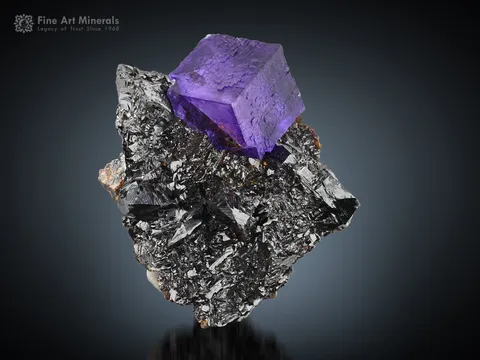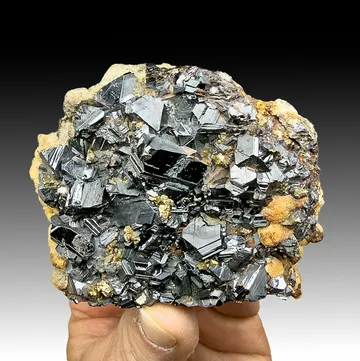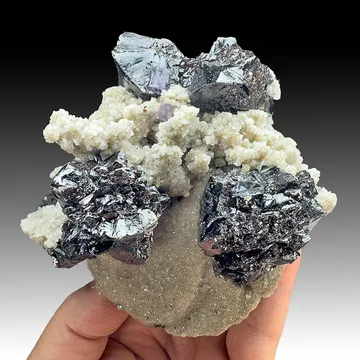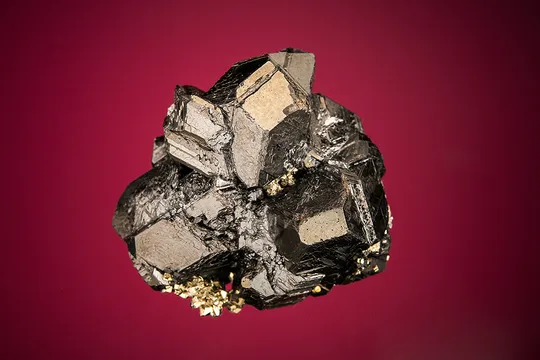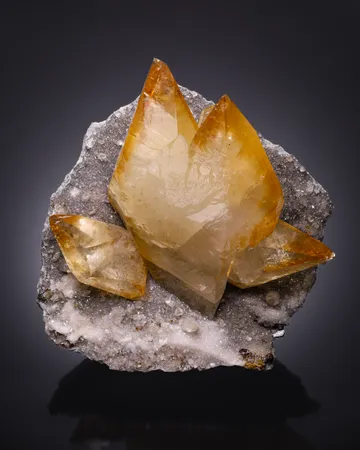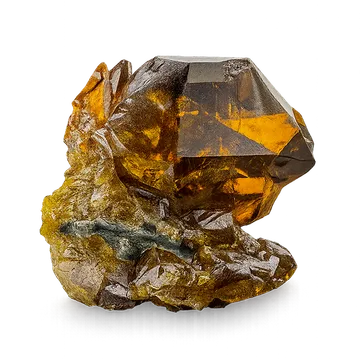
Sphalerite from Elmwood Mine, Tennessee — lustrous, dark reddish-brown crystals with ruby-fire edges; iconic Elmwood pockets with calcite, fluorite, baryte.
Key facts
Elmwood sphalerite is one of the great American zinc-sulfide classics: heavy, lustrous, dark, and architectural, with flashes of red-brown and “ruby jack” fire when a crystal edge catches strong light. The best pieces are not simply black ore; they are cabinet mineral specimens with sharp isometric faces, resinous-to-adamantine luster, and enough three-dimensional relief to make the light run across the crystal faces. On matrix, the species becomes even more identifiable: amber calcite, lilac-to-purple fluorite, ivory baryte, dolomite, quartz, galena, and occasional bitumen all belong to the familiar Elmwood visual language.

Photo: Wikimedia Commons
The mine lies near Carthage in Smith County, central Tennessee, within the Central Tennessee Ba-F-Pb-Zn mining district. Geologically it is a Mississippi Valley-type zinc deposit: mineralization occupied open spaces, fractures, collapse breccias, and vugs in carbonate rocks of the Knox Group, especially the Mascot Formation. That open-space setting is the key to the collector material. Instead of merely disseminated ore, Elmwood produced vug linings and pocket specimens: plates of sphalerite crystals that could support golden calcite scalenohedra, purple fluorite cubes, rounded white baryte aggregates, and sparkling dolomite or quartz.

Photo: Wikimedia Commons
For many collectors, Elmwood is remembered first for calcite and fluorite, but sphalerite is the reason the mine existed. It was the principal ore mineral and the structural foundation for many of the most famous combinations. A great Elmwood sphalerite specimen does not need an accessory mineral, though: a plate of lustrous, sharply formed, dark reddish-brown sphalerite can stand on its own as one of the finest crystallized sphalerites from the United States.

Photo: Wikimedia Commons
Search for specimens: View all sphalerite specimens from Elmwood Mine, Tennessee, USA
Elmwood is a deep, carbonate-hosted zinc mine near Carthage, Smith County, Tennessee, roughly east of Nashville and close to the Cumberland River. The locality belongs to the Central Tennessee Ba-F-Pb-Zn district, a cluster of underground zinc operations that collectors often discuss together as the Elmwood-Gordonsville-Cumberland complex. This matters for labels: a specimen may have circulated for decades under the broad “Elmwood” name even when the exact shaft, mine, or pocket within the complex was not recorded.
The deposit is Mississippi Valley-type mineralization in Ordovician carbonate rocks. Sphalerite, the zinc sulfide ZnS, formed as open-space fillings in collapse breccias, fractures, and cavities in limestone and dolomite. The classic specimen pockets were not an accidental side story to the geology; they were the direct result of the same vuggy, brecciated setting that made the ore body mineable. In the open cavities, sphalerite crystallized as coarse masses and crystal-lined surfaces, later sharing space with calcite, fluorite, baryte, quartz, dolomite, galena, pyrite, marcasite, celestine, and hydrocarbon bitumen.
The discovery story is unusually well documented. New Jersey Zinc announced the Elmwood zinc deposit in 1969 after a large, statistical drilling campaign aimed at a buried target more than a thousand feet below the rolling central Tennessee landscape. Production followed in the mid-1970s, and the mine’s specimen reputation was established quickly. By the late twentieth century, Elmwood material had become a fixture of American mineral collecting: golden calcite crystals, purple fluorite, ivory baryte balls, and lustrous black-to-brown sphalerite plates entered private collections, museum displays, and dealer inventories worldwide.
Operations have had several chapters. The deposit was discovered in 1969 and entered full production in 1975. Mining later ceased under earlier ownership in the 2000s, and Nyrstar subsequently reopened Middle Tennessee operations, with ore from Elmwood again being hoisted in 2010 through the Gordonsville workings. Mindat records the Elmwood Mine itself as closed as of December 31, 2023, while broader Middle Tennessee mine-status reporting has placed the complex in care and maintenance or non-operational status in the mid-2020s. Whatever the corporate status at a given moment, this is private industrial mine property, not a public collecting site.
Collector access has historically depended on mine operations and the handling of specimen pockets encountered underground. Fine examples reached the market through miners, mine-associated collectors, old collections, and later through major dealers and collection dispersals. Modern collectors should assume no field access. Specimens are acquired through established dealers, auctions, estate collections, and older labels rather than by visiting the mine.
Elmwood sphalerite is typically dark brown, reddish brown, brown-black, or black in ordinary display lighting, but the best crystals show red, orange-red, or wine-colored internal highlights along thin edges and broken transmitted-light zones. This is one of the classic tests of an attractive Elmwood piece: a crystal that looks almost black under diffuse light may come alive with ruby flashes when backlit or viewed under a strong point source.
The habit is usually coarsely crystalline rather than delicate. Ore studies describe massive coarse-grained sphalerite and interpenetrating crystals projecting into vugs; collector specimens show this as plates, mounds, ridges, and breccia-matrix surfaces covered by sharp, lustrous crystals. Individual crystals commonly fall in the centimeter range, with many specimens showing crystals around 1–3 cm. Larger groups and plates can reach cabinet size, and exceptional display specimens combine numerous sharp sphalerites into sculptural masses. Good isolated sphalerite crystals on matrix are less common than clustered plates, and clean, aesthetic isolation commands attention.
Luster is central. Fine Elmwood sphalerite should look bright, reflective, and resinous to adamantine, not dull or sugary. The faces may show complex growth, stepped surfaces, and angular intergrowths, and the most desirable pieces have enough face definition to be read as crystallized sphalerite rather than merely metallic ore. A black plate with no relief is ordinary; a lustrous reddish-brown plate with sharp crystal architecture is distinctly Elmwood.
The most important associated minerals are calcite, fluorite, baryte, dolomite, quartz, and galena. Golden to amber calcite, including scalenohedral and twinned crystals, is the most famous companion. Purple fluorite cubes on sphalerite are among the most collectible Elmwood combinations, especially when the fluorite is translucent, zoned, or set cleanly on a sparkling dark sphalerite base. Baryte often appears as white to ivory rounded aggregates or mound-like “snowball” forms, commonly perched on sphalerite-rich matrix. Galena, when present, adds metallic contrast but is much less visually dominant than the sphalerite in most collector pieces.
The best sphalerite-only specimens are judged by sharpness, luster, red internal fire, dimensionality, completeness, and freedom from bruising. For combination pieces, the sphalerite must still matter visually: a calcite or fluorite perched on a dead-looking black mass is less desirable than a specimen where the sphalerite base is crystallized, bright, and integral to the composition. Pieces that show both ruby-lit sphalerite and classic Elmwood accessory minerals are especially strong locality representatives.
Elmwood sphalerite is widely available compared with truly rare locality minerals, but top-quality examples are not common. There is still a healthy market in older collection material, dealer stock, and occasional collection dispersals, yet the best undamaged cabinet specimens are increasingly treated as American classics rather than ordinary zinc-mine byproducts. Small specimens and partial plates remain accessible; large, sharp, lustrous, aesthetic pieces with good red fire, calcite, fluorite, or baryte associations move into a much more competitive category.
The main authenticity issue is locality precision. “Elmwood” is sometimes used loosely for material from the broader Carthage-area zinc complex, especially older pieces labeled Elmwood-Gordonsville-Cumberland or simply “Elmwood Mine.” That does not automatically make a specimen false, but serious collectors should look for old labels, dealer provenance, pocket information if available, and visual consistency with the known Elmwood suite. A classic association of lustrous dark sphalerite with amber calcite, purple fluorite, ivory baryte, dolomite, quartz, or bitumen supports the attribution but does not prove it by itself.
No well-documented, locality-specific treatment industry for Elmwood sphalerite is part of the mainstream literature or collecting record. The more realistic concerns are repair, mislabeling, and condition. Sphalerite has perfect cleavage, and Elmwood calcite and fluorite companions are also vulnerable to cleaving and corner damage. A repaired calcite perched on sphalerite may still be a worthy specimen if disclosed; an undisclosed reattachment or reconstructed combination is a different matter. Examine contact points between calcite, fluorite, and sphalerite under magnification and strong light. Look for glue lines, unnatural gaps, shiny adhesive menisci, mismatched dust in crevices, or matrix contact that does not make geological sense.
Condition standards should be species-aware. Sphalerite commonly shows small cleaves, edge chips, and minor bruising on high points, especially on older pieces recovered from an operating underground zinc mine rather than a specimen-only dig. On a display specimen, scattered microscopic abrasions may be tolerable; obvious broken crystal faces across the main display area are not. Calcite tips, fluorite cube corners, and baryte surfaces often reveal the true condition grade faster than the sphalerite does.
Cleaning should be conservative. Elmwood sphalerite’s appeal depends on luster, and aggressive cleaning can dull the surface or expose cleaves. Avoid acids unless a qualified preparator has identified every associated mineral and understands the risk to calcite, dolomite, baryte, sulfides, and possible bitumen. Dust removal with air, a soft brush, or careful water cleaning is usually safer than chemical treatment. Oily or glossy residues in recesses should be viewed skeptically and discussed with the seller.
For buying, favor specimens with a coherent label history and a display angle that does not hide the main damage. Ask whether calcite or fluorite has been repaired, whether any crystal has been reattached, and whether the specimen is from the Elmwood Mine proper or the broader Middle Tennessee complex. A fine Elmwood sphalerite should not have to apologize for itself: strong luster, deep color, red highlights, sharp crystal form, and a convincing association are the hallmarks.
The Elmwood discovery reads less like a prospector’s lucky hammer blow than a high-stakes statistical wager made underground before anyone could see the ore. The target lay far below central Tennessee farmland, beyond the reach of ordinary surface clues. New Jersey Zinc’s geologists had to believe in a buried paleokarst concept: ancient solution cavities and broken carbonate rocks below an unconformity, hidden 900 to 2,000 feet down across a huge part of the Nashville Dome.
The program began in the 1960s with an audacious premise. The company assembled leases, drilled widely spaced holes, and committed to looking for a concealed deposit that surface mapping and geophysics could not reasonably reveal. At the peak, the company held more than 5,000 leases over 900 square miles and had 20 core rigs working in central Tennessee and nearby south-central Kentucky. The effort was expensive before it was successful: more than $600,000 had already been spent when the first real encouragement appeared.
That first encouragement came in February 1967. Drill hole No. 79 hit 5 feet of ore assaying 6.5 percent zinc at a depth of about 1,300 feet. It was not a mine yet, only a reason not to quit. A year later, a hole drilled just 100 feet north of No. 79 encountered only weak mineralization. The margin was brutal: had the first successful hole been placed 100 feet north, the showing might have been dismissed and the Elmwood ore body might not have been recognized.
Then came hole No. 106. Drilled 1,000 feet west of No. 79, it cut 17 feet of 18 percent zinc. That was the kind of result that changes a geologic idea into a mining project. The company drilled the area on 1,000-foot centers, added 89 more holes, fed the data into a computer with assumptions about grade and thickness, and faced a choice: keep drilling closely spaced holes from the surface, or sink an exploratory shaft. The shaft won. It was started in July 1969, driven to about 1,325 feet, and followed by 10,000 feet of exploratory drifts.
The public announcement in January 1969 triggered a land-and-drilling rush on the Nashville Dome. Rival companies poured into the area, competition for leases and drill rigs intensified, and at the height of the play 69 drill rigs were operating on the dome. Beneath all that surface commotion was the hidden environment collectors now know by sight: dark sphalerite lining breccia pockets, the future bases for golden calcites, purple fluorites, and white baryte.
By 1975, after 11 years from the start of drilling and about $15 million in exploration, development, and construction, Elmwood entered production. Ore came first; specimens followed. The mine was built for zinc, but the vugs delivered something no feasibility study could fully measure: mineral specimens that would become icons of American collecting.
There is a smaller, more human collecting story in the language miners used for the calcites. Large orange Elmwood calcites were known underground as “footballs,” while clear gemmy calcites were called “jewels.” One late-2014 pocket produced calcites that later reached the dealer market only after a hard sorting process: most specimens were damaged, and a handful of high-quality survivors had to be selected from about 50 flats. Those names—football and jewel—capture the odd double life of Elmwood. To the mine it was an ore body; to collectors, it was a place where a dark sphalerite matrix could cradle a golden crystal bright enough to earn a nickname.
The Lewis Elrod collection adds another chapter. Elrod began collecting and researching Elmwood minerals in the 1980s, during the years when the mine’s specimens were becoming modern classics. After his death in 2016, his collection was donated to the Middle Tennessee Museum of Natural History, where it became the basis for the museum’s Elmwood holdings. That donation matters because Elmwood specimens are not just pretty objects in circulation; they are also a documented record of a vanished specimen-producing era in Middle Tennessee mining.