






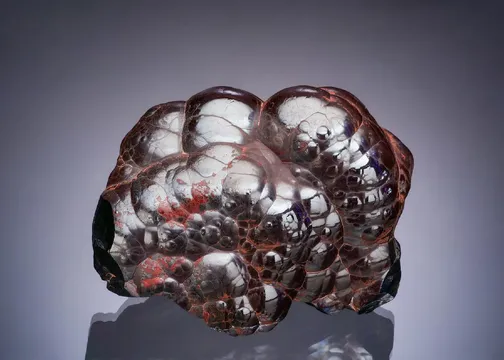
Egremont, UK - renowned replacement-ore locality famed for high-grade hematite and dramatic fluorite-on-hematite, with classic Florence Mine associations.
Key facts
Egremont is the name collectors most often use for the great west Cumbrian hematite specimens from Florence Mine and its joined underground neighbours, Ullcoats and Beckermet, on the southern edge of the town. This is not a small vein locality in the usual British sense, but a major replacement-ore district: warm, iron-rich brines invaded faulted Lower Carboniferous limestone on the western flank of the Lake District and replaced great volumes of carbonate rock with hematite. The deposit produced high-grade iron ore on an industrial scale, but its fame among collectors rests on the cavities, bands, and margins of that orebody, where hematite took on superb specimen forms—deep red to black kidney ore, glittering specularite, hematite-included quartz, red-zoned calcite, cream saddle dolomite, white to pink baryte, delicate aragonite, and, in the classic Florence-Ullcoats association, bright sky-blue fluorite on iron-red matrix.
Regional View
Country View
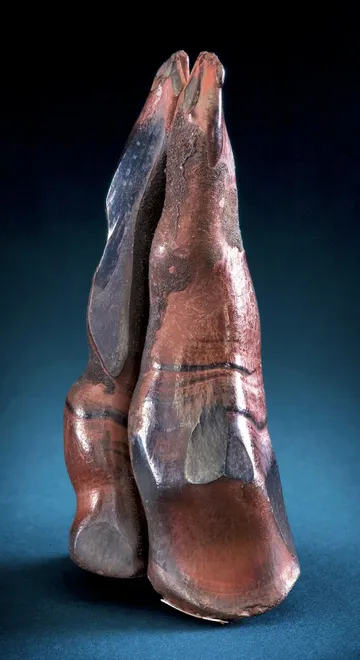
The best Egremont specimens have an unmistakable visual language. Hematite may appear as polished-looking black-red mammillary “kidney ore,” as broken conical “pencil ore,” or as sparkling steel-grey specularite carpeting older botryoidal surfaces. Quartz is commonly sharp and glassy but often warmed by included hematite, ranging from colourless points to smoky and deep red “tomato quartz.” The prized combinations exploit contrast: blue fluorite cubes against red hematite, pale dolomite rhombs perched on metallic specularite, or peachy aragonite tufts on brecciated hematite fragments. Florence Mine was also geologically important because, until final closure and flooding, it offered the last substantial underground exposure where this style of Cumbrian replacement hematite could be studied in place.

Photo: Wikimedia Commons

Photo: Wikimedia Commons
Search for specimens: View all specimens from Egremont, UK
Egremont lies in the West Cumberland Iron Field, where hematite bodies occur mainly as irregular to flat-lying replacements in Lower Carboniferous limestone. At Florence and Ullcoats, the ore lay in a concealed southern part of the field, beneath Permo-Triassic Brockram breccia and St Bees Sandstone, with the limestone resting on Lower Palaeozoic Skiddaw Group rocks. The Florence-Ullcoats orebody occupied a structurally prepared zone between the Ullcoats and Florence faults; those faults, together with carbonate permeability and bedding controls, guided the movement of mineralising fluids and the distribution of ore.
The orebody was overwhelmingly hematite, but never mineralogically dull. Massive hematite formed the bulk of the mineable ore, while open cavities—locally called “lough holes”—preserved the collector minerals. Many small lough holes were lined with tabular specular hematite and bipyramidal quartz. In richer specimen zones a fibrous mammillated layer of kidney ore separated the massive ore from later crystal linings. The orebody margins and altered limestone close to the host rock were especially favourable for the carbonate and sulfate gangue: calcite, dolomite, baryte, and aragonite. Baryte could be abundant near margins and was unwelcome in ore destined for smelting, while calcite in the ore was historically taken by miners as a sign that the edge of the orebody was nearby.
Florence Mine began with shaft sinking in the 1910s under the Millom and Askam Hematite Iron Company. The first ore was raised in the early 1920s from what proved to be the largest orebody found in West Cumberland. A second shaft was sunk during the 1940s, with working transferred to the new pithead in 1947. Florence was joined underground to Ullcoats in the 1950s and later linked with Beckermet, after which ore could be raised through the Beckermet system. Large-scale working ended during the decline of the British iron and steel industry, but Florence survived unusually late: after closure by British Steel in 1980, redundant miners bought the property with redundancy money and continued as the Egremont Mining Company, working hematite on a much smaller scale for pigment, specialist uses, and heritage activity.
The final period of mining centred on shallower workings including the Lonely Hearts Orebody, near the Ullcoats Fault. These workings became famous not because they produced the largest fluorites or the grandest old-time cabinet plates, but because they exposed replacement hematite geology in situ at the very end of the mine’s life. Detailed recording in 2007 documented preserved limestone textures replaced by hematite, fossil structures, mudstone partings passing through ore, lough holes lined with quartz and specularite, kidney ore bands, baryte-rich cavities, and altered dolomitic roof rock carrying pale curved rhombs. When pumping ceased, the underground workings flooded and this exposure was lost to direct observation.
Collecting access today is effectively historical rather than field-based. The mine is flooded, privately owned, and not open as a collecting locality. Florence Arts Centre occupies part of the former mine site and occasional heritage activity has focused on surface history, not underground collecting. Serious collectors therefore encounter Egremont mainly through old collections, dealer stock, and specimens saved during the working and tour years. Labels may read Florence Mine, Ullcoats Mine, Florence-Ullcoats, Beckermet, West Cumberland Iron Field, Cumberland, or Cumbria; because the workings were physically connected and specimens circulated through miners, dealers, and visitors, old labels should be read carefully rather than over-forced into an exact stope unless the specimen has strong provenance.

Photo: Wikimedia Commons
Hematite is the defining Egremont mineral and ranges from compact red ore to superb kidney ore and glittering specularite. In the Florence workings, massive ore commonly enclosed small lough holes lined with tabular specular hematite and quartz; elsewhere, kidney ore formed bands and pockets within the orebody, breaking naturally into conical pencil-ore fragments parallel to its fibrous structure. The strongest collector pieces show glossy, undamaged mammillary surfaces, a deep black-red to purple-red colour, and bright metallic specularite on contrasting iron-red matrix; ordinary pieces are simply massive or bruised ore with little form. Cabinet specimens combining botryoidal hematite, sparkling specularite, quartz, dolomite, or fluorite are especially characteristic of the Florence-Ullcoats system, while fine pure kidney ore remains the classic Cumbrian look that made Egremont specimens fixtures in major collections.
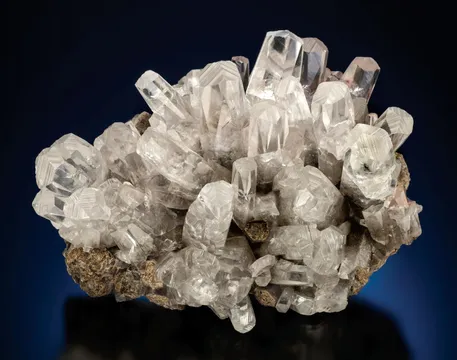
Egremont calcite is a gangue mineral of the hematite cavities and ore margins, typically appearing as small white rhombs, colourless to pale crystals, or red to pinkish hematite-included crystals on hematite matrix. In the late Florence workings, calcite was common close to orebody margins, especially near Ullcoats No. 1 Shaft, where vugs in massive hematite could be lined with crusts of small white rhombic crystals only a few millimetres across; prismatic crystals, some darkened by minute manganese oxide inclusions, were noted very locally. Collector-grade pieces are those with clean lustrous crystals, red zoning or hematite tinting, and a strong matrix contrast rather than dull carbonate crusts; the best cabinet examples can show transparent prismatic crystals with flat rhombohedral terminations and internal reddish hematite colour, a very English visual style tied to the iron field.
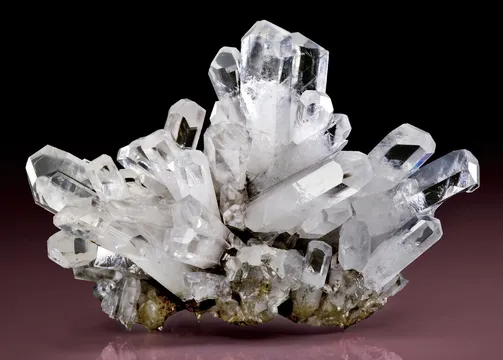
Quartz from Egremont is important because it is woven into the hematite paragenesis rather than occurring as isolated quartz specimens. Small lough holes in massive hematite were commonly lined with bipyramidal quartz crystals alongside tabular specularite; much of the quartz is colourless, but smoky quartz was formerly common, and deep red hematite-included quartz—known locally and in older mineral language as eisenkiesel or “tomato quartz”—is one of the most distinctive Florence looks. Good specimens carry sharp lustrous crystals on botryoidal hematite or specularite, often with a warm red internal colour or smoky tone; lesser pieces are granular quartz crusts without definition. Particularly desirable are plates where hematite-coated botryoidal ore forms the architecture and red quartz or bright quartz points provide sparkle and depth.
Egremont dolomite is best known as pale cream, white, or faintly pink saddle-shaped curved rhombs in vugs on hematite or altered dolomitic roof rock. Fine old Florence specimens exist from earlier workings, while the late Lonely Hearts exposures yielded few top examples but did show good typical curved rhombic crystals in centimetre-scale cavities in altered roof rock near Ullcoats No. 1 Shaft. The collector appeal is the soft colour contrast: buttermilk dolomite perched on red-brown kidney ore or sparkling grey specularite. Good pieces have distinct, undamaged saddle rhombs with separation and lustre; average ones are drusy or bruised carbonate patches. Dolomite is also a key association with the coveted blue fluorite pieces from the connected Florence-Ullcoats mines.
Barite, more commonly spelled baryte in British literature, occurs at Egremont as tabular BaSO4 in veins and vugs, especially near orebody margins and altered limestone close to the hematite. Florence material includes white to pale pink platy crystals, and documented underground exposures showed cavities with more than one generation, earlier pink baryte being overgrown by later white baryte. Because baryte could be concentrated near the margins, it is a useful specimen clue to wall-rock proximity rather than the central massive ore. Good collector pieces show sharp tabular crystals with translucent lustre and colour contrast against hematite, dolomite, or altered limestone; ordinary examples are heavy white cleavages or opaque plates with little definition.
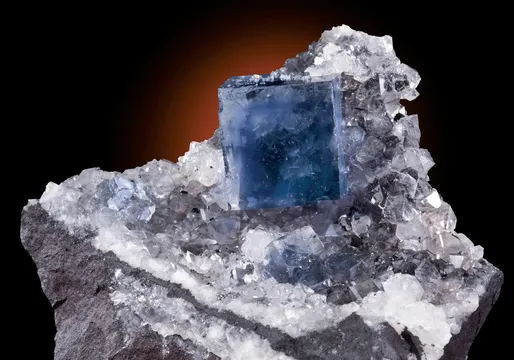
Fluorite is one of the most sought-after Egremont associates, especially the Florence-Ullcoats blue cubes on hematite. In the late Florence workings, small colourless to pale-blue cubes were fairly common in vugs, but the famous older and deeper Florence-Ullcoats material produced beautiful sky-blue cubes up to several centimetres across, the colour set off dramatically by red hematite, steel-grey specularite, and cream dolomite. High-end specimens have transparent to gemmy cubes, sharp edges, minimal bruising at the vug break, and strong contrast with iron-rich matrix; more modest pieces have small pale cubes partly dusted or stained red by hematite. The most recognisable examples are compact cabinet specimens with blue cubic fluorite rising from sparkling specularite or red botryoidal ore.
Baryte is the British spelling for barite, and Egremont collectors will see both names on labels depending on whether a specimen passed through British, European, or American hands. Florence baryte occurs as platy to tabular crystals in vugs and narrow veins, especially toward the orebody margins and in altered limestone next to hematite. The attractive material is pale pink, white, or faintly bluish-white, sometimes in stacked tabular groups and sometimes with dolomite or hematite; fine specimens depend on clean crystal edges, translucency, and intact plates rather than sheer size. Because baryte was a nuisance constituent in the ore, the very features that made it bad for mining—heavy sulfate-rich zones at the margins—made the best crystallised pieces interesting to mineral collectors.
Aragonite is a minor but charming Egremont carbonate, occurring locally in vugs with hematite and calcite, usually as pale radiating sprays, balls, or tufts rather than large crystals. Florence specimens in old collections may show brecciated hematite fragments cemented by calcite, with one side carrying small cream to peach aragonite balls and the other sparkling with specularite. The best examples are miniature to small-cabinet pieces where the aragonite is distinct, fresh, and three-dimensional against dark hematite; ordinary pieces are fragile pale tufts partly obscured by iron staining or damage. Because aragonite was never a volumetrically important mineral in the orebody, well-composed specimens are much scarcer than hematite-quartz or hematite-dolomite combinations.
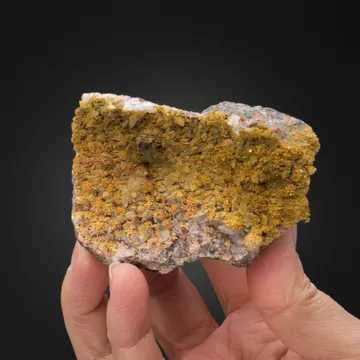
Other documented minerals from the Florence-Egremont system include pyrolusite and minor manganese oxides, while broader descriptions of the west Cumbrian hematite orebodies record rare pyrite, marcasite, chalcopyrite, galena, manganite, hausmannite, siderite, limonite, and goethite in or around comparable deposits. These are not the minerals that built Egremont’s specimen reputation, but they matter because they explain some dark inclusions, oxidation products, and old label attributions. Goethite, for example, was observed as yellowish-brown earthy crusts on hematite in the Lonely Hearts Level and was interpreted as a small, possibly post-mining alteration product rather than a major primary member of the assemblage.
Egremont specimens are finite classics. The mine is flooded, underground access has ended, and new production of crystallised material is not expected from the original source. Availability is therefore governed by old collections, dealer recirculation, and specimens saved by miners, visitors, and British collectors during the mine’s working and heritage years. Massive hematite and modest kidney ore remain obtainable, but top combinations—blue fluorite on hematite, lustrous specularite with red quartz, fine hematite-included calcite, or clean aragonite balls—are much less common and often command locality-driven premiums beyond their species value.
The main authenticity issue is not sophisticated faking but locality and association discipline. Old labels may use Egremont, Florence, Ullcoats, Florence-Ullcoats, Beckermet, Cumberland, or Cumbria interchangeably. Because the mines were connected underground and specimen material moved through miners and dealers, “Egremont” can be a perfectly honest district label even when a precise shaft or level is not documented. Be cautious, however, with generic “Cumbria hematite” upgraded to Florence, with blue fluorite attributed to Egremont without a hematite-dolomite context, and with calcites from other Cumbrian or northern English localities relabelled as Egremont simply because they are red-stained.
Condition is critical. Kidney ore often has naturally broken backs and sawed or trimmed bases; these are acceptable when the display surface is glossy and intact, but bruised mammillary high points reduce desirability sharply. Specularite coatings are easy to dull by rubbing and hard cleaning, and loose hematite dust can migrate onto lighter associated minerals. Quartz is generally robust, but red included crystals show contacts plainly. Fluorite cubes should be checked for cleaved corners and edge bruising where the vug was opened from massive ore. Baryte is soft and cleavable, dolomite rhombs chip at the edges, and aragonite sprays are very fragile; these associations should be handled by the matrix, not by the crystals.
Treatments are usually simple: some hematite, especially pencil ore and compact kidney ore, has been cut or polished for jewellery, pigment display, or educational use. That is not inherently deceptive when disclosed, but a polished object should not be valued as a natural cabinet specimen. Calcite from Florence may show weak fluorescence, and some dealer records note minor long- and short-wave UV response, but fluorescence is not the principal reason to acquire Egremont material. The real collector standard is form, contrast, provenance, and the unmistakable red-ore character of the Florence-Ullcoats system.
Florence Mine’s afterlife is one of the more improbable stories in British mining. British Steel closed the mine on 3 October 1980, but the pit did not simply die. Redundant miners used their redundancy money to buy the property back and reopened part of the workings as the Egremont Mining Company. It was a stubborn, local rescue of an industrial organism that no longer fitted the economics of steelmaking. The mine survived by becoming smaller and stranger: hematite went not only to industrial use but into pigment, dye, cosmetics, and heritage, while the workings themselves became part of the attraction.
The mine was kept dry in its late years because the nearby Sellafield nuclear site needed large volumes of water. That arrangement gave Florence a second life. Water pumped from the mine could serve an industrial purpose, and the miners could continue extracting ore from the shallow workings. When Sellafield no longer needed that water, the arithmetic became brutal. Pumping costs were reported at about £2,000 per week, too much for the small operation to carry from pigment sales and limited mining. Once pumping ceased, the old underground world filled and the last direct access to the replacement-ore exposures disappeared.
Visitors in the late 1990s saw a mine still alive enough to be muddy, mechanical, and red. When the electric winder on No. 2 Shaft could not be used for visitors, people entered by a surface drift to the 300-foot level. Battery locomotives moved ore along the main roadway, and the tour passed a rescue station, a landing on No. 1 Shaft, an ore chute still in use, speckled hematite, and kidney ore samples. One underground account remembers the working area about 30 feet above the main roadway near old Shaft No. 1, ore loaded by an Atlas Copco machine into the chute below, and a fan house reached by a short incline. Below that fan house lay deeper workings already flooded, with the water level near the top of the incline—a preview of the mine’s final fate.
The miners of west Cumbria had a nickname that no mineral collector forgets: the “Red Men of Cumbria.” The fine hematite dust marked everything—clothes, boots, skin, galleries, tubs, and tools. Even a visitor could come away with stains that lingered for years. That red was more than dirt; it was the visible signature of Fe2O3, the same material that made the ore valuable, the specimens memorable, and the later paint project possible.
After closure, the red did not leave the site. Artists took over part of the former mine buildings, and Florence Paintmakers began turning remaining hematite stocks into artists’ materials under the name Egremont Red. The story started with artist Mat Do’s 2012 residency and grew into a social enterprise led by local artists Jenni Payne, Jill Davis, Liz Redmayne, and Margie Foots. The former shower block became a paint-making studio. Hematite was ground for pigment, then worked by hand with a glass muller into oil paint, watercolour, pastels, ink, and dry pigment. The joke attached to the project was perfect for a hematite mine: “You can have any colour as long as it is red.”
The site’s machinery also survived with unusual completeness. The Grade II listing for the Florence pithead records the headframe, heapstead, winding engine house, fan house, ore processing plant, compressor plant, workshop, cages, rails, gates, crushers, screens, trommel, ball mill, conveyors, and control gear. One especially striking detail is the electric winding engine, described as probably the earliest surviving example nationally still in situ. For a collector holding a palm-sized kidney ore specimen, those surviving structures give scale: the polished red knob in the cabinet came from an industrial world of shafts, cages, chutes, crushers, pumps, and men working inside a body of iron.

Photo: Wikimedia Commons
.jpg)


