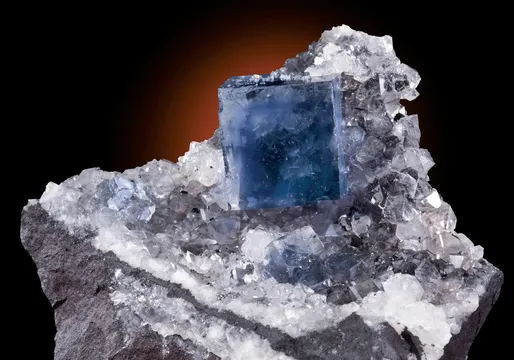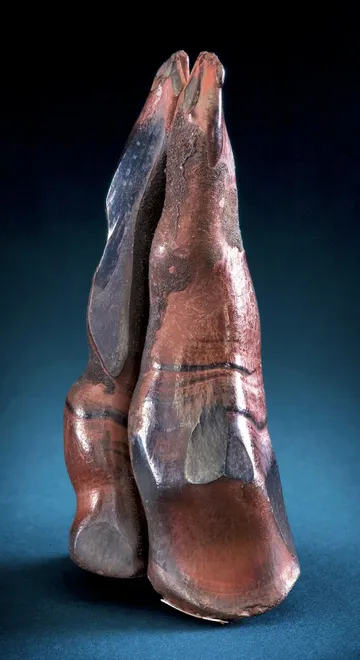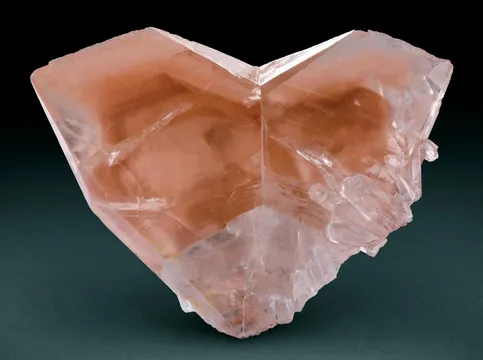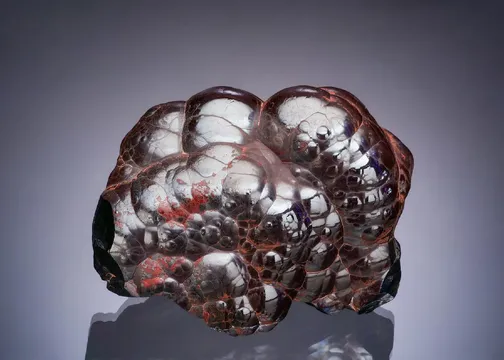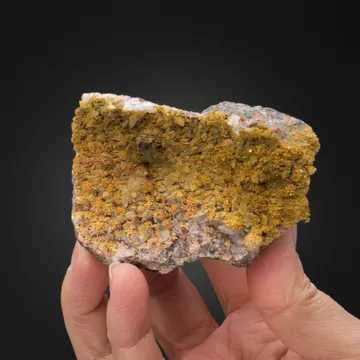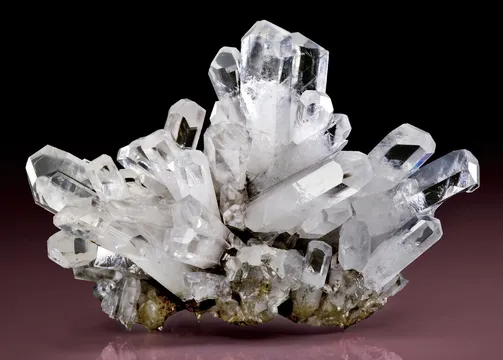
Bigrigg Mine, UK - classic calcite locality near Egremont, famed for sharp glassy to milky prisms and scalenohedra with hematite tinting, prized by collectors.
Key facts
Bigrigg is one of the great old names in English calcite. The locality sits in the West Cumberland Iron Field near Egremont, where high-grade hematite orebodies were mined from Carboniferous limestones along faults and replacement zones on the western margin of the Lake District. To the mining companies it was an iron-ore ground; to collectors it became a classic calcite locality, famous for sharply formed, glassy to milky, prismatic and scalenohedral crystals, many showing the iron-rich red-brown tinting that gives Bigrigg pieces their unmistakable warmth.
The name “Bigrigg Mine” needs to be read with a collector’s caution. In old specimen labels and in the mining literature it often covers a cluster of pits and shafts around the village of Bigrigg rather than one cleanly bounded mine. Croft Pit, Wyndham or Langhorn, James’s Pit, William Pit, Hay Pit, Lady Pit, Pallaflat, Woodend and nearby workings have all contributed to the collector identity of Bigrigg. This vagueness is not a weakness of the locality so much as part of its history: mining here was old, complicated and commercially reworked, while specimen labels were often written for the nearest village rather than for the exact shaft.
Regional View
Country View
The best Bigrigg calcites are elegant, old-world specimens: transparent to translucent crystals perched on iron-rich matrix, sometimes with one side selectively stained or coated by hematite so that a single crystal can pass from clear-white to red-brown. Fine examples range from small cabinet pieces with slender water-clear “cannon spar” prisms to larger cabinet plates of intergrown scalenohedra. Some specimens carry antique labels from nineteenth- and early twentieth-century collections, and the locality was already sufficiently celebrated by 1889 for Henry A. Miers to publish a crystallographic paper on the calcites of the Egremont district.
Search for specimens: View all specimens from Bigrigg Mine, UK
Bigrigg lies just north of Egremont in west Cumbria, within the West Cumberland Iron Field. The ore deposits here are part of the same broad hematite province that made Egremont, Cleator Moor and Frizington internationally known in the nineteenth century. The essential geological setting is Carboniferous limestone cut and displaced by faults, later mineralized by iron-bearing brines. The principal ore was hematite, developed as irregular replacement bodies, flats and vein-like masses along structural pathways. In the wider orefield, the hematite is overwhelmingly dominant, with gangue minerals such as calcite, baryte, aragonite, dolomite, quartz and locally fluorite making up a small but specimen-rich part of the assemblage.
At Bigrigg and its neighbouring pits the ore was worked from several named shafts and pits rather than a single tidy operation. Old maps and mine records identify Bigrigg Pit at about NY003127, and modern locality databases place Bigrigg Mine near 54°30'02"N, 3°32'23"W. The wider Bigrigg area includes the historically important Pallaflat Mine at NX997126, Woodend Mine at NY008127, Croft Pit, Wyndham or Langhorn, Parkhouse, Mossbay and other workings clustered around the village. This dense pattern explains why old labels reading simply “Bigrigg” or “Bigrigg Mine” can refer to specimens from a number of closely related iron-ore workings.
The local ore bodies were developed in the numbered limestones of the Chief Limestone Group. At Pallaflat, the ore is recorded as vein-like bodies on fault planes and as flats in the First, Second and Fourth Limestones; a little manganese ore was also encountered. The mineralizing system was not a typical lead-zinc vein district assemblage. Instead, it was a hematite replacement field in which collectors’ minerals formed in cavities, seams and residual openings in or near the iron ore. That distinction matters: Bigrigg calcites are classic not because calcite was economically abundant, but because pockets within a hematite mine occasionally provided the right combination of open space, carbonate-rich fluid and iron-oxide colouring.
Mining in the Bigrigg area is old. Royalty accounts cited by John Postlethwaite show iron ore being obtained at Bigrigg almost continuously from 1635 to 1701. Work was renewed between 1820 and 1825, and by 1829 there were three companies mining eight pits around the village. The west Cumbrian iron boom accelerated after the Whitehaven, Cleator and Egremont Railway began opening the district to heavier ore traffic in the 1850s. The high-grade, low-phosphorus hematite of west Cumbria was well suited to nineteenth-century steelmaking, especially where acid Bessemer practice required clean ore.
Operators and ownership shifted over time. Lord Leconfield’s interests are closely tied to Croft Pit and other Bigrigg-area workings in the nineteenth century, while the Bigrigg Mining Company Limited, Wyndham Mining Company Limited and Pallaflat Mining Company appear in records and directories for different parts of the district. The Pallaflat Mining Company was formed in 1874; its No. 1 shaft was working ten years later, and production of 83,412 tons of iron ore is recorded for 1888. Pallaflat closed in 1914 after three pits had been developed. Other records show red hematite output from Bigrigg/Croft in years ranging from the 1880s into the 1930s, and mine-database entries record Bigrigg-area workings as continuing or developing later than the often-quoted 1932 closure date. For collectors, the practical point is that the classic specimens belong mainly to the long nineteenth-century mining period and the old dump reworking that followed.
The most important specimen finds are the calcite pockets. Pallaflat is especially well documented for clear, transparent nail-head and scalenohedral calcite groups, including “butterfly” twins and pieces with selective hematite colouring. Baryte was also produced there, notably transparent pastel-green crystals with calcite. Woodend is less prolific as a specimen locality but has produced calcite on banded hematite kidney ore with small brassy pyrite crystals, a combination that stands apart from the more familiar clean calcite plates. Bigrigg Mine sensu stricto is documented for calcite, baryte, aragonite, dolomite, hematite, hausmannite and pyrolusite, but the marketplace overwhelmingly remembers the locality for calcite.
Collecting access today should be treated as closed unless explicit permission has been obtained. Modern mine-location databases mark Bigrigg-area sites as private land, and the ground contains old shafts, disturbed spoil, subsidence hollows and flooded or collapsed workings. The surviving material in collections and on the market comes from historic mining, old dumps, estate dispersals, museum duplicates and long-held private collections rather than from routine modern field collecting.
Bigrigg calcite is the signature collector mineral: transparent to translucent prismatic and scalenohedral CaCO3 crystals, commonly colourless, milky-white, pale pinkish or red-brown where hematite lies below the surface or selectively coats one side of the crystals. Classic pieces range from miniatures with 2 to 4.5 cm prisms to cabinet specimens carrying crystals of several centimetres, and unusually large old pieces are known with crystals exceeding 10 cm. The finest examples show sharp terminations, bright vitreous lustre, open three-dimensional growth on iron-rich matrix, minimal bruising, and the characteristic contrast between clear calcite and hematite-stained faces; ordinary pieces tend to be more massive, iron-soiled, cleaved or crowded, while elite Bigrigg specimens preserve the airy geometry that made the locality a textbook and museum-gallery calcite source.
Other documented Bigrigg-area minerals include hematite, the economic ore and frequent matrix, plus baryte, aragonite, dolomite, fluorite, pyrite, hausmannite, braunite, pyrolusite, manganite, magnetite, rhodochrosite, siderite, galena, sphalerite, millerite, siegenite, quartz, rutile, muscovite, epidote, zircon and several group or obsolete field terms such as “limonite” and “psilomelane.” Among these, baryte is the most important collector associate, especially from Pallaflat and related Bigrigg workings, while the manganese minerals are the locality’s quieter rarities, reflecting the small pockets of manganese ore recorded in the Bigrigg and Wyndham ground. Bigrigg is not established as a mineral-species type locality in the standard locality lists consulted, but it is notable in Carboniferous stratigraphy: mudstone beds at Bigrigg are cited as the type locality for the Yeadonian ammonoid Gastrioceras cumbriense, historically also treated under Cancelloceras cumbriense in the marine-band literature.
The chief authenticity issue with Bigrigg is not modern faking but locality precision. Labels reading “Bigrigg,” “Bigrigg Mine,” “Egremont,” “Cumberland,” “West Cumberland” or “Pallaflat” may describe specimens from adjacent but distinct workings. For high-value pieces, give extra weight to old labels, collection history, publication history and visual match to documented Bigrigg-area habits. A specimen labelled “Bigrigg Mine” may be perfectly legitimate in the traditional collector sense while not being provable to a single shaft.
Bigrigg calcites are often confused with other West Cumberland calcites from Florence, Egremont, Frizington, Cleator Moor and nearby mines. The most persuasive Bigrigg pieces combine clear to milky prismatic or scalenohedral calcite with red-brown hematite staining or iron-rich matrix, but that look is not unique to one shaft. Pallaflat labels are more meaningful when the specimen shows the documented suite of transparent nail-head or scalenohedral calcite, occasional butterfly twins, and baryte association.
Condition is a major value driver. Calcite has perfect rhombohedral cleavage and a Mohs hardness of 3, so old Bigrigg crystals are commonly cleaved, chipped at terminations, bruised along prism edges or dulled by abrasion from mining and dump recovery. A few scattered cleaves are tolerable on historic specimens, but sharp terminations and undamaged display faces separate serious pieces from merely representative ones. Iron staining is natural and often desirable when it is selective or internal-looking; dull brown dirt in crevices, by contrast, can obscure lustre and should not be mistaken for the classic hematite effect.
Some Bigrigg and Woodend calcites have been noted as showing faint pink fluorescence. Fluorescence should be treated as a bonus, not a diagnostic proof of locality. Avoid acid cleaning unless you know exactly what is on the specimen: calcite will effervesce and etch readily, and iron oxides that supply the locality’s colour contrast can be altered or removed by aggressive treatment. Store and ship these specimens with the same care given to other classic calcites: isolated crystal tips, old repairs, cleaved back edges and friable hematite matrix are all common vulnerabilities.
On today’s market, Bigrigg calcite is available but finite. Representative old miniatures and small cabinet pieces appear periodically, while top cabinet specimens with transparent, undamaged, well-spaced crystals and antique provenance are genuinely scarce. Prices rise sharply for twinned crystals, unusually clear prisms, strongly selective hematite coloration, museum or early collection history, and pieces specifically attributable to Pallaflat, Woodend or another named Bigrigg-area pit.
The most evocative early image of Bigrigg mining comes from Postlethwaite’s account of the reopened pits between 1820 and 1825. Before steam power took over the work, ore and water were drawn by jack-rolls and horse gins. In the wetter pits, the horses were driven “at full speed both day and night,” with fresh relays put in every two hours. It is a stark little scene: small iron pits in wet Cumbrian ground, men fighting water as much as rock, and horses circling hour after hour so the ore could keep moving.
The great specimen era grew out of that industrial world. Bigrigg was never a gentleman’s spar quarry; it was a hematite mining village where calcite survived because occasional cavities opened in the ore. By the later nineteenth century, crystals from the Egremont district were striking enough for H. A. Miers to describe them formally. A generation later, A. E. H. Tutton used calcites from Bigrigg in his discussion of crystal habit, contrasting hexagonal prisms capped by low rhombohedra with “dog-tooth spar” from the same mine. The point still resonates for collectors: two Bigrigg calcites can look so different that only crystallography, locality history and an experienced eye tie them together.
The most dramatic human episode tied to the Bigrigg pits came in November 1924 at Croft’s iron-ore mine. A fall of rock trapped ten men underground; two others escaped uninjured. Rescue parties cut toward the imprisoned miners without communication at first, while news of the accident travelled far enough to appear in newspapers overseas. Then the rescuers heard a voice from behind the fall: “We are all well and uninjured.” Nine of the ten trapped men were married. They were eventually brought out after 28 hours underground, turning what could have been another grim west Cumbrian mining disaster into a rescue story remembered in local histories.
Bigrigg’s older accident records also show how precarious the industry could be. In 1893, a fatal shaft accident at Lord Leconfield’s Croft Pit became an example in calls for tighter regulation of metalliferous mines. The inquest was held at the Seacote Hotel, with the rope itself exhibited and described as rotten. H. M. Inspector of Mines J. L. Hedley used the case to press the need for compulsory examination of plant and appliances, arguing that lives depended on the soundness of equipment used every day around a mine. It is a sobering backdrop to the polished calcites in modern cabinets: these specimens came from a working landscape where a bad signal, a dropped rail or a failed rope could be fatal.
Collectors had a second, quieter chapter in the 1980s, when local collectors worked the Pallaflat dumps and recovered many fine specimens. Those dump finds helped keep Bigrigg material circulating long after the mines had shut, and they explain why some pieces have relatively modern collection histories despite belonging to a nineteenth-century mining field. The finest of them preserve the old locality’s look: clear calcite rising from iron-rich matrix, sometimes with baryte, sometimes with hematite seemingly painted onto only one side of a crystal.