Pallaflat Mine, UK - West Cumberland hematite locality known for glassy calcite crystals and rare barite, with butterfly twins, prized by collectors.
Key facts
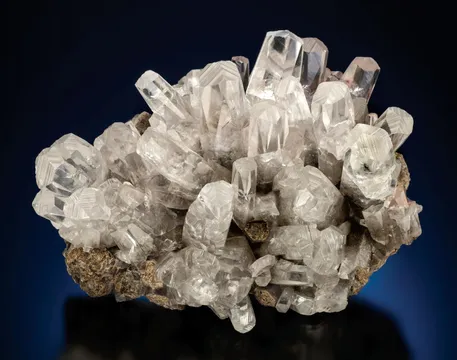
Pallaflat Mine is one of the classic specimen localities of the West Cumberland Iron Field, the narrow, intensely mined belt of hematite deposits around Egremont, Bigrigg, Cleator Moor and Frizington on the western edge of the Lake District. Its ore was not a lead-zinc vein in the Pennine sense, but part of the great Cumbrian hematite system: iron-rich brines replaced Carboniferous limestone along faults and bedding-parallel flats, leaving bodies of red hematite and cavities capable of growing startlingly clear calcite and barite. For collectors, Pallaflat matters because a comparatively short-lived iron mine produced calcite groups that rank among the most distinctive British classics: transparent nail-heads, tapering scalenohedra, doubly terminated crystals and the famous “butterfly” twins, commonly set on red-brown hematite or limonitic ironstone.
Regional View
Country View
The best Pallaflat specimens have an unmistakable West Cumbrian look: glassy, water-clear to milky calcite rising from dark iron-oxide matrix, sometimes with a red or brown hematite dusting confined to selected faces or backs of crystals. Barite from the mine is much scarcer but highly prized, especially the transparent to translucent pastel green, blue-green or grey-blue tabular blades associated with calcite. The mine’s appeal is sharpened by history: Pallaflat was already an established name in 19th-century iron mining, closed in 1914, and then enjoyed a second life as a collector locality when its dumps were dug hard in the late 20th century.

Photo: Daderot, Wikimedia Commons
Search for specimens:
Pallaflat Mine lies at Bigrigg, near Egremont, in the West Cumberland Iron Field of Cumbria, England. The locality belongs to the exposed northern part of the orefield, where Carboniferous limestone reaches the surface or lies shallow enough to have been exploited by numerous shafts and pits. The regional ore system is dominated by hematite replacement bodies in limestone, controlled by faults, bedding, permeability contrasts, and the relationship between Carboniferous limestones and overlying or formerly overlying Permo-Triassic red-bed successions. In this setting, iron-rich, saline fluids moved through fractures and reactive limestone horizons, replacing carbonate rock with hematite while leaving cavities and open spaces in which later gangue minerals crystallized.
At Pallaflat itself, the ore was recorded as occurring both in vein-like bodies on fault planes and as bedding-related flats in the 1st, 2nd and 4th Limestones. A little manganese ore was also noted. This geometry explains much of the specimen character: hematite supplied the red-brown matrix and the dusting or inclusions seen on many calcites, while open vugs and lough-like cavities in the ironstone-limestone system allowed calcite and barite to grow freely. The mine is not a broad-species locality; its documented mineral list is compact, but the quality of a few species is exceptional.
The Pallaflat Mining Company began operations in 1874. No. 1 shaft was working by 1884, and by 1888 the company had produced 83,412 tons of iron ore. Two further pits were developed before the mine finally closed in 1914. The mine appears in contemporary and later records under closely related names, including Pallaflat Mine, Bigrigg/Pallaflat, and Pallaflat Iron Ore Co.; an 1886 newspaper account of a fatal accident describes the Pallaflat iron-ore mines as owned by the Maryport Iron and Steel Company. As with many West Cumberland hematite mines, the economic story was iron first, specimens second — yet the collector legacy has outlasted the industrial one.
Collecting access today must be treated as private-land access, not casual public collecting. Buddlepit records the Pallaflat pit sites as private land, and a Russell Society field visit in 2018 explicitly thanked the landowner for permission to visit the Pallaflat dumps. That same visit found the dumps heavily overgrown and long collected, with very little remaining compared with earlier decades. For modern collectors, most worthwhile Pallaflat material is therefore best regarded as old collection or dealer-circulated material, with occasional pieces from historic dump collecting.
The great specimen recovery period after mining came from the dumps. Local collectors worked them during the 1980s, recovering many of the calcites and calcite-barite combinations now circulating. Later recollections describe digging calcite and hematite from the tips and extracting good calcites from large blocks of dump material. Some of that ground was reportedly later bulldozed for road material, which helps explain why fine Pallaflat specimens have become increasingly collection-bound.
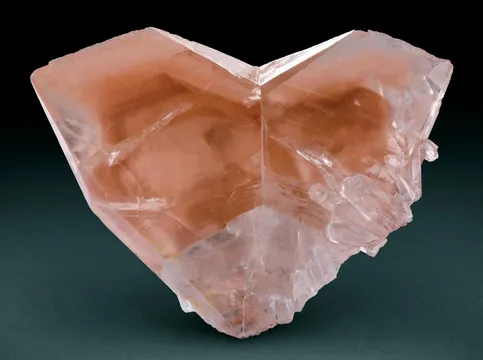
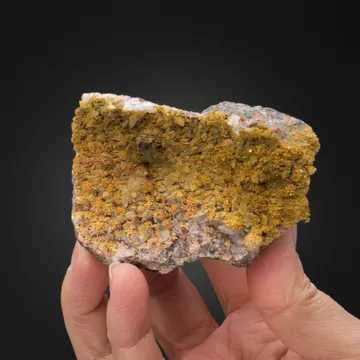
Calcite is the defining Pallaflat species: clear to milky-white, lustrous crystals occur as nail-heads, prismatic groups, scalenohedra, doubly terminated crystals and dramatic butterfly twins, generally on red-brown hematite, goethitic or limonitic iron-oxide matrix. Documented specimen descriptions give individual crystals from about 1 cm on dense cabinet plates up to roughly 3.5–5.5 cm on larger and older examples, with some twinned crystals around 8–9 cm overall; the best pieces show strong transparency, sharp undamaged terminations, open three-dimensional architecture, and the locality’s desirable selective hematite dusting, especially where reddish coloration touches one side or the backs of otherwise colourless crystals without dulling the glassy faces.
Barite from Pallaflat is far less common than calcite and is most admired as tabular to bladed, lustrous crystals in pale green, blue-green, grey-blue or delicate pastel tones, usually perched on hematite-rich matrix and commonly accompanied by colourless calcite scalenohedra or nail-heads. Fine miniatures show dense clusters of gemmy to translucent blades measuring to a few centimetres, while a celebrated 15 cm blue English barite attributed to Pallaflat has been singled out in the Mineralogical Record literature as one of the finest in private hands; choice examples are clean, bright, well-terminated, and visually balanced with calcite rather than being merely massive or chipped bladed aggregates.
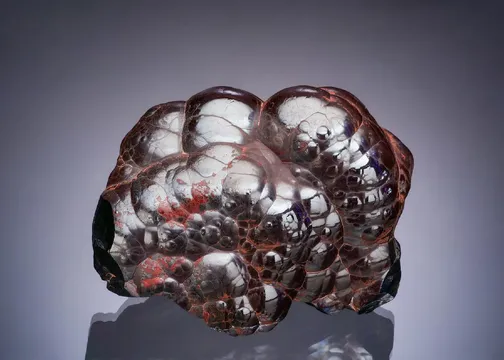
Hematite is Pallaflat’s ore mineral and the foundation of nearly every important specimen from the mine, but collectors usually encounter it as red-brown to dark iron-oxide matrix, botryoidal or massive kidney-ore-like surfaces, and fine dustings or inclusions on calcite and barite rather than as stand-alone specularite crystals. The most attractive hematite-bearing pieces are those where the iron oxide gives colour and geological context without overwhelming the carbonate or sulphate crystals: thin, stable hematite matrix under clear calcite, red coatings restricted to selected calcite faces, or dark hematite plates carrying pastel barite and colourless calcite are far more desirable than heavy ore chunks with little crystallized gangue.
The formal mineral list for Pallaflat is notably short: barite, calcite, hematite and the non-species field term “limonite” are the principal documented entries. Pallaflat is not established in the consulted records as a type locality for any mineral species. A 2018 field-trip report records a tiny fluorescent fluorite crystal from the Pallaflat dumps, an intriguing rarity in the broader Egremont hematite-gangue context, but fluorite is not the mineral for which the locality is collected. The locality’s reputation rests on quality, not diversity: a small suite expressed with unusually strong aesthetics.
The main authenticity concern with Pallaflat specimens is locality discipline. West Cumberland produced calcite and barite at several neighbouring mines — including Bigrigg, Parkside, Mowbray, Frizington-area workings and Florence-related material — and specimens can be visually close. Pallaflat calcite should fit the known habit range: clear to milky nail-head, prismatic or scalenohedral crystals, butterfly twins, commonly on hematite-rich ironstone, sometimes with one-sided red-brown hematite dusting. Barite should be treated more cautiously because fine blue to greenish West Cumbrian barites from several mines have circulated for generations, and old labels may use broad terms such as “Cumberland,” “Egremont,” “Bigrigg,” or simply “West Cumberland.”
Specific mislabelling is documented: one high-end Pallaflat calcite retained an old Anton Berger label giving the locality as “Pallaflat, Cornwall, England,” a geographic error understandable to a non-British label writer but significant for cataloguing. Such labels are part of the collecting history, but the correct county context is Cumberland/Cumbria, not Cornwall. No well-documented Pallaflat-specific fake industry is known from the sources consulted; the realistic risks are confused locality attribution, over-broad “Bigrigg” labelling, repairs not disclosed on older cabinet pieces, and condition losses on fragile crystal edges.
Condition matters greatly. Pallaflat calcites can be surprisingly transparent, so bruised tips, cleaved terminations, rehealed-looking chips, iron staining that is actually dirt, or scuffed lustre quickly reduce quality. Butterfly twins and doubly terminated crystals are especially vulnerable because protruding edges and re-entrant angles chip easily. Barite is more fragile still: the thin tabular blades often show edge nicks, broken terminations or detached crystals, and even dealer descriptions of good pieces sometimes note slight chipping as not unusual for the locality. Matrix stability should also be checked, because some pieces sit on iron-oxide-rich, limonitic or goethitic material that may shed powder or crumble at weak points.
Fluorescence is not a major selling feature for classic Pallaflat material. Calcite may be tested like any calcite, but the locality is not marketed primarily for fluorescent calcite. A tiny fluorescent fluorite crystal was reported from a 2018 visit, but that should be regarded as a curiosity rather than a normal expectation. Handle all pieces as old British classics: avoid acid cleaning, avoid soaking iron-oxide matrix, keep labels with the specimen, and store barite away from pressure points.
Market availability is modest but steady. Calcite appears periodically in British classic stock, auction groups and old-collection dispersals, ranging from small cabinet groups to expensive museum-level pieces. Fine calcite-barite combinations are much rarer and can command strong prices, particularly when pastel barite is clean and well associated with transparent calcite on hematite. The best provenance — old European collections, British Museum/Natural History Museum associations, Barstow-era material, or well-documented 1980s dump finds — adds real value.
The mine’s industrial story includes a stark reminder of what the beautiful specimens came from. On Friday morning, 19 November 1886, James Menhenet, a 54-year-old married miner living in Queen Street, Cleator Moor, was working at Pallaflat with his son and another man when they heard timber cracking. The men stopped work and ran. Menhenet ran the wrong way, toward the fall, and before he could turn back he was crushed by falling timber, metal and earth. The estimate given at the inquest was 100 tons. Witnesses spoke of broken heads in the timbering, repairs made by putting legs under them, and soft, crumbling ore. One company representative gave the phrase that lodges in the mind: Pallaflat ore was “like shot or a bag of meal,” liable to run if a hole opened at the face. The jury returned accidental death, but the coroner remarked that better protection was much to be regretted, and the inspector advised spiling such ground.
A century later the same mine had become a collector’s haunt. Pete Ward, writing about his life in British classic minerals and his years around Dick Barstow and other northern collectors, remembered digging “calcite and haematite out of the tips at Pallaflat mine” and getting “some very nice calcites in big blocks in the dump.” That is the sort of plain sentence collectors recognise immediately: not a publicity description, just a field recollection of heavy, iron-stained blocks being opened for glassy calcite. Ward also remembered that the tips were later gone, “bulldozed for road materials,” a sentence that explains why so many Pallaflat pieces now feel like survivors.
The Russell Society’s North Branch visit on 18 August 2018 captured Pallaflat in its late collecting phase. Four members, led by Ian Dossett and reported by Frank Bouweraerts, first worked Southam Mine, where brambles made the dump awkward and baryte had to be found in massive bluish hematite-stained sheaves. Then the party moved to Pallaflat, also overgrown and already heavily searched over the years. The finds were modest: massive iron ore, calcite, and a tiny fluorescent fluorite crystal found by Ian. The most memorable collecting statistic was not mineralogical but human: the blackberries were so good that “50% of the party” concentrated on them instead.