






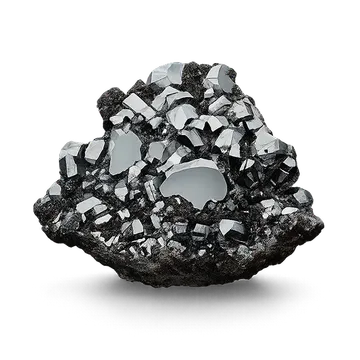
Egremont hematite, a finite Cumbrian classic from Florence Mine, featuring kidney ore and specularite, prized for luster, form variety, and historical value.
Key facts
Egremont hematite is one of the great British classics: heavy, lustrous, red-brown to black Fe2O3 from the West Cumberland iron field, most famously from Florence Mine on the southern edge of the town. The collector’s image of the locality is not a flat ore sample but a sculptural mass of “kidney ore”—rounded, botryoidal to mammillated hematite with a deep metallic sheen, sometimes satin rather than mirror-bright, and commonly showing reddish internal layers where the surface is broken. The best pieces have the presence of cast metal and the warmth of old red ochre at the same time.

Photo: James St. John / Wikimedia Commons
The mineralogical setting is as important as the surface beauty. The Egremont deposits belong to the Cumbrian hematite province, where iron-rich fluids replaced Lower Carboniferous limestones to form large, irregular ore bodies. In and around Florence, Ullcoats, Beckermet, Bigrigg, and related Egremont-area workings, hematite occurs not merely as massive ore but as a suite of display-worthy forms: compact ore, fibrous kidney ore, pencil ore, specularite, and hematite-associated quartz, dolomite, calcite, fluorite, baryte, and aragonite.
Florence Mine gives the locality special historical weight. It was sunk in 1914, became part of the interconnected Florence–Ullcoats–Beckermet system, and survived long after large-scale Cumbrian iron mining had faded. By the end, it was remembered as Europe’s last working deep iron ore mine, with final closure and flooding in the late 2000s. That closing chapter matters to collectors: Egremont hematite is a finite classic, not a locality with continuing underground production of fresh specimens.

Photo: Rob Lavinsky / Wikimedia Commons
Collectors prize several different Egremont looks. Pure kidney ore is judged by form, luster, freshness, and the completeness of the rounded surface. Specularite is judged by the sharpness and sparkle of its black metallic blades. Combination specimens gain special desirability when glassy quartz—clear, smoky, or red hematite-included “eisenkiesel”—is perched on bladed specularite over a kidney-ore base. Pieces retaining matrix, breccia, or limestone replacement textures are less common than loose polished-looking masses, and they carry added locality interest.
Search for specimens: View all hematite specimens from Egremont, Cumbria, England
Egremont lies in the West Cumberland iron field, on the western side of the Lake District, where hematite deposits occur in and around Carboniferous limestone near the margin of the older Lower Palaeozoic rocks. The Egremont locality on specimen labels often means Florence Mine specifically, but serious collectors should understand it as part of a cluster of related mines and deposits: Florence, Ullcoats, Beckermet, Bigrigg, Wyndham, Pallaflat, Croft, and other workings in the Egremont–Bigrigg–Haile area. Florence is the name that dominates the specimen market because it remained productive late, was well documented, and supplied many recognizable kidney ore, specularite, quartz, and fluorite associations.
The deposit type is metasomatic limestone replacement. In the Florence–Ullcoats orebody, hematite replaced Lower Carboniferous limestone within a structurally controlled setting between the Florence and Ullcoats faults. The limestones are concealed locally beneath Permo-Triassic rocks, including Brockram breccia and St Bees Sandstone. The broader West Cumbrian pattern is that large orebodies are commonly associated with faults and permeable red-bed cover, with hematite replacing limestone while locally preserving bedding, stylolites, fossils, and mudstone partings. The great mass of the ore was compact hematite, but open cavities and replacement textures produced the specimen-quality material.
Florence was first sunk in 1914, with production beginning in the early 1920s. A second shaft was sunk in the 1940s, and later underground connections linked Florence with neighbouring Ullcoats and Beckermet workings. Deep production declined and large-scale mining was effectively over by the late 1970s to 1980, but the mine survived on a smaller scale through the Egremont Mining Company and through the unusual economics of water pumping, pigment, and specialist hematite products. The shallow “Lonely Hearts” workings became especially important in the mine’s final era and in geological descriptions made shortly before closure.
The historical production figures are enormous. The combined west and south Cumbrian iron fields produced an estimated hundreds of millions of tons of hematite, and the Florence area contributed significantly to that output. A local geotrail account records more than 100 million tons mined by the time large-scale production ended in the 1970s. The ore’s low phosphorus content and richness made it important to the iron and steel industry, especially when local coal, railways, and west Cumbrian industrial infrastructure were all tied together.
Collecting access today should be treated as closed. The underground workings were flooded after pumping stopped, and the mine site now functions around heritage, arts, and pigment-making rather than active collecting. Florence Arts Centre occupies the former mine site, and the old industrial buildings are part of the locality’s surviving cultural landscape. Specimen collecting underground is no longer a realistic option; any surface access would require explicit permission and should not be assumed. Modern specimens on the market are therefore from old mine production, dealer stock, private collections, or old collections being dispersed.
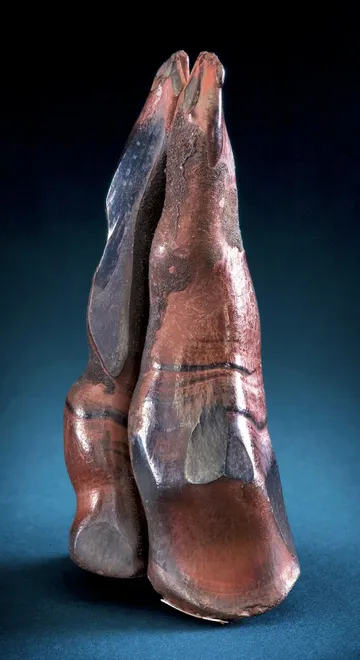
Notable finds include large botryoidal kidney ore masses, “horse tooth” or spike-like hematite forms, sharp specularite plates, quartz on specular hematite over kidney ore, smoky quartz groups, eisenkiesel with red hematite inclusions, pale-blue fluorite on hematite, and dolomite- or calcite-associated vug specimens. The famous “lough holes” of the ore—small cavities in the massive hematite—could be lined with specular hematite and quartz, turning an industrial orebody into one of Britain’s great specimen sources.
The signature form is kidney ore: rounded, botryoidal, mammillated, or reniform hematite built from fibrous to radiating internal growth. Freshly preserved surfaces can be graphite-grey, steel-grey, black, reddish brown, burgundy, or milk-chocolate brown, commonly with a satin-metallic to bright metallic luster. Broken edges reveal the truth of the structure—radial fibers, concentric layers, and red-brown internal hematite that can look almost woody or agate-like in section.
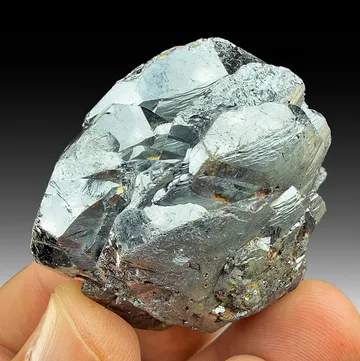
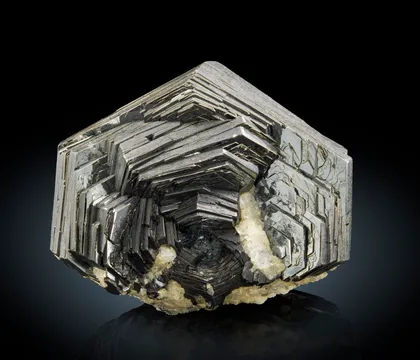
Specularite from Florence and nearby Egremont mines is the other great mode. It occurs as small, sharply bladed, highly lustrous black metallic crystals, often sparkling across the surface of massive or botryoidal hematite. The best pieces show a dense druse of crisp blades rather than a dull micaceous coating. On combination specimens, specularite may form a glittering intermediate layer between the older kidney ore and later quartz.
Quartz associations are classic. Colourless to smoky bipyramidal crystals are typical of the celebrated Florence combinations, and many specimens show the squat “beta-style” habit familiar from English hematite-quartz pieces. These crystals are not true high-temperature beta quartz retained from formation; collectors use the term descriptively for the steep, bipyramidal look. The most distinctive quartz variety is eisenkiesel, a red to orange hematite-included quartz that miners also knew as “tomato quartz.” On the finest examples, small red crystals sit on dark specularite and reddish kidney ore, creating a three-generation effect: botryoidal hematite, black metallic hematite, and hematite-included quartz.
Typical specimen sizes range from thumbnails and miniatures to cabinet pieces. Small lough-hole linings may show quartz or specularite in cavities only a few centimetres across. Kidney ore masses commonly appear as hand-sized pieces, while large cabinet specimens exceeding 10 cm are known and desirable when the surface is complete. Some marketed examples list botryoidal spherules around 2 cm across, while quartz crystals on combination pieces commonly range from millimetres to a few centimetres.
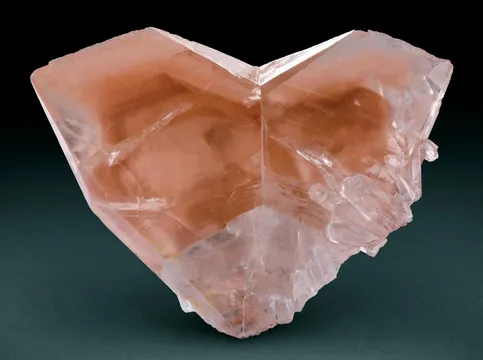
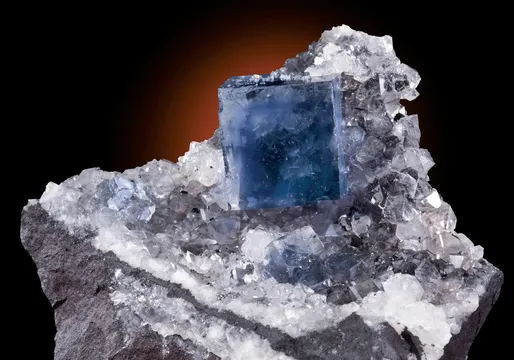
Associated minerals include quartz, smoky quartz, eisenkiesel, fluorite, dolomite, calcite, baryte, aragonite, and minor goethite in collector specimens. Fluorite from the deeper Florence and Ullcoats workings could be pale blue to sky blue, sometimes in small cubes on or near hematite. Dolomite and calcite are frequent vug minerals, and baryte tends to appear as white to pale-pink platy crystals, especially nearer orebody margins. The orebody is overwhelmingly hematite, however; the attractive accessories represent a small mineralogical fraction of a very large iron deposit.
Quality in Egremont hematite is judged by different standards depending on form. For pure kidney ore, the best pieces have a continuous sculptural surface, high natural luster, strong rounded relief, minimal bruising, and visible radial structure on natural breaks without looking crudely polished. For specularite, collectors want bright, sharp, undamaged blades rather than rubbed black surfaces. For quartz combinations, balance matters: clean crystals, contrast against black specularite, and a clearly identifiable kidney-ore or hematite matrix. For historical value, an old British label, a mine-specific attribution, or a date from a known collecting period can materially improve desirability.
The main authenticity issue is locality, not species. Egremont hematite is distinctive, but West Cumberland produced similar kidney ore and specularite from several mines, and older labels may say only “Egremont,” “Cumberland,” “West Cumberland,” “Florence,” or even simply “Cumbria.” Florence is often used loosely in the market for attractive West Cumbrian hematite, so careful collectors should treat precise mine labels as provenance claims, not visual certainties. A piece labelled Florence but lacking old provenance may still be good Egremont-area material, but the claim is strongest when supported by an old collection label, dealer history, or a morphology matched to well-documented Florence production.
There are no well-established, locality-specific fake Egremont hematites in the sense of manufactured Florence specimens, but hematite as a species is widely imitated in jewellery and metaphysical goods by magnetic “hematine,” “hemalyke,” or other man-made ferrite materials. Those products are generally irrelevant to serious natural kidney ore, but the distinction matters for polished objects sold simply as hematite. Natural Egremont hematite is dense and may show little to no magnetic attraction; a strongly magnetic bead or carving is not evidence of classic Florence ore.
Treatments to watch for are mostly surface enhancements. Some kidney ore in the broader market has been polished, waxed, oiled, or rubbed to increase sheen. That is not always deceptive when disclosed—hematite has long been used for jewellery and pigment—but it changes how a specimen should be valued. Natural kidney ore surfaces should show growth texture, subtle relief, and sometimes minor pits or contact areas. Overly uniform gloss, rounded high points with no natural microtexture, or a greasy surface should prompt questions.
Condition issues are common and important. Botryoidal hematite is hard and dense, but protruding lobes bruise, rub, and chip along edges. Many kidney ore pieces have attachment scars, contacted backs, or broken sides exposing radial fibers; these are normal, but damage across the display face lowers value. Specularite blades are more vulnerable than massive kidney ore and can lose brilliance through abrasion. Quartz-on-hematite combinations should be checked for chipped quartz tips, repaired clusters, and loose crystals set into hematite pockets. Red earthy hematite can shed dust, so avoid washing or aggressive cleaning unless you know exactly what surface you are dealing with.
Rarity is tiered. Small massive or botryoidal hematite pieces from old stock remain available. Good undamaged kidney ore with strong sculptural form is less common. Matrix pieces, old-label examples, and fine quartz-specularite-kidney ore combinations are increasingly competitive because the mine is closed and flooded. Specimens that can be tied to historic collecting dates—especially mid-20th-century Florence material, 1970s British Steel-era specimens, or examples from recognized old collections—carry a premium.
Current market availability is steady but finite. Egremont hematite appears regularly through British mineral dealers, classic-mineral specialists, auctions, and old collection dispersals. Prices range widely: modest miniatures can still be accessible, while sharp quartz-on-specularite combinations, large cabinet kidney ore, old provenance pieces, and unusual horse-tooth forms can move into high collector territory. The best advice is to buy for surface quality first, provenance second, and size third; a smaller, crisp, naturally lustrous kidney ore is preferable to a larger bruised mass with a vague label.
The last years of Florence Mine read less like a tidy industrial closure than a slow argument with water. When British Steel closed the mine in 1980, the story might have ended there, as it did for many other British iron workings. Instead, former miners used their redundancy money to buy the property and formed the Egremont Mining Company. The arrangement that kept Florence alive was unusual: British Nuclear Fuels at Sellafield needed water, the mine needed pumping, and for a time the two needs matched. While water was pumped from the workings, the miners could still extract hematite on a small scale for pigment, specialist steel uses, and heritage activity.
That relationship with water defines the final collecting memory of the mine. One collector with permission to go underground later recalled watching the water “swirl up the levels” when the pumps were turned off. The photographs from that final underground visit were taken as the water was actively rising. A last rake of trucks was brought up the decline loaded with specimens. Two tubs and the locomotive did not make it out; they were left at the bottom of the slope and are now described as being under roughly a hundred feet of water. For a locality famous for dense, enduring iron oxide, it is a striking ending: the great orebody still there, the specimen ground still there, but sealed by floodwater.
Florence also has a quieter afterlife in colour. The same hematite that stained miners red became the raw material for a new pigment-making project at the old mine site. In 2012, visual artist Mat Do’s “Egremont Red” residency imagined a new use for the remaining iron-ore stock. The former shower block was turned into a paint-making studio, and four local artists—Jenni Payne, Jill Davis, Liz Redmayne, and Margie Foots—worked to develop saleable artists’ materials from the mine’s pigment. Florence Paintmakers became a cooperative, producing watercolours, pastels, ink, and oil paint from Cumbrian minerals. It is a rare case where a mineral locality did not simply pass from industry into nostalgia: it kept making colour.
Even the miners carried the ore visually. A contemporary account of Florence’s afterlife refers to them as the “Red Men,” a name earned because the fine red dust coated them during work. That detail matters to collectors because it connects the polished cabinet specimen to the working mine. The red streak that identifies hematite in a mineral book was not abstract at Egremont; it was on clothes, tools, buildings, faces, mine water, pigment stock, and eventually artists’ paint.
.jpg)

