Dzhezkazgan mining district, Kazakhstan — premier sandstone-hosted copper locality yielding bornite, chalcocite, native silver, calcite and quartz; prized for…
Key facts
Dzhezkazgan is one of the great names in copper mineral collecting: a giant sandstone-hosted copper district in the Chu-Sarysu Basin of central Kazakhstan, mined on an industrial scale yet remembered in cabinets for individual crystals of bornite, chalcocite, betekhtinite, silver, copper, sphalerite, calcite, and quartz. The district’s best pieces have the unmistakable look of a low-temperature copper system expressed in open space: sharp dark metallic copper sulfides sitting on white to colorless quartz, honey to pale gray calcite, cream barite, or bleached sandstone; wiry and dendritic native metals; and secondary blues and greens from azurite and malachite in oxidized zones.
Geologically, the importance of Dzhezkazgan is not merely that it is large. It is a benchmark sediment-hosted copper deposit where copper sulfides occupy permeable sandstone and conglomerate horizons, filling pore spaces and replacing grains rather than forming the high-temperature vein assemblages familiar from many classic copper mines. The collector sees that setting in the specimens: instead of heavy massive ore alone, the best cabinet pieces show the contrast between pale gangue and late metallic crystallization, often with bornite crystals dark blue, violet, coppery, or black from iridescent tarnish, chalcocite in pseudohexagonal plates, and calcite or quartz providing architectural relief.
Regional View
Country View
Historically, Dzhezkazgan links Bronze Age copper working, nineteenth-century Russian Imperial prospecting, British and French concession activity before the First World War, Soviet-scale exploration and mine construction, and modern Kazakhmys production. For mineral collectors, the most important modern specimen-producing interval was the late twentieth century, especially the 1990s into the early 2000s, when superb crystallized bornite, chalcocite, betekhtinite, native silver, and associated combinations entered the international market. Many of the best specimens are now recycled collection pieces rather than newly mined finds.
Search for specimens: View all specimens from Dzhezkazgan mining district, Kazakhstan
Dzhezkazgan is a sediment-hosted stratiform copper district developed in red-bed successions of central Kazakhstan. The copper ores occur in a thick Pennsylvanian fluvial red-bed sequence, where ore-bearing sandstone and conglomerate members host copper sulfides as intergranular cement and grain replacements. The ore system is classically tied to reduction of originally red oxidized clastic rocks: bleached sandstones and conglomerates mark broad reduced zones, and the ore minerals are concentrated where oxidized metal-bearing brines encountered reducing conditions associated with hydrocarbons and organic residues. This gives Dzhezkazgan its collector signature: pale sandstone, quartz, calcite, and barite serve as hosts or gangue for copper sulfides rather than the massive quartz-sulfide vein textures of many hydrothermal districts.
The district is not a single specimen pocket mine, though old labels often simplify it to “Dzhezkazgan Mine.” Mindat treats it as a mining district and notes that important collector specimens came from several shafts and levels, especially shafts numbered 31, 46, 55, and 57. The productive area is roughly a 10 by 10 km copper district, and the ore bodies occupy multiple horizons through a substantial vertical interval. Published geological descriptions divide the sandstone-hosted ore into ten ore-bearing members, with multiple ore beds within some members; the ore bodies extend over a large district-scale footprint rather than a single narrow vein.
The ore assemblage is copper-rich but not simple. Chalcocite-group minerals, bornite, chalcopyrite, galena, sphalerite, silver minerals, native copper, native silver, barite, quartz, and calcite all belong to the collector record. In the ore horizons, mineral zonation is described from hematite through chalcocite, bornite, chalcopyrite, and pyrite. This zonation matters to specimen interpretation: Dzhezkazgan’s famous chalcocite and bornite did not occur as isolated curiosities but as part of a district-scale chemical front in permeable sedimentary rocks. The same system also yielded unusual rhenium-bearing and copper-silver minerals, plus rare secondary copper nitrates, hydroxides, phosphates, and sulfates in oxidized environments.
Mining history is unusually long. The wider Zhezkazgan-Ulytau region was exploited for copper in antiquity, and ancient workings are a major part of the district’s cultural landscape. In the modern mining era, large-scale work began in 1913, when copper ore from Zhezkazgan was processed by the Sarysu enrichment works of Spasskoe JSC under Leslie Urquhart. The deposit’s modern geological destiny was strongly shaped by Kanysh Satpayev, whose work in the 1920s and 1930s argued for the enormous scale of “Big Dzhezkazgan” and helped justify the Soviet industrial complex that followed. The Dzhezkazgan Mining and Metallurgical Combine was formally approved in 1958; the North Zhezkazgan mine was commissioned in 1960, East Zhezkazgan mine 55 in 1964, South Zhezkazgan in 1965, and East Zhezkazgan mine 57 in 1967. The Zhezkazgan copper smelter produced its first cathode copper in 1971.
Modern production remains industrial and controlled. Kazakhmys describes the Zhezkazgan site as a major complex with mines, concentrators, a copper smelter, and associated infrastructure. Collector access should be considered essentially unavailable without formal permission, and old underground localities should not be treated as casual field-collecting destinations. Most specimens available to collectors today are from older production, dealer inventories, estate dispersals, and recycled collections.
The best documented specimen finds include world-class bornite crystals, crystallized chalcocite and djurleite, lustrous betekhtinite needles, native silver with acanthite, native copper and copper pseudomorphs after cuprite, and attractive combinations with quartz, calcite, and barite. Mine 57 and specific levels such as the 180 meter level appear repeatedly on collector labels, especially for sphalerite on quartz and associated sulfide specimens. A particularly famous class of material consists of sharp iridescent bornite crystals on quartz or calcite, many of which appeared internationally during the 1990s and early 2000s and are now considered classic rather than current production.
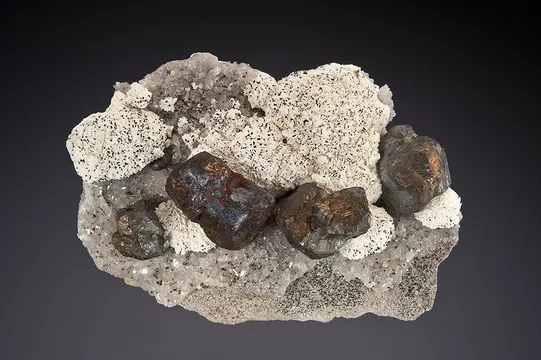
Dzhezkazgan bornite is the district’s trophy mineral: sharp pseudo-isometric crystals, commonly described as cubes, octahedra, dodecahedra, trapezohedra, and complex combinations, range from millimeters to several centimeters and may sit as isolated crystals or intergrown groups on quartz, calcite, barite, or pale matrix. Color is a central part of the appeal, from dark blue and black to coppery, violet, and peacock-iridescent surfaces; the finest examples are bright, well formed, and three-dimensional rather than merely iridescent massive sulfide. Bornite occurs with quartz and calcite especially often, and also with betekhtinite, chalcocite, barite, chalcopyrite, tennantite-subgroup minerals, sphalerite, and locally native copper or malachite. Good Dzhezkazgan bornite is separated from ordinary material by crisp crystal geometry, undamaged edges, strong metallic luster under the tarnish, and a balanced placement on pale gangue; the best pieces read as sculptural crystal specimens, not just colorful ore.
Quartz at Dzhezkazgan is important chiefly as the stage on which the copper sulfides perform. The collector-grade habit is drusy to small prismatic colorless, white, or lightly smoky quartz, commonly forming plates or crusts that host bornite, chalcocite, sphalerite, chalcopyrite, barite, and calcite. Quartz crystals are typically modest in size compared with the sulfides, but they provide strong contrast and a clean reflective matrix for dark metallic crystals; some specimens show quartz as sharp colorless crystals only a few millimeters long, while large display plates can carry substantial sulfide coverage. The best quartz-associated Dzhezkazgan pieces have fresh, undamaged quartz that is not bruised or coated by unattractive oxide films, with metallic crystals isolated enough to stand out against the pale surface.
Native copper from the Dzhezkazgan district is best known in dendritic, arborescent, wiry, and crystalline aggregates, with collector pieces commonly coming from the Dzhezkazgan-Zhilandy-Itauz sphere of copper deposits. Associations include cuprite, malachite, quartz, and bornite, and some material shows copper after earlier cuprite, forming meshy or skeletal coppery octahedral pseudomorphs. The color ranges from fresh copper-red to darker brown or patinated surfaces; many pieces are thumbnails to small cabinets, though visually strong branching forms can display larger than their dimensions. The most desirable examples preserve sharp dendritic branching or clearly pseudomorphic geometry, preferably with contrasting green malachite or red cuprite accents, while ordinary pieces are dense, flattened, or heavily oxidized copper masses with little form.
Dzhezkazgan calcite occurs as translucent to nearly transparent rhombohedral, scalenohedral, dogtooth, and etched crystals, most valued when it contrasts with bornite, chalcocite, sphalerite, quartz, or barite. Documented collector pieces include calcite crystals several centimeters across, including twinned rhombohedra and smoky golden dogtooth habits, with bornite groups to about a centimeter or chalcocite crystals protruding from or below pale calcite. Calcite is not rare in the district, but fine display specimens depend on composition: clean lustrous carbonate with metallic sulfides placed visibly on the surface is far more desirable than massive calcite with buried ore. Because calcite is softer than quartz and cleaves readily, edge bruising, broken tips, and contact marks are common condition points on older Dzhezkazgan pieces.
Native silver from Dzhezkazgan is a classic accessory to the copper-sulfide suite, most familiar as wires, curls, small nests, and hackly aggregates, commonly darkened by acanthite coating but occasionally showing brighter silver where protected or cleaned. Mindat records silver habits as wires to several centimeters, and collector references include both small thumbnails and larger wire specimens, including a noted 13 cm wire example in the Mineralogical Record index. Silver commonly occurs with acanthite and may also appear with chalcocite or copper minerals, fitting the district’s silver-rich copper ore chemistry. Fine pieces are judged by three-dimensional wire form, lack of crushing, and natural-looking dark patina; compact black acanthite-rich lumps with only a few indistinct silver threads are far less desirable.
Dzhezkazgan chalcocite is prized for dark metallic pseudohexagonal plates, short prismatic crystals, cyclic twins, and compact rosette-like groups, often perched on calcite, quartz, or pale matrix and sometimes associated with bornite, chalcopyrite, sphalerite, barite, silver, djurleite, and betekhtinite or its pseudomorphs. Collector specimens commonly show crystals from a few millimeters to about 1.5 cm, with larger sharp groups being much scarcer; some labels and descriptions note that visually similar djurleite may complicate identification among the black copper sulfides. The best examples show clear six-sided outlines, bright metallic to subtly iridescent surfaces, and enough separation from matrix to make the form legible. Dull massive black ore, even if rich, does not compete with the elegant calcite- or quartz-hosted plate specimens for display quality.
Sphalerite from Dzhezkazgan is a quieter but highly collectible member of the assemblage, valued for honey-yellow to amber-brown translucent crystals on quartz, calcite, or sulfide matrix. Documented specimens from Mine 57, including the 180 meter level, show lustrous colorless quartz crystals hosting doubly terminated amber sphalerite crystals up to about 3 cm across; other recorded pieces include sphalerite with chalcopyrite, calcite, and quartz in small-cabinet formats. The low-iron golden to amber color distinguishes the most attractive Dzhezkazgan sphalerites from ordinary dark brown sphalerite, and clean transparency at the edges is a major plus. Good pieces have a single dominant crystal or well-spaced group with bright luster and minimal edge scuffing, while less desirable specimens are granular, dark, or visually lost among massive sulfides.
Dzhezkazgan is one of the definitive collector localities for betekhtinite, with lustrous gray, lead-bearing copper-iron sulfide needles and thick acicular sprays that may reach a few centimeters, although many are unterminated or partially altered. Mindat specifically distinguishes bright lustrous gray needles of betekhtinite from dull gray to black pseudomorphs after betekhtinite, usually chalcocite or bornite, a distinction that matters greatly for advanced labels. The best specimens came from modern finds that elevated the species from a mineralogical curiosity to a display species, including material widely associated with a famous 1998 discovery. Fine examples show bright metallic needles standing free or in radiating aggregates, ideally with sharp relief on matrix; ordinary pieces are blackened, massive, or replacement material lacking fresh betekhtinite surfaces.
Chalcopyrite at Dzhezkazgan is part of the district’s copper-sulfide zonation and occurs with bornite, chalcocite, sphalerite, calcite, quartz, pyrite, galena, and barite. Specimen-grade chalcopyrite is less famous here than bornite or chalcocite, but it appears as brassy yellow crystals and crystalline aggregates, sometimes adding color contrast to quartz-sphalerite-calcite combinations or to bornite-rich pieces. Its significance is often associative rather than standalone: the best Dzhezkazgan chalcopyrite pieces are balanced combinations where bright brassy crystals sharpen the color palette beside dark bornite, black chalcocite, honey sphalerite, or pale gangue. Massive brassy patches in ore are commoner and much less desirable than sharp, well-isolated crystals with minimal tarnish or bruising.
Azurite from Dzhezkazgan represents the oxidized copper story above and around the primary sulfide ores, occurring as deep blue crystals, rounded aggregates, and azurite-malachite combinations from the mine and district. Collector pieces documented from the locality are commonly thumbnail to miniature size, with individual azurite crystals reported around sub-centimeter scale and specimens in the roughly 3–6 cm range; some attractive pieces show blue azurite partly replaced or accompanied by green malachite. Dzhezkazgan azurite is not as universally elite as its bornite, but good pieces are richly colored, three-dimensional, and not merely blue crusts. The most desirable examples preserve sharp crystal faces or ball-like aggregates with vivid color and minimal abrasion, especially where malachite provides contrast without completely obscuring the azurite.
Acanthite from Dzhezkazgan is most collectible in association with native silver, where it forms black coatings, masses, and silver-sulfide-rich portions of wiry silver specimens. The district’s silver commonly appears blackened, and that dark surface is often acanthite rather than simple dirt or oxidation, giving silver specimens their characteristic high-contrast look. Acanthite crystals as display specimens are less prominent than the silver-acanthite combinations, but the species is important because it records the silver-rich side of the copper system and may be intimately intergrown with native silver wires or curls. Good pieces show obvious silver-acanthite association and natural texture; featureless black lumps require caution unless the label, provenance, or analysis supports the identification.
Cuprite at Dzhezkazgan occurs in the oxidized copper assemblage, with octahedral crystals recorded to about 2 cm and with native copper, malachite, and quartz among its common collector associations. The most memorable material includes pseudomorphs and replacement textures in which copper or malachite preserves cuprite-derived geometry, creating skeletal, meshy, or octahedral forms that appeal strongly to pseudomorph collectors. Fine cuprite should show deep red internal color or sharp octahedral form, ideally with native copper or green malachite contrast. Ordinary material may be small, dark, and embedded, but well-formed crystals or clear pseudomorphic relationships make Dzhezkazgan cuprite much more interesting than its specimen count suggests.
Malachite from Dzhezkazgan occurs as green coatings, fibrous surfaces, pseudomorphs after azurite, and rarer replacements after native copper, often with azurite, cuprite, copper, or quartz. The district has produced attractive malachite-after-azurite specimens, though they are not generally ranked with the greatest Bisbee or Tsumeb pseudomorphs; their value lies in sharp retained azurite form, satin luster, and the association with Dzhezkazgan’s broader copper suite. Some especially interesting specimens show arborescent copper largely replaced by minty green malachite with spots of red cuprite. Good pieces are crisp and sculptural, with fibrous or velvety surfaces intact; weak specimens are powdery crusts or green stains on ore.
Tennantite-subgroup minerals are documented from Dzhezkazgan as part of the copper-arsenic-sulfide assemblage and occur in association with bornite, quartz, calcite, sphalerite, and other sulfides. Collector references include small tennantite crystals on matrix, with a Mineralogical Record index noting a 1.2 cm crystal from Dzhezkazgan, indicating that the species can be more than microscopic ore petrography here. Because tetrahedrite-tennantite group species can be visually difficult to separate without analysis, serious labels should be treated carefully unless the specimen has old authoritative provenance or analytical backing. The best pieces show distinct dark metallic tetrahedral crystals rather than anonymous black sulfide patches, especially when placed against quartz or carbonate matrix.
Barite from Dzhezkazgan is a gangue and combination mineral, appearing as cream to pale radiating groups or bladed aggregates with bornite, chalcocite, quartz, calcite, and other sulfides. Its collector role is often compositional: cream barite gives relief and color contrast to iridescent bornite or dark chalcocite, and good association pieces can be more attractive than barite-only specimens from the district. Documented bornite-barite pieces show isolated bornite crystal groups set against radiating barite on matrix, a classic Dzhezkazgan aesthetic. Fine examples have fresh lustrous barite sprays and well-positioned sulfides; damaged blades, dull coatings, or massive barite with little sulfide interest are much less desirable.
Other documented Dzhezkazgan minerals include galena, pyrite, covellite, djurleite, roxbyite, stromeyerite, freieslebenite, bournonite, galena, atacamite, botallackite, nantokite, iodargyrite, brochantite, beaverite-(Cu), spangolite, libethenite, pseudomalachite, chrysocolla, gerhardtite, likasite, spertiniite, dokuchaevite, and the problematic rhenium-bearing species dzhezkazganite. Dzhezkazganite is historically important because it was reported from the deposit as a Re-Mo-Cu-Pb sulfide and tied to rhenium in the ores, but its formula and species status have been treated cautiously. The oxidized chalcocite ores are also notable for first Soviet reports of gerhardtite, likasite, and spertiniite, and the rare blue and green copper hydroxide/nitrate assemblage is a specialized sub-field within Dzhezkazgan collecting.
Dzhezkazgan material is common enough on the market that collectors should focus on quality, not merely locality. Bornite and chalcocite pieces from old dealer stocks and estate collections appear regularly, but the finest crystals—sharp, undamaged, lustrous, and well placed on quartz or calcite—are far scarcer than the locality name suggests. Betekhtinite is a serious rarity in fresh metallic crystals; many dull black needle-like pieces are pseudomorphs after betekhtinite rather than fresh betekhtinite, and the distinction should be reflected in labeling and price.
Mislabelling is the most important locality-specific issue. Old labels often say “Dzhezkazgan Mine,” but the specimen may have come from the broader district, a numbered shaft, East Dzhezkazgan, Mine 57, Mine 55, or the Zhilandy-Itauz area. Some of that simplification is harmless in older cabinet context, but it matters for advanced locality collecting. Chalcocite versus djurleite is another recurring problem: the black pseudohexagonal copper sulfides can look similar, and some specimens sold as chalcocite may deserve analytical confirmation if the exact species is important. Tennantite-subgroup labels should also be read conservatively unless supported by analysis.
The district’s sulfide specimens are condition-sensitive. Bornite and chalcocite crystals nick easily along exposed edges, and iridescent surfaces may be rubbed, dulled, or artificially over-brightened by cleaning. Calcite cleaves and bruises, quartz points chip, and barite blades break. Silver wires are easily bent or crushed, while acanthite-coated silver can shed or look deceptively sooty; an old natural black patina is often part of the specimen’s character and should not automatically be removed.
There are no widely established, locality-specific Dzhezkazgan fake traditions comparable to some modern fabricated wire-silver localities, but caution is still warranted. Any exceptionally rich wire silver should be examined for natural attachment, matrix consistency, and provenance, because silver wires in general are vulnerable to manipulation or artificial growth claims in the broader mineral market. Strongly rainbow-colored “peacock ore” should also be approached with care: Dzhezkazgan bornite naturally tarnishes in attractive blues, purples, and bronzes, but acid-treated chalcopyrite and artificially enhanced copper sulfides exist in the general trade. For Dzhezkazgan bornite, the collector wants sharp crystal form and a believable old surface, not merely loud color.
Fluorescence is not a major collecting feature of the district’s principal species. Native copper and silver should be handled with clean, dry hands or cotton gloves to slow tarnish and avoid skin oils. Sulfides are best kept dry and away from aggressive cleaning agents; acid cleaning can damage calcite and alter sulfide surfaces. For long-term display, avoid high humidity and repeated handling, especially on specimens containing acanthite, copper, and delicate secondary copper minerals.
Long before Dzhezkazgan was a Soviet industrial symbol or a name on bornite labels, it was a copper landscape. The ancient mines west of modern Zhezkazgan were not token scratchings; estimates attributed to Kanysh Satpayev speak of roughly a million tonnes of copper ore taken in antiquity, with tens of thousands of tonnes of copper produced. Archaeological accounts describe settlements and metallurgical sites such as Milykuduk, Sorkuduk, Ainakol, Akshi, Pokro, and Kresto, places where ore, hearth, slag, and habitation belonged to the same copper economy. For a mineral collector holding azurite, malachite, or copper from the district, that deep history gives the specimen an unusual resonance: the same oxidized copper colors that brighten a cabinet today were exactly the signs ancient miners followed into the steppe.
The modern story turns on the stubborn confidence of Kanysh Satpayev. In the late 1920s and early 1930s he argued that the Zhezkazgan copper deposit was vastly larger than official expectations and too large for the existing Karsakpai works to handle. By the end of 1931, his geological team had demonstrated copper reserves many times greater than earlier Geological Committee predictions. In 1934, Satpayev warned that the Karsakpai smelter would be insufficient for the scale of Big Zhezkazgan; the industrial answer eventually became not just new mines but a whole mining-metallurgical complex and the growth of Zhezkazgan and Satpayev as mining cities. His story is central to the locality because the later specimen-producing shafts were born from that decision to treat the deposit as a giant, not an outlying copper occurrence.
The district also carries the peculiar international flavor of early twentieth-century Central Asian mining. Large-scale work began in 1913 under Spasskoe JSC, headed by the Englishman Leslie Urquhart, with ore processed at the Sarysu enrichment factory. Those pre-revolutionary ambitions were interrupted by war, revolution, and nationalization, but they mark the first industrial chapter of the deposit. Later Soviet development transformed the district: the Dzhezkazgan Mining and Metallurgical Combine was approved in 1958, North Zhezkazgan was commissioned in 1960, East Zhezkazgan mine 55 in 1964, South Zhezkazgan in 1965, East Zhezkazgan mine 57 in 1967, and the smelter produced its first cathode copper on February 23, 1971. To a specimen collector, those numbers are more than industrial chronology; they explain why so many fine labels carry shaft and mine numbers rather than romantic mine names.
A later collecting story belongs to the mineral itself: bornite, a common ore mineral worldwide but rarely a great crystal species, suddenly had a modern benchmark. In the 1990s to early 2000s, Dzhezkazgan produced large, sharp, lustrous bornite crystals on quartz and calcite, the kind of material that changed how collectors thought about the species. Fine examples appeared with blue metallic iridescence, copper-violet tarnish, and pseudo-isometric forms several centimeters across; some larger plates became important collection pieces. One well-documented specimen, a 26.7 cm bornite on quartz found in 1996 and later in the Edward E. David collection, shows the scale that made Dzhezkazgan more than a thumbnail locality. The best of these pieces now tend to surface from old collections rather than new mining, and they have become classic modern sulfides.
Betekhtinite has its own quieter drama. Before Dzhezkazgan, many collectors knew the species mostly as an obscure name in sulfide references. The district’s rich metallic needle specimens, especially the now-famous late-1990s material, made it a cabinet mineral. Yet the locality also created one of the most important label cautions in modern sulfide collecting: bright lustrous gray needles are betekhtinite, while dull gray to black needles from the same district may be pseudomorphs after betekhtinite, commonly chalcocite or bornite. In other words, Dzhezkazgan gave collectors both the best of the species and the trap that makes the best examples worth understanding.