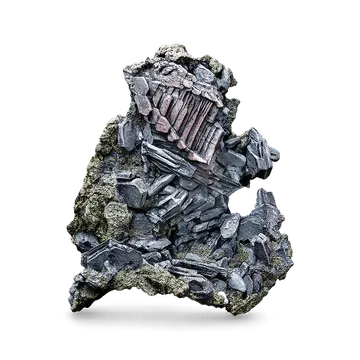
Chalcocite from Dzhezkazgan, Kazakhstan — steel-gray to black crystals with metallic luster and geometric form; highly valued by collectors for rarity and disp…
Key facts
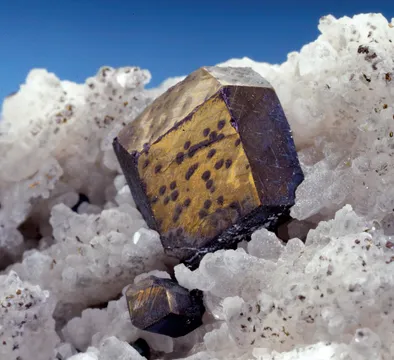
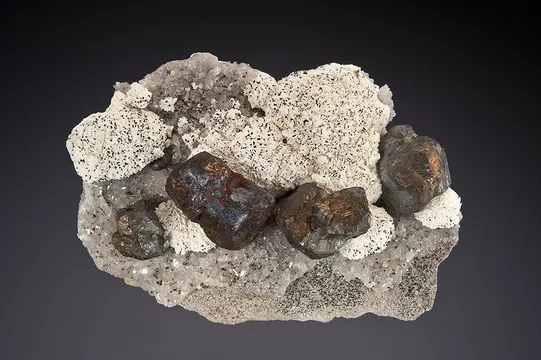
Dzhezkazgan chalcocite is one of the great surprises of the post-Soviet specimen market: a copper-ore mineral from a giant industrial sandstone-copper district that nevertheless produced sharp, display-worthy crystals with a personality all their own. The best pieces show dark steel-gray to black metallic luster, subtle bronze or bluish iridescence, and highly geometric pseudohexagonal tabular crystals or short prismatic forms perched on pale calcite, quartz, or altered sandstone matrix. The contrast can be excellent: black-bronze chalcocite crystals standing on white calcite or sparkling drusy quartz, with occasional chalcopyrite, bornite, or oxidized copper minerals adding small flashes of color.

Photo: Wikimedia Commons
Mineralogically, the appeal lies in the way a huge sediment-hosted copper system translated its ore zoning into collectible crystals. Dzhezkazgan is a sandstone-hosted copper deposit in the Chu-Sarysu Basin of central Kazakhstan. Copper sulfides occur in sandstone and conglomerate horizons, where ore brines moved through permeable beds and precipitated copper minerals as cement and grain replacements. Chalcocite is not a minor afterthought here: it is a defining ore mineral in the high-grade part of the system, and the chalcocite-bornite zones are central to the deposit’s economic importance.
Collectors usually know Dzhezkazgan first for bornite, betekhtinite, native copper, native silver, and a suite of unusual copper-sulfide and copper-secondary minerals. Chalcocite from the district sits in that same family of attractive sulfide classics. The best specimens are not merely chunks of ore; they are sculptural miniatures with cleanly separated crystals, good metallic skin, and strong geometry. Pieces from the 1990s are especially valued, and several market records describe the material as classic, now seldom encountered in fresh supply, and rarely available in top quality.
Search for specimens: View all chalcocite specimens from Dzhezkazgan mining district, Kazakhstan
The Dzhezkazgan mining district lies in central Kazakhstan around the city of Zhezkazgan, a locality whose specimen labels may also read Dzhezkazgan, Jezkazgan, Zhezqazghan, Karaganda Region, Dzhezkazgan Oblast, or modern Ulytau Region. The name problem is more than transliteration: administrative boundaries have changed, and many classic specimens entered collections under older Soviet or post-Soviet regional names. For collector purposes, “Dzhezkazgan mining district” is best understood as a mining district rather than a single pocket or a single mine.
Geologically, the deposit belongs to the sandstone subtype of sediment-hosted stratabound copper deposits. The ore-bearing section consists of Pennsylvanian fluvial red-bed sandstone and conglomerate horizons within the Chu-Sarysu Basin. USGS work describes ten ore-bearing sandstone members in the Dzhezkazgan deposit, numbered from lowest to highest, within a roughly 600 m Pennsylvanian stratigraphic section. Two to four ore-bearing sandstone beds occur within each member, and the ore bodies extend across a large area and a significant vertical range in the dipping sedimentary pile.
The most important collector point is that these are not vein pockets in the alpine sense. The copper sulfides grew in permeable sedimentary beds, as intergranular cement, grain replacement, and locally more open crystalline aggregates. Ore zoning at Dzhezkazgan progresses through hematite, chalcocite, bornite, chalcopyrite, and pyrite zones. That zoning reflects the progressive reduction of oxidized copper-bearing brines as they interacted with reducing environments associated with hydrocarbons in the sandstone system. In plain collecting terms, a fine chalcocite specimen from Dzhezkazgan is a crystallized expression of the same chalcocite-rich ore front that made the deposit economically important.
Mining history is long and layered. Mindat notes that one of the mines in the district is a Late Bronze Age copper mine, a reminder that copper in this region was known long before industrial development. Modern mining began in the early 20th century, with first mining works at Zhezkazgan in 1913. The major Soviet industrial phase followed the geological work of Kanysh Satpayev and others in the 1920s and 1930s. In 1938, Soviet authorities ordered design and construction of a new Zhezkazgan combine with mines, enrichment factories, a new city, and a copper smelter. The factory and first five mines and quarries began operating in 1943, final construction was completed in 1958, and the Dzhezkazgan Mining and Metallurgical Combine was formally approved in 1958.
Several shaft numbers matter to specimen collectors. Mindat records that the district produced specimens from various levels of shafts 31, 46, 55, and 57. Shaft or mine numbers on old labels should therefore be preserved; they can add real locality precision in a district where “Dzhezkazgan” is often used broadly. East Zhezkazgan mine 57 was commissioned in 1967, and the Zhezkazgan copper smelter produced its first cathode copper on February 23, 1971. Later production and expansion included the Itauz quarry and the Zhylandy group in the late 1990s, as well as the Zhaman-Aibat/Zhomart development in the 2000s.
Collecting access should be treated as industrial and restricted. This is an active mining and metallurgical district, not an open collecting area. Any modern field collecting would require permission from the land and mineral-rights holders and strict compliance with mine safety rules. Most collector specimens in circulation are legacy pieces recovered through mine production channels, dealer networks, and collections that formed during the 1990s and early 2000s.
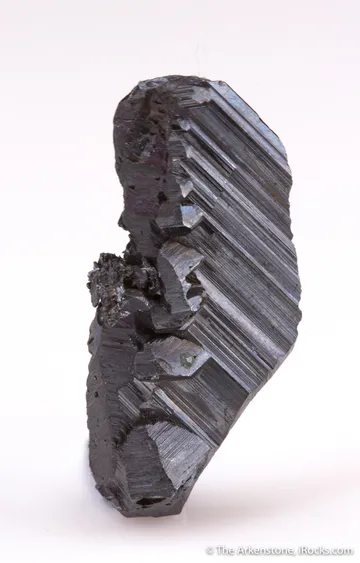
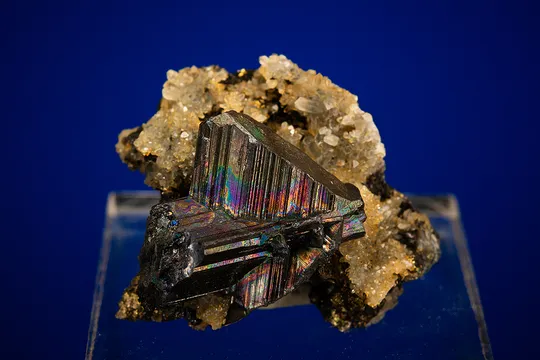
Dzhezkazgan chalcocite is typically dark gray, black, or bronze-gray, with a metallic luster that can range from bright and reflective to slightly satin-like where surfaces are naturally dulled or lightly tarnished. Fine specimens may show blue, purple, or bronze iridescence, sometimes only as a thin surface sheen rather than the heavy rainbow color more familiar from some bornite specimens.
The most recognizable habit is pseudohexagonal tabular chalcocite: six-sided plates or flattened crystals that sit like dark shields on matrix. Mindat describes the locality’s chalcocite as terminated orthorhombic prisms and pseudohexagonal tabular trillings to a few centimeters, and market records repeatedly emphasize pseudohexagonal crystals from sub-centimeter size up to about 1.0–1.5 cm on collectible specimens. A specimen with crystals to 0.7 cm on calcite, a small-cabinet piece with pseudohexagonal crystals to 1.3 cm, and a high-end rosette-like group with individual crystals to about 1.5 cm all fall within the documented collector range.
The best pieces are miniatures and small cabinets with crystals that are distinct rather than fused into massive ore. Matrix specimens are especially attractive when the chalcocite is perched on white calcite or quartz, giving enough contrast for the black metallic forms to read clearly. Drusy quartz matrix with calcite and chalcopyrite is a classic look; calcite matrix with six-sided chalcocite plates is another. Matrix-free clusters exist and can be exceptionally sharp, but they need strong form and clean faces to compete with the more architectural matrix pieces.
Associated minerals are part of the district’s identity. Chalcocite occurs with bornite, chalcopyrite, calcite, quartz, galena, sphalerite, djurleite, barite, betekhtinite or pseudomorphs after betekhtinite, native copper, native silver, and a variety of secondary copper minerals. A particularly important caution is the relationship between chalcocite and djurleite: Mindat notes a rumor that some of the hexagonal plates may be djurleite. For the serious collector, that means the best labels should be read with mineralogical humility. A “chalcocite” plate from Dzhezkazgan may be entirely plausible, but visually similar copper sulfides in this system can deserve analytical confirmation if the species distinction matters.
Quality is judged first by crystal definition. A good Dzhezkazgan chalcocite should show recognizable crystal outlines, preferably sharp pseudohexagonal or short prismatic forms, not merely black copper-sulfide masses. Luster is next: bright metallic faces, subtle iridescence, and limited surface dulling greatly improve the piece. Placement matters as well. The most desirable matrix specimens have isolated or rhythmically arranged crystals across a pale surface, rather than crowded aggregates in dark ore. Damage is important because chalcocite is relatively soft and brittle; small nicks on edges, bruised terminations, or rubbed metallic faces are common enough that undamaged crystals carry a premium.
Dzhezkazgan chalcocite is not common in fine crystallized specimens, despite the immense scale of the ore deposit. The district is a major copper producer, but specimen-grade chalcocite came out episodically, with many attractive examples circulating from 1990s production and collection material. Current availability is uneven: modest pieces appear from time to time, while sharp, aesthetic, damage-free examples are far less frequent.
Prices vary sharply by quality. Recent public market records show ordinary but attractive small-cabinet material selling modestly, while an especially sharp, matrix-free toenail with rosette-like groups and individual crystals to about 1.5 cm reached a much higher auction result. That spread is typical for the species: chalcocite is not rare as ore, but fine crystals with locality character can behave like a specialty classic.
Authenticity concerns fall into three practical categories. The first is locality precision. Older labels may say Dzhezkazgan Mine, Zhezkazgan Mine, Dzhezkazgan mining district, Karaganda Region, Dzhezkazgan Oblast, or simply Kazakhstan. None of these is automatically wrong, but the broader the label, the less specimen-specific it is. Shaft numbers, old collection labels, and association with known 1990s Dzhezkazgan material are valuable.
The second concern is species identification. Chalcocite, djurleite, bornite, and other dark copper sulfides can be difficult to distinguish by eye, especially when crystals are tarnished, altered, or pseudomorphous. Dzhezkazgan is specifically known for copper-sulfide complexity, including chalcocite and djurleite, and for dull gray to black pseudomorphs after betekhtinite that may be chalcocite or bornite. If a specimen is being bought as a high-value species example rather than simply as a Dzhezkazgan copper-sulfide specimen, analytical confirmation is worth considering.
The third concern is surface condition. Chalcocite’s metallic faces can dull with handling, abrasion, or exposure, and edges bruise more easily than they appear to. Avoid oily surfaces, suspiciously uniform artificial shine, or heavy coatings that obscure crystal faces. I found no locality-specific tradition of fabricated Dzhezkazgan chalcocite fakes comparable to the well-known faked markets for some colorful secondary copper minerals; the main risk is misidentification, overbroad locality labeling, and condition not matching the price.
The story behind Dzhezkazgan’s chalcocite is not a single pocket discovery; it is the story of a copper district so large that its scientific recognition changed the industrial map of central Kazakhstan.
In 1927, the young Kanysh Satpayev arrived at the Karsakpai copper mine as an engineer-geologist. Kazakhstan now remembers that appointment as a milestone: Satpayev was the first professional mining engineer among the Kazakh people. The conditions were not romantic. Official commemorative accounts describe a place with no local professional staff, inadequate financing, and scientific equipment left behind by English concessionaires. The people managing the plant were skeptical. They thought the copper reserves would last perhaps 10 to 15 years.
Satpayev saw something different. Within three years, his team had argued that what looked like several separated copper deposits belonged to one large system: Big Zhezkazgan. The contrast in estimates is still startling. Earlier English specialists had estimated about 60,000 tons of copper; Satpayev’s work supported reserves of at least two million tons. By 1937, the copper reserves he explored were large enough to justify calling Zhezkazgan the largest copper deposit in the world in contemporary Soviet planning accounts, and to support construction of the Zhezkazgan Mining and Metallurgical Combine.
The district then moved from geological argument to heavy industry. In 1938, Soviet authorities ordered immediate design of a new plant: mines, enrichment factories, a new city, and a copper smelter. The first five mines and quarries began work in 1943, during the Second World War, and final construction was completed in 1958. What collectors now admire as sharp black chalcocite crystals came from the same ore system that justified railways, reservoirs, smelters, and an entire mining city.
There is an older shadow behind the modern mine as well. Mindat records that one mine in the district is a Late Bronze Age copper mine. That detail is easy to pass over, but it is one of the most evocative facts about the locality: Dzhezkazgan was a copper place long before chalcocite crystals entered Western cabinets with 1990s dealer labels. The district’s black copper sulfides belong to a landscape where ancient miners, Soviet geologists, modern industrial shafts, and specimen collectors all touched the same metal system at very different scales.
Box, S.E., Seltmann, R., Zientek, M.L., Syusyura, B., Creaser, R.A., and Dolgopolova, A. (2012), “Dzhezkazgan and associated sandstone copper deposits of the Chu-Sarysu basin, Central Kazakhstan.” A key USGS-indexed publication on the deposit model, ore zoning, Re-Os age constraints, copper endowment, and the role of brines and hydrocarbon reductants.
Box, S.E., Syusyura, B., Hayes, T.S., Taylor, C.D., Zientek, M.L., Hitzman, M.W., Seltmann, R., Chechetkin, V., Dolgopolova, A., Cossette, P.M., and Wallis, J.C. (2012), Sandstone copper assessment of the Chu-Sarysu Basin, Central Kazakhstan, U.S. Geological Survey Scientific Investigations Report 2010-5090-E. The most useful broad technical report for understanding Dzhezkazgan within the Chu-Sarysu Basin and the regional sandstone-copper assessment.
Mindat locality page: Dzhezkazgan mining district, Kazakhstan. The principal specimen-mineral reference for the district, including mineral list, historical locality names, shaft notes, and collector-relevant habit descriptions for chalcocite, bornite, betekhtinite, and associated species.
Mindat occurrence record: chalcocite from Dzhezkazgan mining district. A focused occurrence entry for chalcocite from the district with specimen-photo indexing.
Wikimedia Commons: “Chalcocite-220581.jpg,” Rob Lavinsky, iRocks.com. A freely licensed image record of a 5.6 x 5.1 x 2.5 cm Dzhezkazgan chalcocite specimen with sharp, lightly iridescent crystals.
Wikimedia Commons: “Chalcocite-220582.jpg,” Rob Lavinsky, iRocks.com. A close-up view of the same specimen, useful for studying the unusual crystal habit and metallic surfaces.
MineralAuctions: “Chalcocite (fine crystals), Dzhezkazgan Mining District, Kazakhstan.” A 2025 market record for a 7.3 x 5.0 x 3.1 cm small-cabinet specimen with pseudohexagonal crystals to 1.3 cm.
MineralAuctions: “Chalcocite (unusual habit), Dzhezkazgan, Kazakhstan.” A 2009 market record documenting a 5.6 x 5.1 x 2.5 cm specimen with two 1.0 cm crystals and an unusual habit.
MineralAuctions: “Chalcocite (excellent quality), Dzhezkazgan Mining District, Kazakhstan.” A 2025 high-end auction record for sharp rosette-like chalcocite groups, individual crystals to about 1.5 cm, and a documented collection provenance.
USGS Publications Warehouse: Sandstone copper assessment of the Chu-Sarysu Basin, Central Kazakhstan — The best technical starting point for the regional geology, deposit model, and resource context.
USGS: Dzhezkazgan and associated sandstone copper deposits of the Chu-Sarysu basin — Concise summary of ore zoning, copper endowment, Re-Os age data, and brine-hydrocarbon genetic interpretation.
Mindat: Dzhezkazgan mining district, Kazakhstan — Essential mineral list and specimen-locality reference, including notes on chalcocite habit and associated minerals.
Mindat: chalcocite from Dzhezkazgan mining district — Focused chalcocite occurrence and photo index for the district.
Kazakhmys history page — Useful chronology of modern mining and metallurgical development at Zhezkazgan and related Kazakhmys operations.
Government of Kazakhstan: Kanysh Satpayev 125th anniversary article — Accessible historical account of Satpayev’s role in proving the scale of the Zhezkazgan copper field.
Government of Kazakhstan: Satbayev and the development of Kazakhstan as a scientific society — Additional detail on Satpayev’s early work at Karsakpai/Zhezkazgan and the scientific recognition of Big Dzhezkazgan.
Wikimedia Commons: Chalcocite-220581 — Freely licensed specimen photograph showing classic Dzhezkazgan crystal style on matrix.