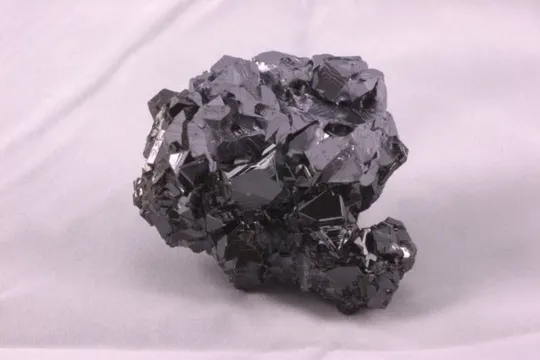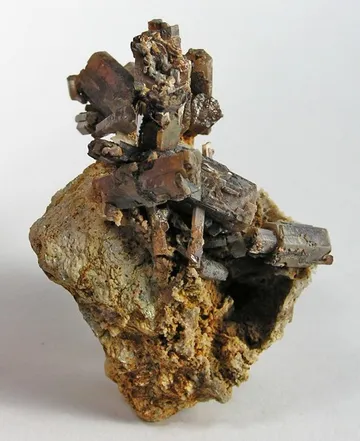
Droujba mine, Bulgaria — a renowned Laki district locality famed for architectural calcite and quartz with rhombohedrons and pseudomorphs, prized by collectors.
Key facts
Droujba mine is one of the distinctive specimen localities of the Laki ore district in the northern Central Rhodope Mountains of southern Bulgaria. Collectors know it by several spellings—Droujba, Drujba, and the Bulgarian “Дружба”—and by its placement within the Djurkovo Complex near Laki, in Plovdiv Province. In geological terms it belongs to the Central Rhodopean Pb-Zn-Ag hydrothermal province: a belt of vein, replacement, and skarn-related ore systems formed during the Eocene–Oligocene tectono-magmatic evolution of the Rhodope metamorphic core complex. The specimen appeal is not the massive galena-sphalerite ore itself, but the late open-space mineralization: lustrous calcite, quartz, dolomite, and pseudomorphs developed in cavities and fractures after the main sulphide stages.
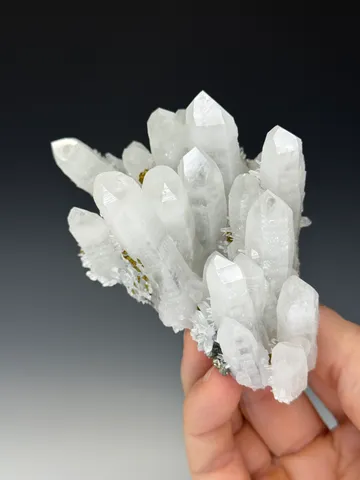
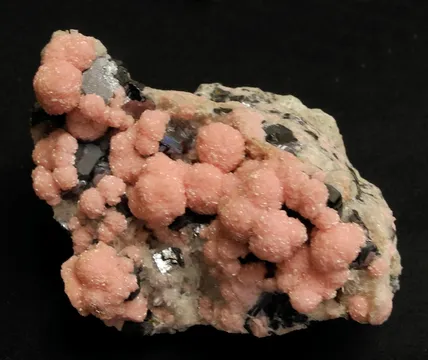
The mine’s best cabinet specimens have a recognizable look. Droujba calcites are commonly pale cream, colorless, salmon, or delicate manganese-pink, often as rhombohedrons, scalenohedrons, sceptered crystals, and complex parallel-growth aggregates on sparkling quartz. Many of the most prized pieces are not simple single-species crystals but mineralogical events frozen in sequence: calcite over quartz, quartz casts after calcite, dolomite coating or replacing calcite, and occasional combinations with galena, pyrite, chalcopyrite, and other sulphides. Good Droujba pieces are typically architectural rather than merely pretty—one sees hollow forms, epimorphs, lenticular rhombs on quartz needles, and sugary tan dolomite preserving the shapes of earlier calcite.
Regional View
Country View
The broader Djurkovo-Laki mineral system is structurally controlled by steep NNE-trending ore-bearing faults, with mineralization occupying veins in gneisses and replacement bodies in marble layers. That geological architecture explains the mixed character of Droujba specimens: quartz-sulphide veins provided cavities and frameworks, carbonate-rich host rocks fed calcite and dolomite, and later fluid pulses overprinted earlier crystals. The collector result is a locality suite that sits comfortably beside better-known Bulgarian Rhodope material from Madan, but with its own particular strength in calcite-quartz-dolomite replacement specimens.

Photo: Wikimedia Commons

Photo: Wikimedia Commons
Search for specimens: View all specimens from Droujba mine, Bulgaria
Droujba mine is a Pb-Zn-Ag underground mine locality in the Laki Municipality of Plovdiv Province, southern Bulgaria, in the Rhodope Mountains near the town of Laki and close to the village area of Zdravets and Djurkovo. Administrative and mining sources connect the Droujba name with the Govedarnika/Droujba workings, while mineral collectors and specimen databases place Droujba in the Djurkovo Complex. This overlapping mine-field nomenclature is important: a specimen labelled simply “Laki, Bulgaria” or “Djurkovo, Bulgaria” may refer to a closely related working, but the classic Droujba collector material is usually sold under Droujba or Drujba mine.
The deposit belongs to the Laki ore district, part of the Central Rhodope Pb-Zn province. The ore field lies in high-grade metamorphic rocks of the Central Rhodopean metamorphic complex, especially gneisses, amphibolites, and marbles, with abundant pegmatitic bodies in parts of the Djurkovo system. Regional work on the Rhodope Massif places these Pb-Zn-Ag systems in a post-orogenic extensional setting associated with uplift of metamorphic core complexes, faulting, magmatism, and hydrothermal circulation during the Early Tertiary. In practical specimen terms, the important fact is that Droujba’s mineralized structures cut reactive carbonate units as well as silicate-rich metamorphic rocks, creating both open-space veins and carbonate-replacement zones.
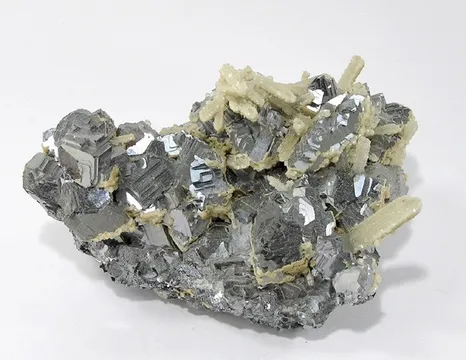
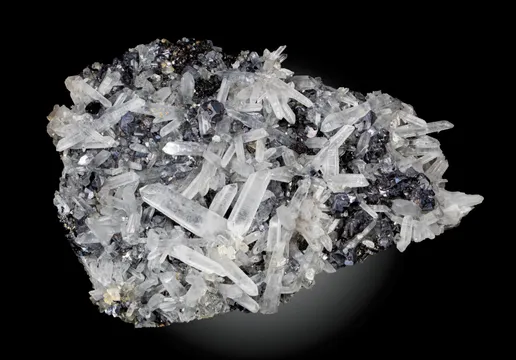
The ore mineralization is dominated by the normal sulphide suite of a polymetallic lead-zinc system: galena, sphalerite, pyrite, and chalcopyrite, with silver-bearing and copper-bearing accessory phases documented from the locality. Published work on the Djurkovo-Laki system distinguishes a quartz-pyrite stage, a main polymetallic sulphide stage, and a late quartz-carbonate stage. That late stage is the one collectors see most vividly. Quartz points, calcite rhombs and scalenohedrons, dolomite coatings, and quartz or dolomite pseudomorphs after calcite record repeated changes in fluid chemistry, acidity, carbonate saturation, and silica activity after the principal ore event.
In the Djurkovo part of the system, mineralization is described as subvertical veins and rich replacement bodies in marble layers, with two principal NNE-SSW veins named West 2 and Eastern Apophysis in the literature on the Djurkovo deposit. Govedarnika, closely associated in the Laki district and in some operating descriptions with Droujba, is more strongly skarn and metasomatic in character. The collector suite from Droujba reflects this district-scale complexity: quartz-sulphide frameworks, carbonate-rich late growth, and replacement textures that may involve calcite, dolomite, quartz, and locally rhodochrosite or other carbonates.
Mining in the Laki area developed as part of Bulgaria’s organized lead-zinc industry, historically tied to GORUBSO operations and later to Laki Invest AD and related Rhodope mining companies. Government concession records show the Djurkovo lead-zinc concession contract dating from January 4, 2000, with later amendments, and modern corporate reporting places Dzhurkovo and Govedarnika among active Laki Invest mines. Local Bulgarian descriptions state that Droujba began as part of the Fifth Mine Administration of GORUBSO and that Droujba and Djurkovo remain the functioning mines in the municipality. The mine is not a casual collecting site; it is an active or controlled industrial underground operation, and any specimen material reaching collectors should be assumed to have come through miners, dealers, or mine-approved channels rather than public access.
The most recognizable specimen finds include large plates of manganese-bearing pink calcite, quartz-covered ridges crowned by calcite, calcite rhombohedrons on quartz needles, dolomite-coated calcite scalenohedrons, and hollow quartz or dolomite epimorphs after calcite. Documented cabinet specimens include a 26.5 x 23.0 x 11.0 cm plate of “baby pink” sceptered calcite scalenohedrons, with the largest calcite reported at 6.5 cm; a 24 x 17 x 11 cm quartz-covered matrix carrying a creamy 9 cm calcite crystal and noted as mined in 2003; and a 10.6 x 7.2 x 4.2 cm calcite-dolomite-quartz combination in which sharp calcite scalenohedrons were coated with tan dolomite microcrystals. Such pieces are the reason Droujba has a reputation beyond ordinary ore-field gangue.
Calcite is the signature display mineral from Droujba: colorless to creamy rhombohedrons, salmon-centered lenticular rhombs, sharp scalenohedrons, sceptered manganese-bearing pink crystals, and complex parallel-growth aggregates on quartz are all documented from the mine. Fine pieces range from miniature groups with 2–3 cm crystals to large cabinet plates over 20 cm across, and the best have bright luster, undamaged terminations, open composition, and visible paragenesis—calcite perched on quartz, calcite coated by dolomite, or calcite later serving as the form for quartz or dolomite casts. Manganese-bearing pink calcite from Droujba can show strong orange fluorescence, giving top pieces an additional cabinet attraction under UV light, but ordinary examples with bruised cleavage tips, dull etched faces, or crowded, massive growth are far less desirable than crisp rhombs and sculptural scalenohedrons with contrasting quartz.
Quartz from Droujba is most valued not as simple rock crystal but as part of the mine’s replacement and cavity-growth story: sparkling colorless to milky crystals form beds, needles, and crusts that host calcite, while later silica produced hollow epimorphs and casts after calcite, including “snowy” quartz surfaces preserving former carbonate shapes. Reported specimens include quartz after calcite around 6–7 cm wide, small-cabinet examples with former calcite scalenohedrons to about 2 cm replaced by sugary quartz on larger milky quartz, and quartz beds carrying creamy or pink calcite. The best Droujba quartz specimens have clean, bright, three-dimensional casts or sharply sparkling crystal carpets with a clear relationship to calcite; simple milky quartz lacking pseudomorph texture or calcite association is much more ordinary.
Dolomite at Droujba is a specialist’s mineral because much of the best material is textural rather than gemmy: cream to light tan sugary dolomite coats, carpets, and replaces calcite, preserving scalenohedral and doubly terminated calcite forms or building cauliflower-like mounds on matrix. Documented pieces include an 11.4 x 7.2 x 5.7 cm cream-colored dolomite pseudomorph after calcite on piled-up dolomite and bowtie groups of doubly terminated calcite crystals replaced by light tan dolomite with colorless quartz. Attractive Droujba dolomite specimens are those where the replacement is legible—the collector can still “read” the lost calcite crystal—while the best combinations add quartz points or spaced calcite forms under a sparkling tan dolomite microcrystal coating; massive beige crusts without preserved form are far less compelling.
Beyond the three main display minerals, Droujba has a serious polymetallic species list. Documented ore and accessory minerals include galena, sphalerite, pyrite, chalcopyrite, arsenopyrite, chalcocite, covellite, wurtzite, molybdenite, native silver, acanthite, proustite, polybasite, famatinite, tennantite-subgroup and tetrahedrite-subgroup minerals, plus oxidation-zone species such as anglesite, cerussite, azurite, malachite, jarosite, goethite, hematite, magnetite, and wulfenite. No species is treated here as a Droujba type-locality mineral; the rarity interest is instead in the Ag-Cu-Pb-Zn assemblage and in the highly collectable carbonate-silica replacement habits. Amethyst is also recorded from the locality, and occasional rhodochrosite-after-calcite material from Droujba has entered the specimen market.
Droujba authenticity problems usually begin with labels rather than with deliberate fabrication. “Droujba,” “Drujba,” “Djurkovo,” “Laki,” “Govedarnika,” and “Rhodope Mountains” can appear on labels for closely related but not identical mine-field material. A good label should preserve the mine name if known and should not be casually upgraded from “Laki district” to “Droujba mine” simply because the specimen is calcite on quartz from Bulgaria. For older specimens, labels citing Droujba/Drujba mine, Djurkovo Complex, Laki, Plovdiv Province are consistent with the collector literature.
No major, well-known class of artificial Droujba fakes dominates the market. The caution is subtler: replacement terminology is often misused. Quartz “after calcite” should show inherited carbonate geometry—hollow forms, casts, or surfaces preserving former rhombs or scalenohedrons—not merely quartz associated with calcite. Dolomite “after calcite” should likewise preserve earlier calcite form rather than simply coating calcite. When buying high-priced pseudomorphs, inspect whether the morphology is truly inherited or whether the description is only an aesthetic guess.
Condition matters strongly. Calcite cleaves easily, and Droujba scalenohedrons and rhombs often have exposed tips and edges; even small chips are obvious on lustrous colorless or pink crystals. Quartz casts after calcite may be hollow and surprisingly light, so pressure on the “walls” of a cast can crush or flake the sugary quartz. Dolomite replacement specimens can shed granular microcrystals if handled roughly. Specimens with galena or chalcopyrite should be stored dry, away from acidic display materials, and dusted gently rather than washed.
Fluorescence can add value, especially for manganese-bearing calcite showing orange response, but UV reaction should be treated as a bonus rather than proof of locality. Pink color alone is not enough to identify Droujba material; the stronger evidence is the full habit-and-association package: pink to cream calcite on quartz, dolomite microcrystal coatings, quartz epimorphs after calcite, and occasional Pb-Zn sulphides. If proustite or other silver sulfosalts are claimed on a Droujba label, keep the specimen out of strong light and seek analytical confirmation, because such species are rare and visually easy to confuse in complex ore fragments.
Market availability is moderate. Droujba calcite-quartz and quartz-after-calcite specimens appear regularly through Bulgarian dealers, European show stock, online auctions, and recycled older collections, while the best large pink calcite plates, clean epimorphs, and sculptural calcite-dolomite-quartz combinations are much scarcer. Small and mid-sized examples remain accessible, but sharply crystallized cabinet specimens with intact calcite and a clear paragenetic story command a premium.
Droujba sits in a lived mining landscape rather than an abandoned romantic ruin. Local descriptions place the mine beside the Laki–Momina Voda–Rozhen road, near Zdravets and the small Rezhushevska or Rezhishovska hamlet, with the Djurkovska River running through the area. That setting matters to collectors because it explains why specimens from Droujba have never been the product of weekend collecting in an open dump; they are products of an operating Rhodope mining community, where mineral specimens are incidental survivors of ore extraction.
One of the most vivid field accounts from the Djurkovo area is not a mineral-collecting report but a travel narrative through the surrounding villages and mine roads. After three days around Djurkovo, the writer describes abandoning a planned visit to St. George when rain began, then driving down to the much-sung “Rudnik Druzhba” and the Bozova sawmill, taking photographs, drinking cold water, and returning through Laki to photograph the church of St. Nicholas the Wonderworker. The small details—three cars, a mountain road from Asenovgrad through Yugovsko Hanche, a rain-spoiled morning, cold water by the mine—give a sense of the locality as collectors rarely see it: not as a label in a drawer, but as part of a Rhodope route of hamlets, churches, timber, mine buildings, and mountain weather.
The mine also has a stark modern history. On April 30, 2015, Bulgarian news reported a fatal accident during planned blasting work in the Govedartsi/Govedarnika shaft of Droujba mine near Djurkovo. Daniela Raichkova, a longtime mine employee from Laki, was killed; reports stated that five miners who had been at the site were questioned, the Labour Inspectorate began a full inspection, and the mine was to remain closed until investigative actions were complete. One broadcast account preserved a haunting last detail from the mine manager: she had said “bye, bye” to the workers and gone toward another workplace before the blast crew proceeded. It is not a collector story in the usual sense, but it is part of the truth of Droujba: the same underground spaces that produced lustrous pink calcite and hollow quartz casts were also active industrial workings where local families earned their living at real risk.