A collector's guide to Dreamtime claim, USA: its geology, mining history and notable minerals, illustrated with the 76 specimens documented from this locality on EarthWonders.
Key facts
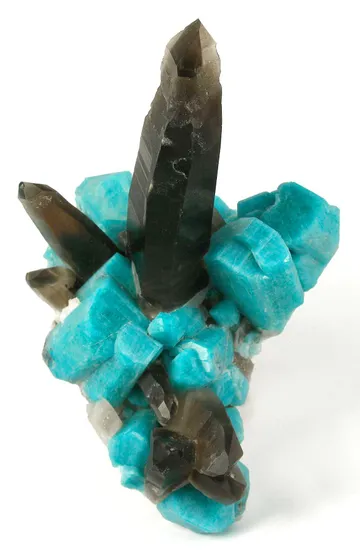
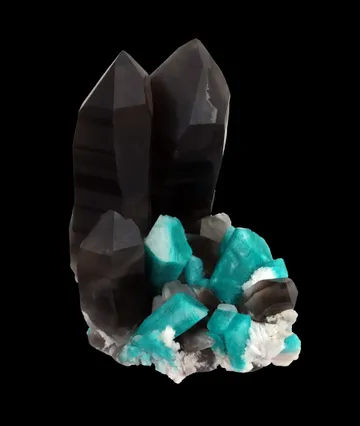
Dreamtime claim is one of the named specimen-producing claims in the Crystal Creek–Crystal Peak part of Teller County, Colorado, on the western flank of the Pikes Peak batholith near Lake George and Florissant. For collectors, it belongs to the great Pikes Peak amazonite–smoky quartz tradition: small miarolitic cavities in Precambrian granite and pegmatite veins, opened one pocket at a time, yielding plates and floaters of feldspar, quartz, albite, fluorite, and iron oxides. The claim is especially important because its best pieces are not merely “Colorado amazonite” in the broad sense; they carry a distinct Dreamtime look—pale to gray-green amazonite and pink microcline, bright bladed albite, smoky quartz ranging from glassy pale tea to dark lustrous prisms, purple to blue-green fluorite cubes, and sculptural sprays of bronze-black goethite.
Regional View
Country View
The broader Crystal Peak district has been famous since the nineteenth century for amazonite and smoky quartz, but Dreamtime entered the modern collecting literature and dealer circuit as a late-1990s and 2000s claim worked for specimen minerals rather than ore. Its documented mineral list is compact, but unusually collector-friendly: microcline including amazonite, quartz including smoky quartz, albite, fluorite, and goethite. A few pieces also preserve the old collector term “onegite” for amethystine or quartz crystals included by hairlike goethite; at Dreamtime, that association is one of the locality’s signatures.

Photo: Wikimedia Commons
The finest Dreamtime specimens are pocket pieces in the full sense: they show open-space crystal growth, balanced associations, and color contrast rather than massive broken feldspar. A good plate might have blocky amazonite crystals to a few centimeters across on pale feldspar; an excellent combination adds a sharp smoky quartz crystal set where it can be seen; and the most distinctive Dreamtime pieces may substitute fluorite or goethite for the usual amazonite–smoky pairing. The 2008 Monster Pocket fluorites and the Wormhole Pocket goethites gave the claim a wider reputation among collectors who follow Colorado pegmatites closely, because both produced specimens that depart from the familiar teal feldspar-and-black-quartz formula.
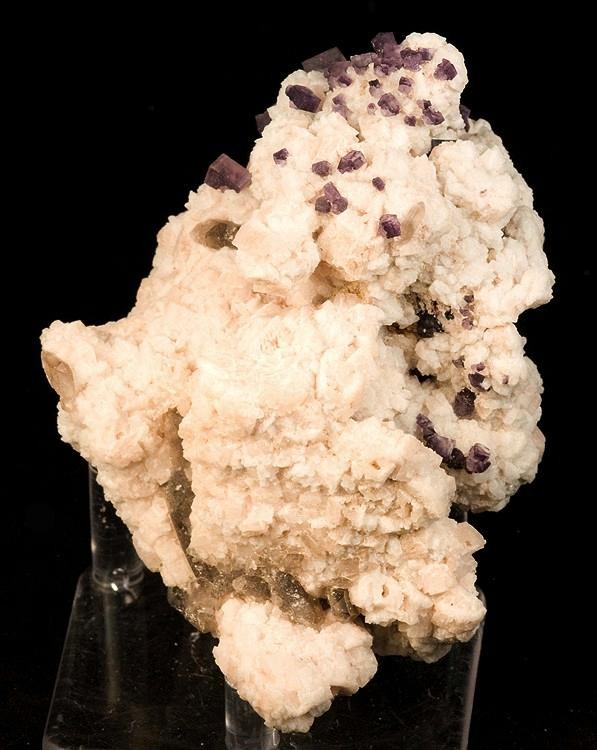
Photo: Wikimedia Commons
Search for specimens: View all specimens from Dreamtime claim, USA
Dreamtime claim is a specimen-mining claim in the Crystal Creek area of the Crystal Peak district, Teller County, Colorado, within the Pike National Forest. The claim lies in a landscape of decomposed Pikes Peak granite cut by quartz and pegmatite veins. The productive targets are not continuous ore bodies in the metallic-mining sense, but isolated miarolitic cavities—pockets—where late-stage fluids left open space for feldspar, quartz, fluorite, albite, and iron minerals to crystallize freely. The country rock is part of the approximately 1.0-billion-year Pikes Peak batholith, an A-type granite province famous for pocket pegmatites throughout the Lake George, Crystal Peak, Crystal Park, Devil’s Head, and related collecting areas.
The Crystal Creek area has a long specimen-mining history dating back to the 1800s. Early descriptions of the broader Crystal Peak locality emphasized amazonstone, smoky quartz, and large feldspar crystals from cavities in granite; later collectors and small-scale miners refined the area into named claims, pockets, and trends. Dreamtime is one of those modern named localities. Its unpatented lode claim was located in late 1998 by Quentin H. Good, and early work was described as a pick-and-shovel operation aimed specifically at specimen minerals. The Forest Service environmental assessment for the Dreamtime Mine describes the claim as a 20-acre rectangle, about 600 feet by 1,500 feet, in the southeast quarter of Section 11, Township 12 South, Range 71 West, approximately five miles northeast of Lake George.
The claim’s mineralization is typical of high-quality Pikes Peak pocket pegmatites but has its own emphasis. Microcline occurs both as ordinary pink to cream feldspar and as amazonite; smoky quartz and clear to included quartz appear as individual crystals, groups, and plates; albite commonly forms white bladed cleavelandite-style aggregates; fluorite occurs as pastel to purple cubes and more rarely as large color-zoned cubes; and goethite forms radiating bladed clusters, sprays, and hedgehog-like groups, sometimes associated with quartz or so-called onegite. Hematite is mentioned in the mine’s Forest Service documentation and appears as a coating or sparkle on some quartz-associated pieces, though it is not part of the short standard species list usually cited for the claim.
Mining at Dreamtime was conducted as specimen mining rather than bulk extraction. The operator’s proposed work plan called for removing overburden with mechanized equipment at promising sites, then excavating quartz and pegmatite veins with hand tools in search of pockets. The plan contemplated as many as five open pits at one time, with maximum pit depths of about 30 feet and a maximum disturbed area of one acre at any given time. Specimen cleaning was also part of the operation: the documents describe preliminary cleaning and grading at the site, with further weak-acid cleaning to be done offsite if necessary.
Dreamtime is also unusually well documented because it became the subject of a public-land mining dispute in the early 2000s. A 2003 federal court decision and a 2004 Forest Service decision notice record the operator’s conflict with federal surface-management rules over mechanized digging, an A-frame structure, occupancy, reclamation bonding, and what uses were reasonably incident to mining on an unpatented claim. The later Forest Service decision allowed mechanized and hand-tool crystal mining under a plan of operations, limited overnight stays, prohibited permanent structures, authorized a removable trailer for storage/office/emergency shelter under conditions, required fencing and signage around active digs, and required reclamation bonding and mitigation measures. For collectors, those documents are valuable because they confirm the claim’s purpose and target minerals in unusual detail.
The claim has produced named-pocket material that is recognizable in the market. The Monster Pocket, documented from 2008, produced fluorite-rich specimens: purple, color-zoned cubes scattered on pale microcline, in some cases with smoky quartz hidden or attached. The Wormhole Pocket is associated with fine goethite specimens—radiating, lustrous, black to brown bladed clusters, some collected by Adam Sotomayor and later photographed and sold through major mineral dealers. Dealer records also document 2000s smoky quartz finds from Dreamtime, including large, lustrous, sharply terminated crystals with albite and amazonite at the base.
Collecting access should be treated conservatively. Dreamtime is a claim/locality within a heavily claimed and partly private/controlled district. The Colorado Geological Survey notes that the Crystal Peak area between Woodland Park and Lake George is famous for amazonite and related minerals but is now mostly private land or claimed and cannot be accessed without permission. A Lake George Gem & Mineral Club schedule from 2011 described Dreamtime as a “famous” private mine and listed a club visit by invitation. In practical collecting terms, Dreamtime specimens should be acquired through established provenance, dealer labels, old collections, club-documented visits, or direct permission from the claimholder/operator; casual prospecting on or near the claim is not appropriate.
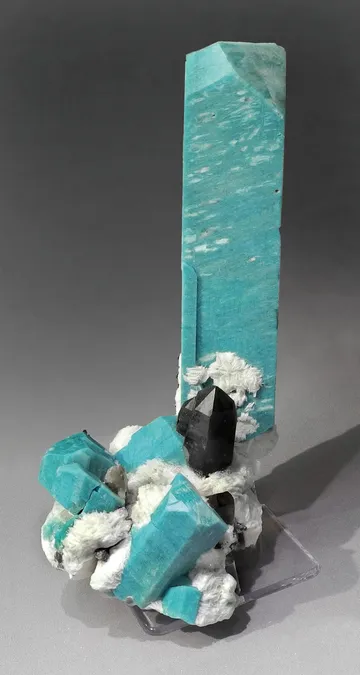
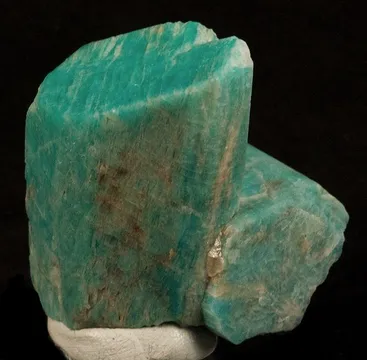
Microcline from Dreamtime is the structural host and visual stage for much of the claim’s best mineralization: blocky cream, pale pink, and gray-green crystals occur as matrix, plates, and discrete sharp feldspar crystals, with the amazonite-colored examples forming the most prized subset. Good Dreamtime microcline is judged less by sheer size than by form, luster, and association—sharp faces, a fresh feldspar sheen, and clean contrast with smoky quartz, albite, fluorite, or goethite lift a piece above ordinary broken pocket feldspar. Documented specimens include gray-green amazonite crystals to about 3.2 cm on a 7.8 cm matrix, pale pink microcline supporting purple fluorite cubes from the 2008 Monster Pocket, and thin plates of crystallized pink microcline carrying dark smoky quartz groups.
Quartz at Dreamtime appears both as ordinary quartz and as the smoky variety, and it is central to the claim’s pocket character: crystals may be glassy, pale, smoky, doubly terminated, included by goethite, coated by hematite, or perched with feldspar and fluorite. Clearer Dreamtime quartz is less abundant in the literature than smoky quartz, but the same collecting standards apply—complete terminations, bright luster, lack of pocket bruising, and a well-positioned association make the difference. Particularly interesting pieces include quartz walls or plates associated with fluorite, goethite-coated quartz with later crystal faces, and small doubly terminated crystals included by goethite needles, historically called onegite by collectors.
Smoky quartz is one of Dreamtime’s core collector minerals, typically occurring as lustrous euhedral crystals on microcline, amazonite, albite, or fluorite-bearing pocket matrix; colors range from light tea-brown and water-clear smoky to darker Colorado-style crystals with glossy faces. Documented Dreamtime pieces include a 5.3 cm plate with several sharp dark smoky crystals on pink microcline, an 11.6 cm cabinet crystal with bladed albite and small amazonite sections at the base, and Monster Pocket specimens where smoky quartz appears as a bonus association to color-zoned purple fluorite. The best smoky quartz from the claim is complete and undinged, with crisp terminations, glassy faces, good contrast against feldspar, and an orientation that lets the crystal read as a specimen rather than a detached point.
Goethite is one of the distinctive minerals that separates Dreamtime from many more conventional amazonite–smoky quartz localities in the Pikes Peak batholith. It occurs as lustrous black, bronze-black, chocolate-brown, and locally golden-black bladed sprays, radiating clusters, and hedgehog-like aggregates, sometimes on pink microcline and sometimes with smoky quartz or onegite. Documented crystals reach about 1.5 cm in sprays and blades, while cabinet clusters from the Wormhole Pocket and other recent finds range from roughly 4 to 8 cm across. Top Dreamtime goethite has metallic to submetallic luster, three-dimensional radial form, minimal crushing along blade tips, and either strong sculptural isolation or a contrasting feldspar/quartz association.
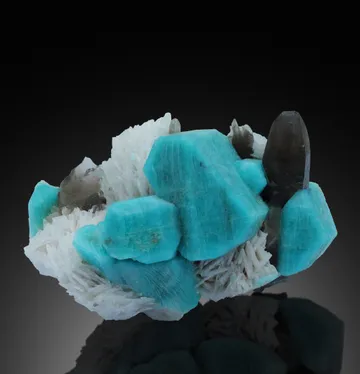
Amazonite from Dreamtime is microcline colored in the blue-green to gray-green range, commonly paler and softer-toned than the deepest teal crystals from the most celebrated Colorado pockets, but capable of excellent form and association. The best documented Dreamtime amazonites show lustrous, sharp crystals on feldspar matrix, sometimes with smoky quartz or white albite/cleavelandite, and specimen sizes in the miniature to small-cabinet range are typical in the market. Good pieces are judged by crystal sharpness, color saturation, lack of chalky alteration, and whether the amazonite is presented as a true crystal group rather than a broken feldspar mass; the most desirable examples preserve the classic Colorado color contrast with smoky quartz or bright albite.
Fluorite is a standout Dreamtime species because the claim produced unusually attractive fluorite for a Pikes Peak pegmatite setting, especially from the 2008 Monster Pocket. Specimens show cubes from millimeter scale up to several centimeters, with colors reported as light purple, blue-violet, brownish, colorless, and very pale sea-green; some are color-zoned or twinned, and at least some fluoresce bright to modest purple. The best fluorites occur on pink to cream microcline, white albite, smoky quartz, or hematite-coated quartz, with sharp cube edges and intact corners. Large, rich, gemmy cubes are scarce from the claim, and condition is critical because fluorite’s perfect cleavage makes edge wear and bruising common.
Albite at Dreamtime is usually seen as white bladed cleavelandite-style aggregates and small crystal groups rather than as the principal display mineral. It is important because it adds texture and contrast to smoky quartz, amazonite, microcline, and fluorite specimens: white albite blades at the base of a smoky quartz or between feldspar crystals give a piece a finished pocket aesthetic. Documented Dreamtime material includes smoky quartz with bladed albite and amazonite, and fluorite on pink microcline with white albite overgrowths. The best albite-bearing pieces show clean, bright blades that are not iron-stained or crushed, and they function as a visual bridge between the darker quartz or fluorite and the feldspar matrix.
Other minerals and terms from Dreamtime require careful wording. Hematite is documented in the Forest Service description of target specimen minerals and appears on some quartz-associated pieces as a coating or sparkly metallic accent, but it is not always listed in the locality’s standard short mineral list. “Onegite” is a historically used collector term for quartz or amethyst with hairlike goethite inclusions, not a valid species; at Dreamtime, onegite-labelled pieces are notable because they combine included quartz with bladed goethite in unusually aesthetic ways. No verified type-locality minerals are known from Dreamtime claim.

Photo: Wikimedia Commons
Dreamtime specimens are generally reliable when accompanied by old dealer, collector, or photographic provenance, but mislabelling is a real concern because “Crystal Peak,” “Lake George,” “Florissant,” “Teller County,” and “Pikes Peak batholith” are often used loosely in the market. A specimen labelled simply “Lake George amazonite” may not be Dreamtime; conversely, some Dreamtime pieces were historically marketed under broader district names. The strongest labels include Dreamtime claim or Dreamtime Mine, Crystal Peak area, Teller County, Colorado, and ideally a pocket name such as Monster Pocket or Wormhole Pocket, or a collector/dealer chain such as Adam Sotomayor, Brian Kosnar, Rob Lavinsky/iRocks, Fabre Minerals, Heritage Auctions, or MineralAuctions.
No well-documented systematic fakes are known for Dreamtime, but repairs and composite-looking associations should be inspected carefully. Colorado amazonite–smoky quartz combinations are valuable enough that reattachments, repaired smoky quartz crystals, and rebuilt feldspar/quartz combinations are always possible in the broader market. Northstar Minerals has listed a Dreamtime smoky quartz on amazonite specimen openly described with a repair, which is the correct way such material should be represented. Examine the contact between smoky quartz and feldspar under magnification: pocket clay in crevices, matching luster and patina, and natural growth contacts are reassuring; glue lines, mismatched dirt, or impossible orientations deserve skepticism.
Condition expectations vary by species. Amazonite and microcline commonly show edge wear, bruised corners, cleaves, or dull zones from pocket collapse and extraction. Smoky quartz should be checked for chipped terminations, rehealed breaks, and basal repairs; even a small ding on a termination can strongly affect value. Fluorite is especially vulnerable because of its cleavage and should be examined for bruised cube corners, edge rub, and cleaved faces. Goethite blades are tough enough to survive as sprays, but tips and protruding fans are easy to crush; pristine radial clusters command a premium.
Fluorescence is relevant mostly for fluorite. Dreamtime fluorite has been documented with modest to bright purple fluorescence, but response can vary, so do not treat fluorescence alone as proof of locality. Cleaning should be conservative. Feldspar and quartz tolerate careful washing well, but fluorite can be etched or dulled by aggressive acids, and goethite sprays can trap residues or lose visual quality if over-cleaned. Specimens with pocket clay should be cleaned slowly with water, soft tools, and patience; acid work should be left to those familiar with Pikes Peak pegmatite material.
Rarity is uneven. Dreamtime microcline, smoky quartz, and amazonite are available periodically, but fine, aesthetic combination pieces are much less common than ordinary feldspar/quartz fragments. Fluorite-rich Monster Pocket specimens and top goethite sprays are genuinely scarce and tend to disappear into specialist Colorado collections. The claim appears regularly enough in auction archives and dealer backstock to be obtainable, but not in large volume; serious collectors should prioritize provenance, balance, and condition over size.
Dreamtime’s most dramatic story is not a single giant crystal, but the collision of old Western mining law, modern public-land regulation, and the practical realities of specimen mining. Quentin H. Good located the Dreamtime claim in late 1998 and moved a small trailer onto the claim in January 1999. His stated work was specimen mining in the Crystal Creek area, where the prize was not a vein of metal ore but a hidden pocket—perhaps only a small cavity, perhaps a roomier void lined with amazonite, smoky quartz, fluorite, or goethite. Early documents describe the operation in almost charmingly simple terms: “pick and shovel.” But the practical problem of the claim was overburden. To reach pocket-bearing pegmatite, Good wanted mechanized equipment; the Forest Service wanted an approved operating plan, mitigation, and reclamation.
By 2001 the disagreement had become physical on the ground. The court record describes backhoes, a bulldozer, trenches, and an A-frame structure. On September 25, 2001, George Quist operated a four-wheel-drive backhoe at Dreamtime for two to three hours while Good supervised. Good also rented a backhoe from Bill’s Tool Rental in Colorado Springs on July 21, 2001, October 23, 2001, and May 1, 2002, using it to remove overburden and conduct reclamation work. To a mineral collector, those dates read like the unromantic underside of pocket mining: before the crystal is cleaned, photographed, labelled, and placed under lights, there is decomposed granite to move, a pit to stabilize, and a dispute over where hand work ends and regulated surface disturbance begins.
The federal court decision of April 16, 2003, turned Dreamtime into a published legal case. Magistrate Judge Boland framed it as a classic conflict: an individual’s right to prospect and develop mineral resources on public land against the Forest Service’s duty to manage and protect National Forest surface resources. Good was found guilty on counts tied to mechanized digging without authorization and maintaining the A-frame structure, and not guilty on two other counts where the judge found the evidence insufficient. The line collectors remember is less the legal conclusion than the judge’s description of the relationship: he wrote that calling it an “ongoing feud” would be generous. Few American specimen localities have their operating history laid out so starkly in a federal opinion.
Then came the Hayman Fire. In June 2002, as Colorado’s largest wildfire to that time burned through the Pike National Forest, Dreamtime was close enough to the drama that Good appeared in newspaper accounts. He was 29 years old. After being allowed back briefly with other residents to check on property, he said he jumped up and down when he saw that his log cabin and neighboring gem mine were still intact. The quote is memorable because it captures exactly how personal a specimen claim can be: not just a hole in the ground, not just inventory, but a life’s work sitting in the path of a major fire. The Forest Service environmental assessment later recorded that the fire burned lightly over the Dreamtime claim, while some nearby patches burned hot enough to kill ponderosa pine and Douglas fir overstory.
The later Forest Service decision reads like a negotiated truce, though hardly a simple one. Mining could proceed, but with rules. Mechanized and hand-tool crystal mining were allowed; overnight stays were limited to 60 nights per year; permanent buildings were not authorized; a wheeled trailer could remain only under specified conditions; individual dig sites had to be fenced or flagged; a perimeter fence could be built no more than 200 feet from active or proposed dig sites; human waste had to be removed to an approved facility; and reclamation would be accepted only after new vegetation reached at least half the ground cover of adjacent sites and had survived two growing seasons. The decision also required at least two Forest Service inspections per year and set an anticipated reclamation bond of $15,595, most of it tied to the cost of filling and reclaiming pits if the operator failed to do so.
Against that bureaucratic backdrop, the pockets themselves kept giving collectors tangible reasons to care. The Monster Pocket of 2008 produced fluorite-rich pieces that are still identifiable in photographs and auction records: purple, color-zoned cubes sprinkled over pale microcline, with smoky quartz tucked in as a bonus. The best examples are small enough to hold yet visually complex—pastel feldspar, violet fluorite, and smoky quartz all in one pocket-grown arrangement. Dreamtime’s Wormhole Pocket goethites are just as distinctive in another direction: black to brown bladed sprays, some lustrous enough to look metallic, gathered into sculptural fans and hedgehog clusters. These are not generic iron oxides; they are the kind of locality-specific pieces that make a collector write the pocket name on the label.