






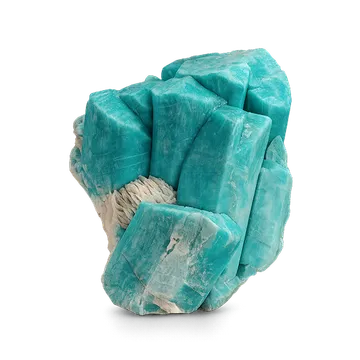
Crystal Peak amazonite, Colorado — renowned for large, well-formed blue-green crystals with smoky quartz, prized for color, luster, and collecting pedigree.
Key facts
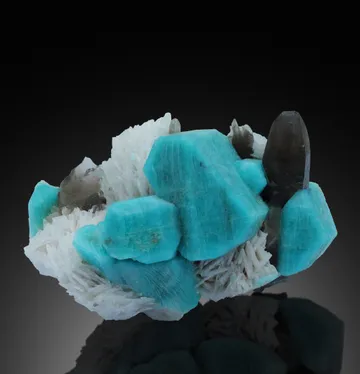
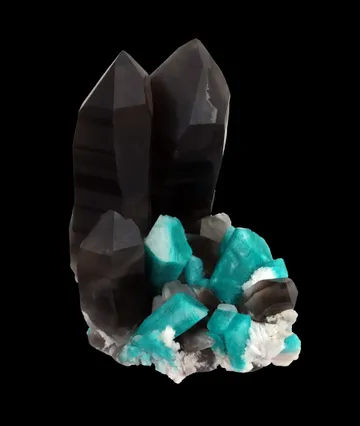
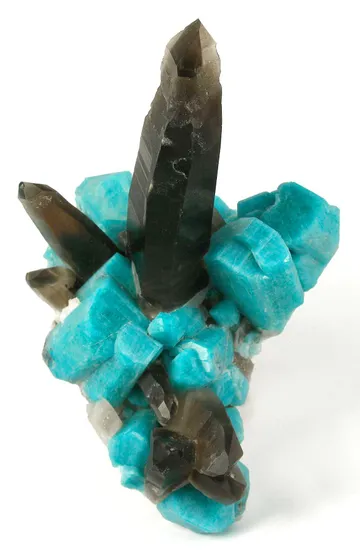
Crystal Peak amazonite is one of the great American mineral classics: blue-green microcline, often in blocky triclinic crystals, set against smoky quartz so dark it can read nearly black. The finest pieces have a visual language that is instantly recognizable—turquoise-to-teal feldspar, white cleavelandite or pale microcline accents, and sharply prismatic quartz rising through the feldspar like smoke through ice. For serious collectors, the locality’s strongest specimens are not merely “amazonite from Colorado”; they are sculptural combinations whose color contrast, crystal scale, and historical pedigree place them among the most desirable feldspar specimens in the world.

Photo: James St. John / Wikimedia Commons
The locality sits in the Pikes Peak batholith, a Proterozoic granitic complex whose pegmatites and miarolitic cavities have supplied amazonite, smoky quartz, topaz, fluorite, cleavelandite, goethite, hematite, and a suite of rarer accessory species for more than a century. In the Crystal Peak field, amazonite is not primarily a lapidary material; its importance lies in crystals. Colorado Geological Survey describes Colorado amazonite as exceptional because it occurs as large, well-formed crystals rather than only as massive material, and Crystal Peak is the area where that distinction becomes spectacular.
The most important modern production has come from the Smoky Hawk trend and related claims in the Crystal Peak district. There, the Dorris family’s work at the Smoky Hawk claim brought a new generation of intensely colored amazonite-smoky quartz specimens to market and to museums. The best pieces are judged by color saturation, luster, sharpness, balance between feldspar and quartz, completeness of the matrix, and the honesty and quality of any repair or restoration. Deep blue-green color with crisp white striping or caps, dark lustrous smoky quartz, and three-dimensional architecture are the hallmarks collectors pay for.

Photo: Rob Lavinsky / Wikimedia Commons
Crystal Peak also matters historically. Specimens from the Lake George–Crystal Peak–Florissant region were already attracting attention in the 19th century, and the locality helped establish Colorado as a premier amazonite source. The old names—Crystal Peak, Crystal Butte, Florissant Crystal Beds, Lake George diggings—still echo in labels. Modern labels may be more precise, naming claims such as Smoky Hawk, Jack Rabbit, Two Point, Take Five, or individual pockets such as Lucky Monday, Icon, Smithsonian, Majestic, Legacy, or Whimsical Blue. That pocket-level provenance is now part of the value.
Search for specimens: View all amazonite specimens from Crystal Peak, Colorado, USA
Crystal Peak lies north of Florissant and between the Woodland Park–Lake George mineral belt of Teller and Park counties. In collecting usage, “Crystal Peak” commonly refers not only to the peak itself but to the broader pegmatite field around it, including named claims and pockets that may be labeled Lake George, Florissant, Crystal Creek, or Crystal Peak depending on the collector, dealer, or historical label.
The mineralization is hosted by granitic pegmatites in the Pikes Peak batholith. The collectible crystals formed in miarolitic cavities: open spaces in late-stage pegmatitic bodies where feldspar, quartz, albite, fluorite, iron oxides, and accessory rare-element minerals could grow inward into voids. In the best cavities, blocky amazonite microcline and smoky quartz developed as free-standing crystals rather than as massive intergrowths locked in solid granite. Many pockets later ruptured, collapsed, or were partly cemented by reddish clay rich in albite and iron oxides, which explains why many otherwise outstanding plates require painstaking reconstruction.
The Smoky Hawk trend is the best-documented modern producer in the district. Joseph Dorris described it as a narrow pegmatite trend about 0.9 miles long and roughly 0.4 miles wide, with exploration over 185 acres covered by twenty unpatented mining claims. The claim was filed in December 1998 after years of prospecting, mechanized exploration began in 2000, and production from numerous pockets began in 2003 after permitting. By the mid-2010s, more than 900 to over 1,000 pockets had been excavated, depending on the report date, yet only about fourteen had produced major exceptional specimens. That ratio is important: Crystal Peak is famous not because every pocket is superb, but because the rare good pockets can be extraordinary.
Mining evolved from shallow, hand-dug workings to mechanized excavation. Early collectors worked primarily with picks and shovels; modern operators have used excavators and limited blasting to reach pegmatites below the old surface diggings. Even when machines expose the pegmatite, pockets are collected by hand. Water, screwdrivers, picks, padding, memory, patience, and later laboratory preparation matter as much as horsepower.
Access has changed dramatically. Much of the Crystal Peak area is private land, rural-residential property, or active claim ground, and permission is essential. Colorado Geological Survey specifically warns that the Crystal Peak area is mostly private land or claimed by private entities and cannot be accessed without permission. Specimen quality, safety, landowner relations, and claim law all point to the same conclusion: the responsible collector should arrange access through legitimate claim owners, mineral clubs, commercial digs, or documented permission rather than casual trespass.
Notable finds include the 1997 Tree Root Pocket associated with Bryan Lees on the Two Point area of the trend, numerous Smoky Hawk pockets such as Legacy, Majestic, Smithsonian, Lucky Monday, Chuck’s, Dragon’s Mouth, Icon, and Whimsical Blue, and the 2012 Icon Pocket that produced the Smoky Hawk King. That plate, assembled from a remarkably large cavity, became the district’s benchmark museum-scale amazonite-smoky quartz specimen.
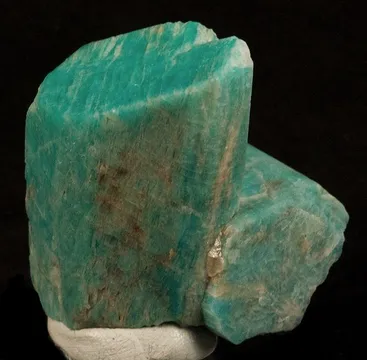
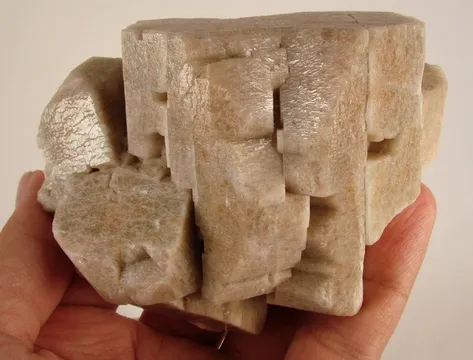
Crystal Peak amazonite is microcline, KAlSi3O8, colored blue-green to turquoise by lead-related color centers in the feldspar structure. The best crystals are blocky to tabular, with sharp feldspar geometry, satiny to vitreous luster, and a color range from pale bluish green through rich teal to highly saturated blue-green. On the Smoky Hawk trend, deeply colored material is especially prized, and some crystals show white stripes or white caps. Those white areas are microcline as well, not a separate paint-like coating; they are part of the feldspar growth history and can be a desirable locality feature when naturally positioned and aesthetically balanced.
The classic habit is a group of blocky amazonite crystals intergrown with smoky quartz. Smoky quartz may be short and stout, long and prismatic, doubly terminated in unusual pockets, or tapered toward tessin-like terminations in some Smoky Hawk material. The smoky quartz can range from translucent brown to dark gray and nearly black; collectors particularly favor transparent-to-translucent crystals that still provide strong contrast against saturated feldspar.
Typical cabinet-quality combinations fall from thumbnail to small-cabinet and cabinet size, but the district has produced large plates and spectacular museum pieces. Individual crystals in saleable specimens may be only a centimeter or two across, while major plates can carry amazonite crystals many centimeters across and quartz crystals that dominate the composition. In the 2012 Smoky Hawk King find, a cavity roughly six feet wide by eight and a half feet long produced about a ton of amazonite and smoky quartz crystals, and the assembled major plate measured nearly three feet by two feet in published accounts.
Common associated minerals include smoky quartz, albite var. cleavelandite, common microcline, fluorite, goethite, hematite, and iron-oxide pseudomorphs after earlier late-stage minerals. The Smoky Hawk claim and the broader Crystal Peak field also have a notable rare-mineral suite: topaz, phenakite, cassiterite, ferrocolumbite, milarite, monazite, bastnäesite, xenotime, zircon, bertrandite, rutile, anatase, synchysite, apatite, and rare aluminofluoride assemblages have all been documented from the area. These species are generally secondary to the amazonite-smoky quartz story, but they add depth for locality specialists.
Quality is determined by a tight set of locality-specific factors. First is color: deep, even, blue-green amazonite is far more desirable than pale green or patchy feldspar. Second is form: sharp blocky crystals with clean faces, strong terminations, and good three-dimensional relief outrank massive or bruised aggregates. Third is association: dark smoky quartz in balanced contrast is the classic. Fourth is surface: natural luster and crisp edges matter, while iron staining, clay-filled crevices, and etched or dull surfaces reduce value unless the specimen’s composition is exceptional. Finally, provenance matters. A confirmed Smoky Hawk, Jack Rabbit, Two Point, or named-pocket label can add confidence and collector interest, especially when tied to known miners or collections.
Crystal Peak amazonite is widely available in small fragments and modest crystals, but fine matrix combinations remain genuinely selective. The market currently includes everything from inexpensive loose amazonite pieces and repaired small-cabinet combinations to high-end dealer pieces and museum-grade plates. Recent public sales and dealer listings show active demand: small-cabinet Smoky Hawk combinations have sold in the high hundreds to low thousands of dollars, while premium cabinet pieces and historic or pocket-specific specimens can rise much higher. Joe Dorris has publicly described his best pieces as reaching the tens of thousands of dollars, though such specimens are uncommon.
The principal authenticity issue is not widespread fake amazonite from Crystal Peak, but incomplete disclosure. Repairs and restorations are common on serious amazonite-smoky quartz combinations from this district because many pockets ruptured naturally and many specimens are recovered in pieces. A repaired Crystal Peak specimen is not automatically undesirable; in fact, many important pieces would not exist as display specimens without expert reassembly. The collector’s concern should be clarity: how many repairs, where they are, whether any missing crystal areas were restored, and whether the work is stable and visually honest.
Condition concerns are inherent to feldspar. Amazonite has good cleavage and can bruise along edges, cleave through corners, and chip on terminations. Smoky quartz is harder, but pocket rupture, extraction, and cleaning can leave contacts, broken bases, rehealed-looking fractures, or reattached points. Iron oxide coatings, clay residues, and white secondary minerals can be either attractive or distracting depending on placement. Overcleaning can flatten luster or remove subtle pocket character; undercleaning can hide color and faces. On high-end pieces, ask for daylight photographs, back-side images, and a repair map.
Treatments are not a major locality-specific problem for natural Crystal Peak crystal specimens. Amazonite used for beads, cabochons, spheres, and decorative carvings may be sold simply as “Colorado amazonite,” and such pieces can be genuine but may not represent specimen-grade Crystal Peak crystal material. Dyed or misidentified blue-green stones exist in the broader decorative-stone trade, but the classic Crystal Peak combination—blocky microcline with smoky quartz and cleavelandite—is distinctive. Provenance and mineralogical context matter more than color alone.
Label precision is another issue. “Pikes Peak,” “Lake George,” “Florissant,” “Crystal Peak,” and “Teller County” have all appeared on labels, sometimes accurately and sometimes loosely. Older labels may be valuable even when imprecise, but modern acquisitions should seek as much specificity as possible: claim, pocket, miner, collection history, and whether the piece came from original mining or from older collection dispersal.
In 1876, Crystal Peak was already being sold to the public imagination as “A Fruitful Field for the Specimen Hunter.” The old account described 25 to 30 miners working there “constantly” during the previous summer and fall, in country where deer, scenery, and mineral curiosity all shared the same stage. That is the early Crystal Peak in miniature: a mineral field that was never just a hole in granite, but a place where tourism, commerce, collecting, and western romance tangled almost from the beginning.
The locality’s modern mythology is centered on pockets. A Crystal Peak pocket may be no larger than a boot box, or it may be big enough to change a museum collection. The miner is not simply “digging amazonite”; he is reading decomposed granite, fractures, clay, iron stains, pegmatite direction changes, and the feel of the tools. In productive ground, the machine may remove overburden, but the last work is intimate—water, screwdrivers, fingers, and restraint. Dorris has emphasized that even at Smoky Hawk, where the pocket frequency is unusually high, most pockets are marginal. One published estimate from the Smoky Hawk trend gives about one reasonable-quality pocket in twelve and about one high-quality pocket in seventy.
The 2012 Icon Pocket is the great modern episode. At the end of June, the Dorris family opened a pegmatite on the Smoky Hawk claim that produced several large miarolitic cavities. The largest cavity was kite-shaped, about six feet wide and eight and a half feet long. It yielded roughly one ton of amazonite and smoky quartz crystals. Out of that wreckage and abundance, the largest plate—nearly three feet by two feet in Joseph Dorris’s symposium account, and described elsewhere as roughly three feet by two and a half feet—was assembled into the Smoky Hawk King.
The extraction happened under unusual circumstances: High Noon Productions was filming for the television series Prospectors, so the find was not merely mined but documented as it unfolded. The cavity was not a tidy museum case waiting underground. It was a real pocket, ruptured and packed with crystals and debris, and the finished plate required years of preparation. Tim Dorris cleaned and restored the massive ceiling plate over the following two years. When mineral clubs circulated news of the acquisition effort, they described a specimen weighing more than 85 pounds, nearly three feet long and almost two feet wide, dominated by extraordinarily large amazonite, smoky quartz, and cleavelandite crystals. At the 2014 Denver show it won “Best in Show,” and in 2015 it was shown in Tucson. The Denver Museum of Nature & Science then worked to secure it for permanent public display.
The Smoky Hawk King became more than a specimen; it became a public argument for why mineral collecting matters. Museum curator James Hagadorn and supporters compared it to other Rocky Mountain icons such as the Alma King rhodochrosite and Diane’s Pocket aquamarine. BusinessDen reported that the museum was working to raise $1 million around the acquisition and exhibit effort. Joe Dorris was direct about the scale of the find: “I wasn’t afraid to put that name on it because I don’t think it’s ever going to be matched.” He also captured the aesthetic reason collectors understood the fuss: “the contrast just pops.”
Smaller pockets can be just as memorable. The Night Hawk Pocket on the Smoky Hawk claim produced a cabinet specimen photographed and described by Rob Lavinsky, with Joe and Tim Dorris later adding that the pocket was “quite small, less than a foot across.” Only a few other pieces came from it, all smaller and comparatively insignificant. That is a very Crystal Peak kind of story: a pocket less than a foot across, remembered years later because one specimen had the right geometry, translucency, and drama.
Another part of the locality’s field lore is the amount of hidden work after mining. Large amazonite-smoky quartz combinations often begin as puzzles. Pocket rupture, tight cavity space, and weathering mean that crystals may be detached, jumbled, clay-cemented, or broken away from their original positions. The best preparers are “fit finders”—people who can recognize how fragments belong together and reconstruct a plate without losing the geological truth of it. Tim Dorris is widely known for that skill. In this district, preparation is not cosmetic afterthought; it is often the difference between a bucket of beautiful fragments and a world-class specimen.
Crystal Peak’s rarer minerals supply quieter stories. A pre-1940 Lazard Cahn topaz in Joseph Dorris’s collection may have been collected by Ed Over, Willard Wulff, or George White. In 2017–2018, etched gemmy topaz crystals turned up scattered in Smoky Hawk mine debris. Phenakite on amazonite and cleavelandite has been known since the 1880s but remains infrequent; Dorris recovered a handful of loose phenakites from the Buckner pegmatite on the Smoky Hawk claim in 2009. Bodie and Kim Packham found some of the best recent ferrocolumbite crystals, including a pocket specimen with two terminated columbites on cleavelandite that passed to Philip Persson and entered the Colorado School of Mines Museum collection.
The micromineral stories are easy to miss because the scale is so different from the grand plates. Thomas Cheatham, with Dorris’s permission, spent years searching abandoned pocket debris on the Smoky Hawk claim and found tiny vugs with anatase, rutile, niobium-rutile, xenotime, monazite, synchysite, and bastnäesite, with Brad Meese helping document them photographically. Derek Leidy’s September 2021 amazonite-smoky quartz pocket produced clusters of flat bladed bertrandite crystals; the largest single crystal in one cluster measured only 4 x 7 mm. In a district famous for plates measured in feet, some of its best mineralogical surprises are measured in millimeters.
_2.jpg)
