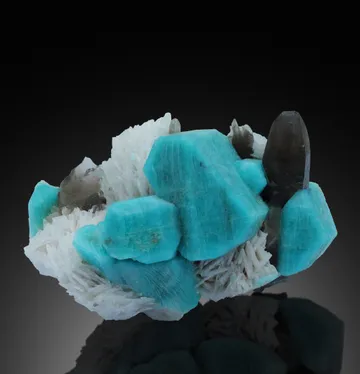
A collector's guide to Smoky Hawk claim, USA: its geology, mining history and notable minerals, illustrated with the 200 specimens documented from this locality on EarthWonders.
Key facts
The Smoky Hawk claim is one of the defining modern sources for the classic Colorado combination of amazonite and smoky quartz: blocky, saturated blue-green microcline crystals set against satin-black quartz, commonly lifted from pocket clay with cleavelandite, fluorite, iron oxides, and a quiet suite of rare NYF-pegmatite minerals. The claim lies in the Crystal Peak mining district near Lake George and Florissant, Teller County, within the Pikes Peak Batholith and the Lake George intrusive center—a granitic terrain whose miarolitic pegmatites have been famous since the late nineteenth century for specimen pockets rather than conventional ore.
Smoky Hawk matters because it revived a district many collectors thought had already given up its best. The Dorris family, operating through Glacier Peak Mining and Pinnacle 5 Minerals, used mechanized exploration to reach deeper pegmatite structures below the old shallow workings, then collected the pockets by hand. The result was an extraordinary run of named pockets—Legacy, Majestic, Smithsonian, Lucky Monday, Chuck’s, Dragon’s Mouth, Icon, and others—that put fresh, documented, museum-quality amazonite-smoky quartz combinations into the market in the 2000s and 2010s.
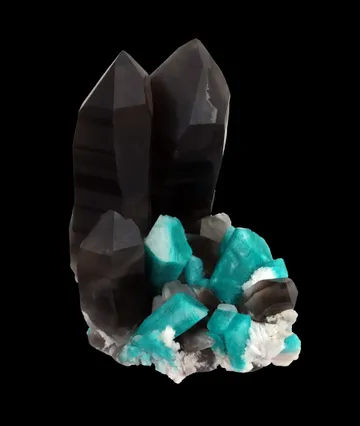
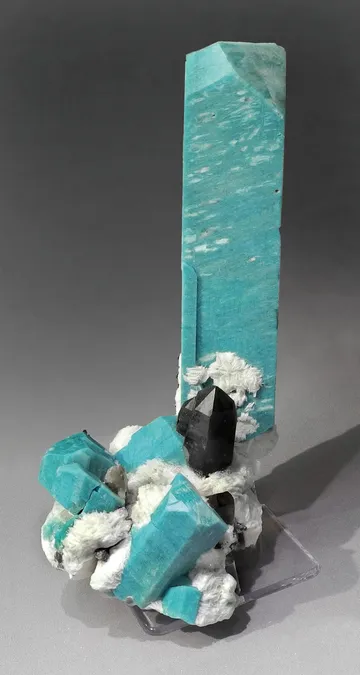
At its best, Smoky Hawk material has a look that is hard to mistake: porcelain-lustred turquoise to teal amazonite, sometimes with sharp white microcline caps or stripes; dark, well-terminated smoky quartz crystals rising from the feldspar like black glass; and white platy cleavelandite rosettes that give the combinations both contrast and architecture. The very finest plates are three-dimensional, balanced, and surprisingly sculptural, not merely colorful. They reward close inspection: grid-like cleavage and growth textures on the feldspar, subtle bicoloration toward brighter green rims, tapered smoky terminations, and little late-stage accents of goethite, hematite, fluorite, or rare species tucked into crevices.
Regional View
Country View
The claim is also important because its modern production is unusually well documented. Joe Dorris’s symposium accounts give pocket counts, mining dates, named finds, dimensions, and mineral assemblages; club-trip descriptions record present-day access realities; and museum and public-facing sources trace major specimens such as The Legend and the Smoky Hawk King into institutional collections. For serious collectors, that documentation gives Smoky Hawk pieces a provenance advantage over older “Pikes Peak” or “Lake George” material whose labels may be vague, inherited, or inflated.

Photo: Wikimedia Commons

Photo: Wikimedia Commons
Search for specimens: View all specimens from Smoky Hawk claim, USA
Smoky Hawk is a gemstone- and specimen-producing claim in the Crystal Peak area of Teller County, Colorado. The deposit is a set of miarolitic granitic pegmatites in the Pikes Peak Batholith, assigned in published accounts to the rare-earth-element, niobium-yttrium-fluorine family of pegmatites. That classification matters to collectors because it explains both the expected major species—microcline, quartz, albite, fluorite—and the repeated appearance of rarities such as bastnäsite, bertrandite, cassiterite, milarite, monazite, phenakite, rutile, xenotime, zircon, topaz, ferrocolumbite, and genthelvite.
The productive structure is the Smoky Hawk trend, a narrow belt of pegmatites traced across the Crystal Peak district. Joe Dorris described the trend as an area of about 185 acres covered by twenty unpatented claims, with the majority of finds along a belt roughly 0.9 mile long and, in the fuller 2016 account, about 0.4 mile wide. Pocket distribution is not random. The best cavities occur where pegmatites change direction, where vertical fractures connect with more horizontal structures, and where step-fault-like changes appear to have created room for miarolitic cavities. Linear pegmatites elsewhere in the district may carry scattered pockets, but Smoky Hawk’s reputation rests on an unusually high concentration of productive cavities in a small area.
Mineralization is essentially pocket mineralization, not ore mining in the usual sense. The pegmatites produce open cavities lined or filled with crystals, clay, broken plates, and iron- or manganese-oxide coatings. The principal collectible assemblage is amazonite with smoky quartz and cleavelandite; common supporting minerals include non-blue microcline, albite, fluorite, goethite, hematite, zinnwaldite or biotite-series mica, and pseudomorphs after rhombohedral carbonate minerals such as siderite or calcite. In the Lucky Monday pocket and other named pockets, goethite or hematite pseudomorphs, fluorite cubes, carbonate forms, and rare Be-, REE-, Ti-, Nb-, Zr-, and phosphate minerals broaden the assemblage far beyond the familiar blue-and-black display pieces.
Historically, the broader Crystal Peak and Lake George district was recognized in the nineteenth century for amazonite, smoky quartz, topaz, and related pegmatite minerals. Along the Smoky Hawk trend, important older or adjacent claim names include Dry Hole, Jack Rabbit, and Two Point, with the 1997 Tree Root Pocket on the trend becoming a benchmark for modern amazonite-smoky quartz color. The Smoky Hawk claim itself was filed in December 1998 after years of prospecting by Joe Dorris and his family. Mechanized exploration began around 2000, and production from numerous pockets started in 2003 after permitting. Glacier Peak Mining’s work shifted the district from casual shallow digs toward a more systematic specimen-mining model: excavators expose pegmatite structures; limited blasting may open deeper ground; but the pockets themselves are still collected with water, screwdrivers, hand tools, wrapping, and patient field fitting.
The production figures explain why collectors treat Smoky Hawk as more than just another Crystal Peak label. By 2015, Dorris reported more than 1,000 pockets excavated on the trend, with fourteen major pockets yielding exceptional specimens. The most intensive production centered on about seven acres of the Smoky Hawk claim, with notable discoveries in successive seasons. Mining depths reportedly reached as much as 60 feet, though much work averaged 30 feet or less, putting the modern work well below the depth commonly reached by pick-and-shovel collectors during the district’s first century.
The best-known finds include the Legacy pockets of 2005, Lucky Monday in 2011, and the Icon Pocket of 2012, whose largest cavity produced the Smoky Hawk King. The Legacy pockets yielded large dark smoky quartz, rich blue-green amazonite, white caps and stripes, cleavelandite rosettes, and goethite pseudomorphs. Lucky Monday produced a celebrated suite of amazonite-smoky quartz specimens and also documented genthelvite in the Smoky Hawk pocket environment. The Icon Pocket was the great museum-scale event: a large, kite-shaped cavity about six feet wide by eight and a half feet long produced roughly a ton of amazonite and smoky quartz crystal material, from which a nearly three-foot by two-foot plate was assembled.
Access today must be treated as controlled claim access, not open public collecting. Smoky Hawk is an active mining claim operated by the Dorris family, and the Crystal Peak area is a patchwork of National Forest, private land, active claims, reclaimed mine areas, gates, and access restrictions. The operator’s published visitor information makes clear that the amazonite and smoky quartz claims are not fee-dig sites; visits are generally arranged through clubs, with written permission, safety rules, liability forms, and on-site instructions. Club-trip notes emphasize high-clearance four-wheel-drive access beyond staging areas, hard-hat requirements near excavated walls, designated collecting areas, and immediate reporting of any crystal cavity. For collectors, the practical point is simple: Smoky Hawk specimens should be acquired through documented sales, club-authorized visits, or legitimate operator channels, not through casual collecting on claimed ground.
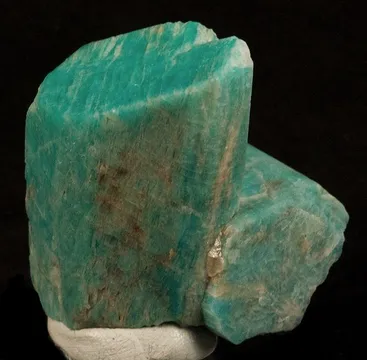
Amazonite is the signature mineral of Smoky Hawk, occurring as turquoise to deep blue-green blocky and tabular microcline crystals, commonly associated with smoky quartz and white platy cleavelandite; published locality data describe the habit as blocky to tabular, the color as turquoise with some white stripes or caps, and the quality as world-class. The best pieces come from major miarolitic pockets on the Smoky Hawk trend, especially named pockets such as Legacy, Lucky Monday, Smithsonian, and Icon, where the amazonite is richer and deeper than the light to medium bluish green material typical of much of the Pikes Peak Batholith. What separates the best Smoky Hawk amazonite from ordinary fragments is saturated, even blue-green color; complete three-dimensional crystals; sharp terminations and clean faces; natural association with dark smoky quartz; and, in the most sought-after examples, white microcline caps or stripes and subtle teal-to-green bicoloration rather than dull, iron-stained, cleaved, or isolated feldspar.
Quartz at Smoky Hawk is primarily the pocket-forming partner of microcline, present as smoky quartz crystals, broken crystal shards, secondary overgrowths, and less commonly paler or milky material in pegmatite cavities; in the best pockets it occurs as well-terminated prismatic crystals rising from amazonite clusters, while in ruptured pockets it may be present only as sharp fragments or detached single crystals. The locality’s quartz is valued most when it remains in natural, balanced combination with deep blue-green amazonite and cleavelandite, especially on plates where the quartz crystals are not merely tucked into clefts but visibly anchor the composition. Ordinary quartz from the claim may be dark but detached, etched, broken, or coated; fine pieces show clean terminations, good transparency or translucency through the smoky color, undamaged prism edges, and convincing pocket provenance.
Smoky quartz is the dramatic dark counterpoint to Smoky Hawk amazonite, usually forming very dark brown to black prismatic crystals with a characteristic satin luster rather than the glassy shine of many alpine quartz localities. Dorris noted that smoky quartz from the Smoky Hawk trend tends to show more consistent dark coloration than much district material and may have tapered terminations, including tessin-like habits; Legacy-pocket crystals reached 12 inches by 4.5 inches in the reported pocket suite, while cabinet specimens more commonly show crystals from a few centimeters to several inches. The finest Smoky Hawk smoky quartz is not simply black—it is sharp, lustrous, undamaged, and compositionally placed against vivid amazonite, preferably with cleavelandite or minor fluorite, whereas broken tips, detached quartz, internal fractures, heavy oxide coatings, and dull etched faces quickly move a specimen down in quality.
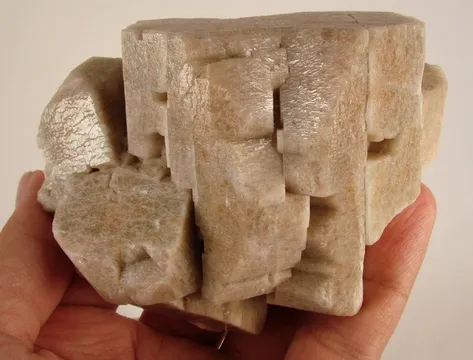
Microcline at Smoky Hawk includes both ordinary feldspar and the prized blue-green variety amazonite, but the locality is unusual because a high proportion of collectible pockets produce strongly colored amazonite rather than only common microcline with smoky quartz. Non-blue to pale microcline can occur as matrix, caps, stripes, and associated feldspar, while white caps and stripes on some Smoky Hawk amazonite have been interpreted as microcline rather than a foreign coating. Strong microcline specimens from the claim show sharp feldspar morphology, crisp twinning or cleavage texture, clean terminations, and architectural placement with quartz or cleavelandite; ordinary material is abundant as cleaved, bruised, massive, or pale feldspar fragments and is valuable chiefly when it helps support an aesthetic amazonite-smoky quartz composition.
Cleavelandite, the platy variety of albite, is one of the minerals that gives Smoky Hawk combinations their depth and complexity: white, bladed rosettes and aggregates form pockets, nests, and ledges around which amazonite and smoky quartz can be arranged. In the Legacy pockets, many amazonites and smokies were reported with large-bladed cleavelandite, and the major pocket assemblage of the Smoky Hawk trend is repeatedly described as dominated by amazonite, smoky quartz, and cleavelandite. Fine cleavelandite on Smoky Hawk specimens is crisp, white, and textural without overwhelming the blue-green feldspar; lesser examples are stained, clay-filled, crushed, or present only as background matrix, but even then they can be important provenance clues because cleavelandite-rich architecture is characteristic of many of the claim’s better pocket plates.
Fluorite is a secondary but important Smoky Hawk species, appearing in the claim’s NYF pegmatite assemblage and in sublocality records such as the Hawk Feathers pocket, where it is documented with albite, cleavelandite, microcline, amazonite, quartz, and smoky quartz. Collectible fluorite from Smoky Hawk is far scarcer than amazonite or quartz, and it is most desirable when it occurs as distinct cubes or accents on amazonite, smoky quartz, cleavelandite, or lustrous iron-oxide pseudomorphs rather than as damaged isolated fragments. Good pieces are judged by sharp cube form, attractive color or clarity, intact edges, and association; the strongest examples add a rare third color and species to the classic blue-green-and-black combination without looking artificially busy.
Albite is documented at Smoky Hawk both as the species itself and as cleavelandite, and it forms part of the feldspar framework of the miarolitic pegmatite pockets. As ordinary albite it is usually less visually dominant than amazonite, smoky quartz, or bladed cleavelandite, but it matters mineralogically because it is part of the sodium feldspar component of the pocket assemblage and provides matrix, contrast, and sometimes the platy habit collectors describe under the cleavelandite name. The best albite-bearing Smoky Hawk pieces are not collected as albite specimens in the narrow sense; they are amazonite-smoky quartz plates whose white feldspar is clean, well formed, and compositionally useful, while stained, crumbly, or anonymous albite matrix has little independent collector value unless tied to a documented named pocket.
Beyond the principal display minerals, Smoky Hawk has produced a remarkable specialist suite. Documented species and groups include bastnäsite, bertrandite, cassiterite, columbite-(Fe) or ferrocolumbite, genthelvite, goethite, hematite, hydroxylapatite or apatite, milarite, monazite-group minerals, phenakite, rutile and niobium-rutile, siderite or other rhombohedral carbonates, topaz, xenotime, zircon, and manganese oxides including analyzed cryptomelane-dominant material. The claim is not known chiefly as a type locality; its scientific weight lies instead in how actively mined pocket debris has yielded both museum-scale amazonite-smoky quartz plates and tiny vugs of rare species measured in millimeters. Genthelvite is especially notable from the Lucky Monday environment, while later work by Thomas Cheatham, Brad Meese, Mark Jacobson, Joseph Dorris, Markus Raschke, and others brought attention to microminerals that many collectors would otherwise overlook in the shadow of the big blue feldspars.
The central authenticity issue with Smoky Hawk specimens is not usually fake material in the sense of synthetic crystals. The greater concern is locality inflation, pocket-name inflation, and incomplete disclosure of preparation. “Pikes Peak,” “Lake George,” “Crystal Peak,” “Florissant,” “Smoky Hawk,” “Smoky Hawk trend,” and named pockets such as Lucky Monday or Icon are not interchangeable labels. A general Crystal Peak amazonite-smoky quartz combination should not be upgraded to Smoky Hawk without credible provenance, and a Smoky Hawk specimen should not be assigned to Legacy, Lucky Monday, Smithsonian, Icon, Blue Moon, Black Crown, or another pocket without a label, miner record, publication, invoice, old collection history, or other chain of evidence.
Cleaning, repair, and restoration are normal for this locality and should be evaluated with maturity rather than reflexive suspicion. Pikes Peak Batholith amazonite-smoky quartz pockets commonly rupture, collapse, stain, and clay-fill after crystallization. Important plates may be recovered as interlocking pieces from pocket debris, and many significant specimens require fitting, adhesive repair, careful chemical cleaning, and sometimes restoration of small gaps. Dorris has been unusually explicit that almost all significant amazonite-smoky quartz combinations from this environment go through some form of cleaning and preparation, and dealer listings from Smoky Hawk commonly disclose one or more repairs. A well-repaired Smoky Hawk combination with no distracting fill, no visible glue lines, and a natural pocket relationship can remain highly desirable; undisclosed repairs, visible fills, saw marks, mismatched crystals, or overly aggressive restoration materially reduce confidence and value.
Condition problems are predictable. Amazonite cleaves readily and can show bruised corners, missing caps, open cleavage cracks, iron penetration, or manganese staining. Smoky quartz may have broken or reglued tips, chipped prism edges, internal fractures, detached crystals, dull etched surfaces, or secondary coatings that either improve luster or trap contaminants. Cleavelandite can be fragile and difficult to clean. Goethite, hematite, iron oxides, clay, and manganese oxides may be either attractive accessories or destructive coatings; manganese staining is especially difficult to remove, and hematite blebs may leave pits even after cleaning.
Collectors should examine Smoky Hawk pieces from several angles. Look for color continuity in the amazonite, natural contact relationships between quartz and feldspar, matrix integrity, repaired joins on quartz bases, feldspar cleavage surfaces that might be mistaken for glue lines, and unusual weight distribution that suggests a reconstructed plate. On named-pocket material, retain every label and invoice. A small, documented, unrepaired or lightly repaired Smoky Hawk miniature may be more meaningful than a larger but vague “Colorado amazonite” cluster.
Fluorescence is not the selling point for the standard amazonite-smoky quartz assemblage, though apatite or unusual late-stage minerals from the broader Crystal Peak area may respond under shortwave ultraviolet. In practical handling, avoid ultrasonic cleaning, heat shock, harsh acids, and prolonged soaking of repaired pieces. Even water can reach old glue lines or clay-filled seams. Dust with a soft brush, handle from the matrix rather than by quartz points or feldspar crystals, and assume that large repaired plates should be supported from beneath.
Market availability is better than for many historic Colorado classics because the Dorris family’s modern production placed many documented pieces into circulation, and current dealer inventories still show Smoky Hawk and Smoky Hawk-trend material. That said, the market is stratified. Singles, fragments, repaired small cabinets, and modest combinations are obtainable; balanced, deep-color, cabinet-size combinations with clean dark smokies are much scarcer; and major named-pocket plates with white caps, strong cleavelandite architecture, fluorite, or museum history are legitimately rare. The best material is no longer just “pretty Colorado amazonite”—it is a documented product of a specific modern mining campaign, and pricing increasingly reflects that provenance.
On June 27, 2005, the Smoky Hawk season was still uncertain. Joe Dorris and his son Tim had been running a track hoe since June 10 and had found good material, but nothing that changed the year. Robert Quist was operating the excavator across a 35-foot working face when a thick pegmatite emerged at the far right, dipping down from right to left. It widened to about a foot. Eight feet along the pegmatite and about six feet below the surface, rusty red patches and large smoky quartz chunks appeared—the kind of sign every pocket miner learns to respect.
That same day, while Tim Dorris and Leonard Himes worked one spot, Joe Dorris and Isaias Casanova began another roughly 20 feet away, where an old hand dig had stopped just short of something better. Both openings began to yield crystals. The first pocket became 05-056; the second, 05-057. Both were heavily iron-stained, but the amazonite underneath looked deep blue green, and 05-056 showed white caps. The hour was late, so the pockets were packed with newspaper and buried for the night.
The next several days proved that the first pocket was not a tease. Tim collected about 20 flats from 05-057. Smoky quartz crystals reached eight inches, amazonites reached four inches, and many groups were set with large-bladed cleavelandite. On July 2, Scott Dorris joined the operation during a short leave from Air Force navigator training. Joe meant to keep the excavator productive until midafternoon, but Scott appeared over the edge with the sentence that ends all scheduling: “Hey, Dad. We need your help pulling out a plate.”
The pocket looked like a small cave, about four feet wide and four feet high. Tim was partly inside it, clearing a ceiling plate that had fallen face down. The plate was about 18 inches across and too heavy for one person. Scott and Tim pried it up, pulled it straight out, turned it over, and a huge smoky quartz came into view above large amazonites with white stripes and caps. The machine stopped. The day’s rent no longer mattered. They washed the plate, searched for missing fits, and by dusk had filled 22 flats and a couple of crates from that pocket alone.
The night brought the ugly counterpoint to the discovery. Because the pocket still held material, the family repacked it and buried it, intending to return after taking a day with Scott. Someone on the mountain had evidently seen the excitement. During the night, the pocket was dug up, the newspaper removed, and the remaining specimens taken. The major plate survived, but some fine white-cap and white-stripe combinations disappeared into the world without the clean provenance they should have had.
The numbers from the Legacy pockets are still startling. Pocket 05-057 became two interconnected chambers measuring about 7.5 feet long, 3 feet deep, and 1 foot high, and filled 24 flats and packing crates. Pocket 05-056 measured about 5.5 feet wide, 3.5 feet deep, and 2 feet high, and filled 22 flats and crates. The largest smoky quartz crystals reached 12 inches long by 4.5 inches in diameter. Some of the largest amazonite crystals reached 4.5 inches tall by 3.5 inches wide. The specimens were so heavily crusted with red iron oxides that cleaning took hundreds of hours; later, the great plate—The Legend—went through eight months of fitting and then laboratory cleaning by Collector’s Edge from about March 2006 until September 2007. The Martin Zinn family ultimately purchased The Legend and donated it to the Colorado School of Mines Geology Museum.
Six years later, Lucky Monday began as a bad day. On Monday morning, June 13, 2011, the big John Deere 992 excavator would not start. The crew tried starter fluid, fuel filters, air filters, pumping fuel, draining air, water, batteries—nothing worked. The smaller John Deere 690 went into the main excavation instead, where the crew had been following a pegmatite that had shown common microcline but no season-saving pocket.
Then the machine stopped. Tim Dorris had found an opening into a cavity, first only about 15 by 10 centimeters. A pick handle went in to the hilt. A tape measure followed: 60 centimeters, then 90 centimeters, then 1.16 meters before stopping. The pocket appeared as a black void, large enough to raise the most dangerous emotion in pocket mining: hope. When they opened it carefully, the first signs were only shards and breakdown. Then Tim pulled out the specimen later known as Two Pillars: two long smoky quartz crystals rising from bright amazonite, intact enough to turn a failing season into a famous one. The Lucky Monday pocket would become one of the great named modern Smoky Hawk finds.
The 2012 Icon Pocket pushed Smoky Hawk from specialist fame into public mineral lore. The Dorris family uncovered the pegmatite at the end of June, and excavation continued on and off through July because High Noon Productions was filming for the television series Prospectors. The largest cavity was kite-shaped, about six feet wide and eight and a half feet long, and it produced roughly one ton of amazonite and smoky quartz crystals. From that material, a plate nearly three feet by two feet was assembled into the Smoky Hawk King, now associated with the Denver Museum of Nature & Science. It was a television moment, but more importantly it was a mineralogical one: a major Colorado pocket recorded while the modern collector world watched.
There are smaller stories in the same dirt. In 2017 and 2018, etched gemmy topaz crystals turned up in Smoky Hawk mine debris. In 2009, Joseph Dorris recovered a handful of loose phenakites from the Buckner pegmatite on the Smoky Hawk claim. Thomas Cheatham, collecting with permission from abandoned pocket debris, spent years finding tiny vugs that yielded anatase, rutile, niobium-rutile, xenotime, monazite, synchysite, and bastnäsite with Brad Meese helping document the microminerals photographically. In September 2021, Derek Leidy opened an amazonite-smoky quartz pocket with clusters of flat bladed bertrandite, the largest crystal in one cluster only 4 by 7 millimeters. Smoky Hawk is famous for plates measured in feet, but some of its best mineralogical evidence fits under a microscope.