






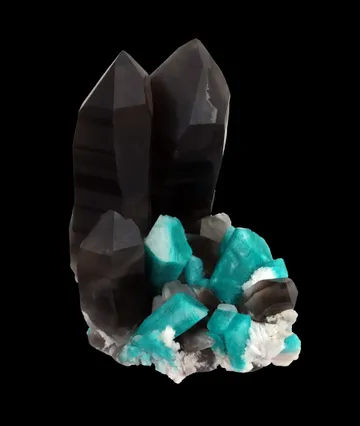
Crystal Peak, Colorado pegmatite locality famed for blue-green amazonite with smoky quartz, a historic collecting ground with benchmark pockets and key specime…
Key facts
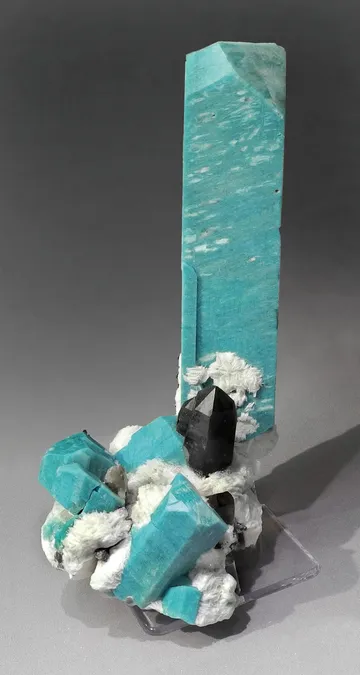
Crystal Peak is one of the great American specimen localities: a Colorado pegmatite field where the collector’s ideal of color contrast—blue-green amazonite locked with dark smoky quartz—was not merely produced, but repeatedly produced at world-class level. The locality lies in the Pikes Peak batholith near Florissant, Lake George, and Crystal Creek, where Proterozoic granite and its late-stage pegmatitic differentiates developed open miarolitic cavities. In those cavities, crystals grew into free space rather than remaining trapped as ordinary grains in solid rock. The best Crystal Peak specimens have a look that is instantly recognizable: blocky triclinic microcline, often amazonite, in saturated teal to blue-green, accompanied by dark brown to nearly black smoky quartz, with white cleavelandite, pale microcline caps or stripes, iron-oxide pocket clay, goethite, hematite, and occasional fluorite supplying the finer details.
The locality matters historically because it has been known to collectors since the nineteenth century and has never quite left the front rank of American field collecting. Early descriptions of the Pikes Peak region already listed amazonstone, smoky and clear quartz, albite, fluorite, columbite, goethite, hematite, zircon, and related species; later writers singled out the Crystal Peak area as one of the oldest and best-known collecting grounds of the Pikes Peak region. Modern mining, especially along the Smoky Hawk trend, transformed Crystal Peak again by reaching deeper pegmatites below the old shallow pick-and-shovel digs. That work produced named pockets and specimens now used as benchmarks: Tree Root, Legacy, Smithsonian, Lucky Monday, Icon, and the Smoky Hawk King among them.
Regional View
Country View
Crystal Peak is not a single mine in the simple sense. On labels and in field usage, the name may cover the mountain, the Crystal Peak mining district, and a family of nearby claims and pocket localities in Teller and adjacent Park County. Labels may read Crystal Peak, Crystal Creek, Florissant, Lake George, Smoky Hawk, Jack Rabbit, Two Point, Take Five, Ute, Dreamtime, Lucky Monday, Ray Ziegler pocket, or other named pockets and claims. Serious collectors should keep those distinctions, because a precise sublocality can carry real mineralogical and market meaning.

Photo:

Search for specimens: View all specimens from Crystal Peak, USA
Crystal Peak is a miarolitic pegmatite locality in the Pikes Peak Granite, part of the wider Pikes Peak batholith of central Colorado. The region’s collectible minerals occur in pegmatite dikes and pods, especially in cavities where late volatile-rich fluids allowed crystals to grow into open space. These are not ore bodies in the usual mining sense; the valuable “ore” is specimen rock—pocket plates, loose crystals, and reconstructed crystal groups from cavities in granite. The Smoky Hawk pegmatites have been described as rare-earth-element pegmatites of the niobium-yttrium-fluorine, or NYF, family, a classification that fits the presence of fluorite, columbite, xenotime, monazite, zircon, bastnäsite, phenakite, milarite, genthelvite, and related accessory minerals.
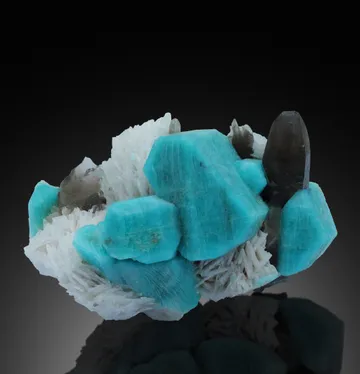
The district’s chief mineralization is the amazonite-smoky quartz-cleavelandite association. In an ideal pocket, microcline crystallized as sharply faced blocky crystals, with some crystals colored as amazonite and some carrying white caps or white stripes of later or differently colored microcline. Smoky quartz developed as prisms ranging from stubby to tapered, with terminations that may be lustrous and nearly black. Cleavelandite commonly forms white platy rosettes or bladed masses that cradle quartz and amazonite. Fluorite, goethite, hematite, biotite or zinnwaldite-group mica, topaz, phenakite, cassiterite, ferrocolumbite, and REE minerals make the difference between a merely handsome combination and a mineralogically rich pocket suite.
Crystal Peak’s collecting history is old by western American specimen standards. Nineteenth-century accounts of the Pikes Peak region already treated amazonstone and smoky quartz as signature minerals, and Willard Wulff’s 1939 account remembered the Crystal Peak area near Florissant as a collector’s paradise known since the early 1870s. For much of the first century, collecting was mostly shallow work: hand digging, probing altered granite, and following pegmatite seams where erosion or earlier pits exposed them. Fine specimens entered private collections, universities, and museums, but production was irregular and pocket documentation was often thin by modern standards.
The modern phase is dominated by claimed ground and mechanized specimen mining. The Smoky Hawk claim, filed by Joe Dorris in December 1998 after years of prospecting by the Dorris family, became the center of a mapped pegmatite trend. Glacier Peak Mining began mechanized exploration there in 2000 and mining in 2003. The productive Smoky Hawk trend has been described as a narrow belt roughly 0.9 miles long and about 0.4 miles wide, with exploration over 185 acres covered by twenty unpatented mining claims. Dorris reported that more than 900 pockets had been excavated by 2016, fourteen of them major pockets, including Dragon’s Mouth, Legacy, Majestic, Smithsonian, Lucky Monday, Chuck’s, and Icon. Earlier and neighboring claims along the same trend include the Dry Hole, Jack Rabbit, and Two Point claims, with the famous Tree Root Pocket discovered in 1997 by Bryan Lees on the Two Point ground.
The key practical advance was depth. Older collectors could reach shallow decomposed granite; modern excavators, limited blasting, and careful benching opened deeper pegmatites, with mining reported down to about sixty feet and more typically thirty feet or less. Even so, the actual pocket work remained hand work. Productive cavities were collected with water, screwdrivers, wrapping paper, patience, and pocket mapping. That matters to collectors because many of the best Crystal Peak plates were not lifted as pristine, ready-to-display cabinet pieces; they emerged from ruptured pockets, heavy iron staining, clay, secondary quartz, and broken crystal rubble, then required months or years of cleaning and skilled reconstruction.
Access today must be treated with seriousness. The Crystal Peak district includes private land, National Forest land, active unpatented claims, club claims, historic pits, and reclaimed workings. Much of the best amazonite-smoky quartz ground is claimed or privately controlled, and unauthorized digging on a claim is not acceptable. Legitimate collecting usually means joining an organized mineral-club trip, obtaining permission from a claim owner, visiting a legal fee or hosted dig when available, or collecting only on ground that has been carefully checked for land status and claim status. For most collectors, the realistic route to top Crystal Peak specimens is the mineral market rather than a casual weekend shovel.
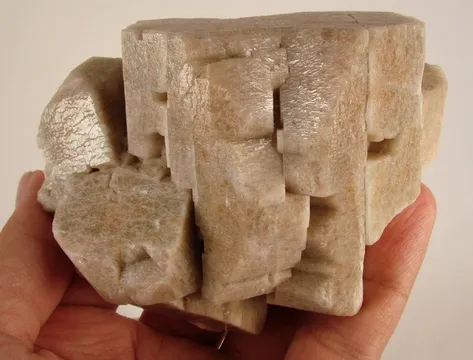
Microcline is the backbone of Crystal Peak: the ordinary pale, cream, tan, white, or salmon feldspar of the pegmatites as well as the blue-green amazonite variety that made the district famous. In Crystal Peak pockets it forms blocky triclinic crystals, commonly sharp and stepped, with twins including familiar feldspar habits such as Carlsbad, Baveno, and Manebach noted from the wider district. The best non-amazonite microcline specimens are not simply “feldspar matrix”; they show crisp individual crystal form, attractive white caps or stripes, good luster after cleaning, and natural association with smoky quartz, cleavelandite, fluorite, goethite, or hematite. Ordinary pieces are dull feldspar masses from weathered pegmatite, while better pieces preserve pocket geometry: separated crystals, open vugs, nested quartz, and the pale feldspar architecture that frames the more colorful minerals.
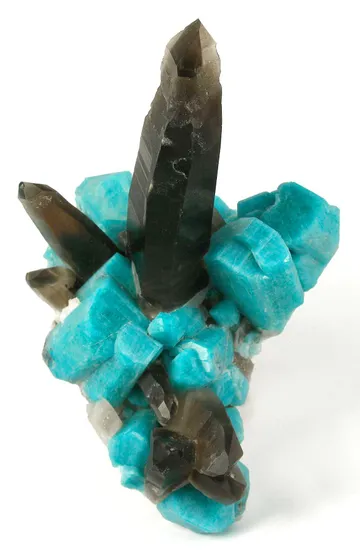
Crystal Peak amazonite is blue-green microcline in blocky crystals, ranging from pale greenish material to the deep teal and saturated blue-green that made the Smoky Hawk trend famous. The most prized pieces show sharp, lustrous amazonite crystals in strong contrast with dark smoky quartz, often on white cleavelandite or pale microcline, and the elite pocket material may show white caps, white stripes, or subtle color zoning from medium blue-green interiors to brighter teal-green outer zones. Published accounts of Smoky Hawk emphasize that its amazonite is generally deeper in color than much of the broader batholith, and that white-capped or white-striped pockets are unusually common there compared with the district as a whole. Small sharp singles are collectible, but the great Crystal Peak amazonites are balanced combination plates: saturated color, clean faces, minimum bruising, stable restoration when present, and credible named-pocket or claim provenance.
Quartz from Crystal Peak ranges from clear to smoky and, more rarely, amethystine or goethite-included “onegite” material, but its importance at this locality is tied to miarolitic pocket growth rather than sheer abundance. Clear quartz is less abundant than smoky quartz in the classic Crystal Peak assemblage, yet it can occur as lustrous crystals, late overgrowths, and colorless to pale smoky stages associated with microcline, albite, fluorite, goethite, and hematite. Some late quartz records from the Lake George-Crystal Peak area describe goethite included in colorless to amethystine quartz and late amethyst following goethite, giving the quartz suite a richer paragenetic story than a simple feldspar-smoky pair. Good Crystal Peak quartz pieces have sharp terminations, undamaged prism faces, readable pocket context, and association with feldspar or iron oxides; ordinary pieces are merely broken, iron-stained quartz fragments from old diggings.
Smoky quartz is the dramatic dark counterpoint to Crystal Peak amazonite, forming prisms from small thumbnail points to large cabinet crystals, commonly brown-black to nearly black, with a satin to glassy luster and sharp terminations where pocket conditions were favorable. Smoky Hawk material is especially noted for dark color, consistent satin luster, and a tendency in some pockets toward tapered terminations, including crystals described as approaching Tessin habit. In major pockets such as the Legacy finds, smoky quartz crystals reached impressive sizes and occurred with dark blue-green amazonite, cleavelandite rosettes, white caps or stripes, and goethite pseudomorphs after carbonate. The finest pieces are not just dark crystals; they are well-composed groups in which smoky quartz projects cleanly from blue-green feldspar with little tip damage, convincing pocket pedigree, and restoration that is disclosed and structurally sound.
Goethite at Crystal Peak is both a specimen mineral and a pocket signature. It appears as brown to black iron oxide, sharp blades, sprays, coatings, and particularly as pseudomorphs after earlier rhombohedral carbonate such as siderite or calcite, sprinkled on amazonite, smoky quartz, cleavelandite, or pocket matrix. In some Lake George-Crystal Peak pockets, goethite marks a late paragenetic stage after the main smoky quartz-microcline-albite-fluorite assemblage, and goethite-included quartz can produce the purple-toned material collectors call onegite. The best Crystal Peak goethites have distinct crystal form—bladed, rhombic, or pseudomorphous—rather than merely dirty iron stain; on combination specimens, sharp goethite pseudomorphs can add locality character, while pervasive friable oxide crust can obscure or weaken the aesthetics.
Fluorite is a valued accessory in the Crystal Peak pegmatites and a meaningful bonus on amazonite-smoky quartz plates. Historic accounts note fluorite in several forms, especially cubes, ranging from colorless to light bluish green, deeper green, violet, and purple; modern Smoky Hawk records treat fluorite as one of the significant macro minerals accompanying amazonite, smoky quartz, cleavelandite, goethite, and hematite. It may occur as isolated cubes, groups on microcline or albite, and occasional attractive accents on smoky quartz or amazonite. The collector standard is high: good Crystal Peak fluorite should be clearly crystallized, visibly associated rather than hidden in matrix, and not merely a small cleaved chip; the best examples add a purple or green halide note to an already classic feldspar-quartz composition.
Other documented Crystal Peak minerals give the locality much of its depth for advanced collectors. Albite, especially cleavelandite, is a major pocket mineral; hematite occurs as crystals, coatings, and pseudomorphs; topaz and phenakite have been known since early collecting days but are scarce in fine display pieces; cassiterite and ferrocolumbite are important rare-element indicators; and the Smoky Hawk mine and surrounding pegmatites have yielded small but significant occurrences of genthelvite, milarite, monazite, xenotime, zircon, rutile, anatase, bastnäsite, synchysite, bertrandite, and unusual aluminofluorides reported from the broader Crystal Peak area. No single IMA type-mineral identity defines Crystal Peak’s fame; instead, the locality’s importance lies in a classic macro-assemblage supported by an unusually interesting NYF accessory suite.
Crystal Peak material rewards provenance. A label that says only “Colorado” or “Pikes Peak” is less useful than one naming Crystal Peak, Crystal Creek, Lake George, Florissant, or a claim such as Smoky Hawk, Jack Rabbit, Two Point, Take Five, Ute, or a named pocket. Because the district spans a web of claims, old workings, and county-line label habits, older specimens may be honestly labeled in broad terms. Still, for high-value amazonite-smoky quartz combinations, ask for the most precise known locality and prior ownership.
Repairs are common in substantial Crystal Peak combinations, and they are not automatically disqualifying. Many pockets were naturally ruptured, clay-filled, iron-stained, or partly collapsed before recovery, and large plates often required careful cleaning and fitting. A repaired specimen can be entirely legitimate if the work is disclosed, the fit is accurate, and the final piece represents one pocket rather than an assembled fantasy. Undisclosed reattachment, mixed-pocket reconstruction, filled gaps, or added crystals should materially affect value. On important pieces, a black light, magnification, and careful inspection along feldspar-cleavage contacts and quartz bases are prudent.
Condition issues follow the mineralogy. Microcline cleaves readily and bruises along corners and edges; amazonite color may be strong even where faces are incomplete, so sharpness matters. Smoky quartz tips are often the first places to check for chips, rehealed breaks, and reattached terminations. Cleavelandite rosettes can be fragile and undercut. Goethite may be friable in bladed sprays or coatings. Fluorite cleaves and can be edge-worn or internally fractured. Iron oxide crusts are part of the pocket environment, but heavy unremoved crust can conceal damage; overcleaning can leave feldspar etched, chalky, or unnaturally bright.
Treatments are usually preparation rather than color enhancement. Crystal Peak pockets commonly require removal of clay, iron oxides, and secondary coatings, and some specimens spend long periods in professional preparation. There is no need to assume that fine amazonite color is dyed; the locality is famous precisely because natural blue-green microcline occurs there. Polished amazonite carvings, beads, and lapidary goods sold as “Colorado amazonite” may be genuine material, but they are a different collecting category from crystallized Crystal Peak pocket specimens.
Market availability is unusually good for a classic American locality because modern production has continued intermittently, yet top pieces remain scarce. Small amazonite singles, smoky quartz crystals, microcline groups, and repaired miniature combinations appear regularly. Fine unrepaired groups, vividly colored white-cap or white-stripe amazonite, balanced smoky quartz-amazonite plates, fluorite-bearing combinations, and named-pocket specimens remain strongly collected. Museum-grade plates with major pocket history are in a different league and should be judged by aesthetics, documentation, preparation quality, and structural honesty.
The modern Crystal Peak story has a family name running through it: Dorris. Joe Dorris and his family turned the Smoky Hawk claim from a promising patch of altered granite into one of the most documented amazonite-smoky quartz specimen mines in the United States. The claim was filed in 1998 after years of prospecting; by 2003, after permitting, the family was producing from deeper pegmatites with excavators, water, hand tools, and a degree of pocket documentation that earlier generations of collectors rarely left behind.
The 2005 Legacy pockets read like the script of a field collector’s best day. Joe and his son Tim had been running a track hoe at Smoky Hawk since June 10, with good but not extraordinary results. On June 27, the eighteenth day of a thirty-day operating budget, two pockets opened about twenty feet apart in the same working face. Pocket 05-056 appeared on one side; pocket 05-057 opened on the other. Both showed the right signs: thick pegmatite, rusty red areas, big smoky quartz chunks, and deep blue-green amazonite hidden under iron oxides. By day’s end the cavities were packed with newspaper and buried.
Pocket 05-057 came first. Over the next several days Tim collected about twenty flats of material from it. The smokies reached eight inches; amazonites reached four inches; many specimens were built around large-bladed cleavelandite. The crystals were iron-stained, but the size and architecture were unmistakable. The family waited to reopen 05-056 until Scott Dorris could arrive for the July 4 holiday weekend, fresh from Air Force commissioning and navigator training. On July 2, with both sons on the mountain, Joe bracketed the pocket with the excavator and left Scott and Tim to work it while he kept the machine running elsewhere.
Then Scott appeared at the edge of the dig with the sort of sentence every pocket miner wants to hear: “Hey, Dad. We need your help pulling out a plate.” Joe thought he was being teased. When he reached the pocket, it was a small cave about four feet wide and four feet high, with Tim half inside, working behind an eighteen-inch plate that had separated from the ceiling and fallen face down. Scott and Tim pried it loose while Joe filmed. They lifted it like drawing a blade from a scabbard, turned it over, and a huge smoky quartz rose out of blue-green amazonite. The piece would be named the Legend.
Work stopped. Losing a day’s machine rent no longer mattered. Tim washed the plate; white caps and white stripes emerged. The family understood immediately that the specimen was exceptional not only for size, but for color and style. Scott was cautious, calling it the largest white-cap combination; Tim insisted it was the largest good-quality combination, period. Joe agreed that, among large known amazonite-smoky quartz plates, this one had the color, the caps, the stripes, cleavelandite, and goethite pseudomorphs to stand apart. The pocket ultimately filled twenty-two flats and crates, while the earlier pocket filled twenty-four. The largest smoky quartz crystals from the two pockets measured up to twelve inches long and 4.5 inches across; some amazonites reached 4.5 by 3.5 inches. Cleaning consumed hundreds of hours, and final preparation of the Legend ran from about March 2006 into September 2007. The Martin Zinn family later purchased the specimen and donated it to the Colorado School of Mines Geology Museum, where its status as a record white-cap and white-stripe Crystal Peak specimen was secured.
That same Legacy story carries a darker field lesson. After the family buried the still-productive pocket for the night, someone returned to the mountain, dug it out, removed the newspapers, and stole remaining specimens. Joe did not believe the missing pieces would have completed the Legend, but he knew fine combination specimens were gone. In a district where pockets may be only feet from old digs, and where good news travels fast, the episode explains why serious claim owners guard access and why ethical collecting is not an abstraction at Crystal Peak.
Three years later, the 2008 Smithsonian pocket gave the Smoky Hawk story another defining scene. That season began with doubt. The Dorris family had invested thirty-four days of heavy-equipment work at Site B, encountered hard unaltered granite, and considered whether the area had run its course. To reach deeper structure, Joe spent the winter and spring amending permits to allow blasting. On June 9, 2008, they began site preparation; by June 11, they were drilling eight-foot holes into a granite knob, shooting it, and clearing rubble. Early pockets were good but not conclusive. Heat, wind, thunderstorms, equipment problems, broken truck parts, and the constant cost of teeth and repairs formed the background music of the mine.
On June 19, a group from the Colorado Springs Mineralogical Society visited, along with Mike Wise from the Smithsonian. While visitors helped work several small pockets, a seam of exceptionally colored amazonite appeared about eight feet down, running horizontally across the pegmatite rather than following its dip. At first it looked discouraging: broken rubble, beautiful color, few intact groups. Then Tim removed about a foot of shards and exposed an open cavity. Smoky tips began appearing from the floor as water washed the pocket clean.
Joe started filming and jokingly announced the Smithsonian pocket, with Mike Wise present. Mike demurred. The pocket began to produce excellent singles, but no plates at first. Tim spotted a small plate on the right edge and asked Mike to pull it, giving the practical warning every pocket digger understands: pull straight, don’t wiggle, don’t chip a tip. Joe nearly forgot the camera and then caught the extraction. Mike pulled the plate out, turned it over, and the cheering told the story before the specimen could be seen clearly. Wet from the bucket, it showed five glossy black smokies nested among bright blue-green amazonites and a ball of cleavelandite. It measured about five by 4.5 inches, carried smokies to 2.5 inches and amazonites to 1.5 inches, and was intact—no damage, no missing crystals. Mike conceded the name.
The Smithsonian pocket did not yield endless plates, but it filled sixteen four-inch flats by the time it was finished, and the material covered three six-foot tables, a card table, two TV trays, and part of another shelf when laid out for assembly. Its best plate became one of the district’s great unrepaired specimens, proving that even in a field famous for reconstruction and ruptured pockets, Crystal Peak could still produce a perfect natural composition.
The most public Crystal Peak discovery came in 2012. At the end of June, the Dorris family opened a large pegmatite on the Smoky Hawk claim while High Noon Productions was filming for the television series Prospectors. The largest cavity was kite-shaped, roughly six feet wide and 8.5 feet long, and produced about one ton of amazonite and smoky quartz crystals. From that material came the Smoky Hawk King, an assembled plate nearly three feet by two feet, described as Colorado’s largest high-quality amazonite and smoky quartz combination specimen. It went to the Denver Museum of Nature and Science for preparation and display, making the find not just a pocket story but a public museum event.
Cross, Whitman, and W. F. Hillebrand, “Minerals from the Neighborhood of Pike’s Peak,” U.S. Geological Survey Bulletin 20, 1885 — Early scientific treatment of Pikes Peak-region minerals, including amazonstone, smoky and clear quartz, fluorite, columbite, goethite, hematite, zircon, and other species known by the early 1880s.
Foord, E. E., and R. F. Martin, “Amazonite from the Pikes Peak Batholith,” The Mineralogical Record, vol. 10, no. 6, 1979, pp. 373–384 — Key modern reference repeatedly cited for Colorado amazonite-bearing pegmatites and their mineralogical setting.
Foord, E. E., “Part C—Amazonite-bearing pegmatites of the Lake George center,” in Černý and others, Trip 12—Granite Pegmatites of the Black Hills, South Dakota and Front Range, Colorado, Geological Association of Canada Guidebook, 1982, pp. 51–59 — Field-guide treatment of the Lake George-Crystal Peak amazonite pegmatites.
Kile, D. E., and D. D. Eberl, “Crystal growth mechanisms in miarolitic cavities in the Lake George ring complex and vicinity, Colorado,” American Mineralogist, 1999 — Important scientific paper using Crystal Peak-area amazonite and smoky quartz crystal-size distributions to interpret growth mechanisms in miarolitic cavities.
Dorris, Joseph L., “Amazomite and Smoky Quartz Mining on the Smoky Hawk Claim, Teller County, Colorado,” 36th Annual New Mexico Mineral Symposium, 2015, pp. 11–12 — Primary account of the Smoky Hawk claim, its NYF pegmatites, the 2012 Smoky Hawk King find, pocket statistics, claim history, and mining methods.
Dorris, Joseph, “Amazonite and Smoky Quartz Pegmatites of the Smoky Hawk Trend, Teller County, Colorado,” Second Eugene E. Foord Pegmatite Symposium abstract volume, 2016, pp. 29–30 — Detailed summary of the Smoky Hawk trend, major named pockets, structural controls, amazonite color, white caps and stripes, smoky quartz habit, and production limits.
Jacobson, Mark Ivan, Brad Meese, Thomas Cheatham, Joseph Dorris, and Markus Raschke, “Crystal Peak: Lesser Known Mineral Finds,” 42nd Annual New Mexico Mineral Symposium, 2022, pp. 12–13 — Essential recent account of Crystal Peak rarities, including topaz, phenakite, cassiterite, ferrocolumbite, genthelvite, milarite, monazite, xenotime, bertrandite, synchysite, bastnäsite, anatase, rutile, and unusual aluminofluorides.
Willard W. Wulff, “The Mineral Localities of the Pikes Peak Region,” 1939; reprinted in the Friends of Mineralogy, Colorado Chapter newsletter, May 2016 — Historic collector’s view of Crystal Peak as an early and prominent collecting field, with notes on microcline, smoky quartz, fluorite, albite, topaz, phenakite, goethite, columbite, hematite, and pseudomorphs.
Pinnacle 5 Minerals, “Summer 2005 – Story of the Legend and the Legacy Pocket” — First-person account of the Legacy pockets and the Legend specimen, later donated to the Colorado School of Mines Geology Museum by the Martin Zinn family.
Pinnacle 5 Minerals, “Season 2008 and Smithsonian Pocket” — First-person account of the Smithsonian pocket, including its intact five-by-4.5-inch amazonite-smoky quartz-cleavelandite plate.
Mindat: Crystal Peak, Teller County, Colorado, USA — Locality page with mineral list, sublocalities, references, and photo-linked occurrence data.
Mindat: Crystal Peak area, Park County, Colorado, USA — Useful companion locality page for the adjacent and historically intertwined Lake George-Crystal Peak collecting area.
Mindat occurrence: Amazonite from Smoky Hawk claim, Crystal Peak, Teller County, Colorado, USA — Claim-specific occurrence page tying amazonite to the Smoky Hawk claim and its literature.
U.S. Geological Survey: Crystal growth mechanisms in miarolitic cavities in the Lake George ring complex and vicinity, Colorado — Scientific framework for understanding why Crystal Peak pocket crystals grew as they did.
New Mexico Mineral Symposium: Dorris 2015 Smoky Hawk abstract — Best concise source for the Smoky Hawk King, pocket counts, mining depths, and modern Smoky Hawk production.
Second Eugene E. Foord Pegmatite Symposium abstract volume, 2016 — Includes Joseph Dorris’s Smoky Hawk trend abstract and broader Colorado pegmatite context.
New Mexico Mineral Symposium: “Crystal Peak: Lesser Known Mineral Finds,” 2022 — Best compact source for rarer Crystal Peak minerals and recent micromineral documentation.
Pinnacle 5 Minerals: Crystal Peak Area Minerals — Current producer/dealer page showing the range of Smoky Hawk and Crystal Peak-area species, including goethite, fluorite, cleavelandite, hematite, and rarities.
Pinnacle 5 Minerals: Stories archive — First-person mining stories from Joe Dorris, including the Legend, Smithsonian, Christmas, Betty Jean, and later Smoky Hawk seasons.
Wikimedia Commons: Smoky Hawk amazonite and smoky quartz photograph by Rob Lavinsky — Open-license image of a classic Smoky Hawk combination specimen from the Night Hawk Pocket.
Wikimedia Commons: Jack Rabbit Mine amazonite and smoky quartz photograph by James St. John — Open-license photograph of a Crystal Peak-area Jack Rabbit Mine amazonite-smoky quartz combination.
_2.jpg)
