






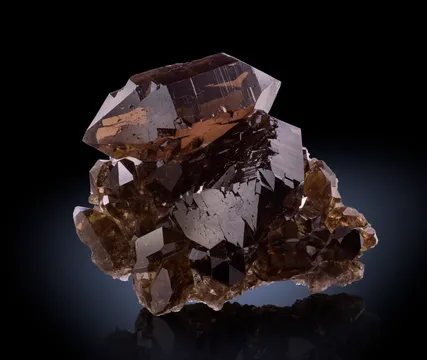
Crystal Peak smoky quartz – dark, sharply terminated crystals with satin luster, often paired with amazonite; a Colorado classic from the Pikes Peak batholith.
Key facts
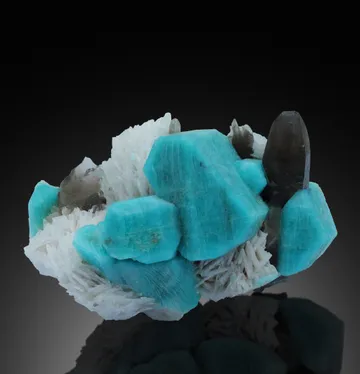
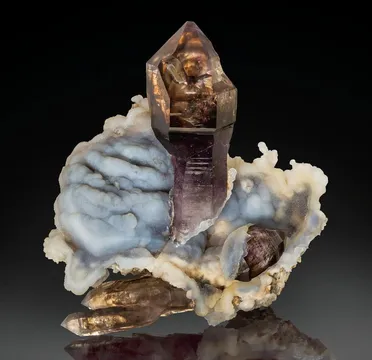
Crystal Peak smoky quartz is one of the great American pegmatite classics: dark, sharply terminated quartz from miarolitic cavities in the Pikes Peak batholith, most famously displayed with robin’s-egg to deep teal amazonite. The best specimens have an almost graphic contrast—near-black quartz spears rising out of blue-green microcline, sometimes cushioned with white cleavelandite or touched by pale fluorite. For many collectors, that color pairing is the signature look of Colorado mineralogy.

Photo: Wikimedia Commons
The locality sits in the larger Lake George–Crystal Peak part of the Pikes Peak batholith, a Precambrian granitic complex whose late-stage pegmatites developed open cavities. Those cavities allowed quartz, microcline, albite, fluorite, goethite, hematite, mica, and rarer accessory species to grow as free-standing crystals rather than as locked grains in solid granite. In this setting smoky quartz is not merely an accessory; it is the dark architectural mineral that gives the locality’s amazonite combinations their drama.
The Crystal Peak area has been worked by collectors since the late nineteenth century and remains active through modern claim mining. Its historical importance rests on continuity: old hand-dug pockets, twentieth-century commercial and tourist collecting, and recent mechanized specimen mining have all produced material recognizable as “Colorado classic.” The most admired modern pieces, especially from the Smoky Hawk trend, are not just quartz crystals; they are carefully recovered, cleaned, and often painstakingly reassembled pocket sculptures.

Photo: Wikimedia Commons
Collectors look first for locality character: black to deep brown smoky quartz with natural satin luster, sharp prism faces, clean terminations, and credible association with amazonite, cleavelandite, fluorite, or pocket goethite. A single smoky crystal from Crystal Peak can be handsome, but the locality’s highest appeal is in balanced combinations where the quartz is both prominent and compositionally integrated with the feldspar.
Search for specimens: View all smoky-quartz specimens from Crystal Peak, Colorado, USA
Crystal Peak is a peak and mineral district locality in Teller County, north of Florissant and near the Lake George intrusive center. The smoky quartz occurs in miarolitic granitic pegmatites of the Pikes Peak batholith. These pegmatites are not ore bodies in the conventional metallic-mining sense; they are specimen deposits—pocket-bearing, volatile-rich late-stage granitic bodies where open cavities preserved euhedral crystals.
The most productive modern part of the district is the Smoky Hawk trend, a narrow pegmatite trend within the Crystal Peak mining district. Joseph Dorris described these pegmatites as rare-earth-element pegmatites of the niobium-yttrium-fluorine family, notable for abundant miarolitic cavities producing amazonite, smoky quartz, and cleavelandite. The same trend has produced fluorite, goethite, hematite, mica formerly called zinnwaldite in older literature, and an impressive suite of rarer species including bastnäesite, bertrandite, cassiterite, milarite, monazite, phenakite, rutile, xenotime, zircon, topaz, calcite, ferro-columbite, and genthelvite.
The district’s older collecting was done largely with picks, shovels, and shallow trenching. Modern production changed the scale. On the Smoky Hawk trend, mechanized work opened deeper pegmatites that earlier collectors could not practically reach. Even where excavators and limited blasting expose the pegmatite, the pocket work remains hand work: the desirable crystals are still extracted slowly, with water, small tools, and careful mapping of pocket fragments.
Access is a serious matter at Crystal Peak. The area includes private land, National Forest ground, and many active or historical unpatented mining claims. A valid claim controls the minerals within its boundaries, and collecting without permission is trespass and claim jumping. Serious collectors should treat the district as a permission-only locality unless they have confirmed land status and claim status independently. Organized club visits and arranged claim visits are the safest legitimate routes where available; casual digging on someone else’s claim is not part of responsible Colorado collecting.
Production has been episodic rather than continuous. Individual pockets matter more than tonnage. Named finds and claims—Jack Rabbit, Dry Hole, Two Point, Dreamtime, Smoky Hawk, Lucky Monday, Icon, and others—carry weight because they connect a specimen to a particular pocket style, mining period, or collector history. Notable finds include the 1986 Keyhole vug, the 1997 Tree Root Pocket, the Lucky Monday pocket of 2011, and the 2012 Icon/Smoky Hawk King discovery that produced one of the district’s largest high-quality amazonite and smoky quartz plates.
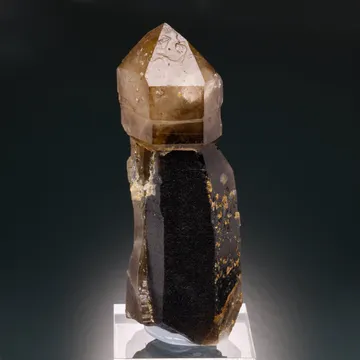
Crystal Peak smoky quartz ranges from transparent gray-brown and root-beer brown through very dark brown to nearly black. Fine crystals often look opaque in normal display lighting but reveal brown translucency when strongly backlit. This is a useful locality clue: many high-quality Crystal Peak smokies are dark without looking like glassy black plastic. Their surfaces commonly show a satin luster rather than the brilliant glassy luster collectors associate with alpine quartz.
The typical habit is prismatic quartz with rhombohedral terminations, often stout to elongated. Smoky Hawk material in particular has been noted for a tendency toward tapered terminations, including some crystals approaching tessin habit. In combination specimens the quartz may stand as a single dominant spear, appear as paired or parallel crystals, or form several dark points distributed across an amazonite matrix. Aesthetic pieces depend heavily on how well the quartz contrasts with and rises above the feldspar.
Size is highly variable. Thumbnail and miniature crystals are common in recovered pocket debris, but cabinet specimens with smoky quartz crystals several centimeters long are the collector standard. In the Lucky Monday pocket, reported smoky quartz crystals ranged from about 2.5 to 22 cm long and 1 to 10 cm in diameter. Major modern plates can carry quartz crystals in the 10–20 cm range, though specimens of that caliber are rare and usually come with significant preparation histories.
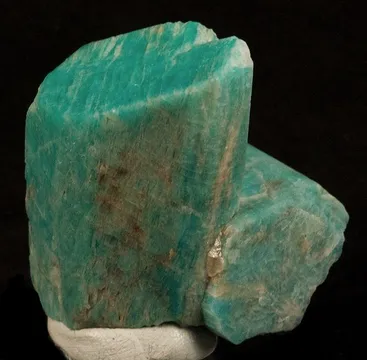
The classic associations are microcline var. amazonite, albite var. cleavelandite, fluorite, goethite, hematite, and mica. Amazonite is the prestige partner: blue-green, teal, or locally white-capped microcline crystals that set off the dark quartz. Cleavelandite occurs as white platy albite rosettes or laths, sometimes filling contacts between quartz and feldspar. Fluorite, when present, is usually a later-stage accessory, commonly pale green to blue-green and often etched. Goethite and hematite are common enough to be expected, either as attractive late pocket minerals or as the staining and coating that make many pockets unrecoverable as fine specimens.
Quality at Crystal Peak is judged by more than darkness. A top smoky quartz specimen should have intact terminations, minimal bruising, natural surface texture, sharp edges, and a pleasing relationship to the amazonite or matrix. On combination pieces, the quartz should not be visually lost among bulky feldspars; the best examples have dark quartz crystals placed so they create height, direction, and contrast. Cleaned but not overworked surfaces are valued. Heavy iron or manganese staining, dull etched faces, broken tips, and obvious glue lines all reduce desirability.
Crystal Peak smoky quartz has a distinctive and well-documented authenticity problem, but it is not chiefly a problem of synthetic crystals. The issue is preparation, repair, restoration, and disclosure. Many important pockets collapsed or ruptured before discovery, and many major specimens were recovered as matched pieces that required careful reassembly. In this locality, repair is not automatically a condemnation; it is part of the collecting culture. What matters is whether the work is disclosed, whether it is limited to natural fits, and whether restoration has crossed into visual reconstruction.
Major Smoky Hawk and related amazonite-smoky quartz specimens should be examined with a strong light, magnification, and attention to contact points between quartz and amazonite. Fit repairs may be nearly invisible because the original crystal contacts are unique and interlock like a puzzle. Simple repairs may show only faint lines. Restorations may include fills along gaps or near bases. Reconstructed tips or rebuilt crystal faces are a more serious matter and should be explicitly described in sales records.
The most common condition issues are broken quartz tips, bruised prism edges, cleaved amazonite, detached quartz crystals, pocket clay, iron-oxide staining, manganese-oxide staining, goethite or cryptomelane coatings, and etched surfaces. Hematite or iron-oxide blebs can leave pits even after removal. Manganese staining is especially stubborn. Some pockets contain good shapes that never become good specimens because the staining penetrates the feldspar or because the smoky quartz surfaces are too corroded.
Collectors should also watch for locality inflation. “Pikes Peak,” “Lake George,” “Crystal Peak,” “Smoky Hawk,” and “Florissant” are related but not interchangeable labels. A general Pikes Peak batholith smoky quartz with amazonite may be attractive, but it should not be upgraded to Smoky Hawk, Lucky Monday, Icon Pocket, Jack Rabbit, or Dreamtime without provenance. Named-pocket attribution should come from an old label, miner/dealer documentation, publication, auction record, or direct chain of ownership.
Artificial irradiation is a general smoky quartz concern in the wider market, but it is not the defining issue for Crystal Peak collector specimens. The locality naturally produces very dark smoky quartz in granitic pegmatites. A suspiciously uniform, glassy black crystal without plausible Colorado morphology, matrix, or provenance deserves caution, but a dark Crystal Peak smoky on amazonite is not suspect merely because it is black. The stronger warning sign is usually a vague or overconfident label attached to a polished, carved, assembled, or heavily restored piece.
Availability is steady at the small to mid-level and limited at the high end. Single smoky quartz crystals, partial combinations, and smaller amazonite-smoky groups appear regularly from old collections and recent production. Fine cabinet plates with strong amazonite color, prominent dark smoky quartz, attractive composition, and full disclosure of repairs are much scarcer. Major named-pocket pieces are trophy specimens and may trade privately, through specialty dealers, or at major mineral auctions.
In the summer of 2012, the Dorris family opened what became one of the defining modern pockets of the Crystal Peak district. On the Smoky Hawk claim they uncovered a pegmatite that produced several large miarolitic cavities, the largest yielding a specimen now known as the Smoky Hawk King. The discovery came at the end of June, but collecting stretched on and off through the end of July because High Noon Productions was filming the extraction for the television series Prospectors. That is unusually public for a major American mineral pocket: the usual tense, private work of exposing, watering, wrapping, and removing crystals happened under cameras.
The largest cavity in that 2012 find was described as kite-shaped, roughly 6 feet wide and 8.5 feet long. It produced about one ton of amazonite and smoky quartz crystals. From that mass, a plate nearly 3 feet by 2 feet was assembled—the Smoky Hawk King—and the specimen went to the Denver Museum of Nature & Science for preparation and exhibit. The numbers matter because they frame the pocket correctly: not a small lucky vug, not a casual weekend dig, but a major collapsed pegmatite cavity whose best form had to be recovered through mining, mapping, cleaning, and reconstruction of natural relationships.
One year earlier, on June 13, 2011, the Lucky Monday pocket changed what had reportedly been an otherwise discouraging season. The pocket took its name from that Monday discovery and became one of the most celebrated modern Smoky Hawk finds. It was described as a horseshoe-shaped cavity, with each side opening about 0.75 m across. The contents eventually filled 55 flats—boxes about 10 cm deep by 28 cm by 40 cm. Cleaning and fitting the loose pieces took more than a year, and final cleaning and preparation took another six months.
Lucky Monday produced fourteen large museum-quality specimens over 10 cm, including a largest piece called the “Porcupine,” about 32 cm long, with seven major smoky quartz crystals reaching 15 cm. The pocket also yielded more than 75 single smoky quartz crystals in the 5–15 cm range, more than 75 amazonite crystals in the 2–5 cm range, approximately 50 small amazonite groups without smoky quartz, and several pounds of broken gem-quality smoky quartz and amazonite rough. That mixture—world-class plates and buckets of broken promise—is exactly how Crystal Peak pockets behave.
The Lucky Monday side pocket added another surprise: genthelvite. A pocket adjacent to Lucky Monday yielded the first reported genthelvite crystals from the Lake George district, loose, lustrous, dark maroon, blocky octahedra with reddish halos. One approached 5 cm, a remarkable size for the species. For a district famous to the public for blue-green feldspar and black quartz, discoveries like that remind collectors that the best Crystal Peak pockets are chemically complex pegmatite systems, not just attractive color pairings.
Older stories give the district a different texture. The Keyhole vug, announced in 1986, brought attention to matrix plates of green amazonite and white cleavelandite from Crystal Peak. The Tree Root Pocket, found in 1997 along the Smoky Hawk trend, became another benchmark for rich color and high-quality amazonite-smoky quartz combinations. These named pockets are now part of the locality language. When collectors compare a new Crystal Peak specimen, they are not only asking whether it is pretty; they are asking whether it belongs in the lineage of Keyhole, Tree Root, Lucky Monday, Icon, and Smoky Hawk King.
There are quieter field stories too. A Crystal Peak pocket collected in October 1987 was reportedly found by digging beside an exposed pegmatite in the hope that a new cavity lay off to the side. Crystals appeared almost immediately at grassroots level, and the pocket ultimately contained nearly 500 pounds of crystals. It took almost two days to collect. That episode captures the peculiar tension of the district: the indication can be as modest as an exposed pegmatite and a few fragments of float, but the reward—if the structure opens correctly—can be measured in hundreds of pounds of pocket material.
_1.jpg)
