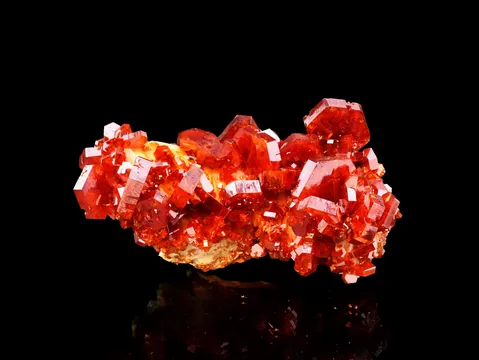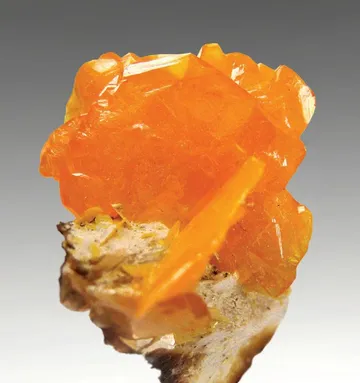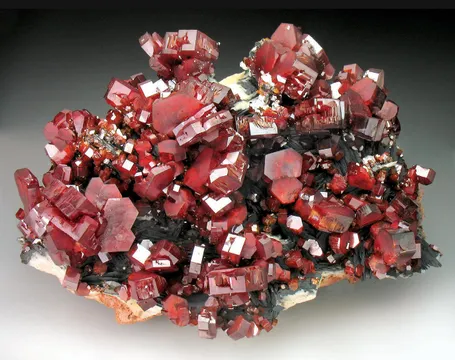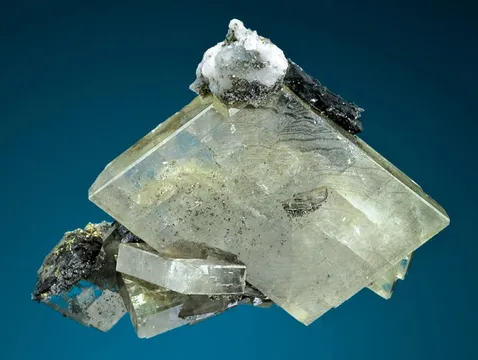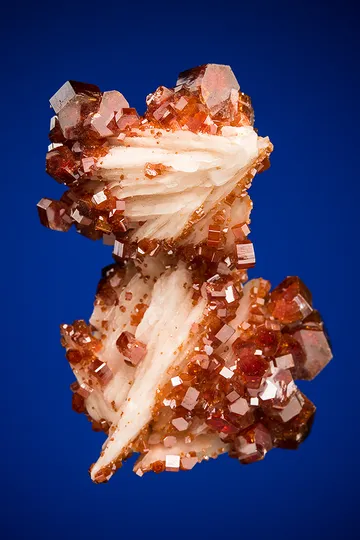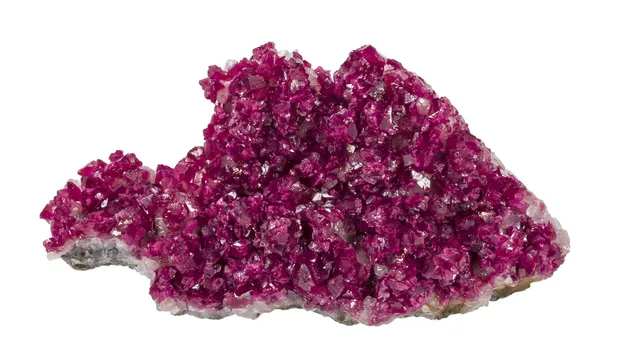
Drâa-Tafilalet Region, Morocco - a mineral province with diverse specimens: Mibladen red vanadinite, Imiter silver, Bou Azzer cobalt, and Oumjrane azurite.
Key facts
Drâa-Tafilalet is not a single mine locality in the tidy old sense; it is a mineral province. For collectors, that distinction matters. The modern administrative region gathers together a spectacular stretch of Moroccan geology: the eastern and central Anti-Atlas with its Precambrian inliers and Paleozoic cover, the Saghro and Ougnat massifs, the High Atlas margins, the Upper Moulouya lead district around Midelt, the desert country around Taouz, and the copper-bearing Maïder terrain around Oumjrane and Alnif. Few collecting regions offer such a dense concentration of recognizable specimen “looks”: red vanadinite on baryte from Mibladen, wire and mossy native silver from Imiter, cobalt-pink carbonates and arsenates from Bou Azzer, blue azurite and green malachite on quartz from Oumjrane and M’ssici, brilliant linarite-brochantite plates from Goulmima, and iron-oxide vugs from Taouz.
The geological variety is the reason. In the north, the Upper Moulouya district includes Mibladen’s stratiform lead-baryte-galena mineralization in Jurassic carbonate rocks and the neighboring Aouli vein systems in older rocks. Farther south and southeast, the Anti-Atlas domains carry epithermal silver veins, cobalt-nickel arsenide systems, copper-nickel-lead-zinc veins, manganese deposits, barite veins, and oxidized lead-vanadium occurrences. The result is not one famous assemblage but several overlapping specimen cultures, each with its own collectors’ vocabulary: “Mibladen red,” “Imiter silver,” “Bou Azzer cobalt,” “Oumjrane azurite,” and “Taouz goethite.”
Historically, the region spans medieval workings, French colonial mining camps, mid-20th-century industrial lead and silver operations, modern corporate mining, and contemporary artisanal specimen recovery. Imiter was worked for silver long before modern mining and remains one of Morocco’s great silver names. Mibladen and Aouli supplied major lead production in the 20th century, then passed into the collector market through dumps, shafts, reworked galleries, and local diggers. Oumjrane-Bou Nahas re-emerged in the 2010s as a first-rate hydrothermal copper-vein specimen locality, while Taouz and Tadaout added a desert iron-oxide and vanadinite style quite different from the classic Midelt material.
The best specimens from Drâa-Tafilalet have strong locality character. Mibladen vanadinite is prized when the crystals are sharp, lustrous, saturated red to orange-red, and cleanly displayed on white, cream, honey, or manganese-coated baryte. Imiter pieces are judged by the sculptural form and freshness of native silver, acanthite, and red silver minerals in pale carbonate or quartz gangue. Oumjrane azurite is best when it shows isolated, highly lustrous, flattened or lenticular crystals rather than anonymous blue crusts. Goulmima pieces stand out when royal-blue linarite blades and emerald brochantite sprays lie crisply on white quartz. Taouz material is at its best when black goethite or hematite gives architecture rather than mere stain.
Regional View
Country View

Photo: Wikimedia Commons

Photo: Wikimedia Commons
Because the region is so broad, serious collectors should read a Drâa-Tafilalet label with care. “Morocco” is too vague; “Drâa-Tafilalet” is still only a regional attribution. The real scientific and market value lies in the district and mine name: Mibladen, Aouli, Sidi Ayad, Imiter, Bou Azzer, Bou Nahas, Oumjrane, El Fecht, Goulmima, Taouz, Tadaout, Imini, or another named occurrence. The difference is not academic. A red vanadinite on baryte, a blue azurite on quartz, and a black goethite stalactite may all be honestly Moroccan, but they record very different ore systems.
Search for specimens: View all specimens from Drâa-Tafilalet Region, Morocco
Drâa-Tafilalet occupies a mineralogical crossroads between the Atlas ranges and the Sahara-facing Anti-Atlas. The region includes the provinces of Midelt, Errachidia, Tinghir, Ouarzazate, and Zagora, and its specimen localities sit in several different geological domains. To the north are the High Atlas and Upper Moulouya districts; to the south are the Saghro-Ougnat and Maïder-Tafilalet parts of the Anti-Atlas, where Precambrian basement, Paleozoic sedimentary successions, and later faulting created an exceptional density of veins, replacement bodies, and oxidized ore zones.
The Mibladen mining district, northeast of Midelt, is the collector’s classic northern anchor of the region. Its lead-baryte-galena mineralization is stratiform and hosted mainly in Liassic limestones and dolomites, though the district’s old workings were split into many named sectors, shafts, pits, and “quartiers.” The principal collector products are secondary lead minerals formed in the oxidized portions of the deposit: vanadinite, cerussite, anglesite, wulfenite, mimetite-group material, and associated baryte, calcite, dolomite, goethite, coronadite, and manganese oxides. Mibladen’s best vanadinite specimens are not simply red crystals; they are sharply individualized hexagonal crystals with high luster, good exposure, and balanced contrast against baryte or dark oxide-coated matrix.
Aouli, closely tied historically and geographically to Mibladen, is a different style of deposit. It is a vein system in the Upper Moulouya district, with ore bodies distributed among named vein fields such as Aouli, Sidi Ayad, Sidi Saïd, Poulet, and Ansegmir. Galena, sphalerite, chalcopyrite, baryte, fluorite, quartz, and carbonates dominate the primary and gangue assemblages, with oxidized azurite, malachite, cerussite, iron oxides, and manganese oxides in the secondary zone. Many “Aouli” fluorites in collections are more accurately tied to Sidi Ayad or Sidi Saïd, and the best copper-secondary pieces show blue and green minerals in direct association with fluorite, baryte, or quartz.
The Imiter silver district near Tinghir and Boumalne-Dadès is the great silver locality of the region. It is a Neoproterozoic silver deposit in the eastern Anti-Atlas, with mineralization generally discussed as epithermal or hydrothermal and structurally controlled in sedimentary and volcanic units. The collector assemblage is rich in silver minerals: native silver, acanthite, proustite, pyrargyrite, polybasite-group minerals, pearceite-group minerals, imiterite, silver-mercury species, sulfosalts, calcite, quartz, fluorite, and base-metal sulfides. The mine is historically important both for production and for mineralogy, as it is the type locality for imiterite, Ag2HgS2. Modern Imiter specimens are most often encountered as native silver or acanthite on pale carbonate or quartz, with freshness, undamaged wires, and believable extraction history being crucial.
The Bou Azzer mining district spreads across the Ouarzazate-Zagora part of the Anti-Atlas and is one of the world’s emblematic cobalt-nickel arsenide districts. It is famous to collectors for erythrite, roselite, talmessite, cobalt-bearing calcite and dolomite, skutterudite, safflorite, nickeline, silver species, and an extraordinary roster of arsenates and secondary minerals. The district is also mineralogically significant for type-locality species, including wendwilsonite and other rare phases documented from its mines. Bou Azzer material is often sold simply as “Bou Azer” or “Bouazzar,” spellings that reflect both historical usage and transliteration; mine-level labels such as Aghbar, Bouismas, Aït Ahmane, Ightem, or Tamdrost are much more informative.
Oumjrane and Bou Nahas, in the Alnif-Tinghir area of the eastern Anti-Atlas, represent a younger chapter in the specimen trade. The Bou Nahas deposit is a copper-nickel-lead-zinc vein system hosted in Ordovician detrital rocks, especially sandstone-quartzite and pelitic units of the Upper Bani succession. The principal lode is described as an east-west, south-dipping lenticular lode, with brecciated, ribboned, disseminated, and massive ore textures. Chalcopyrite is the main ore mineral, but specimens include azurite, malachite, native copper, cuprite, baryte, quartz, marcasite, pyrite, galena, sphalerite, siderite, dioptase, and rarities such as bounahasite, Cu+Cu2+2(OH)3Cl2, first described from Bou Nahas. Production from Bou Nahas has been reported since 2014 at industrial scale, while collectors know the district from pockets found during mining and from older post-French workings around Oumjrane and El Fecht.
Oumjrane’s azurite localities are more complex than a single mine name suggests. The main Bou Nahas shafts have produced specimens, but many of the better azurites came from old workings south of Oumjrane village and from the El Fecht area northwest of Oumjrane. The older workings yielded short, discoidal to unusual dipyramidal-looking azurite crystals, commonly on pale green malachite and quartz. El Fecht yielded flattened “sun” clusters in marl, mostly low-grade wholesale material but occasionally large, attractive clusters with crystals developed around the edges. M’ssici and nearby Alnif-area copper occurrences add further azurite-malachite-quartz material to the regional trade, making exact labels especially valuable.
Goulmima, in Errachidia Province, is a small but distinctive locality for linarite and brochantite on quartz. Specimens that reached the market around 2003 show intense blue linarite as flattened blades and green brochantite as acicular to radiating aggregates on white quartz. These are not large-volume classics like Mibladen vanadinite, but they are instantly recognizable association pieces: high color contrast, delicate crystal habit, and a white quartz ground that makes even modest crystals display well.
Taouz and Tadaout, in Errachidia Province near the desert edge, are best known to collectors for vanadinite, goethite, hematite, quartz, baryte, pyrolusite, coronadite, cerussite, mimetite, wulfenite, phosphohedyphane, and other oxidized lead-manganese-iron assemblages. Vein 12 at Tadaout is particularly well represented in documented specimen photography, with goethite, hematite, quartz, vanadinite, manganese oxides, and related minerals recorded from vugs and vein material. Unlike the bright baryte-hosted Mibladen vanadinites, Taouz pieces often lean toward dark iron-oxide drama: red to brown vanadinite on black goethite, sharp goethite prisms in hematite, or quartz stained and included by iron oxides.
Imini, in Ouarzazate Province, adds another major economic deposit to the regional picture: manganese. Its collector output is less central to the EarthWonders species list than Mibladen, Oumjrane, Goulmima, or Taouz, but it reinforces the region’s unusual range of oxidized systems. The Drâa-Tafilalet barite districts are also important. Regional studies describe many barite veins in the Anti-Atlas part of Drâa-Tafilalet, commonly exploited by artisanal methods in open trenches, with quartz, calcite, and iron oxides as common associates in the ore. For collectors, these barite veins are not all specimen producers, but they help explain why baryte appears again and again as matrix, gangue, and display contrast across the region.
Access today varies sharply by locality. Active industrial mines such as Imiter and Bou Nahas require authorization and should not be treated as casual collecting sites. Mibladen, Aouli, Sidi Ayad, Taouz, and related old workings have long attracted artisanal diggers, visiting collectors, and mineral dealers, but abandoned shafts, unstable galleries, open trenches, and dump faces are real hazards. The specimen market is therefore the practical collecting route for most serious buyers: choose pieces with mine- or vein-level labels, older collection history where possible, and enough matrix or association to make the attribution credible.
Quartz from Drâa-Tafilalet is rarely the headline species, but it is one of the region’s most useful specimen builders: at Bou Nahas and Oumjrane it forms white to gray drusy coatings of tiny crystals that set off pyrite, marcasite, chalcopyrite, sphalerite, malachite, azurite, and native copper; at Goulmima it is the pale, sparkling ground for linarite and brochantite; at Taouz and Tadaout it occurs with goethite, hematite, baryte, vanadinite, manganese oxides, and siderite, sometimes as sharp colorless crystals and sometimes as iron-included or ferruginous material; and in the Aouli-Sidi Ayad vein systems it accompanies baryte, fluorite, galena, and copper oxidation minerals. Good quartz specimens from the region are therefore usually not judged as cabinet quartz classics, but as association specimens: bright clean druse, undamaged points, strong contrast with blue-green copper minerals or black iron oxides, and a matrix role that makes the rarer species look better rather than hiding them.
Goethite in Drâa-Tafilalet ranges from earthy iron-oxide matrix to fine crystallized display material, with the Taouz-Tadaout area providing some of the most locality-specific examples: Vein 12 at Tadaout is documented for black goethite crystals lining vugs in hematite matrix, as well as goethite associated with vanadinite, quartz, pyrolusite, limonite, phosphohedyphane, cerussite, and galena. In the Mibladen and Aouli districts, goethite and other iron oxides are common oxidation products and can make attractive dark matrix for vanadinite or copper minerals, while Oumjrane azurite specimens may include goethite or limonitic iron oxides with quartz and malachite. The best pieces show crisp black or brown lustrous surfaces, stalactitic or vuggy architecture, and a clear mineral association; ordinary examples are merely rusty matrix or powdery limonite with little crystal definition.
Azurite is one of the great blue signatures of Drâa-Tafilalet, especially from the Oumjrane mining area, M’ssici-Alnif occurrences, and Aouli-Sidi Ayad vein systems. Oumjrane’s best early pieces are miniature to small-cabinet specimens with lustrous azure-blue crystals from about 6 mm to over 1 cm on pale green malachite and quartz, including unusual short, discoidal, lenticular, dipyramidal, or flower-like aggregates; later El Fecht material is often darker, flatter, and “sun-shaped,” with rare clusters reaching several centimeters and occasionally around 10 cm across. M’ssici-style pieces commonly show azurite with malachite on quartz and iron oxide matrix, while Aouli-Sidi Ayad azurite is prized when it occurs with fluorite, baryte, malachite, and quartz. Fine examples have separated crystals, wet luster, saturated but natural blue color, and intact edges; lower-grade material is crusty, bruised, powdery, or too massive to show the locality’s characteristic forms.
Brochantite from Drâa-Tafilalet is most collectible in the Goulmima association, where bright to deep green acicular, prismatic, and radially divergent crystals occur with royal-blue linarite on white quartz; specimens from the 2003 find can show brochantite as glittering needles or fans that either accent the linarite or dominate the piece as a green crystal carpet. The species is also recorded in the broader Oumjrane copper assemblage and appears in some regional copper-oxidation parageneses with azurite, malachite, quartz, and lead-copper sulfates, but the Goulmima pieces are the ones with the strongest collector identity. Better specimens have clean emerald-green sprays, minimal bruising, obvious linarite contrast when present, and a white quartz matrix that has not been iron-stained into visual confusion; lesser pieces collapse into dull green crusts that are hard to distinguish from malachite without magnification or analysis.
Hematite in the region is most visibly tied to the Taouz-Tadaout iron-oxide assemblages, especially Vein 12 at Tadaout, where hematite occurs with goethite, quartz, vanadinite, manganese oxides, pyrolusite, coronadite, baryte, and lead secondary minerals. It may form massive dark matrix, red-brown to steel-gray iron-oxide cores, sharp “fang” or bladed-looking pieces in the trade, and vug walls carrying black goethite prisms. In Oumjrane and related copper areas, hematite and limonitic iron oxides also help create the dark to rusty matrix beneath azurite, malachite, and quartz. Strong specimens show metallic to submetallic luster, sculptural form, and real crystal or vug character; ordinary specimens are simply iron-rich matrix, and labels should be checked carefully because Taouz material is sometimes casually sold as hematite, goethite, manganite, or lepidocrocite based on appearance rather than analysis.
Linarite from Drâa-Tafilalet is best known from Goulmima, where the 2003 material produced intensely colored blue crystals on quartz with green brochantite; the crystals are typically elongated, flattened, bladed, and lustrous, ranging from small accent crystals to blades approaching the centimeter scale, with some larger specimens carrying many scattered crystals across a quartz matrix. The color contrast is the whole point: cobalt to royal-blue linarite lying against white quartz and emerald acicular brochantite. Because linarite is soft and relatively fragile, the best pieces preserve sharp blade edges, bright faces, and open placement rather than crushed blue smears. Good Goulmima labels may still appear as “Goulmina,” “Goulmima,” “Er Rachidia,” or older regional names, but the association of linarite, brochantite, and white quartz is distinctive.
Malachite is widespread but uneven as a specimen species in Drâa-Tafilalet, occurring as green botryoidal linings, crusts, coatings, acicular growths, and pseudomorphic replacement after azurite or native copper in the Oumjrane-Bou Nahas copper system, as well as with azurite and fluorite in the Aouli-Sidi Ayad area and with azurite on quartz at M’ssici and related Alnif occurrences. At Bou Nahas, malachite coats native copper and may partly replace arborescent copper or azurite; in the old Oumjrane azurite workings it provides pale to rich green mammillary or botryoidal contrast beneath blue crystals; at Aouli and Sidi Ayad it appears with baryte, quartz, fluorite, and oxidized copper minerals. Fine pieces are those where malachite is not merely green stain but a textured, crystalline, botryoidal, or pseudomorphic component that strengthens the specimen’s color and form.
Beyond these seven species, Drâa-Tafilalet is a treasury of documented minerals and rarities. Mibladen contributes vanadinite, wulfenite, cerussite, anglesite, baryte, calcite, dolomite, mimetite, coronadite, and manganese oxides; Imiter contributes native silver, acanthite, proustite, pyrargyrite, polybasite-group and pearceite-group minerals, mercury-silver phases, and the type-locality mineral imiterite; Bou Nahas is the type locality for bounahasite and has produced native copper, cuprite, baryte, pyrite, marcasite, chalcopyrite, galena, sphalerite, siderite, dioptase, and unusual chloride-bearing copper species; Bou Azzer adds cobalt-bearing calcite and dolomite, erythrite, roselite, talmessite, skutterudite, safflorite, nickeline, silver species, arsenates, and type-locality minerals including wendwilsonite and other rare species; Taouz-Tadaout adds vanadinite, pyrolusite, coronadite, phosphohedyphane, mimetite, wulfenite, cerussite, baryte, siderite, and iron-manganese oxides. That breadth is why regional labels are common, but mine-level labels remain essential.
The first authenticity issue with Drâa-Tafilalet specimens is not usually fabrication; it is labeling. Many Moroccan specimens are sold with broad commercial labels such as “Morocco,” “High Atlas,” “Midelt,” “Ouarzazate,” or “Sahara,” and those labels can hide important differences. Mibladen is not Taouz. Aouli is not Mibladen, even when both are in the Upper Moulouya district. Oumjrane, M’ssici, El Fecht, and Bou Nahas may all produce azurite-malachite-quartz material, but they are not interchangeable. “Goulmina” and “Goulmima” may refer to the same general linarite-brochantite locality, while older labels may use former regional names such as Meknès-Tafilalet or Souss-Massa-Drâa because Morocco’s administrative regions changed in 2015.
Vanadinite from Mibladen is abundant in the modern market, but quality varies enormously. Avoid paying fine-specimen prices for dull microcrystalline coatings, damaged crystals, or baryte plates with little true vanadinite coverage. Vanadinite contains lead, so it should be handled sensibly: wash hands after handling, do not allow children or pets to mouth specimens, and avoid food preparation areas. Strong, prolonged sunlight and heat are best avoided for display specimens, not because every piece will visibly fade overnight, but because heat and light can stress fragile crystals, old repairs, adhesives, and associated minerals.
Azurite and malachite from Oumjrane, M’ssici, and Aouli should be examined for bruising, dye, glue, and stability. Some lower-grade azurite in the broader market is color-enhanced, and Moroccan tourist-trade quartz geodes are frequently dyed or painted. Fine Oumjrane azurite should have crystal faces, natural variation in blue, crisp edges, and believable matrix relationships; suspiciously uniform blue crusts, glossy resinous surfaces, or dye bleeding into pale quartz should be treated cautiously. Malachite coatings on native copper from Bou Nahas may be natural, but very bright green material on exposed copper should be checked for artificial coatings if the provenance is weak.
Quartz geodes from Morocco deserve special caution. Dyed “amethyst,” “citrine,” “cobalt quartz,” and other brightly colored geodes are common tourist items and should not be confused with collector-grade Drâa-Tafilalet quartz associations. Natural quartz from Bou Nahas, Taouz, Goulmima, or Aouli usually has a geological role: it hosts sulfides, copper secondaries, linarite-brochantite, iron oxides, baryte, or fluorite. If a quartz specimen’s main selling point is an intense unnatural color rather than a documented association, assume treatment until proved otherwise.
Condition issues are species-specific. Linarite and brochantite from Goulmima can be delicate, with linarite blades especially vulnerable to edge damage. Azurite crystals from Oumjrane and M’ssici chip readily, particularly on exposed edges. Goethite and hematite from Taouz are generally sturdier, but stalactitic goethite and vug linings can shed if mounted poorly. Native silver from Imiter can tarnish, and old cleaning can strip character; bright white acid-etched matrix with unnaturally fresh silver should be evaluated for whether the presentation is natural, cleaned, repaired, or prepared. Marcasite- and pyrite-bearing Bou Nahas specimens should be kept dry and stable, as iron sulfides from some localities can deteriorate if exposed to humidity.
Market availability is good for common Mibladen vanadinite, moderate for Taouz goethite-vanadinite and Oumjrane azurite, and much thinner for top Goulmima linarite-brochantite, fine Imiter silver minerals, crystallized Bou Nahas native copper, and rare Bou Azzer type-locality or well-crystallized arsenate specimens. The best Drâa-Tafilalet pieces are not necessarily large; they are precisely labeled, undamaged, and visually representative of their district.
One of the most memorable modern chapters in Drâa-Tafilalet collecting began at Oumjrane-Bou Nahas after mining resumed near the end of 2011. In the early days the locality did not yet have the polished reputation it has now; much of the output was low-grade, and the new shafts were better known for ore than beauty. Then the specimen character emerged pocket by pocket. Baryte appeared in two sharply different habits: thick, lustrous tabular crystals, sometimes gray, brown, or canary-yellow with phantoms, and white rosettes on quartz. Some rosettes reached unusually large sizes, with one described as a monstrous two-generation rosette of about 23 cm. Pyrite masses formed casts after dissolved baryte in a 2013 zone, and marcasite appeared as dazzling small blades, fans, and rosettes on quartz and baryte.
The Bou Nahas native copper story is the kind collectors remember because the numbers are concrete. Until early 2015, the area’s native copper was mostly arborescent or spongy, commonly oxidized and coated by malachite. Then miners hit a small green clay-filled zone containing floaters of crystallized copper. Around 1,000 specimens were reportedly recovered, but only about 100 carried very well formed, sharp crystals. The zone was small and quickly exhausted. The finest coppers showed skeletal, elongated spinel-law twins, some partly red from cuprite, others green with malachite, and a few with strong iridescent films attributed to thin copper and iron oxides. For Morocco, where well-crystallized native copper had not been a major specimen tradition, the pocket was a revelation.
Another Oumjrane story belongs to azurite. The Bou Nahas shafts themselves did not produce the finest azurites in the reopened mining period, although miners remembered large, well-formed crystals from a shaft worked in the 1970s. The better modern collector pieces came from old post-French workings south of the village and from El Fecht, northwest of Oumjrane. The old workings produced short, discoidal crystals and flower-like aggregates on malachite; El Fecht produced flattened “sun” clusters in marls. Most were low-quality wholesale specimens, but every so often a pocket or zone yielded sharper, larger clusters with crystals developed along the edges. That unevenness is exactly why Oumjrane azurite varies so much on the market: one tray may contain dull dark rosettes, another a single lustrous, sculptural miniature with real character.
The Taouz-Tadaout field has its own desert-collecting memory. During the 2012 Mindat Conference trip, Vein 12 at Tadaout was visited by collectors, and one documented cabinet specimen of vanadinite, manganese oxides, and quartz was described as the first piece chiselled from the ceiling of a small adit during that visit. The setting matters: this is not the clean white baryte stage of Mibladen, but a darker iron-manganese environment where red-brown vanadinite, black goethite, hematite, quartz, and manganese oxides create a harsher, more graphic style. The best pieces feel mined from shadow rather than from limestone.
Aouli and Sidi Ayad remain evocative because they combine specimen collecting with abandoned industrial landscape. Visitors describe huge underground workings, dump material rich in green and blue malachite-azurite, and the confusion of labels that has followed the district for decades. Fine fluorite long sold as “Aouli” often came from the Sidi Ayad or Sidi Saïd vein systems. Collectors who care about locality history should preserve those older labels rather than “correcting” them too aggressively; they document the way the market understood the district at the time, even when the more precise mine name is now known.