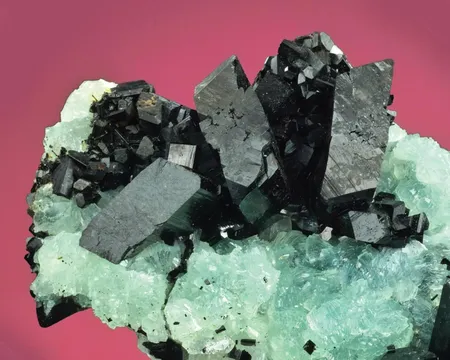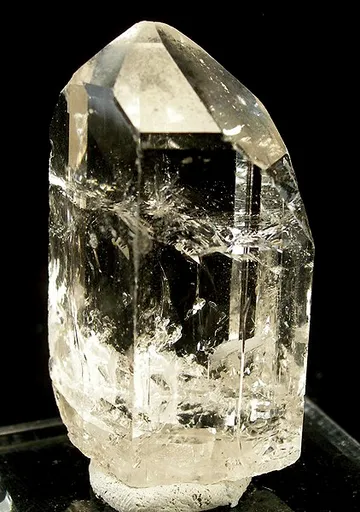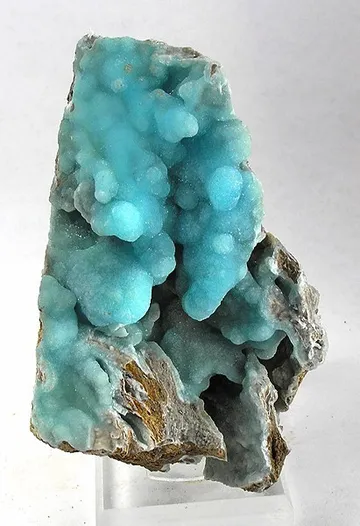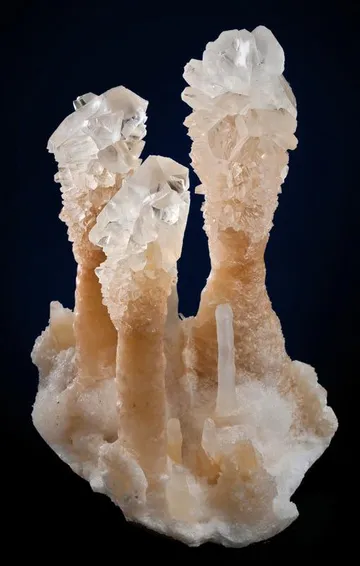
Dongchuan District, China: a copper-rich locality renowned for electric-blue veszelyite on hemimorphite and quartz, prized as small vug specimens for collectors
Key facts
Dongchuan District, north of Kunming in Yunnan Province, is one of those localities whose name carries two different meanings for collectors. In economic geology it denotes a great Proterozoic copper province: a broad sediment-hosted, stratabound to sedimentary-metamorphic copper ore field developed in the Dongchuan Group and related rocks on the southwestern margin of the Yangtze Block. In the mineral trade, especially since the early 2020s, “Dongchuan” has come to mean electric blue veszelyite from the Sanguozhuang area near Tangdan—bright, lustrous, chisel-bladed sprays perched on pale hemimorphite, quartz, and newly described lead-zinc-copper arsenate-phosphates. The best pieces are not large in the way a Tsumeb or Black Pine specimen may be large; they are concentrated, jewel-like vug specimens, often miniature to small-cabinet scale, where intense blue crystals flash against white to grey, sugary hemimorphite and translucent quartz.
The district’s collector importance rests on that collision of industrial scale and microscopic novelty. Dongchuan is a major copper field with Tangdan and Luoxue among its best-known deposits, yet its modern fame has been built specimen by specimen in weathered fractures, old shafts, and oxidized vugs where copper, zinc, lead, phosphate, arsenate, carbonate, and silicate chemistry produced a suite of supergene rarities. Sanguozhuang has become a type-locality cluster for the dongchuanite-group minerals and arsenoveszelyite, while older Dongchuan material includes distinctive pyrite concretions and striking botryoidal malachite–chrysocolla cabinet specimens from the broader ore field.
Regional View
Country View
For the collector, Dongchuan’s signature look is high-contrast secondary copper color: blue veszelyite and azurite, green cuprodongchuanite or olivenite, pale hemimorphite, and occasional powder-blue chrysocolla or velvety malachite. The district rewards close looking. Many pieces that appear simply “blue on white” at arm’s length reveal, under magnification, several generations of growth—hemimorphite crystals first, then blue copper-zinc phosphate blades, then green hemispherical dongchuanite-group aggregates, or late azurite and arsenate needles tucked along cavity rims.

Photo: Wikimedia Commons

Photo: Wikimedia Commons
Search for specimens: View all specimens from Dongchuan District, China
Dongchuan District lies in northeastern Yunnan, roughly north of Kunming, within the Kangdian region along the southwestern margin of the Yangtze Block. The Dongchuan Cu ore field is a district-scale sediment-hosted copper system, extending over hundreds of square kilometres around Dongchuan and including such mines and deposits as Tangdan, Luoxue, Yinmin, Xintang, Lanniping-Baixila, Lanniping-Suoyipo, and Shijiangjun. The main copper deposits are hosted in Proterozoic strata assigned to the Dongchuan or Kunyang succession, especially dolomitic, stromatolitic, carbonaceous, siliceous, and argillaceous units that record shallow marine to marginal-basin sedimentation and later deformation.
The classic Dongchuan ore bodies are stratiform to stratoid copper ores, locally reworked by folding, metamorphism, and hydrothermal redistribution. At Luoxue, the Dongchuan-type ore is hosted in stromatolitic dolomite and argillaceous-arenaceous dolomite of the Proterozoic Luoxue Formation. At Tangdan, the largest mine in the ore field, mineralization includes bedded ore bodies mainly in dolostone and vein-type bodies in dolostone and carbonaceous slate. Copper minerals reported from the primary and enriched ore systems include chalcocite, chalcopyrite, bornite, digenite, covellite, enargite, and tetrahedrite-group minerals, with pyrite, hematite, quartz, calcite, dolomite, siderite, baryte, and other gangue or accessory phases. Rounded pyrite-rich concretions several centimetres across are a particularly distinctive feature of some ore beds.
The district’s specimen-producing oxidized assemblage is a later, near-surface story superimposed on that large copper system. At Sanguozhuang, near Tangdan Town, the best-known collector material came from an old mine shaft northwest of Sanguozhuang Village at an altitude of more than 3,000 metres, on the southern limb of the Huangcaoling syncline. In sandstone fractures around copper-sulfide veins, weathering of copper, lead, zinc, and arsenic- or phosphorus-bearing phases produced hemimorphite, veszelyite, azurite, theisite, kipushite, tyrolite, tangdanite, bayldonite, duftite, arsendescloizite, dongchuanite, cuprodongchuanite, cuprozheshengite, zheshengite, and arsenoveszelyite. That small oxidized environment has proved disproportionately important: it is one of the most productive modern Chinese localities for new supergene phosphate-arsenate species.
Mining history in Dongchuan reaches far beyond modern specimen collecting. The copper district supplied copper for coinage in earlier Chinese dynasties, and scholarly descriptions of the new Dongchuan supergene minerals explicitly note Dongchuan’s long importance as a copper source for minting. Maolu Village preserves another part of that history: the Maolu copper “factory” was a Qing-period smelting locality where ores mined in the Dongchuan area were carried for primitive copper smelting. In the industrial period, Dongchuan became one of China’s major copper districts. Tangdan/Dongchuan copper production is recorded in international mine directories as an underground, concentrate-producing operation under Yunnan Copper, with startup in 1960 and Dongchuan replaced by Tangdan as the named producing mine at the end of 2001.
Collector access today should be treated as controlled mine access, not recreational field collecting. The important Sanguozhuang material is associated with old mine workings and high-elevation underground environments; the broader district includes active and former mines, industrial sites, and historical smelting ground. Most specimens available to collectors have moved through local miners, Chinese collectors, specialist dealers, and the international mineral trade. Provenance matters: labels may read Dongchuan District, Tangdan, Sanguozhuang, Sanguozhuang Pb-Zn Mine, Dongchuan Cu Mine, or Dongchuan Cu ore field, and not all of those terms carry the same geological precision.
The notable modern pockets are small but consequential. A self-collected 2021 vug known among collectors as the “Mond Pocket” reportedly yielded only a dozen specimens, with double-terminated blue veszelyite crystals protected inside a roughly 4 cm geode together with colorless dongchuanite and green cuprodongchuanite. Other early-2020s finds produced single upright, deep teal-blue crystals to around 1.6 cm in vugs lined by sparkling hemimorphite and quartz. These are exceptional sizes for Dongchuan veszelyite and stand apart from the more common thin crusts and sprays of millimetric crystals.
Veszelyite is the species that put modern Dongchuan specimens in front of collectors worldwide: vivid electric-blue to teal-blue, lustrous, translucent chisel-shaped blades and prismatic-tabular crystals, commonly in twisted fan-like, bow-tie, or radiating sprays on grey to white microbotryoidal hemimorphite, quartz, cuprodongchuanite, dongchuanite-group minerals, azurite, chrysocolla, and occasional molybdenite or galena. Most crystals are only a few millimetres long, and fine cabinet display depends less on size than on color saturation, wet resinous luster, crystal separation, and freedom from edge bruising; nevertheless, Dongchuan has produced remarkable crystals near 9 mm and exceptional reported specimens with single crystals around 1.6 cm. The best Sanguozhuang pieces show intense blue blades standing cleanly above pale hemimorphite rather than lying as an indistinct crust, and the most desirable combinations add green cuprodongchuanite or colorless dongchuanite in the same protected vug.
Hemimorphite from Dongchuan is most important as the pale stage on which the district’s blue and green rarities are displayed, but good hemimorphite is not merely “matrix”: it forms white, greyish, colorless, and locally bluish microcrystalline carpets, tabular crystals, sparkling bundles, and botryoidal crusts on quartz or oxidized sulfide matrix. At Sanguozhuang it is repeatedly associated with veszelyite, cuprodongchuanite, dongchuanite, azurite, arsenoveszelyite, zheshengite, and cuprozheshengite, and its open texture helped create the microcavities that preserved delicate secondary growth. Collector-grade hemimorphite pieces are those with bright luster, sharp terminations, clean contrast, and minimal staining; ordinary pieces are sugary white coatings, while the best serve as a crisp white-grey pedestal for saturated blue veszelyite or azurite.
Pyrite in Dongchuan belongs both to the ore system and to the district’s older specimen identity: the ore beds are known for rounded pyrite-rich concretions several centimetres across, and collectors have long recognized Dongchuan pyrite balls and nodular masses with concentric to parallel bands of glittering microcrystals interleaved with dark shale. These are not the sharp cubic pyrites of Spain or Peru; their appeal is textural and geological, like metallic fossils of the sedimentary copper environment. The best specimens retain complete rounded form, crisp banding, bright brassy sparkle, and sculptural balance without being broken flat, while lesser examples are dull, weathered, incomplete nodules or massive pyrite without the patterned concretionary structure.
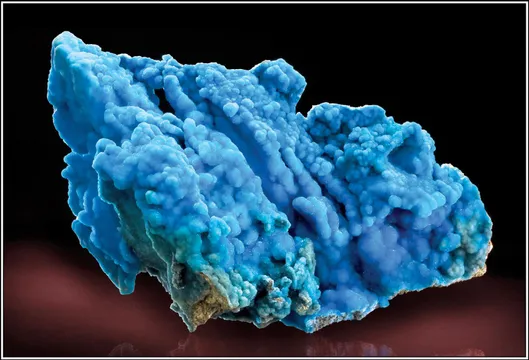
Malachite from the Dongchuan Cu ore field is best known from older cabinet specimens in silky, bubbly, botryoidal to banded masses, commonly accented or partly coated by powder-blue to robin’s-egg-blue chrysocolla. Fine pieces can reach substantial cabinet scale, including documented specimens around 20 cm across, where rounded malachite surfaces fill a sculptural matrix and show strong green color variation from pale mint to deeper emerald. The most attractive examples have unbroken botryoidal skins, satiny luster, contrasting chrysocolla, and a natural matrix shape; ordinary pieces are darker massive crusts or abraded surfaces where the silky growth texture has been lost.
Chrysocolla from Dongchuan appears as powder-blue to blue-green coatings, curved botryoidal layers, and fine crusts over or beside malachite, with the best older ore-field pieces showing a thin blue chrysocolla skin draped across banded or bubbly green malachite. It also occurs in the Sanguozhuang supergene suite as a minor associated mineral with veszelyite and dongchuanite-group minerals, where it is usually a color accent rather than the main species. Good Dongchuan chrysocolla specimens are judged by clean blue color, even coverage, attractive contrast with malachite or blue veszelyite, and stable unpowdered surfaces; common material is thin, dull, poorly bounded blue-green staining on oxidized copper matrix.
Azurite from Dongchuan occurs as brilliant blue microcrystalline coatings, small crystals, and crusts in the oxidized copper assemblage, notably in late-2020 material with analyzed olivenite and in Sanguozhuang pieces associated with hemimorphite, cuprodongchuanite, zheshengite, arsenoveszelyite, and veszelyite. It rarely competes with the world’s large azurite localities for size, but it can be visually strong because the blue is intense and the crystals sit against pale hemimorphite or green arsenates. Better specimens show sparkling, evenly distributed blue crystals, clear association with olivenite or rare Dongchuan phosphates, and minimal rubbing; ordinary pieces are merely blue crusts without distinct crystals or diagnostic association.
Molybdenite is a distinctive but subordinate Dongchuan associate in the Sanguozhuang specimen suite, recorded repeatedly with veszelyite and cuprodongchuanite in photo-documented material. It appears as metallic lead-grey flakes, plates, or foliated patches on quartz-hemimorphite matrix, providing a sharp visual and genetic contrast to the soft blue-green supergene phosphate-arsenate growths around it. The finest collector pieces are not molybdenite specimens in the classic cabinet sense, but combination pieces where bright metallic molybdenite is clearly visible beside saturated blue veszelyite and pale hemimorphite; lesser pieces have smeared, tarnished, or inconspicuous grey flakes that add little to the display.
Quartz in Dongchuan is both gangue and display matrix: quartz veins are part of the remobilized copper system, and in the oxidized Sanguozhuang material quartz forms milky to colorless crystals, drusy linings, and vug walls carrying hemimorphite, veszelyite, dongchuanite, cuprodongchuanite, and related species. It is rarely the reason a Dongchuan specimen is bought, but it is often the reason the specimen works aesthetically, because bright quartz points and pale druse create open pockets and reflective contrast for tiny blue and green crystals. Good examples show clean, sparkling quartz with well-spaced secondary minerals and no distracting iron staining; ordinary pieces are simply quartz matrix with scattered blue flecks.
Olivenite is a confirmed Dongchuan arsenate, especially in material found in late 2020 where green crystals were selected from azurite specimens and analyzed; habits include small needle crystals and botryoidal to spherical aggregates with sparkling blue azurite. At Maolu Village, olivenite is documented as the most common arsenate mineral, occurring with azurite, malachite, tyrolite, aurichalcite, aragonite, and cyanotrichite in a historically smelted copper area. The strongest collector pieces are magnification specimens with bright green needles or botryoids set against brilliant azurite, and they are most valuable when the olivenite is visibly crystallized rather than a vague green coating.
Beyond these species, Dongchuan District has become a modern type-locality cluster. Sanguozhuang is the type locality for dongchuanite, cuprodongchuanite, cuprozheshengite, zheshengite, and arsenoveszelyite, while Tangdan is the type locality for tangdanite. Other documented species from the district and its ore field include chalcocite, chalcopyrite, bornite, digenite, covellite, enargite, sphalerite, galena, tennantite-(Zn), tetrahedrite-group minerals, hematite, magnetite, cuprite, tenorite, calcite, dolomite, siderite, baryte, theisite, kipushite, tyrolite, bayldonite, duftite, arsendescloizite, aurichalcite, cyanotrichite, aragonite, albite, muscovite, montmorillonite, actinolite, and zircon. The rarity hierarchy is very steep: common ore and gangue minerals are abundant in the geology, but display-quality specimens of the new phosphate-arsenate suite are localized, small, and usually require analytical care.
Dongchuan specimens deserve careful locality and species scrutiny. The name “Dongchuan” may refer to the district, the ore field, Tangdan, Sanguozhuang, Maolu, or older mine labels from the broader copper district. For modern blue veszelyite specimens, a precise Sanguozhuang/Tangdan-area provenance is much more informative than a district-only label. Earlier in the trade, some Yunnan veszelyite was loosely or incorrectly attributed to other Yunnan localities, including Laochang-area labels; good documentation should distinguish the Dongchuan material from those older Yunnan occurrences.
The most important identification problem is not usually fake blue color—it is species-level mislabelling among the tiny associated phases. Green to blue-green spherical dongchuanite-group aggregates on Dongchuan specimens have often been called “dongchuanite” in the trade, but analytical discussion indicates that many green balls are actually cuprodongchuanite, the copper-dominant member, while true dongchuanite is much less common and tends toward colorless to pale material. Zheshengite, cuprozheshengite, arsenoveszelyite, theisite, kipushite, tyrolite, and bayldonite can all be visually subtle in millimetre-scale associations. Serious collectors should favor specimens with Raman, EDS, EPMA, or XRD support when the value depends on the rare associated species.
Condition issues are typical of fragile supergene micro-minerals. Veszelyite blades are thin, exposed, and easily bruised along pocket edges; check for broken terminations, rubbed high points, and fresh trimming scars. Hemimorphite carpets can shed small crystals, and botryoidal chrysocolla or malachite can be powdery if weathered. Dongchuanite-group minerals and arsenoveszelyite occur as microscopic aggregates or tiny crystals, so heavy cleaning, ultrasonic treatment, acids, or aggressive brushing can remove the very features that make the piece important. Dongchuanite is reported as non-fluorescent; collectors should not expect fluorescence to authenticate the locality.
Market availability is uneven. Since about 2020, Dongchuan has supplied enough fine veszelyite to become a recognizable modern classic, but truly top pieces—sharp, saturated, lustrous crystals on clean matrix, especially with confirmed cuprodongchuanite, dongchuanite, or arsenoveszelyite—remain scarce. Large single crystals are exceptional. Malachite–chrysocolla and pyrite concretions from the broader ore field appear less frequently as older cabinet material. As with many recent Chinese discoveries, prices vary strongly with aesthetics, analytical confidence, and whether the specimen is a simple attractive blue miniature or a documented association carrying one of the district’s new minerals.
The most revealing modern Dongchuan story begins with secrecy. The Sanguozhuang veszelyite locality first circulated in the specimen world as a “new China” source of superb blue crystals, but the exact place was initially withheld. That did not last. Once new minerals began turning up on the same specimens, the locality could no longer remain simply a trade secret. By late 2023, collectors on Mindat were already discussing the locality openly as Sanguozhuang, and the count of new minerals had become startling for such a small collecting environment: arsenoveszelyite, cuprodongchuanite, cuprozheshengite, dongchuanite, and zheshengite were all tied to the same small Dongchuan-area specimen suite.
One pocket has already acquired a name among collectors. On 3 December 2021, Mond Chang collected specimens from what he later called the “Mond Pocket” at Dongchuan. It was not a grand cavern or an industrial-scale pocket; it reportedly yielded only 12 specimens. The best of them were protected inside a roughly 4 cm long geode, where high-luster blue, double-terminated veszelyite crystals grew with colorless dongchuanite and green cuprodongchuanite. The largest veszelyite crystal was about 9 mm, the largest green cuprodongchuanite sphere about 2 mm, and the largest colorless dongchuanite crystal about 1 mm. Those measurements sound modest until one has seen the material under a lens: the whole drama is compressed into a thumb-sized vug, with several newly recognized minerals sharing the same protected cavity.
Dongchuan’s deeper story is older and rougher than the modern thumbnail boxes suggest. At Maolu Village, beside the old Maolu copper “factory,” the district’s minerals were not curiosities but ore. Copper mined from a series of Dongchuan workings was carried to Maolu and smelted by comparatively primitive methods during the Qing period. The modern collector sees azurite, malachite, olivenite, and tyrolite as a beautiful oxidized assemblage; the historical miner saw a copper source, and the smelter saw feed for furnaces. That overlap—ancient copper working, Qing smelting, twentieth-century industrial mining, and twenty-first-century new-mineral discovery—is part of what gives Dongchuan specimens their unusual weight.
The district also tells a cautionary story about color and names. In 2021, a green “dongchuanite” association was challenged by Hercule Shen, who argued that the green spheres were obviously cuprodongchuanite unless analysis proved otherwise. The point was not pedantry. In hundreds of analyzed samples, the green material was commonly near the copper end member, while true dongchuanite was far less abundant. For collectors, that exchange is a useful reminder: at Dongchuan, beauty may be visible with the naked eye, but the correct name often begins under the electron beam.
Li, Guowu; Sun, Ningyue; Shen, Hongtao; Xue, Yuan; Hao, Jinhua; and de Fourestier, Jeffrey. “Dongchuanite, a new phosphate mineral with a new structure, from Dongchuan copper mine, Yunnan Province, China.” Mineralogical Magazine 87, no. 4 (2023): 611–618. The formal description of dongchuanite, including the Sanguozhuang occurrence, holotype information, morphology, chemistry, and associated minerals.
Sun, Ningyue; Li, Guowu; Xue, Yuan; Shen, Hongtao; and Hao, Jinhua. “Zheshengite, Pb4ZnZn2(AsO4)2(PO4)2(OH)2: A New Mineral of the Dongchuanite Group and the Influence of As–P Isomorphic Substitution on Unit-Cell Parameters of Dongchuanite Group Minerals.” Minerals 14, no. 12 (2024): 1276. Open-access description of zheshengite from Sanguozhuang, including its naming for mineralogist Zhesheng Ma and its relationship to the dongchuanite group.
Sun, Ningyue; Grey, Ian E.; Li, Guowu; Rewitzer, Christian; Xue, Yuan; Mumme, William G.; Shen, Hongtao; Hao, Jinhua; MacRae, Colin M.; Riboldi-Tunnicliffe, Alan; Boer, Stephanie; Williams, Tim; and Kampf, Anthony R. “The new mineral cuprozheshengite, Pb4CuZn2(AsO4)2(PO4)2(OH)2, from Yunnan, China, with site-selective As-P substitution.” American Mineralogist 109, no. 7 (2024): 1248–1257. Peer-reviewed description of cuprozheshengite, a dongchuanite-group mineral occurring as sub-millimetre greenish-blue hemispherical aggregates on hemimorphite with veszelyite and galena.
Sun, Ningyue; Shen, Hongtao; Hao, Jinhua; Xue, Yuan; Luo, Liqun; and Li, Guowu. “Arsenoveszelyite, Cu2Zn(AsO4)(OH)3·2H2O, the arsenic analogue of veszelyite from Dongchuan copper ore field, Yunnan province, China.” Mineralogical record for arsenoveszelyite, documenting the Dongchuan occurrence and its status as the arsenate analogue of veszelyite.
Ma, Zhesheng; Li, Guowu; Chukanov, Nikita V.; Poirier, Gaël; and Shi, Nicheng. “Tangdanite, a new mineral species from the Yunnan Province, China and the discreditation of ‘clinotyrolite’.” Mineralogical Magazine 78, no. 3 (2014): 559–569. Type-mineral record for tangdanite from Tangdan, a key arsenate-sulfate member of the Dongchuan supergene copper assemblage.
Wang, Kenan. “Geochemical characteristics of sedimentation and metamorphism of the Dongchuan copper deposit, Yunnan Province, China.” Precambrian Research 25, no. 1–3 (1984): 135–136. A concise geological treatment of the sedimentary-metamorphic origin, sulfur source, and remobilized vein mineralization of the Dongchuan copper deposit.
Cox, Dennis P.; Lindsey, David A.; Singer, Donald A.; Moring, Barry C.; and Diggles, Michael F. “Sediment-hosted copper deposits of the world: Deposit models and database.” U.S. Geological Survey Open-File Report 2003-107, version 1.3, revised June 2007. Global deposit-model context for sediment-hosted copper deposits, useful for placing Dongchuan in the broader class of stratabound copper systems.
Qiu, Huaning; Zhu, Bingquan; and Sun, Dazhong. “Age significance interpreted from 40Ar-39Ar dating of quartz samples from the Dongchuan Copper Deposits, Yunnan, SW China, by crushing and heating.” Geochemical Journal 36 (2002): 475–491. Geochronological work on quartz from the Dongchuan copper deposits and the timing significance of hydrothermal events.
Dongchuan Cu ore field, Dongchuan District, Kunming, Yunnan, China — Mindat Broad mineral and locality framework for the district, including ore-field subdivisions, mineral lists, commodities, and references.
Dongchuan Cu Mine, Sanguozhuang, Shizhuang Village, Tangdan Town, Dongchuan District — Mindat Key locality page for the modern Sanguozhuang specimen suite and type-locality minerals.
Veszelyite from Dongchuan District — Mindat occurrence record Useful association data for Dongchuan veszelyite, especially hemimorphite, cuprodongchuanite, dongchuanite-group minerals, molybdenite, quartz, azurite, and chrysocolla.
Luoxue Mine, Dongchuan Cu ore field — Mindat Locality page for the Luoxue deposit, with its Proterozoic Luoxue Formation host rocks and classic Dongchuan-type copper mineral list.
Tangdan Mine, Dalaobao, Sahai Village, Tangdan Town — Mindat Locality page for the largest mine in the Dongchuan ore field and the type locality of tangdanite.
Maolu Village, Dongchuan District — Mindat Important for olivenite and for the historical Qing-period copper-smelting context around Maolu.
Dongchuanite article — Mineralogical Magazine, Cambridge Core Open-access type description of dongchuanite and a valuable source on the Sanguozhuang supergene assemblage.
Zheshengite article — Minerals Open-access type description and structural discussion for zheshengite, one of the Dongchuanite Group minerals.
Cuprozheshengite publication record — Monash University Publication record and abstract for the American Mineralogist description of cuprozheshengite.
Malachite-Chrysocolla from Dongchuan Cu ore field — Wikimedia Commons Licensed image and specimen description for a large botryoidal malachite–chrysocolla cabinet specimen.
Veszelyite from Dongchuan District — Wikimedia Commons Licensed photograph showing the vivid blue habit that made the modern Dongchuan finds famous.