Zhaotong, China — Qiaojia babingtonite localities yield jet-black crystals on pale green prehnite with quartz; notable for cabinet-quality, graphic displays pr…
Key facts
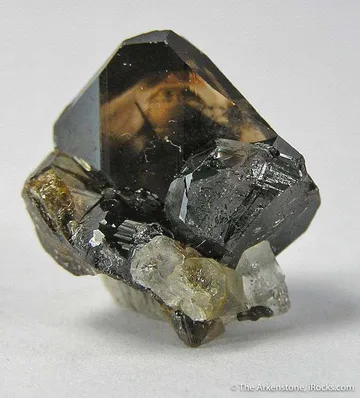
For collectors, “Zhaotong” usually means the babingtonite occurrences of Qiaojia County, in northeastern Yunnan, where a belt of cavities in the Emeishan flood basalts produced some of the most visually compelling babingtonite combinations ever to reach the market. These are not metallic-ore specimens from a formal underground mine. They are vug specimens: open-space growths from basalt, with jet-black babingtonite set against pale green prehnite and colorless to smoky quartz, locally with calcite and tiny olive-green epidote.
The geological setting is what gives the locality its character. Qiaojia lies within the great Late Permian Emeishan basalt province, a vast volcanic pile exposed through southwestern China. In Qiaojia, collectors found productive amygdaloidal and cavity-rich zones extending for many kilometers along the Yangtze River. Within those vugs, late hydrothermal fluids deposited prehnite, quartz, babingtonite, calcite, and minor epidote in a sequence that made unusually aesthetic combination specimens: sugary or botryoidal prehnite cushions first, then sharp black babingtonite tablets and prisms, and in many pieces clear quartz blades or doubly terminated quartz groups.
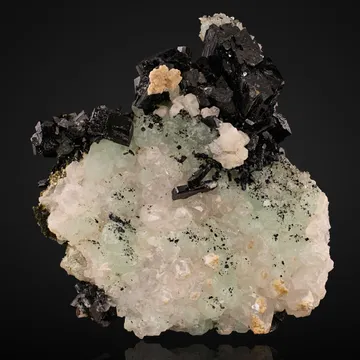
Historically, the locality matters because its best specimens changed expectations for babingtonite. Before the Chinese finds of the mid-2000s, babingtonite was a connoisseur’s dark silicate, prized in classics from Massachusetts, New Jersey, Scotland, Norway, and Japan, but rarely seen as large, dramatic, cabinet-quality crystals on contrasting matrix. Qiaojia supplied black, lustrous, commonly flattened and doubly terminated crystals that could be measured in centimeters rather than millimeters, on pale green prehnite and quartz. The finest pieces have a striking graphic quality: black crystals standing proud from mint-green prehnite balls or from a white-to-smoky quartz framework.
Regional View
Country View

Photo: CarlesMillan, Wikimedia Commons
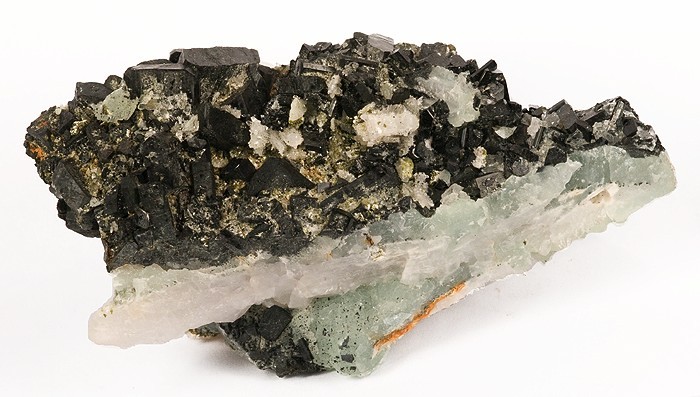
Photo: Rob Lavinsky, iRocks.com, Wikimedia Commons
Search for specimens: View all specimens from Zhaotong, China
The collectible material comes from the babingtonite occurrences near Qiaojia, Qiaojia County, Zhaotong Prefecture, Yunnan Province. The locality is best understood as a group of occurrences rather than a single mapped mine. Published locality descriptions place the specimens in cavities of the Emeishan flood basalts, a large igneous province that covers broad areas of southern Sichuan and northeastern Yunnan. These are basalt vugs and amygdaloidal cavities, not a vein mine in the usual economic sense.
The productive zone is described as extending for many kilometers along the Yangtze River in Qiaojia County, with comparable basalt-cavity occurrences also known across the provincial boundary in Sichuan. This explains a persistent labeling problem: many older and market-circulated examples were simply labeled “China,” “Meigu,” “Sichuan,” “Qiaojia,” or “Yunnan,” and some pieces from one side of the regional basalt belt have been confused with those from the other. For Zhaotong material, the cleanest labels specify Qiaojia County, Zhaotong, Yunnan.
The mineralization is a low-temperature to moderate-temperature secondary silicate assemblage in open spaces. Prehnite forms pale green botryoidal crusts, rounded hemispheres, and sparkling druses. Quartz occurs as colorless, milky, or smoky crystals, including plates and doubly terminated individuals. Babingtonite appears as black, lustrous, triclinic crystals, often tabular to flattened-prismatic, sometimes singly terminated but most admired when doubly terminated and freestanding. Calcite is locally present as white to colorless crystals or veins, and epidote appears mainly as small olive-green tabular microcrystals.
There is no well-documented modern mining company or operator associated with the specimen production. The known occurrences are small excavations made largely by local collectors and specimen diggers following vuggy zones in the basalt. The main market emergence was in the mid-2000s: dealer records and publication references document important material in 2005, 2006, 2007, and around 2008–2009. A later April 2023 find brought fresh cabinet-size combination pieces to the market, showing that the locality was not entirely exhausted, though fine early pieces remain the benchmark.
The best pockets produced prehnite-lined cavities with babingtonite crystals sitting proud of the matrix rather than embedded in it. Especially desirable pieces show sharp black crystals isolated enough to read their triclinic form, set against contrasting pale green prehnite and accompanied by quartz that frames rather than obscures the babingtonite. Commoner specimens are attractive drusy prehnite-and-quartz plates with small scattered black crystals; the finest are sculptural combinations with centimeter-scale babingtonite crystals, undamaged terminations, bright luster, and balanced composition.
Collecting access today should be regarded as uncertain and permission-dependent. The occurrences are not public collecting quarries with formal access, and the productive cavities are associated with small local excavations along rugged basalt exposures. Any field visit would require local permission, a clear understanding of land and mineral rights, and serious attention to slope, loose-rock, and excavation hazards.
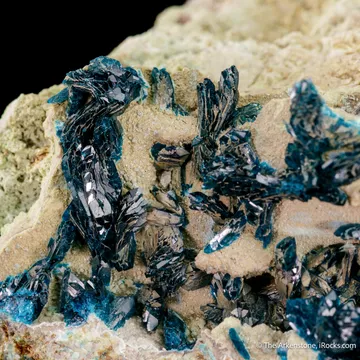
Babingtonite from Zhaotong’s Qiaojia occurrences is the signature mineral: black, lustrous, flattened-prismatic to thick tabular triclinic crystals, commonly sharp and in the best examples doubly terminated, set on pale green botryoidal prehnite with quartz and occasional calcite or epidote. Documented specimens range from thumbnails and miniatures with crystals around 0.8–1.6 cm to cabinet pieces carrying crystals over 2 cm, and exceptional dealer-described pieces have reported main crystals up to about 3.2 x 2.7 cm and even larger individuals in a few early finds. Fine examples are separated from ordinary pieces by undamaged terminations, visible individual crystal form, strong luster, aesthetic isolation on contrasting prehnite, and a matrix that does not bury the black crystals in a dark jumble.
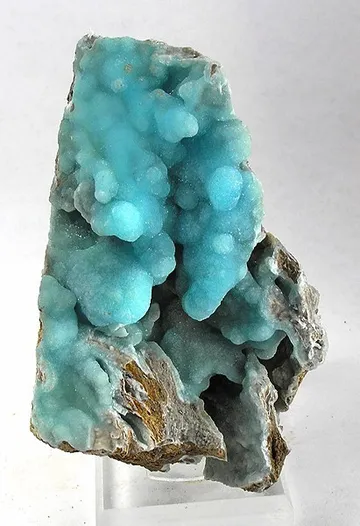
Prehnite from Qiaojia is the locality’s visual stage: translucent to pastel green, pale mint, or creamy green, most often as botryoidal crusts, rounded balls, hemispherical aggregates, and sparkling drusy coatings lining basalt cavities. It occurs with babingtonite and quartz in the classic pieces, and with minor calcite, epidote, and locally analcime reported in photo-based associations. The best prehnite is not merely a background mineral; it forms clean, lustrous, rounded cushions that contrast strongly with black babingtonite and leave open space around the crystals, while ordinary pieces may be more massive, stained, or crowded with small indistinct babingtonite.
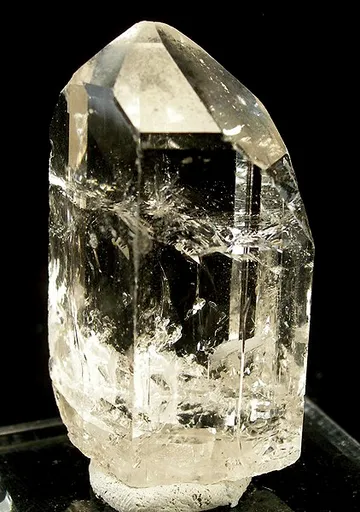
Quartz from the Qiaojia babingtonite occurrences occurs as colorless, milky, gray, and smoky crystals, commonly in plates, intergrown groups, and doubly terminated crystals that provide structure for the prehnite-babingtonite assemblage. Some specimens show tilted, layered quartz matrices; others show prehnite spheres perched on quartz or babingtonite grown over quartz plates, and a few display striking “two-tone” colorless-to-blackish smoky effects. Collector-grade quartz pieces from here are valued less as stand-alone quartz specimens than as architectural partners: crisp crystals, good transparency or smoky contrast, and a composition that lifts the black babingtonite and green prehnite are what make the best Zhaotong combinations.
The exact Qiaojia collector occurrence has a compact verified mineral list: babingtonite, prehnite, quartz, calcite, and epidote. Calcite appears on some specimens as colorless to white crystals or vein material, sometimes with babingtonite and quartz; epidote is a rarer accessory, noted as small olive-green tabular microcrystals. Photo-data associations also record minor analcime and limonite with prehnite, but those are not the minerals for which collectors seek the locality. Broader Zhaotong mineral literature also includes coalfield mineral assemblages from Late Permian coals—quartz, chamosite, kaolinite, pyrite, calcite, illite/smectite, anatase, dolomite, siderite, and marcasite—but those belong to the regional geological record rather than to the classic babingtonite specimen pockets. The collector occurrence is not known for IMA type-locality minerals; its importance is aesthetic and paragenetic, not taxonomic.
The chief authenticity issue is labeling, not artificial treatment. Early Chinese examples were sometimes offered as “manganbabingtonite,” but dealer testing by simple analysis and X-ray diffraction showed the material in question to be babingtonite. Mindat also records later rumors that the Qiaojia material might be the manganese analogue, while noting that the rumor lacked a solid basis and that related basalt-outcrop material from Meigu, Sichuan, contained only minor MnO. For serious purchases, a label that preserves the old history is useful, but the accepted species name for the classic Qiaojia material is babingtonite.
Locality confusion is common. Similar babingtonite-prehnite-quartz specimens occur in the same broad Emeishan basalt belt in neighboring Sichuan, especially around Meigu, and some Qiaojia pieces were formerly labeled “Meigu.” Conversely, some market listings have used Qiaojia, Zhaotong, Meigu, Sichuan, and “China” inconsistently. A good provenance should distinguish “Qiaojia County, Zhaotong, Yunnan” from Meigu County, Liangshan, Sichuan. If an expensive specimen carries only a vague China label, ask for older labels, dealer history, or analytical paperwork.
Condition is critical. Babingtonite from this locality is dark and lustrous, so edge wear and cleaved terminations can hide in photographs; examine high points with strong side lighting. Several otherwise beautiful pieces show contacted or cleaved crystal ends where babingtonite grew against the pocket roof. Quartz points can also be chipped, and prehnite balls may bruise, flatten, or detach along the basalt contact. Iron staining is not unusual and can be attractive in small amounts, but heavy limonite films can dull the contrast that makes the best pieces desirable.
No special fluorescence is central to the locality’s appeal. The handling concern is mechanical: babingtonite crystals can project from comparatively softer-looking prehnite and quartz matrices, and thin plates may have fragile edges. Avoid ultrasonic cleaning; use only gentle air, a soft brush, and minimal water if the matrix is stable. Acid cleaning is not advisable on pieces with calcite and may alter the overall surface character.
Market availability has changed over time. The first wave from 2005–2009 supplied the pieces that built the locality’s reputation, and fine early examples became scarce quickly. Dealer notes have described the best Chinese babingtonites as having nearly disappeared from the market, though a documented April 2023 find released new large combination specimens. Today, small to medium pieces appear periodically, while elite cabinet specimens with large, isolated, undamaged babingtonite crystals remain genuinely uncommon and command a premium.
At the 2005 Munich show, some of the first major Chinese pieces appeared with a tantalizing but uncertain name: “manganbabingtonite.” The specimens had the right drama—black crystals, pale prehnite, quartz—but the chemistry was not something responsible dealers wanted to assume. Fabre Minerals recorded that they doubted the composition and had the material checked by simple analysis and X-ray diffraction. The result was less exotic but more important for collectors: the specimens were true babingtonite, and they were exceptional for size, association, and aesthetics. In practical collecting terms, that moment helped move the Qiaojia material from rumor to reference status.
The early pieces also left a paper trail through European mineral publishing. One 2005 specimen, a prehnite matrix with many small babingtonite crystals and a larger sharp doubly terminated crystal, was later published in Lapis in June 2008. Another 2007 specimen, a group of sizable doubly terminated babingtonites on prehnite with quartz, was photographed for the Sainte-Marie-aux-Mines 2008 show coverage in Minéraux et Fossiles. Those show references matter because they anchor the chronology of the find: the locality was not just producing pretty dealer stock, but specimens significant enough to be noticed almost immediately by the European mineral press.
A second story is written in the labels. French discussion around Le Règne Minéral no. 83 specifically noted that Qiaojia babingtonites had previously been labeled “Meigu.” That is more than a clerical nuisance. Qiaojia in Yunnan and Meigu in Sichuan lie in neighboring parts of the same basalt province, and their specimens can be visually close: black babingtonite, green prehnite, quartz, and basalt-cavity paragenesis. For collectors, the story is a reminder that a fine Chinese babingtonite may carry a geographic history as complicated as its crystal faces.
The locality was not entirely a closed chapter after the first rush. In April 2023, new material reached the market, including large combination pieces with prismatic, flattened, lustrous babingtonite crystals—many doubly terminated—on light green botryoidal prehnite and quartz. One documented example measured 16.7 x 12.8 x 4 cm, a reminder that Qiaojia’s productive zone was a belt of vuggy basalt rather than a single emptied pocket.