






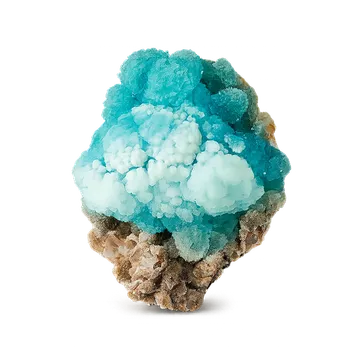
Hemimorphite from Wenshan Mine, Yunnan - blue, velvety skin on bubbly forms; a modern classic prized for intense color, translucence, and locality.
Key facts
Wenshan hemimorphite is one of the modern classics of the species: a saturated sky-blue to electric-blue zinc silicate, usually in botryoidal crusts, stalactitic ridges, and pocket-lining flowstone rather than the bladed white crystal sprays that defined many older hemimorphite localities. The best pieces have a color that collectors instinctively compare to robin’s-egg blue smithsonite, turquoise, or Larimar, but the texture is distinctly hemimorphite: a tight, sparkling skin of minute crystals over rolling, bubbly forms.

Photo: Wikimedia Commons
The locality sits within the broader Wenshan–Dulong tin-zinc district of southeastern Yunnan, close to China’s borderlands with northern Vietnam. The geological story is not a simple “blue mineral in a pocket” tale. It begins with carbonate-rich marine sediments, later metamorphosed and intruded by granitic magmas, producing skarn-style tin-zinc mineralization rich in sphalerite and cassiterite. Hemimorphite formed much later, in the oxidized upper parts of zinc-rich rock, where weathering liberated zinc and allowed it to combine with silica, hydroxyl, and water as Zn4Si2O7(OH)2·H2O.
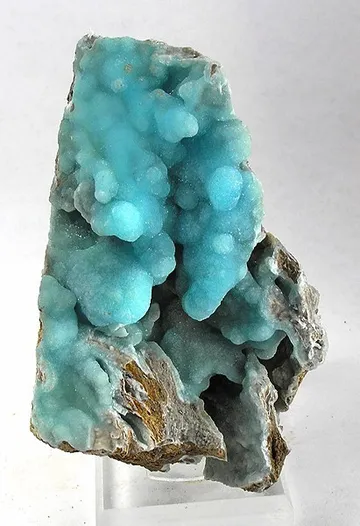
What makes Wenshan special is not just that the hemimorphite is blue. Blue hemimorphite exists elsewhere. The Wenshan look is a combination of intense color, velvety to wet-looking luster, translucency at the thin edges, sculptural pocket geometry, and a microcrystalline surface that catches light like fine sugar. The finest cabinet pieces show continuous blue coatings on natural vugs or slabs of brown gossanous matrix, with little or no chalkiness, abrasion, or sawn distraction.

Photo: Wikimedia Commons
Collectors should also understand that “Wenshan Mine” has been used in the mineral trade with some imprecision. Mindat treats the name as probably generic, referring to one or more undisclosed deposits around Wenshan, and historical dealer labels have also used Dulong, Malipo, Dayakou, and Wenshan for closely related blue material from southeastern Yunnan. For the collector, the practical point is to preserve the old label exactly and to avoid over-refining the locality beyond what the specimen’s documentation supports.
Search for specimens: View all hemimorphite specimens from Wenshan Mine, Yunnan, China
Wenshan Mine is recorded as a zinc mine in Wenshan City, Wenshan Zhuang and Miao Autonomous Prefecture, Yunnan Province, China. The Mindat coordinates are approximate, and the locality has an unusually important caveat: the trade name “Wenshan Mine” may not identify a single precisely disclosed shaft or pit, but rather one or more deposits in the Wenshan area that supplied similar collector material.
The most useful geological frame is the Dulong tin-zinc skarn system. Published geological work on the Dulong district describes tin-zinc mineralization in skarn zones hosted by metamorphic rocks and carbonate units, with cassiterite, sphalerite, pyrrhotite, chalcopyrite, arsenopyrite, pyrite, fluorite, quartz, pyroxene, and diopside appearing in ore assemblages. In collector terms, the blue hemimorphite belongs to the oxidation story rather than the primary ore story: sphalerite-bearing zinc ore was exposed to oxygenated groundwater, producing secondary zinc minerals in vugs, fractures, and leached cavities.
Modern mining in the area has centered on zinc and tin rather than specimen recovery. Older summaries state that small open-pit and shallow underground workings were consolidated into the Wenshan operation in the 1950s, and that by the 1980s ore production had become substantial. A 2006 mineral write-up described the mine as shipping sphalerite and cassiterite concentrates westward to smelters at Gejiu, with accessory copper, silver, cadmium, and indium in the concentrates. More recent geological literature treats Dulong as a major Sn-Zn-In polymetallic skarn system and one of China’s important cassiterite-sulfide districts.
Specimen production appears to have been episodic. Fine blue botryoidal hemimorphite reportedly reached Western markets around 1990–1991, appeared again in 1999, and then reappeared in collector quantities in the 2000s. By 2008–2009, dealers and writers were noting a flow of bright blue botryoidal specimens from Yunnan, though the exact source name varied between Wenshan, Dulong, Malipo, Dayakou, and related labels. Mindat currently lists the Wenshan Mine hemimorphite as very rare at the site, excellent and world-class for the species, and confirmed by visual identification and Raman spectroscopy.
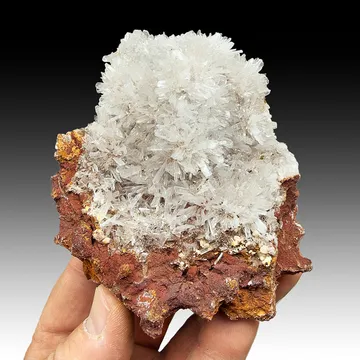
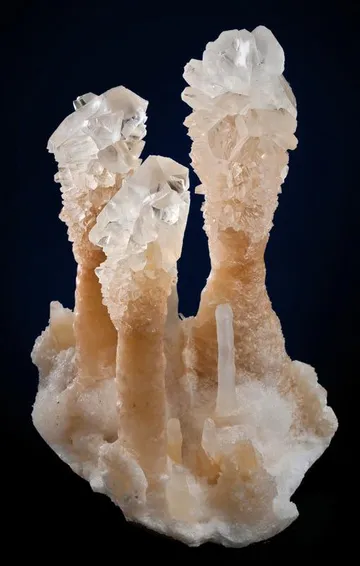
Associated minerals recorded for Wenshan Mine include aragonite, aurichalcite, calcite, and hemimorphite. In specimen photographs, quartz and aurichalcite have also been noted in association with Wenshan hemimorphite. Calcite from Wenshan can be highly sculptural in its own right, and blue aragonite from the district has caused confusion in the market because it can resemble pale botryoidal hemimorphite at a glance.
This is not a casual field-collecting locality. The material comes from mining districts and commercial specimen recovery, not from a public dig site. Any collecting would require permission from landholders and mineral-rights holders, current mine management, and compliance with Chinese mining and safety regulations. For most collectors, acquisition through well-documented old-stock specimens, established dealers, auctions, or collections is the realistic route.
Wenshan hemimorphite is prized first for color. The range runs from pale powder blue and sky blue to highly saturated turquoise and electric blue. The strongest pieces show even, glowing blue without gray cast, chalky white patches, or brown staining across the display face. Thin edges and freshly broken interior rims may be slightly translucent, a useful aesthetic cue on high-grade material.
The classic habit is botryoidal: rounded, bubbly mounds that may merge into flowing sheets across a cavity wall. Some pieces have a “dripping” or lava-flow look, with rounded ridges, knobs, and stalactitic curtains. Others are shallow vug plates lined with a continuous microcrystalline crust. The surface may be velvety, satiny, sugary, or strongly sparkly depending on crystal size and luster. Good Wenshan material often has a smithsonite-like wet luster, but under magnification the surface is a dense mat of tiny hemimorphite crystals rather than smooth carbonate.
Crystallized Wenshan hemimorphite does occur, but the locality is famous for aggregates rather than individual macrocrystals. Many specimens are essentially blue crusts over matrix, with the collector value controlled by color, coverage, form, and condition rather than by measurable individual crystal size. Cabinet specimens around 6–13 cm are common in the market record; large plates and pocket sections exceeding 15 cm are much scarcer and can be important if undamaged. Documented pieces include small cabinets around 5–7 cm, showy plates around 10–13 cm, and large specimens over 17 cm.
The matrix is typically brown to tan, iron-stained, gossanous rock with vugs, leached cavities, or boxwork-like openings. This matrix is not merely a backdrop: it is part of the Wenshan aesthetic. The best examples balance glowing blue hemimorphite against earthy, oxidized matrix, making the secondary origin visually obvious. Some pieces are nearly all blue on the display face, while others show ribbons, pockets, and windows of matrix between botryoidal patches.
Associated minerals to watch for include aurichalcite, calcite, aragonite, and quartz. Aurichalcite may appear as blue-green acicular material and can complicate identification if present as a coating. Calcite from Wenshan can be white, colorless, or pale yellow and may occur in unusual growth forms. Blue aragonite from the mine is a separate collector category and should not be casually relabeled as hemimorphite without testing or very strong provenance.
Quality factors are straightforward but unforgiving. The top tier combines saturated electric or robin’s-egg blue color, uninterrupted coverage, sculptural botryoidal relief, fresh microcrystalline sparkle, and strong three-dimensional form. A flat blue crust can be attractive, but a pocket with ridges, stalactitic drapery, or rounded rolling surfaces is usually more desirable. Damage matters: rubbed high points, chipped domes, dusty surfaces, glue, and obvious saw cuts on the display side all reduce value. A carefully trimmed or sawn back is common and acceptable if it does not dominate the specimen.
The chief authenticity issue is not that Wenshan blue hemimorphite is inherently suspect; the classic Wenshan material is widely accepted and has been in collections for decades. The issue is that intense blue hemimorphite has become a target color in the market. Dyed blue hemimorphite from other localities, especially the highly publicized Mexican fakes, has made collectors more cautious with any unusually blue specimen. Wenshan’s established look is blue botryoidal crusts and cavity linings on oxidized matrix, not blue dye soaking randomly into cracks.
Examine color behavior carefully. Natural Wenshan color should not concentrate unnaturally in fractures, glue seams, saw marks, or porous matrix. It should not rub off on a damp cotton swab, and it should not look like a surface paint sitting over unrelated white or tan material. Beware of specimens with blue staining on unrelated matrix grains, especially if the color pools in protected recesses while high points are pale. A simple visual inspection under magnification often reveals whether the blue is integral to the botryoidal hemimorphite or merely deposited in cracks and roughness.
Confusion with blue aragonite is also real. Wenshan produces aragonite as well as hemimorphite, and both may be pale to bright blue, botryoidal, and attractive. Hemimorphite is harder than aragonite, has different crystal texture under magnification, and does not effervesce in dilute acid the way carbonate minerals do; however, collectors should not casually acid-test valuable specimens. Raman spectroscopy, XRD, or a trusted analytical provenance is best when a specimen is expensive or ambiguous.
Condition problems are typical of botryoidal secondary minerals. The rounded high points abrade easily, and small rubs can dull the most visually important surfaces. The thin blue crust may be underlain by softer or more friable matrix, so trimming can create fragile edges. Stalactitic projections are vulnerable to knocks and may be repaired. A good loupe inspection should look for glossy glue lines, mismatched surfaces, filled cracks, detached-and-reset stalactites, and excessive stabilization.
Market availability is better than the word “very rare” might suggest, because the best finds entered the trade in bursts and many pieces have been recycled through collections, dealer inventories, and auctions. Small to medium specimens are still obtainable. Fine cabinet plates with saturated blue, strong relief, and minimal damage are much harder to replace. Older labels from Trinity Minerals, The Arkenstone, Fabre Minerals, McDougall Minerals, and other established dealers add confidence, especially where they preserve the original locality wording.
Pricing is highly quality-sensitive. Modest pieces with pale color or incomplete coverage may remain accessible, while top-color cabinet specimens can command strong premiums. Auction records and dealer listings show that even relatively small Wenshan pieces can climb when the color is intense, the surface is fresh, or the provenance is appealing. Large, undamaged, electric-blue examples are not commodities; they should be judged specimen by specimen.
In early 2009, Thomas P. Moore captured the collector-world confusion around the new Yunnan blue hemimorphites in a Mineralogical Record online report. The material was arriving in “fairly liberal supplies,” but the locality names were not lining up. Some dealers said Dayakou in Malipo County; others said Dulong in Maguan County; others said Wenshan in Wenshan County. Guanghua Liu’s 2006 book Fine Minerals of China reportedly placed the material at the Dulong mine, while U.S. dealer John Veevaert was offering 19 fine specimens as Wenshan Mine pieces through Trinity Minerals.
The specimens in that 2009 report were not elite trophy monsters by modern standards; they ranged from 4.5 to 9 cm across. But Moore’s comparison was telling. He wrote that they recalled the old blue hemimorphites from Sardinia and exceeded all but the finest Italian antiques in size and intensity of color. The prices also belong to another collecting era: none of the 19 specimens was over $200, and many were under $100. In hindsight, that small dealer posting was a snapshot of Wenshan’s transition from “interesting new Chinese blue hemimorphite” to a modern standard for the species.
The mining story has its own scale. One contemporary write-up described the Wenshan operation as neither large nor modern by global standards, yet the underlying Dulong system had been tested by an exploration program of 300,000 feet of core drilling — about 56 miles of drill core. Those cores outlined a skarn roughly 1,000 feet thick, 2,000 feet wide, and 12,000 feet long, with tin-zinc mineralization concentrated in dozens of horizontal stratiform lenses. The contrast is part of the locality’s appeal: tiny blue botryoids, glittering in leached cavities, are the oxidized afterthought of a vast tin-zinc system built by metamorphism, intrusion, sulfide deposition, uplift, erosion, and groundwater.
The specimen trail continued into institutions. The Fersman Mineralogical Museum’s review of its 2009–2010 acquisitions noted hemimorphite from Wenshan as “bright-blue crusts of bud-like aggregates” incrusting leaching cavities in rock. That phrase is almost a perfect field description. It avoids the usual collector superlatives and simply describes what these specimens are: blue buds lining empty spaces left behind by the dissolution and oxidation of ore.


_3_(34020303751).jpg)