A collector's guide to Coronel Murta, Brazil: its geology, mining history and notable minerals, illustrated with the 511 specimens documented from this locality on EarthWonders.
Key facts
Coronel Murta is one of the essential names in the collector’s map of northeastern Minas Gerais: a municipality on the Jequitinhonha River whose pegmatite fields have produced some of Brazil’s most recognizable colored tourmalines, especially the sceptered, bicolored, watermelon, red, green, and blue-green elbaites long sold under the Barra do Salinas, Barra de Salinas, Morro Redondo, Ouro Fino, and broader “Coronel Murta” labels. Geologically, the locality sits in the Araçuaí pegmatite district of the Eastern Brazilian Pegmatite Province, where highly evolved granitic pegmatites intruded metasedimentary country rocks of the Araçuaí orogen and concentrated boron, lithium, beryllium, phosphorus, fluorine, tantalum, niobium, and other rare-element components into pocket-bearing bodies.
The collector appeal here is not one single mine style. Barra do Salinas is the classic district of sharp multicolored elbaite and indicolite, including green-on-pink scepters and gem crystals on quartz. Morro Redondo is the modern legend: a large pegmatite discovered in 1991 that produced immense volumes of rubellite and bicolored elbaite from pockets and fractures in albite-rich replacement zones. Água Santa anchors the industrial feldspar side of the district, while Manoel Fonseca has given the municipality rare-mineral importance through bergslagite associated with hydroxylherderite on quartz. Add blue kyanite on quartz, violet lepidolite, morganite, aquamarine, cleavelandite, smoky quartz, topaz, cassiterite, columbite-tantalite, and microlite-group minerals, and Coronel Murta becomes more than a tourmaline locality: it is a compact expression of the gem-and-rare-element character of the Jequitinhonha Valley pegmatites.
Regional View
Country View
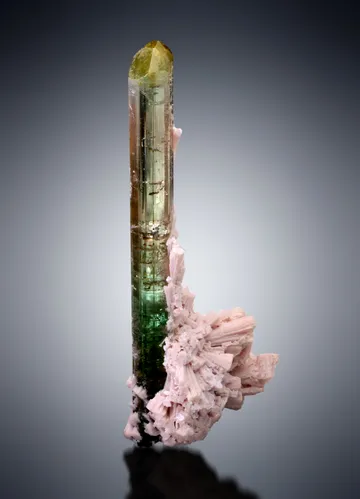
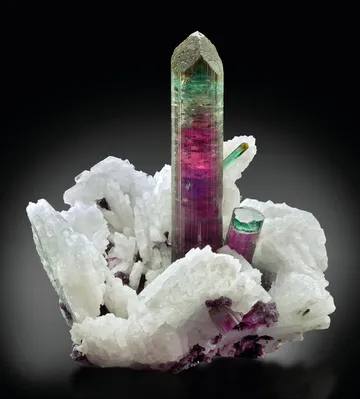
The best Coronel Murta specimens have a particular look: strong color architecture rather than mere color. Fine elbaites can show cranberry-red cores, grass-green caps, teal or blue-green zones, pale pink stalks, and yellowish or smoky terminal bands, often in narrow, sharply terminated prisms. Barra pieces are prized when the crystal is complete, glassy, and sceptered, especially if perched naturally on quartz or nestled in cleavelandite or lepidolite. Morro Redondo pieces are often more massive in market presence, ranging from single rubellite crystals to bicolored suites and quartz-associated specimens. Matrix is scarcer than loose crystals and carries a premium when it is natural, aesthetic, and unrepaired.

Photo: Wikimedia Commons
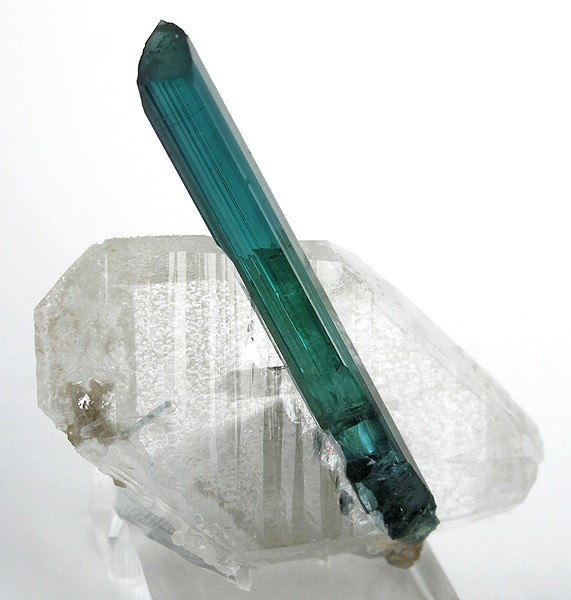
Photo: Wikimedia Commons

Photo: Wikimedia Commons
Search for specimens: View all specimens from Coronel Murta, Brazil
Coronel Murta lies in northeastern Minas Gerais, in the Jequitinhonha Valley, about 30 km from Araçuaí and within the Araçuaí–Salinas gem-pegmatite country that has supplied tourmaline, beryl, quartz, feldspar, mica, and rare minerals for generations. The locality name used by collectors is usually municipal rather than mine-specific; a specimen labeled simply “Coronel Murta” may in fact come from Barra do Salinas, Morro Redondo, Água Santa, Ouro Fino, Terra Corrida, or another claim within the surrounding pegmatite fields.
The district belongs to the Eastern Brazilian Pegmatite Province, a large belt of granitic pegmatites related to the Brasiliano/Pan-African evolution of the Araçuaí orogen. The Coronel Murta field is generally regarded as part of the rare-element, LCT-family pegmatite system, though the local emphasis varies from body to body. In the collector localities, the useful mineralogical shorthand is a boron-rich, lithium-bearing pegmatite association: elbaite and schorl tourmaline, albite and cleavelandite, microcline or K-feldspar, quartz, lepidolite, muscovite, beryl varieties including aquamarine and morganite, topaz, spodumene, amblygonite-montebrasite, cassiterite, columbite-tantalite, tantalite-(Fe), microlite-group minerals, hydroxylherderite, and rare phosphates or arsenates.
The country rocks and intrusive setting are important to understanding the specimens. At the Manoel Fonseca claim, north of Coronel Murta town, biotite schist and quartzite of the Macaúbas Group predominate near a relatively small pegmatoid granite stock. The pegmatite described there is a zoned body more than 100 m long and about 8 m thick, intruded in schist and broadly concordant with foliation. Its wall zone is fine-grained and feldspar-rich with graphic quartz intergrowths, muscovite, and schorl; the intermediate zone carries coarser microcline, quartz, muscovite, albite, and schorl; and a discontinuous quartz core is bordered by albite replacement bodies where phosphate minerals and hydroxylherderite occur.
Morro Redondo is the best-documented specimen mine in the municipality. It is a gemstone and specimen pegmatite in the northern part of the Oriental/Eastern Brazilian Pegmatite Province, about 400 m long, with an average thickness around 30 m, a roughly north-south strike, and a steep westward dip. The pegmatite was discovered in 1991 and became famous for rubellite and bicolored elbaite. Its internal structure includes a discontinuous quartz core, locally very thick, with surrounding albite-dominant replacement bodies. Those replacement zones and closely spaced fractures produced the red-green elbaite for which the mine is best known.
The spectacular Morro Redondo event was the 1994 discovery of a giant albite-rich replacement body near the northern edge of the pegmatite. It contained hundreds of small cavities and mineralized fractures carrying bicolored red-green elbaite crystals up to about 10 x 1 cm. The mined-out cavity has been reported at roughly 15 x 10 x 10 m, and the elbaite production exceeded one tonne. That is why Morro Redondo specimens, even when modest in size, have a very specific historical weight: they belong to one of the great volume finds of gem-quality elbaite.
Barra do Salinas, west of Coronel Murta, is the older and more romantic name. Its pegmatites and sublocalities include Cata Rica, Dois Irmãos, Esperança, Fecha-Fecha, Vieirão, and Vieirinho, along with nearby claims whose labels have moved through the mineral trade in several spellings: Barra do Salinas, Barra de Salinas, Barra da Salinas, Barra de Salinas district, or simply “Barra.” The Barra assemblage is broader than tourmaline alone, with albite, aquamarine, beryl, biotite, cassiterite, columbite-series minerals, elbaite, garnet, kaolinite, kunzite, lepidolite, mica, microcline, morganite, muscovite, phlogopite, pyrite, quartz, schorl, smoky quartz, spodumene, and topaz all documented from the district.
Mining has ranged from garimpeiro work in weathered pegmatite and lateritic soil to mechanized extraction for feldspar and industrial minerals. The Água Santa pegmatite has been described as the principal feldspar producer in the municipality, and a study of 21 Coronel Murta pegmatite workings evaluated K-feldspar derived from G4-suite, S-type granites of about 520–500 Ma for ceramic and glass applications. This industrial side matters to collectors because feldspar mining opens pegmatite interiors that may also contain pockets, cleavelandite replacement zones, quartz cores, and accessory mineral assemblages.
Access today should be treated as private and commercial, not recreational. The known workings are mines, claims, farms, or industrial pegmatite operations, and collecting without permission is inappropriate. For most collectors, Coronel Murta is best approached through well-provenanced specimens rather than field collecting. Because the municipal label is broad and because older dealer labels can omit the exact mine, the most desirable specimens carry a sublocality—Barra do Salinas, Morro Redondo, Terra Corrida, Ouro Fino, Manoel Fonseca, Água Santa—or a documented collection history.
Elbaite is the signature collector mineral of Coronel Murta, especially from Barra do Salinas and Morro Redondo. The finest Barra pieces are slim, lustrous, often sceptered prisms with vivid green, blue-green, pink, red, yellowish, or watermelon zoning; classic examples are thumbnails to miniatures, but older and modern records include crystals in the 5–13 cm range and occasional larger cabinet-level pieces. Morro Redondo elbaite is famous for red-green bicolored crystals and rubellite from albite-rich replacement bodies, including the great 1994 production in which crystals to about 10 x 1 cm came from cavities and mineralized fractures. Matrix pieces on quartz, cleavelandite, feldspar, or lepidolite are less common than loose crystals, and the best examples are judged by transparency, complete termination, saturated but open color, crisp zoning, and an absence of repairs along the prism or at the cap.
“Tourmaline” on Coronel Murta labels usually means elbaite-group material when the crystal is colored, but many older specimens were sold without modern analytical distinction, so the broader tourmaline label remains common and useful. Barra do Salinas tourmalines are known for sceptered growth, etched but lustrous faces, steep pyramidal terminations, green caps on pink stalks, blue-green indicolite zones, and occasional quartz or feldspar matrix; Morro Redondo is more strongly associated with abundant rubellite and red-green bicolor crystals. Schorl also occurs in the pegmatites, especially in wall and intermediate zones, and can be present as black prisms in feldspar, quartz, or mica-rich material. Good tourmaline specimens from Coronel Murta show clear, intentional-looking color architecture and sharp terminations; ordinary pieces are typically chipped, dark, incomplete, overly fractured, or too generically labeled to separate from the mass of Minas Gerais tourmaline.
Quartz is both a specimen mineral and the structural stage on which much of the Coronel Murta assemblage formed. Morro Redondo produced large quantities of colorless, citrine, and smoky quartz crystals, with reported individual crystals reaching up to about 1 m, while Barra do Salinas has supplied quartz matrix pieces carrying indicolite or elbaite, smoky quartz associated with feldspar and mica, and quartz-hosted kyanite. At Manoel Fonseca, quartz crystals about 15 cm long carried tiny white bergslagite crystals with hydroxylherderite rims, giving quartz a rare-mineral role as well as a display role. The best collector quartz from Coronel Murta is not simply clear crystal; it is quartz that preserves a natural pegmatite association, especially a sharply posed tourmaline, blue kyanite, or rare phosphate/arsenate coating without bruising or artificial attachment.
Lepidolite from Coronel Murta is most attractive as a companion mineral to tourmaline and as a display species in its own right, especially the violet-purple to silvery, pseudohexagonal books and aggregates reported from Morro Redondo. In the Barra do Salinas district, lepidolite occurs with elbaite, spodumene, albite, quartz, beryl, and feldspar, and pink lepidolite has been noted historically as a practical pocket indicator in altered tourmaline-bearing pegmatite. Fine specimens show clean violet or lavender color, distinct mica books or rosettes, and a stable association with elbaite, quartz, or cleavelandite; lesser pieces are crumbly masses, mica-stained matrix, or material whose color is too weak to add contrast to the tourmaline.
Beryl at Coronel Murta appears chiefly as aquamarine and morganite in the gem-bearing pegmatites, with Barra do Salinas especially important for pink morganite crystals accented by green elbaite and for beryl within the broader tourmaline-bearing assemblage. Morro Redondo also lists beryl, aquamarine, and morganite among its pegmatite minerals, though the mine’s collector fame rests more heavily on elbaite. The better beryl specimens are gemmy, well-faced crystals with readable terminations and natural associations with elbaite, quartz, feldspar, or cleavelandite; pieces with flat, tabular morganite crystals and green tourmaline accents are particularly desirable because they combine two of the district’s most marketable gem minerals in one specimen.
Aquamarine from Coronel Murta is part of the Be-rich side of the district’s rare-element pegmatites, occurring in Barra do Salinas, Morro Redondo, and small pegmatites near Coronel Murta town that have been noted for high-quality aquamarine. Typical collector pieces are pale to medium blue beryl crystals, sometimes doubly terminated, in quartz-feldspar-mica pegmatite assemblages. The color is usually not the dark Santa Maria-style blue that made other Minas Gerais names famous; Coronel Murta aquamarine is collected more for crystal form, locality interest, and association with tourmaline-bearing pegmatites. The best pieces are transparent, undamaged, sharply terminated crystals with pleasing blue tone and minimal internal fracturing.
Albite is one of the key pocket and replacement-zone minerals at Coronel Murta. At Morro Redondo, albite-dominant replacement bodies around the quartz core were central to the great elbaite production, and at Manoel Fonseca decimetric albite replacement bodies occur near the discontinuous quartz core with apatite and herderite-series minerals. In collector specimens, albite appears as white masses, platy cleavelandite blades, or altered feldspathic matrix supporting lepidolite, tourmaline, quartz, and rare minerals. The best albite-associated specimens show clean white contrast and structural support without overwhelming the colored mineral; friable, kaolinized, iron-stained feldspathic matrix is common and less desirable unless it preserves a rare association.
Kyanite is one of the surprises of Barra do Salinas and gives Coronel Murta an importance beyond gem tourmaline. Documented specimens include deep-blue to light-blue elongated crystals on quartz, free-standing clusters, and larger cabinet pieces; one recorded specimen from a find around 2002 had an overall size of 9.5 x 12.5 x 10.5 cm and a largest kyanite crystal reported at 14.3 x 1.5 cm, while another noted cluster measured about 16 x 10 cm. Associations include quartz, staurolite, mica-group minerals, and muscovite, tying the material closely to the metamorphic environment around the pegmatites. Fine Coronel Murta kyanite is prized for saturated blue color, visible terminations, upright crystal arrangement, and clean quartz contrast; ordinary pieces are pale, broken blades or jumbled aggregates lacking definition.
Cleavelandite, the platy albite variety, is an important matrix and association mineral in Coronel Murta specimens. It occurs as pearly white, translucent to opaque blades and stacks, commonly with lepidolite and sometimes with tourmaline or quartz. From a collector standpoint, cleavelandite adds value when it forms sculptural, bright blades that lift a colored elbaite or violet lepidolite above the matrix; it detracts when it is crushed, dirty, kaolinized, or repaired in a way that obscures whether the tourmaline was naturally attached. Small lepidolite crystals embedded among cleavelandite blades are a typical and attractive Coronel Murta association.
Muscovite is a common structural and accessory mineral in the Coronel Murta pegmatites, present in wall zones, intermediate zones, and pocket assemblages with quartz, feldspar, albite, schorl, lepidolite, and beryl. At Manoel Fonseca it is part of both the fine-grained wall assemblage and the coarser intermediate assemblage, while Morro Redondo specimens may show mica books at the base of tourmaline crystals or in albite-rich matrix. Collector-grade muscovite from the district is usually valued as an association rather than the main attraction: bright books, rosettes, or plates that complement elbaite, lepidolite, quartz, or aquamarine. Pieces dominated by dull, bruised mica rarely stand on their own unless the locality or association is unusually well documented.
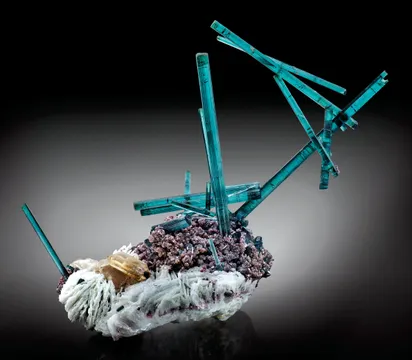
Indicolite is among the most elegant expressions of Coronel Murta elbaite, especially from Barra do Salinas, where blue to blue-green crystals occur as slim transparent prisms, sceptered crystals, and quartz-mounted specimens. Classic examples include gem blue-green indicolite perched on colorless quartz, with crystals around 5–6 cm long represented in older collections, and Morro Redondo has also yielded blue and multicolored elbaite within its pocket production. The best indicolite from Coronel Murta is transparent enough to light from within, not merely dark blue at the surface; it should have sharp prism faces, an intact termination, and clean contrast if on quartz. Dark terminal areas may open to teal, blue-green, or olive tones under strong backlighting, so judging these pieces only under weak show lighting can be misleading.
Feldspar is both an industrial mineral and a specimen matrix at Coronel Murta. The municipality has been studied for K-feldspar from 21 pegmatite workings, with Água Santa identified as the principal feldspar producer, and microcline, K-feldspar, albite, and cleavelandite appear throughout the documented pegmatite assemblages. In specimens, feldspar may be blocky, white to cream, partly kaolinized, or a platform for tourmaline, lepidolite, quartz, and beryl; in the best pieces it is clean, architectural, and clearly natural rather than a broken lump used to prop up a loose crystal. Orthoclase- or microcline-bearing matrix with vivid elbaite and cleavelandite can make the difference between a good loose tourmaline and a top-level Coronel Murta combination.
Rubellite is the red-to-pink face of Coronel Murta tourmaline, and two histories dominate: Barra do Salinas, where rubellite helped establish the district’s reputation by the mid-20th century, and Morro Redondo, where the 1990s production flooded local markets with red and bicolored elbaite crystals and masses. Barra rubellites may occur as sceptered or color-zoned crystals, sometimes with quartz, and older literature records multicolored and red crystals reaching significant miniature to small-cabinet sizes. Morro Redondo rubellite is more abundant in market memory, but fine crystals still require selectivity: rich cranberry or raspberry color, gem translucency, sharp termination, and minimal damage are crucial. Matrix rubellite on lepidolite, feldspar, albite, or quartz is much less common than loose crystal material and deserves careful examination for repairs.
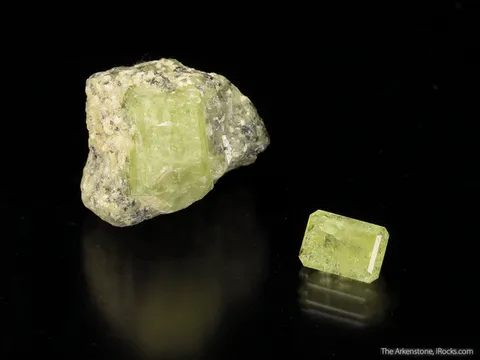
Other minerals documented from Coronel Murta include amblygonite, montebrasite, spodumene and kunzite, morganite, schorl, smoky quartz, rose quartz, topaz, cassiterite, columbite-series minerals, tantalite-(Fe), microlite-group minerals, hydroxylherderite, kaolinite, pyrite, rutile, staurolite, sillimanite, phlogopite, biotite, humboldtine, native gold, and uralolite. The municipality’s rare-mineral highlight is bergslagite, CaBeAsO4(OH), from the Manoel Fonseca claim, where tiny whitish crystals occur on quartz with hydroxylherderite; this is not a type-locality story so much as an important later occurrence in a region famous for producing uncommon Be-, P-, As-, Li-, Ta-, and Nb-bearing pegmatite species. Several dramatic tourmaline names have appeared historically in connection with Coronel Murta, but modern locality records treat some reports—such as chromium-dravite, fluor-buergerite, liddicoatite, povondraite, and certain uvite-series identifications—as erroneous or insufficiently supported, which is a reminder that color alone is not chemical proof in the tourmaline group.
The first collecting issue with Coronel Murta is label precision. “Coronel Murta” is a valid municipal locality, but it is not the same as a mine name. Fine elbaite may be Barra do Salinas, Morro Redondo, Terra Corrida, Ouro Fino, or another nearby pegmatite; older labels may use Barra de Salinas, Barra da Salinas, Barra do Salinas, Barra, or Jequitinhonha Valley without modern administrative detail. A specimen with a strong sublocality and collection history is worth more than an equally pretty but vague “Minas Gerais” or “Coronel Murta” label.
The second issue is repair. Tourmaline crystals from this district are commonly slender and internally strained; repairs across the prism, at the termination, or at the matrix contact are not unusual in high-end pieces. Sceptered crystals deserve particular attention because the neck below the head is a natural weak point and because an added or reattached cap can greatly alter value. Use side lighting, magnification, and UV-curing-glue checks around the cap, base, and matrix contact. Natural etching and growth disruption are common, so do not confuse every irregular surface with damage, but do not accept “natural contact” explanations without close inspection.
Treatments are a gemological concern more than a specimen-display issue, but they matter for faceted stones and gem rough from the region. Blue and green tourmaline from Minas Gerais has commonly been heated to lighten or brighten color; rubellite is less commonly heated because the higher temperatures needed can damage included material. For specimens, heating is rarely disclosed unless the piece has passed through gem channels, and it can be difficult to prove visually. Buy specimen tourmaline for observable quality rather than treatment mythology unless laboratory documentation is important to the purchase.
Mislabelling within the tourmaline group is a real risk. Many “liddicoatite,” “chromium-dravite,” “buergerite,” or exotic tourmaline labels from older collections are not analytically secure. Most colored lithium-tourmaline from Coronel Murta should be treated conservatively as elbaite unless chemistry or a trusted analytical note says otherwise. “Indicolite,” “rubellite,” “verdelite,” and “watermelon” are color-variety terms, not separate species; they are acceptable collector language but do not replace a species identification.
Condition expectations differ by mineral. Elbaite and rubellite often have bruised terminations, rehealed-looking etched faces, and contact at one end; the highest premiums go to clean, complete, transparent crystals. Lepidolite and cleavelandite can be friable, so avoid unnecessary handling and vibration. Feldspar matrix may be kaolinized and undercut, especially in pieces from altered pegmatite. Kyanite blades are directionally brittle and should be mounted or stored so that blade tips do not carry weight. Quartz-associated specimens are more robust but may hide repaired tourmaline contacts in crevices.
Fluorescence is not a primary selling point for most Coronel Murta specimens, though rare phosphates and arsenates may reward careful testing. The more important lighting tool is strong white backlighting: it can reveal whether a dark tourmaline termination is actually blue-green, olive, teal, or red internally, and it separates a merely dark crystal from a gemmy one. For market availability, Coronel Murta remains active in the specimen trade, with small elbaite thumbnails and miniatures appearing regularly, but truly fine unrepaired scepters, transparent indicolite-on-quartz pieces, strong matrix rubellites, and documented Morro Redondo production pieces are much scarcer than the locality name might suggest.
Morro Redondo is the sort of locality story that explains why Brazilian pegmatites became legendary in the first place. The pegmatite was found in 1991, not as an obvious surface show but below a cover of colluvium, and it proved to be a large body: hundreds of meters long, tens of meters thick, and internally divided into quartz-core and replacement-zone architecture. In the early years, miners encountered quartz in extraordinary quantity—colorless, citrine, and smoky crystals, some reported up to a meter long—along with smaller cavities holding green, blue, red, and multicolored elbaite.
Then came 1994. Near the northern edge of Morro Redondo, miners broke into an albite-dominant replacement body so rich in tourmaline that the scale strains normal specimen language. It held hundreds of small cavities and closely spaced fractures lined or filled with bicolored red-green elbaite. The crystals were not giant logs; many were slender, up to about 10 x 1 cm, but the volume was astonishing. More than a tonne of elbaite came out, and when the zone was exhausted it left an empty space roughly 15 x 10 x 10 m. The find was large enough to move the local market. Wholesale lots of a tonne or more of elbaite and rubellite were reportedly offered, and Morro Redondo became the name behind countless red-green Brazilian tourmalines in collections around the world.
Barra do Salinas has an older kind of fame. The region’s reputation for rubellite goes back at least to the 1940s, when superb red tourmalines were found in primary pegmatite near the Salinas River. Later accounts describe Barra crystals as long as 13 cm, often multicolored and frequently among the reddest rubellites of the district, with many attached to quartz. These are the pieces that trained collectors to recognize the Barra look: slender prisms, gemmy interiors, strong color zoning, and sceptered habits in which a green or blue-green head seems to rise from a pink stalk.
The broader Araçuaí–Salinas gem district also produced some of the most vivid mining scenes in Brazilian gem literature. At nearby Ouro Fino, the first gem rubellites were found in November 1979 by garimpeiro Manoel Cardosa on land owned by descendants of Coronel Murta’s founder, Francisco Murta, and his son Antonio Wilson Murta. For a year and a half the operation remained small. Then, in the late spring of 1981, superb red tourmalines were found deeper in the hill. Within weeks, more than 1,000 garimpeiros moved into the area and dismantled a 50 m hill by hand, carrying earth away in sacks, buckets, and wheelbarrows to a washing pond about 400 m away. That episode belongs to the neighboring district, but it is part of the same Jequitinhonha Valley tourmaline culture that shaped the trade in Coronel Murta material.
The label stories can be nearly as interesting as the mining stories. In 2006, a small pocket of lustrous, gemmy elbaite crystals reached the market under the simple label “Coronel Murta.” The crystals reportedly reached 25 cm long and showed several color zones, with a rich yellow zone just below the termination in many examples. The problem was not the quality—it was that the exact source was uncertain. The Coronel Murta name covered thousands of prospected acres and numerous pegmatites, and even experienced dealers could not always say whether a particular crystal came from Barra do Salinas, Genipapo/Jenipapo, Urubu, Terra Corrida, Baxão, Morro Redondo, or another working. For collectors, that story is a permanent caution: Coronel Murta is a real locality, but a great specimen deserves the most precise label that can honestly be defended.