Barra do Salinas, Brazil — famed for multicolored elbaite tourmaline and rare-element pegmatites, plus blue kyanite pockets; a historic, collector-worthy local…
Key facts
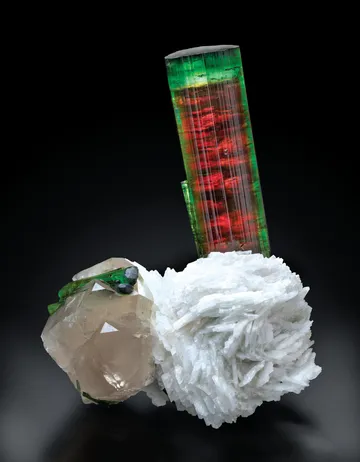
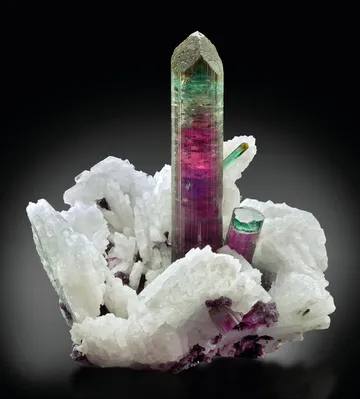
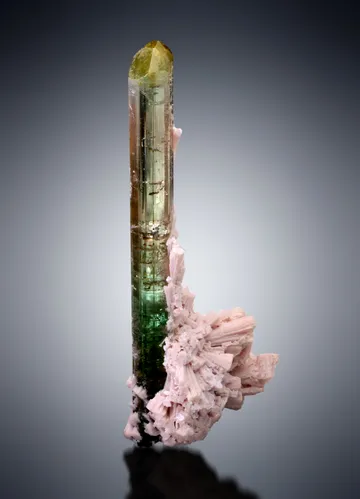
Barra do Salinas is one of the great old names of northeastern Minas Gerais pegmatite collecting: a district west of Coronel Murta, near the Jequitinhonha and Salinas river country, where deeply weathered rare-element granitic pegmatites have yielded the kind of gem tourmaline that trained generations of collectors to recognize a Brazilian pocket by sight. The classic look is not a single color but a sequence—pink, red, green, blue-green, colorless, brownish, and multicolored elbaite, commonly loose from kaolinized pocket zones, sometimes doubly terminated or sceptered, and at best glassy, sharply terminated, and clean enough to seem cut from candy rather than mined from a decomposed pegmatite wall.
The district is more than a tourmaline locality. Its pegmatites produced morganite, aquamarine, spodumene and kunzite, lepidolite, quartz, mica, feldspar, cassiterite, columbite-tantalite-series material, hydroxylherderite and other rare-element pegmatite species. In the same Barra do Salinas region, a separate suite of blue kyanite-on-quartz specimens comes from hydrothermal quartz-rich pockets in mica schists of the Salinas Formation rather than from the tourmaline pegmatites themselves. That dual identity—gem pegmatites on one hand, hydrothermal kyanite pockets on the other—makes “Barra do Salinas” a broader collector name than it first appears.
Regional View
Country View
Historically, the Barra do Salinas pegmatites occupy a proud place in the Araçuaí–Salinas tourmaline story. Reports summarize the district as several granitic pegmatites covering roughly 1,500 hectares, with discoveries said to date to the late nineteenth century but systematic mining beginning in the 1940s and peak production in the 1970s and early 1980s. The best early rubellite crystals, many attached to quartz, helped establish the Barra name in the gem trade; later pockets added multicolored tourmaline, morganite, aquamarine, cat’s-eye tourmaline and large quantities of quartz.

Photo: Wikimedia Commons
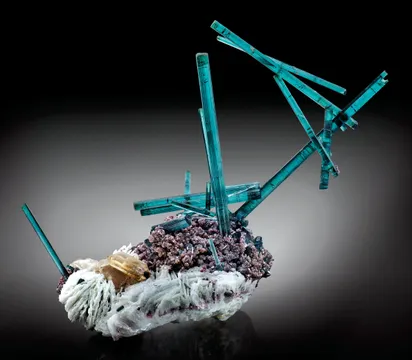
The finest Barra tourmalines are judged as individual crystals as much as as “locality pieces.” Collectors look for intact pyramidal terminations, saturated but not inky color, clean internal zoning, and naturally healed or etched bases that tell the story of a pocket rather than a lapidary trim. Matrix examples are scarcer and especially desirable when elbaite stands on quartz, mica, cleavelandite or feldspar rather than merely sitting loose. By contrast, Barra kyanite is valued for strong blue blades perched on quartz, with broad, undamaged crystal faces and a natural arrangement that survives the difficult extraction of brittle aggregates.
Search for specimens: View all specimens from Barra do Salinas District, Brazil
Barra do Salinas is a municipal district of Coronel Murta in Minas Gerais, Brazil, and mineral labels may read Barra de Salinas, Barra da Salinas, Barra do Salinas, Barra do Salinas district, Salinas, or simply Coronel Murta. The ambiguity matters. “Coronel Murta” is a broad municipal label that can cover a number of famous pegmatites and claims, while “Barra do Salinas” usually refers to the district and its local pegmatite workings west of town. Older labels, especially those attached to loose tourmaline crystals, may be imprecise, and careful collectors try to retain any mine name, pocket name or dealer history that came with the specimen.
The classic deposit type is rare-element granitic pegmatite of the eastern Brazilian pegmatite province, within the broader Araçuaí–Salinas and middle Jequitinhonha gem belt. Named localities and pegmatites associated with the district in modern databases and literature include Cata Rica, Dois Irmãos, Esperança, Fecha-Fecha, Vieirão, Vieirinho, Água Santa and Paineiras/Carlau. The pegmatite suite is dominated by quartz, feldspar and mica, with local pockets carrying cleavelandite, tourmaline, lepidolite, beryl, spodumene and other evolved pegmatite minerals. Much of the feldspar in the worked zones is kaolinized to a soft white clay, leaving quartz, mica, black tourmaline fragments and gem crystals as resistant survivors within collapsed or altered pocket material.
Mining history at Barra do Salinas is a layered story. The Salinas mine was reported as discovered around the late nineteenth century, but serious exploitation is generally placed in the 1940s. Telesco de Mattos led an important early operation after 1945, and within a few years a major pocket produced more than 1,000 kilograms of tourmaline crystals. Antonio Pinheiro later improved and expanded the operation, recognizing not just gem tourmaline but kaolin, mica, beryl and quartz potential. Halley Batista purchased the main Salinas operation in August 1973 and presided over a particularly productive period. A nearby second section, Lavrinha de Salinas, was associated with Klaus Treuherz and produced fine multicolored tourmaline crystals, many on matrix, before closing.
The mine workings described in the 1980s were adapted to the unusual weathered character of the deposit. Instead of neat hard-rock pockets like those in fresher pegmatites, the Salinas operation involved bulldozing thin layers of kaolinized pegmatite and watching closely for pocket indicators: pink lepidolite, smoky quartz, loose gem crystals and concentrations of resistant material. The result was a long excavation described as a “canyon,” locally as much as 30 meters deep, cut into the pegmatite. In places high-pressure water cannons were used against the soft kaolinized walls, and garimpeiros followed the machinery with hand tools to recover crystals before they were broken or lost in the clay.
Production records and historical summaries give a sense of the district’s scale. One of the better Salinas pockets contained 20 kilograms of tourmaline in mixed colors, including rubellite, green, blue, purplish brown, colorless and a superb bicolored crystal. A 1977 pocket yielded 25 kilograms of fine pink tourmaline crystals in the 2.5 to 5 cm range. In August 1980, another notable find produced 6 kilograms of emerald-green tourmaline crystals measuring about 5 to 15 cm. Later summaries note that the Vieirinho pegmatite produced 50 kilograms of multicolored “watermelon” tourmaline from a single pocket, and that the Salto mine produced six tons of pale aquamarine and cat’s-eye tourmaline in 1983. These figures explain why Barra do Salinas is not merely a locality of attractive thumbnails; it was a serious source of gem rough and collector-grade crystals.
The older Barra de Salinas rubellite occurrence, near the mouth of the Salinas River, became famous in the 1940s. Ed Swoboda, who visited in that period, described a primary pegmatite close to the river, with another part across the water within the limits of the town. Some crystals reached about 13 cm and were multicolored, but many of the memorable specimens were deep red rubellite, commonly attached to quartz. Those early pieces are now difficult to separate in the marketplace from other Coronel Murta or Araçuaí–Salinas rubellites unless they have strong provenance.
The kyanite specimens sold under Barra do Salinas come from a different geological setting in the same region. Recent field study of four primary deposits and one colluvial deposit around the village documented quartz-rich kyanite pockets hosted by Neoproterozoic biotite schists of the Salinas Formation. The studied primary deposits—Sítio Sr. Manoel, Morro da Cianita, Morro Redondo and Córrego Bonito—are pocket-like bodies connected by thin irregular quartz veins, aligned mainly N20–40°E, with steep dips to the southeast. The authors preferred a “rosary” morphology for these beaded quartz-rich bodies: larger mineralized pockets connected by slender veins, like beads on a string. Fazenda Pianos was described as a secondary colluvial deposit, with angular quartz blocks and loose kyanite crystals accumulated on a gentle slope.
Access today should be assumed to be private, controlled, and variable. This is not a casual collecting locality. Old workings, modern claims, active exploration, unstable kaolinized cuts, steep trench walls, hydraulic workings and private farmland all make permission essential. Most serious collectors will encounter Barra material through dealers, old collections, Brazilian show parcels, or marketplace specimens rather than through field collecting.
Elbaite is the collector mineral that made Barra do Salinas famous, appearing as loose or matrix-supported gem crystals in pink, red, green, blue-green, colorless, brownish and complex multicolored zoning from the weathered pegmatite pockets. The most desirable Barra elbaites are sharp, lustrous prisms with complete pyramidal or complex terminations, clean zoning, and minimal bruising along the edges; bicolored and tricolored crystals, green-over-pink crystals, sceptered forms, and doubly terminated pieces are especially sought after. Historic reports cite pocket lots ranging from 2.5 to 5 cm pink crystals to 5–15 cm emerald-green crystals, with older rubellites to about 13 cm from the Barra de Salinas river occurrence; ordinary pieces tend to be loose, broken at the base, cloudy, abraded, or too dark to show Barra’s prized transparency and color architecture.
“Tourmaline” remains the practical label on many Barra do Salinas specimens because older finds and mixed pocket lots may not have been chemically analyzed crystal by crystal, but the gem colored material is chiefly elbaite while literature also reports several tourmaline species from the district, including schorl, dravite, uvite and liddicoatite among broader identifications. Barra tourmaline occurs in pegmatite pockets with quartz, mica, feldspar or kaolinized feldspar, cleavelandite, lepidolite, beryl and spodumene; the best pieces show strong color zoning, balanced proportions, glassy luster, and natural terminations rather than sawn ends or chipped points. The locality is also known for unusual market confusion: a vague “Coronel Murta” label can describe excellent tourmaline from Barra do Salinas, Genipapo/Jenipapo, Urubu, Terra Corrida, Baxão, Morro Redondo or other nearby pegmatites, so locality precision adds real value.
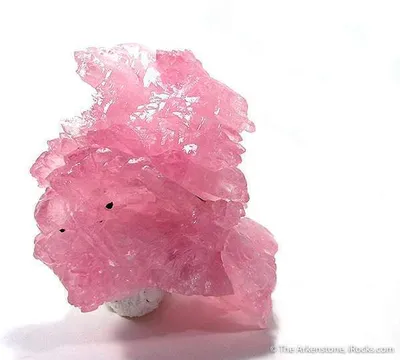
Rhodochrosite from Barra do Salinas is a modern collector curiosity rather than the district’s historic glory: loose, thumbnail-sized, translucent rose-pink pegmatitic rhombohedra entered the market in small parcels, noted for being unusual in origin because rhodochrosite from gem pegmatites is far less common than elbaite or beryl. These crystals do not compete with major hydrothermal rhodochrosite localities in size or color saturation, but they are attractive, distinctive, and locality-significant; good pieces are complete, clearly rhombohedral, evenly pink, translucent around the edges, and free of the bruising and cloudy alteration that can make a small loose crystal look merely like a chip. Associations on the market are generally sparse, with most reported pieces sold loose rather than as showy matrix specimens.
Quartz at Barra do Salinas plays several roles: massive quartz cores in the pegmatites, smoky quartz as a pocket indicator in the kaolinized Salinas workings, window and scepter quartz in some pegmatite pockets, quartz matrix for early rubellite, and quartzose matrix for the separate blue kyanite pockets. The Barra da Salina workings were reported to have produced abundant window and scepter quartz, including one extraordinary pocket with more than 50 tons of quartz and transparent crystals exceeding one meter and about 500 kilograms; in the kyanite deposits, however, quartz is commonly massive, milky to colorless, and locally yellowish or reddish from iron oxides, with fine crystallization less prominent in the studied pockets. For collectors, the best quartz-related Barra specimens are not plain quartz points but quartz carrying elbaite or kyanite, or distinctive old window/scepter forms with secure locality history.
Kyanite from the Barra do Salinas region is celebrated for intense blue blades and crystal groups on quartz, but the best-documented deposits are hydrothermal quartz-rich pockets in Salinas Formation biotite schists rather than ordinary gem pegmatite cavities. Recent work describes kyanite as the principal mineral with quartz, generally in 5–10 cm crystals and rarely to 25 cm, with aggregates reaching decimeter scale but commonly breaking apart during extraction; the assemblage includes staurolite, rutile, schorl, muscovite, paragonite and microcline, with garnet noted petrographically. Top pieces have saturated blue, broad intact blades, strong contrast on quartz, and an undisturbed composition rather than bundles of thin loose “palhetas,” which are commonly sold by weight and considered lower commercial quality.
Lepidolite at Barra do Salinas is important both as a specimen mineral and as a field clue to gem pockets: in the Salinas mine, miners watched for pink lepidolite along with smoky quartz while bulldozing the kaolinized pegmatite, and broader descriptions of the Barra da Salina workings note lepidolite-rich cleavelandite pockets with tourmaline and quartz. Collector-grade lepidolite from the district is scarcer than elbaite and usually valued as an association, matrix or habit specimen rather than a stand-alone showpiece; Toca do Onça material has been noted for diamond-shaped lilac crystals, and good examples should retain fresh lilac to pink color, crisp micaceous form, and a convincing relationship to elbaite, feldspar or quartz. Massive, crumbly or clay-stained lepidolite is commoner and less desirable, though it can still be locality-significant when attached to a fine tourmaline.
Other documented Barra do Salinas minerals include albite and cleavelandite, beryl varieties aquamarine and morganite, spodumene and kunzite, muscovite, microcline, cassiterite, columbite-tantalite-series minerals, hydroxylherderite, herderite, topaz, schorl and other tourmalines, as well as staurolite, rutile, paragonite and possible garnet in the kyanite-pocket assemblage. A particularly important note for species collectors is the reported identification of the rare tourmaline now known historically as fluor-buergerite from the Cata Rica pegmatite; because older tourmaline nomenclature has changed and because the group requires analytical confirmation, such labels should be treated as literature-significant but not casually applied to untested brown tourmalines.
Barra do Salinas rewards precise labeling. “Barra de Salinas,” “Barra da Salinas,” “Barra do Salinas,” “Salinas,” and “Coronel Murta” have all appeared in the market, and the difference can matter. Fine tourmaline simply labeled “Coronel Murta” may genuinely be from Barra, but it may also be from another nearby pegmatite district. The safest labels preserve the original wording and add a modern interpretation only when provenance supports it.
For tourmaline, expect a high proportion of loose crystals. Many were recovered from kaolinized or collapsed pockets rather than intact hard-rock cavities, so healed bases, etched ends, clay in recesses, small edge bruises and missing lower terminations are normal. A healed base is not the same as a broken base; a bright sawn or ground end, fresh chips on prism edges, or a termination rebuilt with adhesive is a different matter and should be disclosed. Matrix pieces are rarer, and a securely attached elbaite on quartz, mica, feldspar or cleavelandite commands a premium over a loose crystal of comparable color.
Heat treatment is a real gemological concern for Barra-region tourmaline and beryl. Literature on the district notes that both beryl and tourmaline from the Barra de Salinas mines can be color enhanced by heat treatment, and specifically that brown tourmaline can become rose-red at approximately 250–400°C. Blue and green tourmaline from the broader Minas Gerais pegmatite region has also commonly been heated to lighten or brighten color, while rubellite is less often heated because inclusions may be damaged at the required temperatures. For mineral specimens, the practical issue is disclosure: heating may not be visually obvious, and a specimen sold as a natural-color collector crystal should be backed by strong provenance or analytical confidence if the claim materially affects price.
Kyanite presents different problems. The crystals are strongly cleavable, brittle, and commonly extracted from quartz-rich aggregates that come apart during mining. Look closely for repaired blades, glued reassemblies, concealed breaks at contact points, iron-stained faces, and abrasion along the blade edges. Rich blue color and natural position on quartz are the main drivers of value; bundles of loose thin “palhetas” are far more common and less important as specimens.
Rhodochrosite from Barra do Salinas is a small-specimen rarity, not a major source of large display rhodochrosite. Because the crystals are loose, thumbnail-sized and relatively simple, condition is everything: a complete rhombohedron with even translucency is much more desirable than a chipped fragment. Locality verification is also important because pegmatitic rhodochrosite from Minas Gerais is known from more than one area, and a loose pink rhombohedron without provenance is easy to misplace.
No strong district-wide fluorescence tradition defines Barra do Salinas specimens for collectors, and most handling concerns are mechanical rather than optical: protect tourmaline terminations, avoid ultrasonic cleaning on fractured crystals, keep kyanite away from pressure and vibration, and use only gentle water and soft brushes on kaolin-stained pegmatite specimens unless you are certain that clay removal will not expose repairs or destabilize matrix.
The most cinematic Barra do Salinas mining scene comes from the Salinas mine during the heavy-equipment period. Imagine a pegmatite so deeply altered that the miners were not following open cavities in solid granite, but peeling the body back like an archaeological trench in white clay. A bulldozer scraped away only 5 to 10 cm of kaolinized pegmatite at a pass. Behind it, garimpeiros watched for the signs that mattered: pink lepidolite, smoky quartz, loose crystals, a change in the clay. When a concentration appeared, the machine work stopped and the hand tools came out. Decades of this treatment cut a trench-like “canyon” into the deposit, in places 30 meters deep.
The mine owner’s solution to theft was as memorable as the workings. Because crystals could appear suddenly from the soft kaolin, and because daylight raiders were a real concern, a portable safety box was kept near the active digging. It had a grooved cylinder on top. A miner placed the crystal into the groove, turned the cylinder, and the find dropped into the locked box. In a mine where a pocket might be nothing but clay, quartz, mica and scattered gem crystals, that little rotating slot was the dividing line between discovery and disappearance.
The older Salinas story is equally large in scale. After Telesco de Mattos began serious work in the mid-1940s, one gem pocket—locally called a vieirinho—yielded more than 1,000 kilograms of tourmaline crystals. Most of the production was bought by local farmers, but Telesco’s son Paulo received 120 kilograms of the best rough and spent five years cutting it into gems. That detail is pure Minas Gerais: a giant pocket, rough moving through local hands, and years of lapidary work hidden behind the neat phrase “tourmaline production.”
A later period under Halley Batista produced the kind of pocket records that still make collectors lean forward. One of the best pockets contained 20 kilograms of tourmaline: rubellite, green, blue, purplish brown, colorless, and a superb bicolored crystal. In 1977, another pocket gave 25 kilograms of fine pink crystals, all in the 2.5 to 5 cm range. In August 1980, a major find produced 6 kilograms of emerald-green tourmaline crystals from 5 to 15 cm long. For specimen collectors, those figures explain why Barra material appears in so many sizes and conditions: a single pocket could feed the gem cutter, the mineral dealer and the local trader all at once.
The Barra de Salinas rubellite occurrence by the Salinas River belongs to the district’s founding mythology. In the 1940s, a primary pegmatite only about 150 meters west of the river produced superb red crystals, many attached to quartz. Ed Swoboda visited the mine in that period and later described a pegmatite that seemed to be cut by the river, with another part on the opposite bank within the town itself. Some crystals were multicolored and reached about 13 cm, but the reputation came from the reddest rubellites. Those old pieces are the sort that now survive as collection ghosts: admired, relabeled, separated from their stories unless an old handwritten tag stayed with them.
The newer kyanite story has a different texture. Around Barra do Salinas, blue kyanite had been sold for the collector market for more than half a century before modern work pinned down the deposits in geological detail. The studied pockets were not ordinary pegmatite miaroles but quartz-rich hydrothermal bodies in mica schist, strung along structural lines like beads on a rosary. In the interior of the pockets, kyanite could be abundant and well developed; near the margins, smaller crystals appeared in chaotic orientations. The best specimens survived as blue blades on quartz, while many aggregates broke apart during extraction, leaving the long loose “palhetas” that dealers could sell by the kilogram.