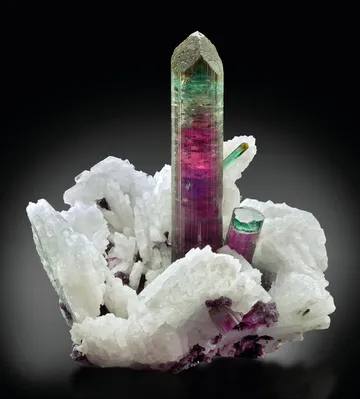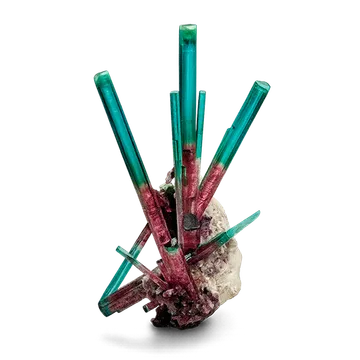
Tourmaline from Barra do Salinas District, Brazil — elbaite with green-pink zoning, scepter terminations, and Barra-style clarity prized by collectors.
Key facts
Barra do Salinas is one of those Brazilian pegmatite names that collectors learn by eye before they learn it by map. The classic specimens are not simply “Brazilian tourmaline”; they have a recognizable architecture: slender to stout gem elbaite prisms, commonly green over pink, sometimes with a scepter-like head, sharp pyramidal terminations, and a glassy, saturated color that can shift from cherry-pink through grass-green, emerald-green, blue-green, and occasional yellowish zones. The best pieces show the prized Barra combination of clarity, color zoning, and sculptural termination rather than just mass.

Photo: Wikimedia Commons
Mineralogically, the collector species here is chiefly elbaite, the lithium-bearing tourmaline that supplies the great pink, green, blue, and multicolored gem crystals of Minas Gerais. “Tourmaline” remains the marketplace and collector term, but serious labels should identify fine colored crystals as elbaite where that determination is justified. The district belongs to the pegmatite country of the middle Jequitinhonha region of northeastern Minas Gerais, west of Coronel Murta, where granitic pegmatites have yielded not only tourmaline but beryl, aquamarine, morganite, spodumene, lepidolite, quartz, microcline, muscovite, cassiterite, columbite-series minerals, and other rare-element pegmatite species.

Photo: Wikimedia Commons
The district’s historical significance rests on two overlapping reputations. The older one is gemological: the Barra de Salinas area was known by the mid-20th century for rubellite and multicolored elbaite crystals, including red material on quartz. The modern collector reputation was sharpened by the distinctive 1970s–1990s production of gemmy green-pink and watermelon crystals, especially the sceptered “Barra” style that later passed through important collections and high-end dealer inventories. Today, the most desirable specimens are clean, unrepaired, transparent, strongly terminated examples with crisp color zoning, particularly green heads on pink stalks, watermelon sections with a red core and green rind, or matrix pieces on quartz, albite, cleavelandite, orthoclase, or lepidolite.
Search for specimens: View all tourmaline specimens from Barra Do Salinas District, Brazil
Barra do Salinas is a municipal district of Coronel Murta, Minas Gerais, Brazil. The name is also encountered in older mineral literature and dealer labels as Barra de Salinas, Barra da Salinas, Barra do Salinas, or simply “Barra,” and older labels may omit Coronel Murta altogether. The locality lies in the gem-pegmatite belt of northeastern Minas Gerais, in the broader Araçuaí–Salinas and Jequitinhonha Valley region, long one of the world’s great sources of colored elbaite.
The deposit type is granitic pegmatite. Mindat records the district as a pegmatite locality west of Coronel Murta and lists a suite of named sublocalities and pegmatites, including Cata Rica, Dois Irmãos, Esperança, Fecha-Fecha, Vieirão, and Vieirinho, along with other claims such as Água Santa and Paineiras/Carlau. The mineral assemblage is typical of evolved gem pegmatites: quartz and feldspar with muscovite and lepidolite, plus lithium and beryllium minerals such as elbaite, spodumene, kunzite, beryl, aquamarine, morganite, hydroxylherderite, and topaz. Cassiterite and columbite-series minerals point to the rare-element character of the pegmatites.
Mining has been pocket-driven and irregular rather than continuous. The most important collector production appears in distinct episodes: early rubellite finds known by the 1940s near the Salinas River, old-time multicolored crystals represented by 1970s specimens, and the famous green-pink sceptered and watermelon-type crystals associated with the 1980s and early 1990s. More recent pieces do appear, including 2020s market examples described as new or recent finds, but the classic scepters are no longer abundant in fresh supply.
Collecting access should be understood as mine and claim access, not recreational collecting. The district is a working and historically worked pegmatite area; documented specimens come from garimpeiro-style mining, named claims, private collections, and the specimen trade. For collectors outside Brazil, practical access is through established dealers, old collection labels, and auction records rather than casual field collecting.
Notable finds include the older red rubellite material that established the area’s reputation, multicolored crystals reportedly reaching roughly 13 cm in older accounts, and the later “Barra scepter” production: green gem heads over pink or reddish stalks, sometimes with a watermelon core, etched faces, and sharp pyramidal terminations. Matrix specimens are scarcer than loose crystals, and good matrix pieces on quartz or albite-cleavelandite are especially desirable because much Brazilian tourmaline production was recovered as single crystals or broken for gem rough.
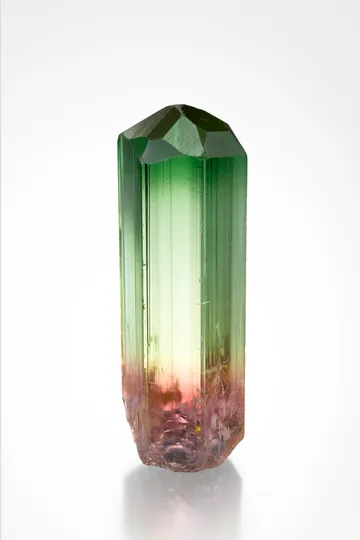
The core Barra do Salinas look is elbaite in prismatic crystals, often vertically striated, with color zoning parallel or transverse to the c-axis. Fine examples may be fully gemmy through much of the prism, but many have a darker terminal zone or a translucent pink stalk. The most celebrated form is sceptered: a narrower pink to reddish stem supports a larger green, blue-green, or yellow-green head. Some specimens show the reverse impression of a green outer generation partly etched away, exposing a pink interior or stalk. This gives the crystals a sculptural, layered appearance that is instantly recognizable to collectors familiar with the locality.
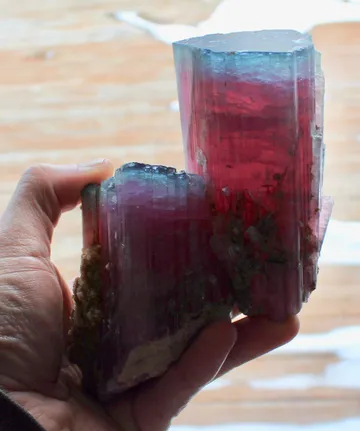
Colors range from deep green, grass-green, emerald-green, blue-green, and indicolite-blue to pink, red, and rubellite tones. Bicolored and tricolored crystals are a specialty. Watermelon examples show pink to red interiors with green rims or caps, and some specimens carry narrow intermediate yellow or pale zones. A few high-end pieces show unusual yellowish terminations or blue-green zones near the tip. Dark terminal areas can look nearly black in ordinary light but open to green, blue-green, or olive tones under strong backlighting.
Typical collector crystals are thumbnails to miniatures, often around 2–7 cm long and under 2 cm thick. Better small-cabinet crystals occur, and older literature and market records document larger examples in the 10–13 cm range. A 11 cm gemmy green crystal offered in the modern market and larger red-pink cabinet pieces show that the district is capable of impressive size, but most of the iconic scepters are miniature to small-cabinet specimens rather than great logs.
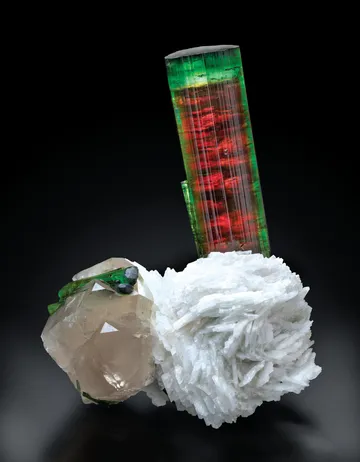
Associated minerals include quartz, smoky quartz, albite, cleavelandite, lepidolite, muscovite, microcline or orthoclase, spodumene, kunzite, beryl varieties including aquamarine and morganite, topaz, cassiterite, columbite-series minerals, and hydroxylherderite. Matrix pieces with quartz are especially attractive when a single green or blue-green tourmaline stands proud from a pale crystal base. Lepidolite associations add color contrast but can be friable, and feldspar or albite matrix may be delicate or partly kaolinized.
Quality is judged first by color saturation, then by transparency, termination, and condition. A fine Barra crystal should not merely be green and pink; it should show a clean, intentional-looking color architecture. Sharp pyramidal terminations, etched but lustrous faces, and undamaged edges carry real premiums. Scepters with a well-proportioned head and stalk are more desirable than simple tapered prisms. Matrix adds value when natural and aesthetic, but suspicious or heavily restored matrix attachments should be examined carefully.
The main authenticity issue is locality confidence. Barra do Salinas is a familiar dealer name, but Minas Gerais has many elbaite localities, and green-pink Brazilian tourmaline can be mislabeled or broadly labeled when provenance is lost. Classic Barra scepters have a distinctive habit—pink stalk, gem green head, etched faces, and sharp pyramidal termination—but habit alone is not proof. Old labels, collection history, and comparison with documented specimens are important.
There are no widely documented locality-specific synthetic fakes for Barra do Salinas tourmaline, but the broader tourmaline market has familiar risks: repaired crystals, restored terminations, glued-on matrix, composite matrix presentations, and overconfident locality attributions. Several documented Barra specimens in the market have repairs, and this is not surprising; tourmaline is brittle, elongated crystals break readily, and matrix pieces are especially prone to separation at the contact. Repairs are not automatically disqualifying, but they must be disclosed and should be reflected in price.
Treatments are more relevant to cut stones than to display specimens. Green and blue tourmaline from Minas Gerais has historically been heat treated to lighten or brighten color, and irradiation has been reported in the wider tourmaline trade for intensifying red or yellow tones. For specimen crystals, heat treatment is less commonly declared and harder to prove visually. A collector should be most cautious with loose, unusually vivid crystals sold without provenance, especially if the color appears too uniform or if the piece is marketed with gemstone language rather than mineral-specimen documentation.
Condition issues are predictable: edge wear on pyramidal terminations, bruised prism edges, basal breakage where the crystal detached from the pocket wall, internal tension cracks, and old glue repairs at mid-crystal. Pink stalks on scepters can be etched, frosted, or naturally irregular; this should not be confused with damage unless there is fresh breakage. Matrix specimens should be checked under magnification for glue at the tourmaline-quartz or tourmaline-feldspar contact, because older loose crystals are sometimes mounted or reconstructed to improve aesthetics.
Rarity is strongly style-dependent. Small green or blue-green single crystals appear periodically. Fine, unrepaired, strongly zoned scepters from the classic 1980s production are scarce. Matrix specimens with tourmaline naturally attached are scarcer still. Recent market records through 2026 show a wide range: modest thumbnails can sell in the low hundreds, classic old scepters commonly reach the low thousands, and exceptional large, gemmy, vividly colored crystals or matrix pieces can command five-figure asking prices.
The oldest Barra de Salinas story worth retelling begins by the Salinas River. In the 1940s, the district’s reputation was made by rubellite from a primary pegmatite only about 150 m west of the river. Ed Swoboda, who saw the workings in the mid-1940s, described a pegmatite apparently cut by the river, with another part of the body lying within the limits of the town on the opposite bank. The crystals that came out were not anonymous red tourmalines: some reached about 13 cm, some were multicolored, and many were attached to quartz. Most were remembered for their exceptionally red rubellite color, the sort of production that fixes a place-name in the gem trade for generations.
A second chapter is the collector chapter: the green-pink scepters that later made “Barra” a shorthand among tourmaline specialists. Several dealer and museum-style descriptions trace superb examples to the Steve Smale collection. Smale, the celebrated mathematician and mineral collector, was in Brazil when some of the classic material came out and acquired a large suite of Brazilian gem crystals. Decades later, those pieces surfaced in auctions and dealer inventories as time-capsule specimens: pink stalks, transparent green heads, etched pyramidal faces, and the kind of bright, saturated color that made dealers describe them as immediately recognizable.
One 7.3 cm Barra scepter sold at auction in 2023 carried that story plainly: it was described as a crystal from 1980s and early 1990s finds, purchased in Brazil when the pieces came out and long held by Dr. Steve Smale. The bidding climbed past $3,000. Another sceptered Barra piece, 5.8 cm and 28 g, sold in November 2025, was described as coming from the productive era when many such crystals were cut into gems rather than saved as mineral specimens. That one also crossed the $3,000 mark. The money is useful market data, but the real story is more mineralogical: a whole style of Brazilian elbaite survived because certain collectors chose to keep crystals intact.
The market has also preserved smaller, almost intimate details. A 4.1 cm, 5 g scepter was nicknamed “The Rocketship,” a fitting name for the narrow pink base and bright green head. A 2015 watermelon miniature from the Smale collection weighed 9 g and showed parallel-growth crystals, an olive-green termination, a grass-green zone, and a pink core wrapped in a thin green rind. A 2026 thumbnail pair, only 2.5 cm across, showed near water-clear green upper portions over lighter pink bases, with partially hollow undersides where etching had opened the crystals into delicate forms. These are not just sales descriptions; they are the small visual clues by which the locality remains alive in the collector imagination.