Conway, USA - A premier New Hampshire locality for miarolitic granite, yielding smoky quartz, microcline, fluorite, topaz, and arfvedsonite crystals prized by…
Key facts
Conway, in Carroll County, New Hampshire, is one of the essential American localities for collectors of minerals from miarolitic granite. The name is not merely a geographic label: the Conway Granite itself is a classic rock unit of the White Mountain batholith, with its type locality at Redstone, within the town of Conway. For specimen people, its importance comes from the late-stage pockets and decomposed pegmatitic zones where quartz, smoky quartz, microcline, albite, fluorite, topaz, zircon, riebeckite-group amphiboles, and especially Hurricane Mountain arfvedsonite were preserved as free-grown crystals rather than as ordinary granite constituents.
The collecting story here is spread across a cluster of related Conway-area sites: the Lovejoy Gravel pits northwest of Conway village; the Redstone granite quarries; Black Cap and Hurricane Mountain localities above North Conway; and the larger Moat Mountain district immediately to the west and southwest. The best specimens show the unmistakable White Mountain look: smoky quartz perched on blocky cream, salmon, or amazonitic microcline; glossy black alkali-amphibole prisms standing out against feldspar; rare ice-like topaz from altered pocket zones; and, on the best older pieces, a balance of cabinet presence and local character that is difficult to duplicate from any other eastern U.S. granite locality.
Regional View
Country View
The Conway assemblage belongs to a high-level, evolved, alkali-rich granitic environment rather than to the classic lithium-cesium-tantalum pegmatites of western Maine and western New Hampshire. Collectors should think in terms of frozen gas-and-fluid cavities along intrusive contacts, “rotten stone” decomposed pegmatite ledges, pocketed granite, and old quarry exposures rather than mined gem-bearing pegmatite veins. That distinction matters: many Conway specimens are not large by international standards, but a sharp, lustrous smoky quartz and microcline association, a convincing old Lovejoy topaz, or a Hurricane Mountain arfvedsonite with good crystal definition has real locality weight.
Search for specimens: View all specimens from Conway, USA
The Conway locality is best understood as a district of evolved granitic pocket mineralization within and around the Conway Granite of the White Mountain batholith. The rock is a pink to reddish biotite granite, locally with greenish phases at Redstone, and it is associated with the Mesozoic alkaline igneous province that cuts across the White Mountains. The specimen-producing pockets occur where late volatile-rich fluids were trapped during final crystallization of granite and related pegmatitic phases. In collector language these are miarolitic cavities: open spaces in the granite lined by free-grown quartz and feldspar crystals, with accessory fluorite, topaz, zircon, amphiboles, and other late minerals.
The most famous Conway collecting ground for rare pocket species is the Lovejoy Gravel pits, historically also called the Lovejoy pit. Despite the name, the productive “gravel” was not ordinary stream gravel. It was decomposed pegmatite and pocketed Conway Granite, a rotten, weathered material derived from in-situ ledges. Collectors worked that decomposed zone because loose clayey granite could release crystals with far less blasting and breaking than fresh granite would require. Lovejoy is the key Conway locality for topaz, microcline, smoky quartz, albite, bavenite, fluorite, cassiterite, opal-AN, riebeckite, stilpnomelane, tremolite, and the historically reported chalcodite-style mica/clay material.
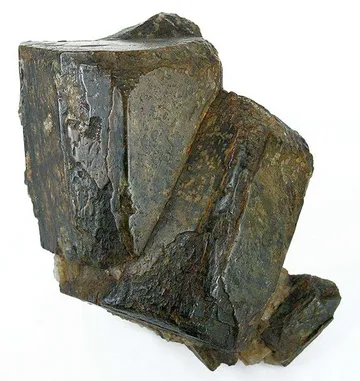
Hurricane Mountain, above North Conway, is the locality that gives Conway much of its stature among amphibole collectors. It is an alkali-rich granitic to syenitic pegmatite and miarolitic-cavity occurrence with several collecting areas historically known as the west, north, east, and summit localities. Specimens from Hurricane are most often remembered for black arfvedsonite or riebeckite-group amphiboles with microcline and albite, but the locality has also produced quartz, smoky and amethystine quartz, astrophyllite, zircon, fluorite, bavenite, hematite, muscovite, and other rare or microscopic species. The best Hurricane material is old, sharp, and unmistakably local: black prismatic amphiboles in pale feldspar, sometimes with zircon or quartz, and far more mineralogical personality than the casual “black crystal” description suggests.
The Redstone quarries form the industrial side of the Conway story. Quarrying at Redstone was organized in the late nineteenth century, and the Maine and New Hampshire Granite Company developed adjacent red and green granite quarries that supplied dimension stone. Those quarries are not remembered primarily for cabinet minerals, but they matter because they expose the type Conway Granite and its contrasting color phases. The red phase is a coarse biotite granite with smoky quartz, microperthitic feldspar, biotite, and accessory minerals; the green phase is a coarse yellow-green granite rich in green microperthite, smoky quartz, hastingsitic amphibole, and biotite. For a collector, Redstone anchors the petrologic identity of the district.
The broader Moat Mountain area, reached from the Conway side by Passaconaway Road and High Street, is the best-known public collecting expression of the same general geologic system. The designated mineral site lies on the contact zone between Conway Granite and the Moat Volcanics, where crystal-bearing miarolitic cavities are common in the granite near the volcanic cap. Current access is regulated; casual collecting is not a license to dig wherever one finds granite in the White Mountain region. The designated Moat Mountain collecting area uses a Forest Service permit system for noncommercial hobby collecting, while other Conway-area localities may be private, protected, closed, or on lands where collecting is restricted. Middle Mountain, for example, is specifically noted as part of The Nature Conservancy in New Hampshire, and removal of mineral or rock samples there is forbidden.
Production was never a single mine campaign in the metallic-ore sense. Instead, Conway specimens came from old quarrying, prospect pits, decomposed granite pits, pocket digging, and long-running hobby collecting. The “ore bodies” of interest to collectors are pockets, seams, altered pegmatitic patches, and friable granite zones rather than continuous veins. Economically, the district’s important mined product was building stone from Redstone; scientifically, the Conway Granite has also attracted attention as an evolved, uranium-, thorium-, tin-, and incompatible-element-enriched granite. For collectors, however, the true production history is measured in individual pockets: Lovejoy topaz pockets, Hurricane amphibole pockets, Black Cap quartz and feldspar finds, and Moat Mountain smoky quartz pockets opened by patient digging in weathered granite.
Quartz from Conway is chiefly a miarolitic-cavity mineral of the Conway Granite, occurring as clear, milky, amethystine, smoky, and locally rutilated crystals rather than as massive vein quartz alone. At the White Mountain Granite quarry on the west side of the Saco River near Birch Hill, quartz and amethyst were recorded with allanite, fluorite, and zircon in granite cavities; at Black Cap, Lovejoy, Hurricane, and Redstone-related pockets, quartz commonly shares space with microcline, albite, fluorite, riebeckite-group amphiboles, and smoky quartz overgrowths or variants. Good Conway quartz specimens are judged by sharp terminations, glassy faces, minimal clay and iron staining, and an intact relationship to feldspar or fluorite; ordinary pieces are usually loose, frosted, broken points or cavity fragments that have lost their matrix and pocket context.
Smoky quartz is Conway’s signature collector mineral, ranging from pale gray-brown points to darker, more saturated crystals in the miarolitic pockets and decomposed pegmatitic zones of the Conway Granite. The classic association is smoky quartz on or among microcline, sometimes with amazonitic color, albite or cleavelandite, fluorite, and late clay or iron coatings; Lovejoy specimens may be small but sharp and locally show feldspar inclusions or intimate quartz-microcline intergrowths, while Black Cap and Hurricane material can have stronger pocket aesthetics. The best pieces retain lustrous, transparent to translucent crystals with undamaged tips and an obvious feldspar matrix; the commoner field finds are iron-stained, etched, chipped, or isolated crystals whose locality can be difficult to defend once separated from their Conway Granite matrix.
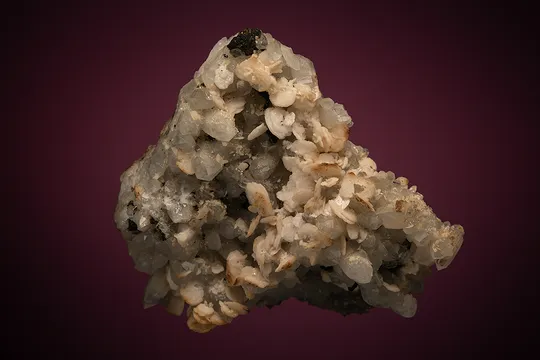
Microcline at Conway is not merely a background feldspar; it is the structural mineral that frames many of the district’s best pocket specimens. Crystals are typically blocky, perthitic, cream, white, salmon, or locally greenish amazonite, and they form the cavity walls and matrix for smoky quartz, albite, topaz, fluorite, and black alkali amphiboles. Lovejoy is especially important for microcline from decomposed pegmatitic granite, while Black Cap and the North Conway localities are known for the visually desirable amazonite-smoky quartz association. Good Conway microcline shows recognizable crystal form, sharp edges, and pleasing contrast with smoky quartz or albite; ordinary pieces are cleaved, chalky feldspar blocks or weathered pocket fragments without crystal definition.
Arfvedsonite is the mineral that makes Hurricane Mountain a nationally significant sublocality within the Conway collecting district. It occurs there as glossy black prismatic to bladed alkali-amphibole crystals in feldspar-rich pegmatitic rock and miarolitic cavities, with microcline and albite as the most frequent specimen associates and zircon, quartz, astrophyllite, and related amphiboles appearing on finer or more mineralogically complex pieces. Crystals to very substantial sizes have been recorded from Hurricane, and old specimens with complete terminations, strong prism faces, and natural feldspar matrix are far better than loose broken black prisms. Labels deserve care: older Hurricane material may be labeled arfvedsonite, riebeckite, crocidolite, or generic “soda amphibole,” and recent analytical work has emphasized that distinguishing arfvedsonite from riebeckite-group material at this locality is not always straightforward.
Topaz from Conway is rare and historically centered on the Lovejoy Gravel pits, where it occurs in the same altered Conway Granite pocket environment as smoky quartz, microcline, albite, and late fluorine-bearing minerals. The known specimens are generally colorless to very pale, sometimes described by collectors as ice-like, and their value lies less in size than in verified locality, crystal integrity, and association with recognizable Lovejoy matrix or older labels. A good Conway topaz should show the prismatic form and glassy luster of the species while avoiding the waterworn look of an anonymous loose crystal; even small matrix examples are desirable because Lovejoy is closed or effectively unavailable to modern collecting, and convincing topaz from that pit is seen far less often than smoky quartz or feldspar.
Other documented Conway minerals make the district much richer than a simple smoky-quartz locality. Lovejoy has records for albite, amazonite, bavenite, cassiterite, fluorite, opal-AN, riebeckite, stilpnomelane, tremolite, and chalcodite-like material, with pyrolusite treated as an erroneous literature entry. Hurricane Mountain adds arsenopyrite, astrophyllite, calcite, hematite, muscovite, zircon, fluorite, bavenite, riebeckite including fibrous crocidolite-style material, and analytically investigated alkali amphiboles; newer micro work has also documented or proposed aegirine, bastnäsite-group material, thorite, siderite, opal, and rare topaz in the Hurricane suite. Conway’s “type locality” importance is chiefly petrologic rather than species-level: the town gives its name to the Conway Granite, while the mineralogical rarities are valued as pocket species from that granite and related alkaline pegmatitic phases rather than as type minerals.
The largest authenticity issue for Conway specimens is locality precision. Labels reading simply “Conway,” “North Conway,” “Moat Mountain,” “Lovejoy,” “Hurricane Mountain,” or “White Mountains” are not interchangeable. Lovejoy is a specific pit locality on the Conway side of the Albany/Conway line; Hurricane Mountain is a distinct North Conway alkali-pegmatite locality; Middle Mountain and parts of the Moat district may fall outside the strict town-locality usage or on lands where collecting is restricted. Older labels may also preserve obsolete names, informal pit names, or the confusing “Passaconaway Pit” wording used in older reports for material now understood as Lovejoy.
There are no well-established, locality-specific Conway fake epidemics, but loose smoky quartz and loose topaz invite skepticism. Smoky quartz is common worldwide, and irradiated smoky quartz exists in the market generally, so a loose dark point without matrix, old label, or credible collection history should not command a strong Conway premium. For high-value pieces, matrix and association matter: smoky quartz with Conway-style microcline and albite, topaz still on pocket matrix, and Hurricane amphibole in feldspar-rich rock are more defensible than isolated crystals.
Condition is often the limiting factor. Conway Granite pockets commonly weather to iron-stained, clay-coated, or etched surfaces, and quartz points are frequently chipped at the termination or contacted where they grew into feldspar. Microcline cleaves readily and may look chalky or bruised if overcleaned. Topaz has perfect basal cleavage and should never be treated casually in an ultrasonic cleaner or subjected to thermal shock. Fluorite from Conway-area pockets can be attractive and may fluoresce purple, but it is fragile, commonly edge-worn, and vulnerable to aggressive cleaning.
Amphibole labels require special caution. Hurricane Mountain specimens historically sold as arfvedsonite may overlap chemically and texturally with riebeckite or related sodium amphiboles. A sharp black prismatic crystal on microcline can still be an excellent Hurricane specimen, but advanced collectors should value analytical labels and avoid overstating species certainty unless the piece has been tested. Fibrous riebeckite var. crocidolite from Hurricane should be handled as a potential respirable asbestos material: keep it boxed, do not abrade or trim it, avoid loose fibers, and do not dry-brush or blow dust from specimens.
Market availability is uneven. Small smoky quartz and microcline pieces from the Conway-Moat district appear regularly, especially from old collections and modern public-site finds. Good Lovejoy topaz, old Black Cap amazonite-smoky combinations, large undamaged fluorite, and sharp Hurricane arfvedsonite on matrix are much scarcer. The best Conway pieces tend to move through specialist New England collections, club auctions, and dealers who understand the locality distinctions; the casual online market often collapses several neighboring localities into “Conway,” which is convenient but mineralogically imprecise.
In 1988, Peter Samuelson opened the find that still hangs over every serious conversation about Conway-area smoky quartz: Peter’s Pocket. It was not a little vug with a few loose points. The cavity was large enough for a person to stand in, and it produced a smoky quartz crystal 1.2 meters long, recorded as the longest smoky quartz crystal found on the White Mountain National Forest. The story explains why Conway’s smoky quartz reputation is so persistent. Most collectors will never see a crystal of that scale from the district, much less dig one, but the fact that such a pocket existed keeps every weathered ledge, clay seam, and feldspary pocket fragment from the Conway Granite feeling possible.
The Lovejoy story is quieter but equally important. H. C. Lovejoy of Conway acquired the pit land around 1920 from a paper company, and what collectors later called “gravel” proved to be decomposed pegmatite and pocketed Conway Granite. By the mid-1950s, the locality was important enough for B. M. Shaub to publish “A New Discovery of Topaz Crystals Near Conway, New Hampshire” in Rocks & Minerals. That article fixed Lovejoy in the literature as more than a casual smoky-quartz dig: it was a rare New Hampshire topaz locality, with a map, photographs, and enough collector excitement that even decades later a small, properly labeled Lovejoy topaz can stop a knowledgeable dealer in mid-sentence.
Redstone tells the same granite story in industrial scale. George Wagg, roadmaster of the Maine Central Railroad, recognized the commercial quality of the stone in the 1880s, and the Maine and New Hampshire Granite Company built a quarrying village around the red and green granite. The first stone shipped in 1886 went for paving stones in New York City and for Union Station in Portland, Maine. By 1889, Redstone had a railroad station, a post office, and hundreds of men employed in quarry work, with rough granite leaving by railcar. The quarrymen were not mining topaz pockets, but they were cutting the very granite that gave the town its mineralogical name.
Hurricane Mountain has its own collector mythology, centered less on one giant pocket than on persistence. The collecting area north of Hurricane Mountain Road was reached by a rough old logging route rather than a formal hiking trail, and earlier generations of collectors worked it hard for black amphiboles, smoky quartz, amethystine quartz, and feldspar pockets. Peter Samuelson’s name is also attached here through “Peter’s Quarry,” a large prospect pit from which fine arfvedsonite specimens were collected. Modern micro-collectors have continued the work in a different register: reviewing old “ordinary” amphibole chunks under magnification, finding green aegirine splinters inside them, and turning what once looked like nondescript black matrix into new analytical questions about the late alkali-rich evolution of the Hurricane pegmatite.
The modern public-collecting chapter is less romantic but just as consequential. After years of steady hobby collecting, interest surged sharply after televised prospecting programs made crystal digging look like a shortcut to treasure. The Moat Mountain collecting area became heavily disturbed, and Forest Service management shifted toward permits, defined rules, and tighter control of where digging could occur. For collectors, the lesson is simple: Conway’s fame was built by pockets, but its future depends on restraint. The district has already given up a 1.2-meter smoky quartz, rare New Hampshire topaz, important alkali amphiboles, and generations of New England field memories; careless digging is the fastest way to lose access to what remains.