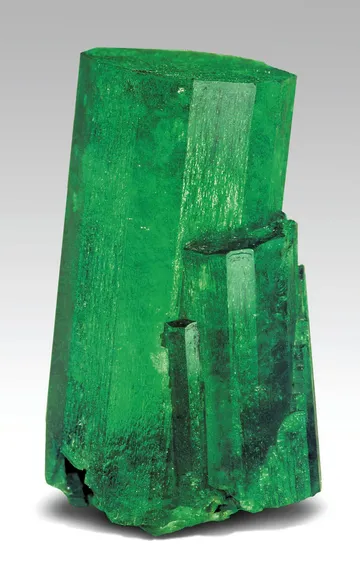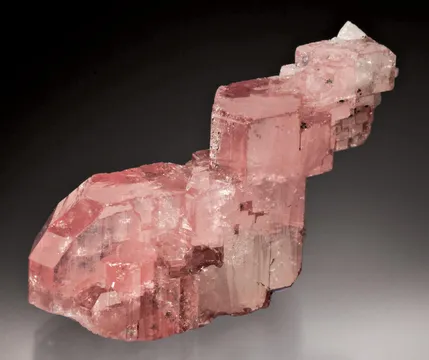
Colombia emerald localities — famed belts like Muzo, Coscuez, Chivor yield rich green crystals set in calcite and shale; prized for color, geology, history.
Key facts
Colombia is the classic home of emerald in matrix: saturated green beryl rising from white calcite, black carbonaceous shale, pyrite, and, in the finest pieces, the unmistakable geometry of a complete hexagonal prism with natural terminations and unforced placement. For mineral collectors, “Colombia” usually means the emerald belts of the Eastern Cordillera—Muzo, Coscuez, La Pita, Peñas Blancas, Quípama, Yacopí-La Palma, Chivor, Gachalá, and related districts—where emerald formed in sedimentary rocks rather than in the pegmatitic or schist-hosted environments familiar from many other countries. That geological peculiarity is the key to the locality’s character: hot basinal brines moved through folded and faulted Lower Cretaceous black shales, calcareous mudstones, and limestones, generating carbonate veins, hydraulic breccias, albitized zones, pyritization, and pockets in which emerald crystallized with calcite, dolomite, albite, quartz, pyrite, fluorite, barite, bitumen, and rare REE fluorcarbonates such as parisite-(Ce).
The country’s importance is not only gemological. Colombia supplied emeralds to Indigenous trade networks long before European contact, transformed European and Asian emerald markets after the Spanish conquest, furnished many of the great historic emeralds of Mughal, Ottoman, Spanish, and modern museum collections, and remains the locality against which fine emerald color is still judged. Muzo is the legendary western-belt name, famed for rich, slightly warm “Muzo” green, trapiche crystals, and matrix specimens on calcite and shale. Coscuez has been a major producer of fine gem material and historically, at times, eclipsed Muzo in volume. Chivor, in the eastern belt, is prized for brighter, cleaner, often slightly bluish crystals and for rare, elegant habits including doubly terminated crystals and hollow “emerald cup” forms.
Regional View
Country View
The best Colombian specimens are visually architectural: a sharp green crystal isolated against contrasting white calcite, a cluster of smaller emeralds distributed naturally through carbonate, a pyrite-brightened shale matrix, or a trapiche section whose six-rayed carbonaceous pattern records growth in the black-shale environment. Size alone does not make a specimen important here. A thumb-sized, completely natural emerald seated convincingly in calcite may outrank a larger but repaired or visually confused piece, and a modest Coscuez or Chivor matrix specimen with excellent contact relationships may be far more desirable than a loose crystal with uncertain mine attribution.

Search for specimens: View all specimens from Colombia
Colombia’s emerald deposits are concentrated in the Eastern Cordillera of the Andes, divided into a western emerald belt and an eastern emerald belt. The western belt includes the Muzo–Quípama area, Coscuez, La Pita, Peñas Blancas, Yacopí-La Palma, and related mines in Boyacá and nearby districts. The eastern belt includes Chivor, Gachalá, Macanal, Buenavista, and neighboring mines in Boyacá and Cundinamarca. Both belts are structurally controlled, but their detailed tectonic settings differ: western-belt mineralization is closely associated with thrusting, tear faults, hydraulic breccias, carbonate veins, and black-shale alteration, while eastern-belt deposits such as Chivor show emerald-bearing structures related to brecciated levels, extensional fractures, and veins within folded sedimentary sequences.
The essential host is a Lower Cretaceous sedimentary package rich in organic matter: black shales, calcareous mudstones, limestones, and related units known under several local stratigraphic names, including the Muzo, Paja, Rosablanca, Villeta, Guavio, and Macanal units depending on district and author. The emeralds are not pegmatitic in the usual sense. Their accepted model is hydrothermal-sedimentary: hot, saline brines interacted with evaporitic components and organic-rich shale, leached or mobilized Be, Cr, and V, and deposited emerald during carbonate veining, brecciation, albitization, pyritization, and carbonatization. The veins and pockets most familiar to collectors are calcite- and dolomite-rich, commonly with pyrite and albite; quartz is present in many emerald veins, and fluorite, barite, apatite, bitumen, Cr-bearing mica, and parisite-(Ce) add the diagnostic accessory suite.
At Muzo, early descriptions emphasized the “emerald formation” of thin shale and limestone beds cut by calcite veins. Miners and geologists recognized several local rock types of practical importance: albite rock; the soft, light gray calcite-dolomite-quartz-pyrite aggregate called cenicero, meaning “ash-like”; and the calcite-rich cama, a breccia-like mass with conspicuous rhombs and rhombic twins of calcite commonly 5 to 10 cm across. Emerald occurs principally in calcite veins and pockets, not uniformly through the shale. The finest matrix pieces preserve that relationship: green prisms emerging from white carbonate, with black shale and brassy pyrite providing contrast.
Mining history is unusually long and complex. Indigenous peoples mined and traded Colombian emeralds before the Spanish conquest, and Spanish accounts from the sixteenth century describe emerald sources in the Somondoco-Chivor region and later the Muzo area. Colonial work, forced labor, crown control, abandonment, rediscovery, private concessions, government administration, leases, conflict, and modern corporate consolidation all left their marks on the specimen record. Muzo and Coscuez became the great western names; Chivor, rediscovered after a long period of abandonment, became the eastern-belt romantic classic; La Pita and other Maripí-area mines became important modern producers.
The modern industry is a mixture of large formal operations, controlled mining titles, smaller licensed workings, and local trading networks. The Muzo Companies and related Colombian entities have modernized operations in the Muzo–Quípama area since 2009. Coscuez has been associated in recent years with Fura Gems and corporate-scale evaluation, bulk sampling, infrastructure work, and resource estimates. La Pita has operated as one of the major western-belt mines, and Chivor remains a mosaic of historic workings and smaller claims, with production that can be intermittent and difficult to quantify publicly. For collectors, this means that specimen availability is irregular: fine matrix pieces emerge when mining intersects suitable pockets and when crystals are preserved rather than broken for gem recovery.
Collecting access at active emerald mines should be considered restricted unless arranged formally through mine owners, concession holders, or authorized local contacts. These are operating gemstone mines, not casual collecting sites. Safety, security, title rights, export rules, and local relationships matter. Material reaches collectors through mine-adjacent markets, Bogotá dealers and cutters, established mineral dealers, historic collections, and occasional documented mine-to-market releases. Mine names on labels deserve scrutiny: “Muzo” may be used broadly in the trade for the region or color style, while a precise label such as Muzo Mine, Coscuez Mine, Chivor Mine, La Pita Mine, or La Pava should be supported by credible provenance whenever value depends on it.
Notable finds include the western-belt trapiche emeralds, with their six-rayed carbonaceous pattern; classic Muzo emeralds perched in calcite; Coscuez gem crystals including historically large crystals; Chivor’s clean bluish-green crystals and rare hollow forms; and parisite-(Ce) specimens from the Muzo district, including crystals associated with emerald and calcite. The finest specimen pockets are those where crystals grew into open space and remained attached to competent carbonate or shale. Many pockets were historically destroyed by gem-oriented extraction, so matrix specimens with undisturbed contacts are substantially scarcer than loose rough.
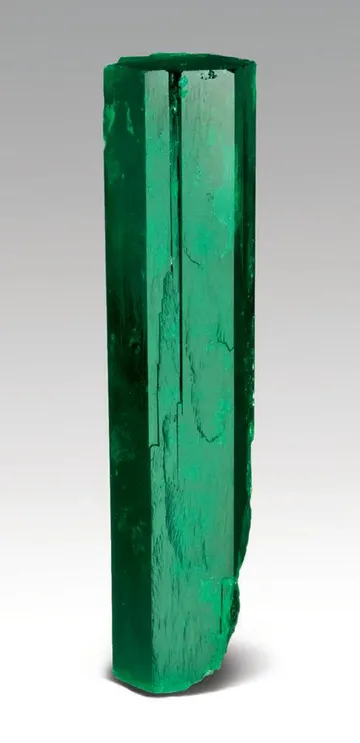
Colombian emerald is the defining collector mineral of the country: Be3Al2(Si6O18) colored chiefly by chromium and vanadium, usually as hexagonal prisms in calcite-dolomite veins, pockets, and breccias within black shale and limestone sequences of the Eastern Cordillera. Western-belt Muzo and Coscuez material is famed for saturated green crystals on white calcite, often with pyrite, shale, albite, quartz, dolomite, bitumen, and occasionally parisite-(Ce); Muzo also produced the celebrated trapiche habit, in which carbonaceous and mineral inclusions form a six-rayed pattern around a central core. Eastern-belt Chivor emeralds are often described as brighter, cleaner, and slightly bluish, with some fine doubly terminated crystals and rare hollow “emerald cups.” Most crystals are small to thumbnail scale as specimens, although large gem crystals and exceptional museum pieces are historically recorded; collector quality depends on natural attachment, complete prism faces and terminations, vivid but not overly dark color, transparency or internal glow, attractive contrast with calcite or pyrite, and freedom from repaired bases, glued contacts, and extraction damage.
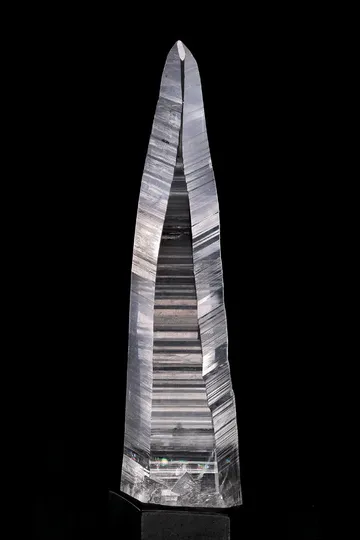
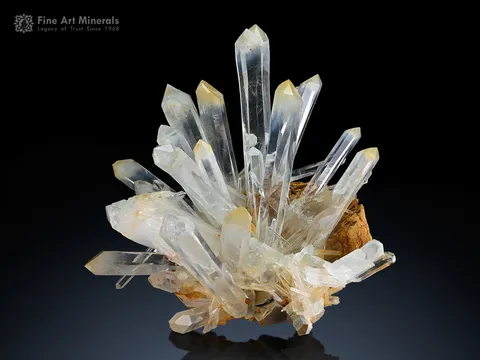
Quartz from Colombian emerald localities is not the headline species, but it is a meaningful gangue and association mineral, especially where it appears as clear to faintly greenish crystals in emerald-bearing veins or intergrown with calcite in Muzo-style carbonate assemblages. Early Muzo descriptions record well-formed quartz crystals in emerald veins, with inclusions of parisite, pyrite, and emerald noted, and less perfect crystals intergrown with the large calcite rhombs of the cama; quartz also appears in the cenicero rock with calcite, dolomite, and pyrite. In specimen terms, Colombian quartz is most valuable when it helps prove and beautify the emerald environment: transparent points or drusy areas framing green beryl, quartz-calcite-pyrite textures that read naturally under magnification, or uncommon pieces where emerald is present with quartz rather than only calcite. Loose or isolated quartz crystals from Colombia rarely carry the same collector weight unless tied convincingly to a major emerald mine and an excellent emerald association.
Calcite is the visual and geological stage on which many Colombian emerald specimens perform. At Muzo and related western-belt mines, calcite forms emerald-bearing veins in the black shale-limestone sequence, water-clear to opaque crystals in vugs, white crystalline matrix for emerald prisms, and conspicuous rhombohedral masses and twins in the cama, where individual rhombs may reach several centimeters. Early descriptions note two dominant calcite habits at Muzo—rhombohedral and prismatic—and close association with emerald, pyrite, and parisite; in the broader Colombian emerald suite, calcite also accompanies dolomite, albite, quartz, barite, fluorite, and bitumen. For collectors, the best calcite is not merely present but compositional: bright white or translucent crystals that contrast with emerald without swallowing it, undamaged rhombs that give geometry to the piece, and matrix that shows natural growth contacts rather than packed powder, glue, or reconstructed carbonate around an inserted emerald.
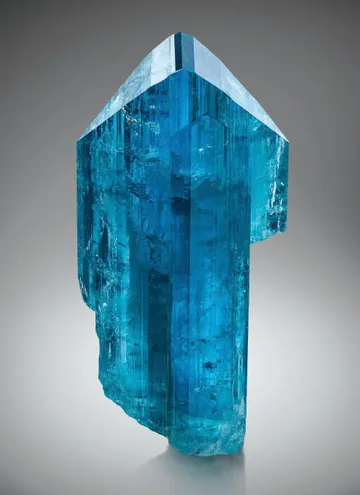
Other documented Colombian emerald-district minerals add considerable depth to the locality. Parisite-(Ce), CaCe2(CO3)3F2, is the most important rarity for mineralogists: it was first described from the Muzo district and named for José Ignacio París, a nineteenth-century lessee of the Muzo mines. It occurs with emerald and calcite as honey to brownish crystals or crystalline masses, and large, well-formed examples are highly prized. Pyrite is abundant and important, occurring as cubes, octahedra, pyritohedra, seams, concretions, and bright accents in veins and shale. Albite is widespread in altered rocks and veins; dolomite and ankeritic carbonates are part of the carbonate gangue; fluorite, barite, apatite, gypsum, marcasite, chalcopyrite, native sulfur, pyrophyllite, bitumen, graphite-like carbon, muscovite/sericite, allophane, halloysite, opal-AN, goethite, hematite, and kaolinite have all been recorded from Colombian emerald districts. Euclase is a notable Chivor-associated rarity, with pale to intense blue crystals documented from the district and from other Colombian emerald localities; fine euclase on calcite from Colombia is scarce and eagerly followed by collectors beyond the emerald market.
Colombian emerald specimens demand more authentication discipline than almost any other classic mineral association. The value of a sharp green crystal on white calcite has encouraged repairs, glued crystals, inserted crystals, reconstructed matrix, and specimens in which crushed calcite or carbonate powder is packed around a real emerald to simulate natural growth. A natural piece should show believable geological contact: the emerald base should merge into calcite or shale in a way consistent with growth, not sit in a socket with glossy residue, bubbles, smeared powder, or a suspiciously uniform collar. Examine the base under magnification, especially where a transparent emerald enters calcite. Check for mismatched surfaces, fresh scratches around the seat, unnatural orientation, and matrix that looks granular or cemented rather than crystalline.
Do not assume that “Colombian” proves Muzo, or that “Muzo” proves the historical Muzo Mine. In the gem trade, Muzo can be used as a color term, a regional shorthand, or a prestige label. The same caution applies to Chivor and Coscuez labels. Mine-specific attribution is strongest when supported by old collection history, dealer documentation, mine-source acquisition, lab work for cut stones, or a consistent matrix-mineral association; it is weakest when attached to a loose crystal, a tourist specimen, or a newly imported piece with no chain of custody.
Treatment issues differ for mineral specimens and cut gems but overlap. Emeralds are commonly fractured, and clarity enhancement with oils or resins is a long-standing part of the gem trade. A faceted Colombian emerald may be untreated, traditionally oiled, resin-filled, or filled with another substance; reputable lab reports distinguish degrees of clarity enhancement. On mineral specimens, oiling can make fractures less visible, but the larger concern is structural assembly: glued-on crystals, repaired terminations, or stabilized matrix. Avoid ultrasonic cleaning, steam cleaning, prolonged heat, solvents, and aggressive detergents, especially with emeralds that may contain fillers, repairs, or delicate calcite.
Condition standards should be realistic. Colombian emeralds often have internal jardin, healed fissures, growth tubes, color zoning, carbonaceous inclusions, or small chips from mining. Many crystals were extracted under gem-oriented conditions, and matrix specimens may show trimmed shale, bruised calcite, or broken side crystals. These are not automatic deal-breakers; what matters is whether the main crystal is complete, attractive, naturally attached, and honestly represented. Calcite matrix is softer and more reactive than emerald, so protect pieces from acids, rough handling, and humidity swings that may affect associated sulfides or repaired areas.
Market availability is broad at the low end and tight at the high end. Small emerald-in-calcite pieces from Colombia are regularly available, but top-quality matrix specimens with saturated color, gemmy transparency, natural seating, pyrite contrast, and strong mine provenance are genuinely scarce. Fine Chivor matrix pieces, trapiche specimens, large parisite-(Ce) associations, and undamaged cabinet-size emerald groups command strong competition from both gem and mineral collectors. The safest purchases are made from dealers who understand mineral specimens rather than only gem rough, disclose repairs and treatments, and welcome magnified inspection.
In the sixteenth-century accounts of Somondoco, the mine now associated with the Chivor region enters history almost cinematically. Spanish chroniclers described men sent from Gonzalo Jiménez de Quesada’s expedition who, after six days, reached the mines and watched Indigenous miners extracting emeralds from the ground. The locality was described as high, sparse mountain country, roughly a league in size, ruled by a powerful local lord named Somondoco. From the emerald ground, the Spaniards could see the eastern llanos—immense plains that made such an impression that the chroniclers treated the view itself as a geographic clue. Centuries later, that detail would matter.
Chivor then disappeared from practical mining memory. The old Somondoco workings were exploited by the Spanish into the seventeenth century and then abandoned for roughly two centuries, swallowed by jungle, politics, uncertain maps, and changing mine names. The rediscovery story centers on Francisco Daniel Restrepo Escobar, a Colombian mining engineer whose career had already carried him through gold and silver work in Antioquia and Tolima. Restrepo used old documentary clues, including the repeated reference to the view eastward toward the llanos, to identify the Chivor ground in the 1880s. In the early modern record, the mine titles were registered as Chivor 1 and Chivor 2, two contiguous areas of one square kilometer each, but for years ownership paperwork and investment schemes advanced faster than actual mining.
The Chivor story soon became international. German gem merchant Fritz Klein learned of the mine in 1911 through Hermann Span and began negotiating options with Colombian title holders. By 1914, a German-backed Syndikat El Chivor had been formed with capital from August Stauch, Dr. Hjalmar Schacht, Rudolf Hahn & Sons of London, and Klein himself. The group hired Prof. Robert Scheibe of the Royal Mining Academy in Berlin to inspect the property; Scheibe and Klein sailed from Hamburg in February 1914 bound for Puerto Colombia. The timing could hardly have been worse. Within months Europe was at war, investment channels changed, and Chivor’s promised renaissance was again delayed by world events, legal uncertainties, and the sheer difficulty of working a remote Andean emerald deposit.
Coscuez has its own darker legend. A mid-seventeenth-century cave-in reportedly buried nearly 300 Spaniards and Indigenous workers at the mine. When mining resumed two centuries later, operations uncovered a tunnel said to contain bones along with bamboo and metal tools. Miners remembered the passage as the “Dead Man’s Underpass,” later known as El Español—“The Spaniard.” For collectors, such stories explain why old Colombian labels can carry a density of history out of proportion to the size of the specimen: a small emerald on calcite may come from ground that has been opened, abandoned, forgotten, fought over, reopened, and renamed across centuries.
Modern field accounts are less romantic but just as vivid. During GIA’s 2015 documentation expedition, the team moved from Bogotá through the eastern and western belts, gathering more than 44 hours of video and 10,000 photographs, and collecting 1,243 rough emeralds weighing 995 carats for origin-reference work. At Chivor’s El Manantial, whose name means “the spring,” groundwater was not a metaphor but a mining condition. A vertical shaft leading to a productive tunnel had to be pumped after every five hours of mining, and pumping took two hours. To reach one productive zone, the visitors walked nearly two kilometers through wet black shale, with water coming over the tops of their boots, following the white calcite veins that miners chase in hope of the green flash.
At Coscuez, the La Paz tunnel compressed recent Colombian emerald history into a mine name. Mine manager Fabian Rodriguez explained that La Paz—“peace”—was founded around the time of the agreement that ended the Green War. The route underground was elaborate: 1,650 meters to the first elevator, down 48 meters, then another elevator down 35 meters, then another 48-meter descent to a tunnel leading toward production. Emerald-bearing rock was bagged in white sacks, loaded into carts, rolled to elevators, lifted to the upper tunnel, and wheeled out. The image is far removed from the tidy romance of a gem in a display case, but it is the working context behind many contemporary Colombian specimens.
The mine markets form another part of the collecting story. In the western belt, the GIA team found structured markets at La Playa on the Río Itoco, El Chacaro at Coscuez, and La Pita in the Maripí area. Muzo itself was described as a giant emerald market, with several blocks of miners and dealers offering rough in streets, shops, and restaurants. At peak moments, buyers and dealers stood shoulder to shoulder. For a collector, that scene explains both the abundance and the uncertainty of Colombian material: fine stones and specimens can pass quickly through many hands, but locality precision may blur unless someone preserves the details from the moment of extraction.
T. L. Ottaway, F. J. Wicks, L. T. Bryndzia, T. K. Kyser, and E. T. C. Spooner, “Formation of the Muzo hydrothermal emerald deposit in Colombia,” Nature 369, 552–554, 1994 — A foundational paper establishing the hydrothermal brine model for Muzo emerald formation in organic-rich black shales without igneous activity.
Yannick Branquet, Bernard Laumonier, Alain Cheilletz, Gaston Giuliani, and Oscar Blanco, “Emeralds in the Eastern Cordillera of Colombia: Two tectonic settings for one mineralization,” Geology 27(7), 597–600, 1999 — A key structural-geology paper comparing the western and eastern Colombian emerald belts.
Isabella Pignatelli, Gaston Giuliani, Daniel Ohnenstetter, Giovanna Agrosì, Sandrine Mathieu, Christophe Morlot, and Yannick Branquet, “Colombian Trapiche Emeralds: Recent Advances in Understanding Their Formation,” Gems & Gemology 51(3), 222–259, 2015 — The major modern reference on Colombian trapiche emeralds, their structure, chemistry, and geological setting.
Karl Schmetzer, Gérard Martayan, and Jose Guillermo Ortiz, “History of the Chivor Emerald Mine, Part I (1880–1925): From Rediscovery to Early Production,” Gems & Gemology 56(1), 2020 — A deeply documented historical study of Chivor’s rediscovery, ownership, investment, and early twentieth-century operations.
GIA, “In Rainier’s Footsteps: Journey to the Chivor Emerald Mine,” Gems & Gemology, Summer 2016 — A field-and-history article linking Chivor’s modern workings with Peter Rainier’s classic accounts and notable Chivor specimens.
Jack Koivula and Robert C. Kammerling, “The Coscuez Mine: A Major Source of Colombian Emeralds,” Gems & Gemology, Summer 1986 — A valuable historical, geological, and production-focused treatment of Coscuez at the moment it was becoming one of Colombia’s dominant producers.
J. E. Pogue, “The Emerald Deposits of Muzo, Colombia,” 1916, republished by Pala International — A classic early geological and mineralogical description of the Muzo deposit, including calcite, quartz, pyrite, parisite, albite, barite, and local mining rock terms.
Mindat: Parisite-(Ce) — Mineral data and locality information for the REE fluorcarbonate named for José Ignacio París and historically tied to the Muzo emerald district.
Mindat: Chivor Mine, Boyacá Department, Colombia — Locality record listing Chivor’s documented mineral suite, including emerald, calcite, quartz, pyrite, albite, dolomite, fluorite, and euclase.
“Características Mineralógicas y Petrológicas de la Euclasa del Distrito Minero de Chivor, Colombia,” Geología Colombiana — A Colombian geological publication on euclase from the Chivor mining district.
“Colombian Emerald Industry: Winds of Change,” GIA — GIA’s field-gemology presentation on mining, cutting, trading, transparency, and modernization in Colombia’s emerald industry.
“Colombian Emerald Trade,” GIA / Gems & Gemology — Embedded field video accompanying GIA’s 2017 Colombia expedition report, covering the mine-to-market emerald trade.
“Emerald Mines of Chivor,” GIA / Gems & Gemology — Embedded field segment from the eastern emerald belt, showing the Chivor mining environment and active tunnel work.
“Coscuez Emerald Mines,” GIA / Gems & Gemology — Embedded field segment on Coscuez, including underground mining and mine-market context.
“Exploring the Emerald Mines Road in Muzo, Boyacá | Emerald Tour | Documentary,” YouTube — A recent travel-documentary style video focused on the Muzo emerald-mining landscape.
“The world's most famous emerald mine | Muzo Colombia | emerald documentary,” YouTube — A documentary-style visit centered on the Muzo mine and its emerald reputation.
The Muzo Emerald Deposit, IUGS Geological Heritage — Concise geological-heritage summary of Muzo’s hydrothermal-sedimentary emerald genesis and historical significance.
Muzo Emerald Colombia: History of the Mine — Official Muzo overview of pre-Columbian, colonial, independence-era, conflict-era, and modern mining history.
The Muzo Companies Colombia: Timeline — Corporate timeline useful for understanding recent modernization and formalization in the Muzo–Quípama area.
Fura Gems: Colombia Mine — Current corporate overview of Coscuez, including historical context and modern development.
GIA: Colombian Emerald Industry — Winds of Change — Essential modern field report on Colombian emerald mining, trading, cutting, mine markets, and origin-reference sampling.
GIA: Colombian Trapiche Emeralds — Best single gemological and mineralogical reference for trapiche emeralds from Colombia.
GIA: Geographic Origin Determination of Emerald — Useful background on how laboratories approach emerald origin, including Colombian material.
GIA: Fracture Filling of Emeralds — Opticon and Traditional Oils — Classic treatment reference for understanding oil and resin filling in emeralds.
Mindat: Chivor Mine, Colombia — Mineral list, references, and locality framework for the Chivor district.
Mindat: Parisite-(Ce) — Reference page for the Muzo-linked type-locality rarity parisite-(Ce).