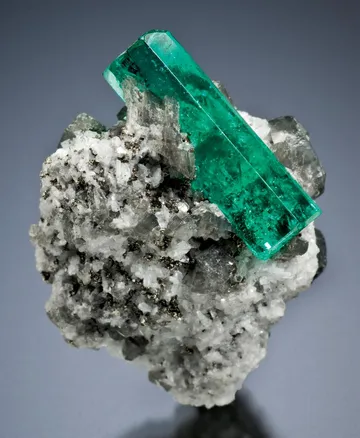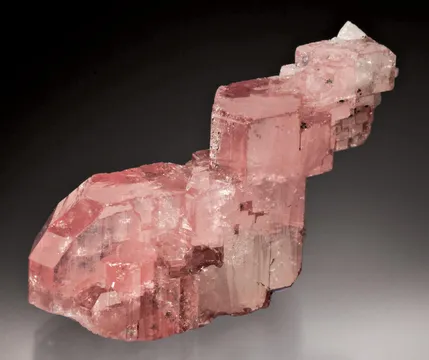
Peña Blanca Mine, Colombia - western emerald belt locality famed for emerald prisms in calcite with quartz, historic trapiche emeralds, and rare fluorite.
Key facts
Peña Blanca—more commonly written in the Colombian trade as Peñas Blancas—is one of the great underappreciated localities of the western Colombian emerald belt. It sits in the San Pablo de Borbur area of Boyacá, north of the classic Muzo–Coscuez–La Pita cluster, and belongs to the same emerald civilization: black, organic-rich Cretaceous sedimentary rocks, hydrothermal brines, folded and faulted shale, calcite veins, and the intense blue-green beryl that made Colombia the benchmark for emerald color. For collectors, however, Peñas Blancas is not simply “another Muzo-region emerald mine.” Its compact Rosablanca Formation shale, unusually abundant clean vein quartz, historic trapiche emerald production, and rare fluorite associations give it a character all its own.
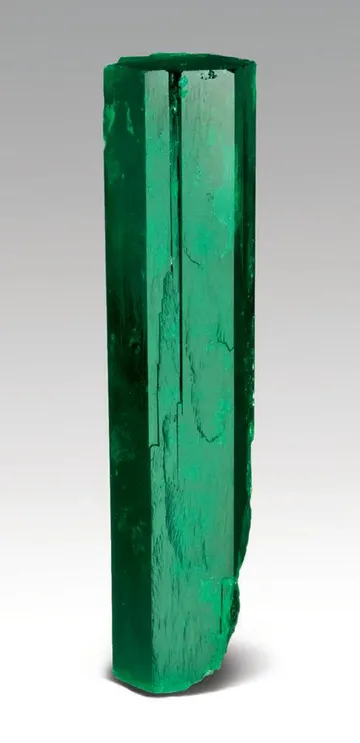
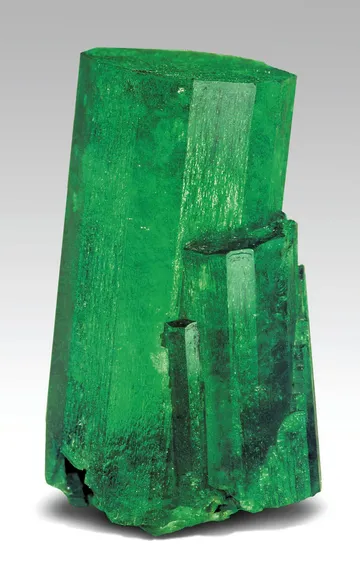
The best specimens have a look that is instantly recognizable once you have handled enough Colombian material: emerald prisms set in white to iron-stained calcite, sometimes with glassy quartz crystals close enough to suggest a single pocket event, and occasionally with fluorite—an association far less expected in a Colombian emerald suite than calcite or pyrite. Fine Peñas Blancas emeralds can be rich, velvety, and slightly bluish green; the crystals are typically hexagonal prisms with flat basal terminations, and the most collectible pieces show complete terminations, sharp prism faces, transparency, and undisturbed matrix. The mine also has a special place in trapiche history. In the 1960s and 1970s, Peñas Blancas yielded large, well-formed trapiche emeralds with black carbonaceous or white albite-rich interstitial material, many of which were unfortunately sacrificed to cutting before mineral collectors fully recognized their specimen value.
Regional View
Country View
Peñas Blancas entered modern gem history with a bonanza at the turn of the 1960s. Older geological accounts had already marked Peña Blanca on maps of the Muzo emerald region, but the locality had faded into near-obscurity before surface emeralds and a rich vein at La Culata drew miners back. Its production helped revive the Colombian emerald trade after a dormant period and became entangled with the rise of several powerful emerald families and syndicates. For specimen collectors today, that history matters because it explains why old Peñas Blancas trapiches, quartz-emeralḍ groups, and emerald-on-calcite pieces may have passed through the Bogotá trade with only broad “Muzo” or “Colombia” labels. A precise Peñas Blancas attribution is therefore worth preserving.
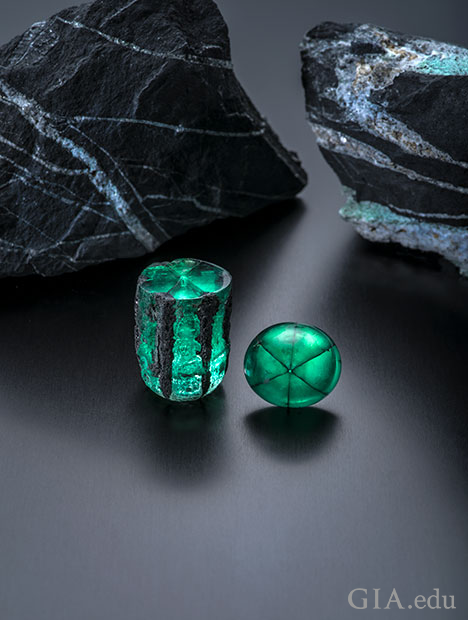
Photo: GIA
Search for specimens: View all specimens from Peña Blanca Mine, Colombia
Peñas Blancas is in the municipality of San Pablo de Borbur, Boyacá Department, within Colombia’s western emerald belt on the western flank of the Cordillera Oriental. The mine is generally grouped with the Muzo mining region, an emerald province that also includes Muzo, Coscuez, and La Pita. In the literature it appears both as Peña Blanca, an older singular form meaning “white outcrop,” and Peñas Blancas, the plural form favored locally; “La Peña” is also used in the region. Published coordinates place the mine near 5°43.0'N, 74°4.9'W, with access traditionally made from Borbur by steep, difficult roads.
Geologically, the deposit is a hydrothermal emerald occurrence in sedimentary rocks rather than a pegmatite-schist emerald deposit. That distinction is fundamental. Colombian emeralds owe their character to hypersaline, carbonic hydrothermal fluids moving through organic-rich shales and carbonate rocks, not to beryllium-bearing pegmatites intruding ultramafic rocks. At Peñas Blancas the host is assigned to the Rosablanca Formation, especially compact, blocky, fine-grained carbonaceous argillite and calcareous sedimentary rock of Valanginian age. That contrasts with Muzo, Coscuez, and La Pita, which are commonly associated with the Paja or Muzo formations and with softer, more fractured black shales.
The ore is vein-controlled. Intersecting white calcite and quartz veins cut the dark host rock, and emerald occurs in and along those veins, commonly attached to vein walls and embedded in calcite-rich vein material. Published field observations record mineralized veins from about 1 to 30 cm wide, usually filled with calcite, dolomite, pyrite, and quartz. The best emerald crystals were observed especially in narrower veins around 5 cm thick, while larger cavities could allow larger individual crystals. Quartz is unusually conspicuous here: clean, transparent “cuarzo de veta” from emerald-bearing veins was distinguished locally from less transparent “cuarzo de tierra” found away from the ore. That abundance of quartz is one of the easiest mineralogical ways to separate Peñas Blancas from many other Colombian emerald localities.
Several named areas recur in the mine’s history. La Culata was the surface bonanza zone where early miners followed productive veins downward through trenches and gullies. El Túnel de los Dos, started during the early bonanza period above La Culata, was remembered as highly productive for many years. The El Trapiche tunnel, later studied geologically, exposed hydrothermal veins in the Peñas Blancas sector; a university thesis documented 400 m of underground workings there and separated crushed, strongly altered zones from more competent rock cut by emerald-bearing veins. The same work tied emerald mineralization to albitization and to the percolation and injection of aqueous, hypersaline, carbonic fluids, with carbon supplied by oxidation of organic matter.
The mine’s modern importance began in 1958–1959, when emeralds reportedly found on or near the surface started a rush. Early production came from shallow trenches and near-surface workings in La Culata, where a productive vein more than 60 m long was followed beneath vegetation. By 1961, gemological reporting described clear, deep-green crystals ranging from about 1 to 30 carats and compared their velvety color to Muzo material. The same early account recorded a “wild rush” of perhaps 1,500 miners and army intervention while the government considered control of the property.
During the bonanza years of roughly 1958–1965, mining was mainly surface stripping and trenching. Miners dug more than 10 m downward, and the workings were later widened by bulldozer into gullies, leaving steep mounds perforated by prospecting holes and covered again by vegetation. By the early 1970s, the richest surface-reaching material had been depleted and work moved more underground, following productive veins with shafts and drifts. Peñas Blancas remained important through the 1960s and 1970s, especially for trapiche emeralds, but it was largely closed or only intermittently productive by the early 1980s after conflict among controlling groups and depletion of the most accessible ground.
Control of the mine has shifted with the broader politics of the Colombian emerald industry. In the late 1970s, after government bidding for leases in the Muzo region, Peñas Blancas was associated with the Quintero brothers. Later accounts of the western Boyacá emerald world describe Peñas Blancas as part of the contested network of properties tied to the Quintero Morales family and to the broader syndicates around Muzo, Coscuez, Quípama, and Chivor. In the twenty-first century, formal mining-title records identify Esmeraldas Peñas Blancas S.A.S. as titleholder for an emerald concession in San Pablo de Borbur, with documentation in 2024 listing the project in the exploitation stage. That formal record sits alongside the older artisanal reality: small tunnels, negotiated access, traditional miners, and a mine whose geology has long been better known to working miners than to outside collectors.
Collecting access should be treated as closed unless arranged directly through legitimate local operators. This is not a fee-dig locality. Published field accounts state plainly that access to emerald mines in the Muzo region requires invitation from a manager, owner, or operator and the accompaniment of local people connected to that particular mine. Roads can be difficult, the terrain is steep and heavily vegetated, and active or prospective workings are mining operations rather than public collecting sites. Collector specimens reach the market through miners, Bogotá dealers, international dealers, and older collections, not through casual field collecting.
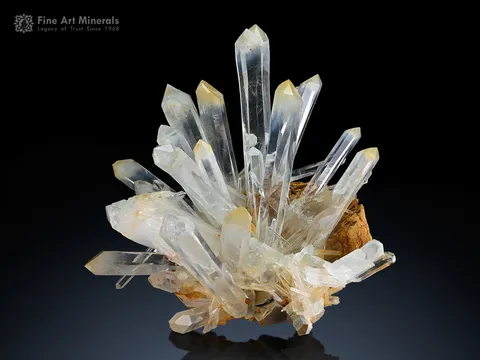
The most notable specimen finds fall into three overlapping categories. First are emeralds on calcite or calcite-quartz matrix: prismatic, lustrous, sometimes gemmy crystals with the slightly bluish green color expected of fine Colombian material. Second are emerald-and-quartz specimens, including the famous style of emerald clusters arranged around or beside transparent quartz crystals; one published specimen from 2004 measured 55 x 65 x 90 mm, and another illustrated quartz crystal from the mine was described as a 23 cm transparent crystal, probably half of a Japan-law twin, accompanied by emerald. Third are trapiche emeralds, especially the older 1960s–1970s production: complete patterned crystals, cabochons, and “reverse trapiche” material with emerald sectors separated by albite or shale. The old trapiche zone was described by locals in 2004 as a steep, overgrown area not then being worked.
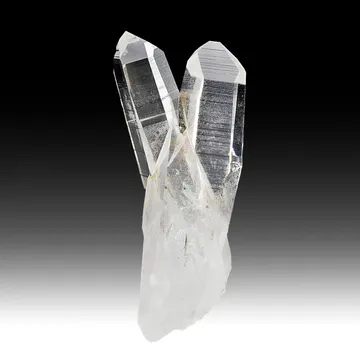
Quartz is one of the minerals that gives Peñas Blancas its separate identity among Colombian emerald localities: in the emerald-bearing veins it occurs as clean, transparent “cuarzo de veta,” commonly associated with emerald and calcite, and it becomes noticeably more transparent toward emerald mineralization. Collectors prize pieces where the quartz is not merely matrix but an active compositional partner—glassy crystals, drusy plates, mosaics, parallel bladed aggregates, or larger transparent crystals rising from calcite with emerald attached or nestled nearby. Published descriptions emphasize that quartz is more common in the emerald-mineralized zone at Peñas Blancas than at other Colombian emerald mines, with exceptional examples including emerald clusters around quartz and a 23 cm transparent quartz crystal associated with emerald; lesser pieces, by contrast, are simply colorless quartz from the mine without the emerald-bearing vein context, clarity, or sculptural relationship to the green beryl.
Peñas Blancas emeralds are classically prismatic, generally first-order hexagonal crystals with flat basal terminations, and the best examples show a slightly bluish green, velvety color with relatively little color zoning. They occur in calcite-, dolomite-, pyrite-, and quartz-bearing hydrothermal veins, often attached to vein walls or embedded in calcite-rich material, with especially good crystals reported from narrow productive veins and larger crystals possible where veins open into cavities. Many crystals have the pitted, etched “cascocho” surface familiar to cutters working Peñas Blancas rough; for collectors, that surface can be a locality signature, but it becomes a drawback when it obscures transparency or breaks the prism outline. The top specimens combine Colombian color with complete terminations, intact prism edges, transparency, strong luster, and honest matrix, while historic trapiche pieces from this mine add a second level of desirability when the six-rayed growth structure is preserved naturally rather than cut apart for gems.
Beryl from Peñas Blancas is essentially the same geological event expressed in a broader mineral label: euhedral green prismatic Be3Al2(Si6O18) crystals from the Rosablanca-hosted hydrothermal veins, some gem enough to be called emerald and others cataloged more conservatively as beryl depending on color, transparency, analysis, or dealer convention. Mindat records green, euhedral prismatic beryl from the mine, and specimen-market examples commonly overlap with emerald, calcite, quartz, and fluorite associations. Good “beryl” pieces from Peñas Blancas should still be judged by emerald-specimen standards—sharp hexagonal form, clean basal termination, saturated green color, transparency, and secure matrix—while ordinary examples are pale, damaged, heavily etched, or disconnected from the calcite-quartz vein assemblage that makes the locality meaningful.
Other documented minerals from Peñas Blancas include calcite, dolomite, pyrite, fluorite, baryte, and possibly siderite, with albite and parisite also appearing in broader geological discussions of Colombian emerald vein assemblages. Calcite is the essential matrix mineral, ranging from white to colorless, creamy, or gray crystals and vein material; dolomite is sufficiently notable that transparent blue dolomite specimens from Peñas Blancas have been analyzed and published in specimen literature. Fluorite is the great rarity for collectors: Peñas Blancas has produced green, colorless, purple, and pinkish fluorite, including cubic or tabular crystals and emerald-fluorite associations that are exceptional in a Colombian context. Pyrite occurs as part of the hydrothermal sequence and as veinlets or stockworks in shale, with weathering responsible for the orangy brown staining often seen on calcite-rich matrix.
Peñas Blancas specimens demand careful locality discipline. Old Colombian emerald labels often default to “Muzo,” even when a piece may have come from Coscuez, La Pita, Peñas Blancas, Chivor, or another district. Visual attribution alone can be unreliable, especially for loose crystals and cut stones. A Peñas Blancas label is strongest when supported by old collection history, a dealer record, a mine-source chain, a specimen photograph from the dealer archive, or a matrix association consistent with the mine’s quartz- and calcite-rich vein style.
Treatment is a real issue for emeralds from this locality. Published gemological work on Peñas Blancas rough documented samples with oil, epoxy resin, or both in fractures and surface cavities. That matters for both cut gems and specimens: oiling may improve apparent transparency, resin may mask fractures, and bubbles in filler can be confused with natural fluid inclusions under magnification. Buyers should ask whether emeralds have been oiled, filled, stabilized, repaired, or cleaned. On specimens, check the contact between emerald and matrix under magnification; repaired or reattached crystals are not rare in the Colombian trade generally, and a fine emerald crystal on white calcite is valuable enough to justify scrutiny.
Condition problems are predictable. Emerald has good hardness but is brittle, and Peñas Blancas crystals may carry natural etch pits and cavities. Distinguish natural pitted “cascocho” surfaces from fresh chips, broken terminations, bruised prism edges, and filled cracks. Matrix pieces often include calcite, which is soft and acid-sensitive; avoid acidic cleaners and prolonged soaking. Iron staining is normal on many Peñas Blancas calcite matrices and should not automatically be treated as dirt. Aggressive cleaning can remove context, luster, or delicate secondary calcite.
Trapiche material requires a separate authenticity check. Natural trapiche emerald has a fixed six-rayed growth structure; it is not a moving star effect, not a surface carving, and not simply black lines painted or filled into a cabochon. Peñas Blancas produced genuine trapiche emeralds historically, including reverse trapiche examples, but the old production is limited and many large crystals were cut apart. Complete natural trapiche crystals from this mine are now much less common than polished slices and cabochons. Be wary of vague “Colombian trapiche” labels upgraded to Peñas Blancas without provenance.
Fluorite from Peñas Blancas is rare and can be surprisingly showy, including clear crystals with green zones or phantoms and purple fluorescence under ultraviolet light. Because published and dealer explanations for the green color have not always agreed, collectors should not pay a premium for a specific chromophore claim unless it is backed by analysis. The association of emerald, calcite, and fluorite is especially desirable when all minerals are clearly in place and undamaged.
Market availability is sporadic. Small emerald-on-calcite specimens appear from time to time, as do occasional quartz-emeralḍ pieces and rare fluorite specimens. Fine trapiche crystals with secure Peñas Blancas attribution are much harder to source than generic Colombian trapiche cabochons. The most desirable cabinet specimens—complete emerald crystals on matrix with quartz, or emerald with fluorite—tend to disappear quickly into advanced Colombian, emerald, or systematic collections.
The modern Peñas Blancas story begins almost like a folktale. For decades the old Peña Blanca prospect had been known in print but nearly forgotten in practice. Local campesinos traveling by mule from Borbur into the Peñas Blancas area for agricultural work sometimes found green stones on the ground and reportedly gave them away, not understanding their value. Then, in 1958, a mule driver showed one of those emeralds to a relative in Muzo. Within months, the quiet hillside had become a rush. Miners found emeralds under vegetation, followed a rich vein for more than 60 m, and pulled gem-quality rough from shallow trenches.
By 1961, the scene had become famous enough to reach GIA in Los Angeles. The early report described clear, deep-green crystals, some with basal pinacoids and small modifying bipyramid faces, and noted production from about 1 to 30 carats. It also captured the social temperature of the discovery: perhaps 1,500 miners had rushed the ground, while the army surrounded the area to keep order and prevent robbery. That combination—velvety green stones, disputed rights, armed control, and sudden wealth—would become a recurring pattern in western Boyacá.
The bonanza years carved La Culata into a new landscape. At first the miners stripped the surface and followed the productive veins downward. Trenches cut more than 10 m into the hill, then bulldozers widened them into gullies. What remained was a terrain of steep mounds, wide cuts, prospecting holes, and encroaching vegetation. Above La Culata, El Túnel de los Dos began in the same period and became one of the remembered productive workings. The mine’s early vocabulary belonged to men reading rock by eye and experience: capas buenas for emerald-bearing layers, cambiado for barren zones, and cama for breccia-like masses.
Peñas Blancas also sits under the shadow of Fura and Tena, the twin peaks that dominate the Río Minero valley. In the Muisca and Muzo legend retold in gemological accounts, the creator Ar-e formed Tena, the first man, and Fura, the first woman, from the earth. Their paradise ended when Zarve, represented by the Río Minero, seduced Fura. Ar-e condemned the pair to death: Tena turned to stone first, and Fura died three days later at his feet. The river was sent to separate them forever. Over time, Fura’s sadness became the blue Morpho butterflies of the region, and her tears became emeralds. For anyone who has approached the western emerald belt through mist, mud, and jungle-green slopes, it is not hard to see why the story endured.
The 1960s and 1970s trapiche production is one of the mine’s great collector tragedies. Large, well-formed Peñas Blancas trapiche emeralds entered collections around the world, showing either dark carbonaceous spokes or pale albite-rich separations. Yet abundance made them vulnerable. Many were not preserved as crystals. Cutters saw six transparent gem sectors around the trapiche structure, so the rays were sawn through and the segments turned into calibrated stones. Rare chatoyant sections became small cat’s-eye cabochons. The result is that today’s collectors may encounter old cut trapiche material more readily than intact Peñas Blancas trapiche crystals from the original production.
A field visit in 2004 caught the mine in a quieter, rougher state. The road remained difficult, the terrain steep and overgrown, and the workings artisanal rather than industrial. Even the better-equipped tunnels could be limited to a single pump for ventilation and a generator for an electric hammer-drill. Yet the ground was still capable of surprise. A transparent quartz crystal about 23 cm long, probably half of a Japan-law twin, was documented with an accompanying emerald crystal, and another specimen from February 2004 showed emeralds clustered around quartz. Those pieces explain why Peñas Blancas matters to mineral collectors beyond cut-gem emerald history.
The mine’s human history is inseparable from the broader emerald wars of western Boyacá. Peñas Blancas wealth helped launch or consolidate some of the best-known names in the emerald trade, including Isauro Murcia, the Molina family, Víctor Carranza, Juan Beetar, and the Quintero Morales family. The district’s later decades were shaped by rivalries, private armies, and shifting concessions. Yet the same accounts that describe violence also describe peace accords, formalization, traditional miners, and renewed attempts to work the old ground legally. Peñas Blancas is therefore not just a locality name on a label; it is a compressed chapter of Colombian emerald history.