La Marina Mine, Colombia — a notable locality yielding blue euclase, pink fluorapatite, and calcite on albite; prized for compact, cabinet-grade specimens.
Key facts
La Marina is the small Colombian emerald mine that suddenly forced serious collectors to make room in the “great euclase localities” conversation. It lies in the Pauna area of western Boyacá, on the western emerald belt just outside the classic Muzo district, where emerald mineralization belongs to Colombia’s unusual sediment-hosted, non-pegmatitic hydrothermal system: black shales, calcareous mudstones, carbonate veins, albitized zones, pyrite, and pockets opened by Andean deformation rather than granitic pegmatites. For collectors, La Marina matters for a compact but distinctive assemblage—pale to vivid blue euclase, hot-pink fluorapatite, white albite, calcite, dolomite, baryte, pyrite, quartz, and emerald—formed in the same broad geologic family that made Colombian emeralds famous, but expressed here in specimens that often look more like high-grade cabinet minerals than rough gem ore.
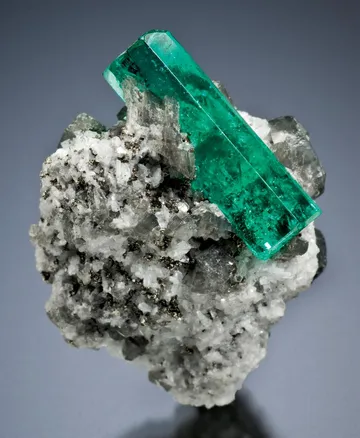
The best La Marina pieces are instantly recognizable: glassy blue euclase blades or wedges, commonly pale greenish blue to medium blue, perched on bright white calcite or albite and, in the finest combinations, accompanied by contrasting pink fluorapatite. The fluorapatite itself is a collector mineral in its own right here—lustrous, tabular to short-prismatic, pink, and often set on sparkling white albite or carbonate matrix. La Marina’s historical significance is modern rather than colonial: it is not one of the legendary old emerald names like Muzo or Chivor, but the 2005 pink fluorapatite discovery and especially the 2015 euclase find gave the mine an international specimen identity out of proportion to its size.
Regional View
Country View
In the broader Colombian emerald context, La Marina illustrates why “emerald mine” labels can be misleadingly narrow for mineral collectors. The emerald industry follows green beryl, but the pockets that matter to collectors may reward the eye with other beryllium minerals and phosphates: euclase where Be-bearing fluids met open space and suitable chemistry, fluorapatite where phosphate and fluorine entered the vein assemblage, and albite or carbonate as the bright stage on which the specimen is displayed. The best pieces are not simply rare because euclase is rare; they are rare because they combine color, transparency, undamaged terminations, and matrix aesthetics in a mine better known operationally for emerald.

Photo: Géry Parent / Wikimedia Commons
Search for specimens: View all specimens from La Marina Mine, Colombia
La Marina Mine is an emerald mine in the Pauna–Maripí sector of western Boyacá, Colombia, within the western emerald belt of the Eastern Cordillera. In collector locality terms it is usually given as La Marina Mine, Pauna Municipality, Western Boyacá Province, Boyacá Department, Colombia; it is also commonly described as being just outside the Muzo district. The mine sits among the productive Boyacá emerald localities that include La Pita, Coscuez, Peñas Blancas, Quípama, and the historic Muzo workings.
Geologically, La Marina belongs to the Colombian emerald class of sediment-hosted hydrothermal deposits. These are not pegmatite emeralds. The host sequence in the western belt is Lower Cretaceous black shale, calcareous mudstone, limestone, and related sedimentary units of the Muzo–Paja–Rosablanca stratigraphic association, fractured and folded during Andean compression. Hydrothermal brines moved along faults, shear zones, breccias, tension gashes, and fold-related structures; they altered the black shales by albitization, carbonatization, and pyritization, then deposited carbonate-rich veins and pockets containing calcite, dolomite, albite, pyrite, quartz, muscovite, fluorapatite, and beryllium minerals including emerald and euclase.
The most locality-specific geologic point for La Marina is the relationship between emerald-euclase mineralization and an anticlinal fold structure in the Pauna area. A published study of the nearby Cunas emerald mine notes that earlier Colombian geological work suggested a genetic link between euclase and emerald mineralization and an anticline fold at La Marina, about 6 km north of Cunas. That matters to collectors because the La Marina euclase is not a pegmatite accident: it is part of the same structurally focused brine system that created the western belt emerald deposits, with beryllium mobilized and redeposited in open spaces in carbonate-albite vein assemblages.
The formal modern mining history is documented through Colombian mining authority records for concession BA3-101. The concession was signed on December 10, 2002, for technical exploration and economic exploitation of an emerald deposit covering 158.6348 hectares in the municipalities of Pauna and Maripí. It was registered in the National Mining Registry on March 18, 2003, for a 30-year term. CORPOBOYACÁ granted the environmental license for emerald mining under the title in 2004. In 2006 the rights and obligations were transferred to Sociedad Minera Internacional Minera La Marina Ltda., with the transfer registered on March 13, 2007. The Program of Works and Operations was approved in 2012. Later ANM records list the title in the exploitation stage and classify the operation as medium-scale mining.
For specimen collectors, the two important production moments are 2005 and 2015. In January 2005, lustrous pink fluorapatite on clean white albite reached the specimen market as a notable new discovery; at least one benchmark specimen was later cited as having been photographed in Mineral Up 2006/1 and reviewed again in The Mineralogical Record’s 2016 Colombian emerald issue. The second and more dramatic moment came in mid-to-late 2015, when lots of pale blue La Marina euclase appeared at the Denver and Munich shows. Reports from the show circuit described bladed, wedge-terminated euclase crystals to 4.5 cm, as singles and clusters, with some specimens carrying pink fluorapatite on albite. That find transformed La Marina from an obscure emerald mine on locality labels into one of the very few sources of world-class Colombian euclase specimens.
Collecting access should be understood in mining, not hobby-field-collecting, terms. La Marina is a working emerald concession, not a public collecting locality. Underground emerald operations in Boyacá are controlled, hazardous, and legally restricted; any material reaching collectors comes through miners, mine owners, exporters, dealers, or old collections. A 2023 Colombian mining authority notice also recorded a suspension of development and exploitation work at La Marina until acceptable underground atmosphere conditions were restored, after an inspection registered CO2 concentrations up to 3%. Whether or not that specific condition has since been remedied, it is a reminder that this is an underground emerald mine first and a specimen source only secondarily.
La Marina fluorapatite is best known as lustrous pink, short-tabular to stout prismatic crystals, typically thumbnail to small-miniature in crystal size and most desirable when sharply perched on sparkling white albite, calcite, dolomite, or baryte rather than loose or crowded into massive matrix. Published and dealer-documented specimens include pink fluorapatite on albite from the January 2005 discovery with individual crystals around 7 mm, later examples to about 2 cm, and matrix pieces in the 3–6 cm range; the strongest collector pieces show saturated rose-pink color, glassy luster, clean hexagonal form, and a bright contrast against white albite or carbonate. Some specimens are strongly fluorescent under both long-wave and short-wave UV, and the most prized combinations are those in which the pink fluorapatite accompanies blue euclase, giving La Marina one of its most distinctive color pairings.
La Marina euclase occurs as glassy, transparent to translucent, pale greenish blue to blue crystals, usually bladed or wedge-terminated, with fine vertical striations and sharp bipyramidal terminations on the best examples. The celebrated 2015 find produced singles and clusters, some on calcite or albite and some associated with pink fluorapatite; reported crystals reached as much as 4.5 cm, while fine miniatures commonly fall in the 2–3 cm range and are judged by completeness, color, transparency, luster, and the absence of cleavage bruises. Matrix pieces are especially coveted because euclase is more often seen as loose crystals, and La Marina’s finest specimens have a very Colombian look: cool blue beryllium silicate rising from white carbonate or albite, sometimes with pink fluorapatite as a dramatic accent.
Other documented minerals from La Marina include albite, baryte, beryl including emerald, calcite, dolomite, gypsum, muscovite, pyrite, and quartz. The mine is not known as a type locality; its distinction lies instead in unusually aesthetic examples of euclase and pink fluorapatite from a Colombian emerald environment. Albite is more than gangue here—it is the bright white sculptural matrix that makes many fluorapatite and euclase specimens work visually. Calcite and dolomite are typical carbonate-vein minerals of the emerald system, pyrite reflects the reduced black-shale chemistry, quartz appears in some specimen associations, and emerald remains the economic target even when collector attention is drawn to the rarer blue and pink species.
La Marina labels require precision. “Colombia,” “Boyacá,” “Muzo district,” and “Pauna” are not interchangeable locality data, and older or hurried dealer labels may compress the locality to “Muzo” or “Colombia” even when the specimen is properly La Marina. For euclase, this matters because Colombian euclase also occurs in the eastern emerald belt, especially Gachalá-area material, and the market has seen Colombian euclase described broadly by country or belt rather than mine. The most convincing La Marina pieces are those with credible provenance from the 2015 find or established dealers, and with the characteristic associations of white albite or calcite and, in some cases, pink fluorapatite.
No La Marina-specific fake or treatment scandal is established in the main collector literature, but several practical cautions apply. Euclase has perfect cleavage and the name itself refers to its tendency to break; contact marks, cleaved terminations, repaired crystals, and bruised edges can be subtle under show lighting. Blue euclase crystals should be examined with magnification for filled or glued breaks, especially on high-value miniatures. A cleanly doubly terminated or complete single crystal from La Marina commands a premium, and any “perfect” crystal should be checked under strong side lighting for hidden cleavage planes.
Fluorapatite from La Marina is less fragile than euclase in the cleavage sense, but it still shows edgewear easily along tabular rims and terminations. The most common condition issue is small chipping on exposed pink crystal edges or damage masked by the brightness of the white albite matrix. Matrix pieces should be checked for glued-on crystals, particularly if the fluorapatite appears isolated on a flat white base without natural contact. Strong UV response has been reported for at least some La Marina fluorapatite, but fluorescence should be treated as a bonus rather than a universal diagnostic.
Market availability is sharply divided. Pink fluorapatite from La Marina appears intermittently in thumbnails and miniatures, and modest examples can still be available at accessible prices when color or size is limited. Fine fluorapatite on albite, especially with saturated pink color and undamaged crystals, is much scarcer. Euclase is the prestige species: ordinary small or contacted crystals are uncommon, fine matrix pieces are scarce, and top miniatures from the 2015 discovery have traded or been offered in the four- and five-figure range. Combination pieces of blue euclase with pink fluorapatite on albite are the locality’s signature elite material.
The La Marina story that collectors remember began not at the mine portal, but on the show circuit. In the fall of 2015, pale blue euclase from a little-known Boyacá emerald mine appeared first as a whisper, then as a rush of glassy blue crystals at major shows. At Denver, specimens were offered at the Marriott hotel show; by Munich, one dealer still reportedly had about 50 pieces—already described as leftovers from the Denver debut. That number was startling because euclase had long been known from Colombian emerald environments, but never in such a concentration of first-class specimens from a single modern find.
The descriptions from that moment read like a collector’s checklist written in a hurry: partially gemmy, pale greenish blue, bladed, wedge-terminated crystals, some loose, some clustered, some on matrix, and not uncommonly associated with pink fluorapatite. Crystals were reported to reach 4.5 cm, a serious size for euclase of this quality. Prices were equally memorable—four figures and even five figures—yet the material sold into major collections because it was not merely rare; it was beautiful in the direct way that needs little explanation across a crowded mineral room.
The 2015 find also changed how collectors looked back at La Marina’s pink fluorapatite. A decade earlier, in January 2005, bright pink fluorapatite on white albite had appeared from the same mine and was important enough to be treated as a new discovery in Mineral Up. Before the euclase rush, those pink apatites could be appreciated as attractive Colombian oddities: small, lustrous, fluorescent, and unusually colorful for an emerald mine. After 2015, they became part of a larger story—the pink half of the blue-and-pink La Marina combination, the accent mineral that made some euclase specimens unmistakable.
There is also a less glamorous field note in the official record. In November 2023, Colombian mining authorities reported that a visit to La Marina found underground CO2 concentrations up to 3%, and the suspension of development and exploitation work was reiterated until the mine atmosphere could be brought within permissible limits. The notice fixed the mine not as an abstract dot on a collector map but as a real underground workplace at 486.8 meters elevation, with air, access, and safety problems that could stop production entirely. For collectors, that bureaucratic detail is a useful corrective: every pristine blue euclase on white calcite began as material recovered from difficult, controlled underground workings, not from a casual roadside pocket.
A dealer who handled material soon after the 2015 discovery captured the emotional side more plainly: “We are all dreaming about Euclases...All...” It is an exuberant line, but not an exaggerated mood. Fine euclase is the sort of species many collectors want and few localities supply well. La Marina’s brief burst of blue crystals gave the market what it rarely gets—a new source with recognizable aesthetics, matrix pieces, and enough material to make a sensation, but not enough to make the locality ordinary.