Braen Quarry, USA — a premier trap-rock locality in Preakness Basalt, notable for stellerite and stilbite, gemmy datolite, and New Jersey tradition.
Key facts
Braen Quarry at Haledon, Passaic County, New Jersey, is a collector locality of unusual concentration: a working trap-rock quarry cut into the Preakness Basalt of the Watchung Mountains, yet known among mineral collectors not for the stone it ships, but for the small, high-quality hydrothermal cavities the basalt occasionally gives up. The quarry exposes Lower Jurassic basalt of the Newark rift basin, part of the volcanic pile erupted during the breakup of Pangaea. In the Haledon pit, collectors prize the mineralized pillow basalt, amygdaloidal and scoriaceous zones, veins, and cavity-bearing structures where late fluids deposited zeolites, datolite, quartz, calcite, sulfates, prehnite, sulfides, and related low-temperature assemblages.
For serious collectors, Braen matters above all for its stellerite and stilbite-group specimens, its pale water-green datolite, and its association with the classic New Jersey trap-rock mineral tradition of Paterson, Great Notch, Prospect Park, and the Watchung quarries. The best Braen stellerite is not the dull, chalky material one expects from many occurrences worldwide; it can form lustrous, colorless to milky, almost jelly-like radiating balls and druses on dark basalt. Stilbite is typically more cream, caramel, white, or orange-toned, forming rounded balls, rosettes, and bow-tie aggregates on scoria, often with heulandite. Datolite appears as gemmy green crystals lining vugs, and also as sharp hollow casts after anhydrite. Calcite, quartz, gypsum, anhydrite, pyrite, chabazite, analcime, natrolite, prehnite, sphalerite, and other rarities round out a locality that is far more mineralogically varied than the word “aggregate quarry” suggests.
Regional View
Country View
The locality’s reputation rose sharply in the 2000s, when notable collectors and dealers began documenting unusually fine pieces from pockets opened in the working quarry. Many of the most recognizable specimens trace through the Richard Kosnar, Kurt Hennig, John Geiges, Eric Stanchich, Bradley Plotkin, and Frank A. Imbriacco III spheres of influence: collectors who either obtained, trimmed, photographed, published, or preserved the material while it was still a niche New Jersey specialty. The 2009 Mineralogical Record article by Frank A. Imbriacco III gave Braen a proper place in the literature and helped move it from “local trap-rock quarry” to a recognized classic locality for collectors of eastern North American zeolites.


Search for specimens: View all specimens from Braen Quarry, USA
Braen Quarry, also known in mineral labels as the Braen Stone Industry Quarry, Sam Braen Quarry, or Braen’s Quarry, is at Haledon in Passaic County, New Jersey, on the eastern side of the classic Watchung trap-rock district. It is a trap-rock quarry extracting basalt from the Preakness Mountain Basalt, the unit historically called the Second Watchung basalt. This is not a metallic ore deposit in the mining sense; the economic product is crushed basalt aggregate and asphalt feedstock. The collectible minerals occur as secondary cavity and vein fillings within the volcanic rock.
The geological setting is the Newark Basin, a rift basin filled with red-bed sedimentary rocks and volcanic flows of Late Triassic to Early Jurassic age. The Preakness Basalt is one of the major Watchung lava units and is mapped as a Lower Jurassic basalt formation. At Braen, the quarry is important because it provides one of the relatively extensive exposures of Preakness Basalt. The collectible pockets are not randomly distributed through uniform stone: they are tied to textural and structural features of the basalt, including pillow formation, amygdaloidal pockets, scoriaceous basalt, veins, and cavity-bearing diapiric structures. Mindat photo records also document a roughly 4 m thick mineralized pillow-basalt layer at the base of the quarry resting on Feltville Formation mudrock, and scoria-capped amygdaloidal basalt overlying the pillow structure at the base of the Preakness Basalt.
The mineralization is the same broad hydrothermal and deuteric trap-rock style that made northern New Jersey famous. Volatile- and fluid-rich late-stage systems exploited open spaces in cooling basalt, leaving cavities lined or filled by zeolites, prehnite, datolite, quartz, calcite, sulfates, clay/chlorite minerals, and sparse sulfides. The mineral sequence and associations vary from pocket to pocket. Some vugs are zeolite-dominant, with stellerite, stilbite, heulandite, analcime, chabazite, natrolite, mesolite, or laumontite. Others are datolite-rich, including lustrous green crystals and datolite casts after anhydrite. Quartz may occur as rock crystal, smoky quartz, amethyst, or as casts after dissolved anhydrite blades. Calcite is a late and attractive component in several pockets, forming golden rhombs and scalenohedra. Sulfides such as pyrite, chalcopyrite, sphalerite, galena, and wurtzite are much scarcer but give Braen a more complex collector suite than a zeolite-only locality.
The quarry began operations in 1920. The Haledon quarry was sold by the Sowerbutt Brothers Company to Samuel Braen’s Sons in 1948, and it has remained in the Braen family since then. Between 1949 and 1977, Braen quarries supplied raw materials to Sam Braen Construction Company projects, with Braen trucks hauling stone, asphalt, concrete, and fuel through a vertically integrated regional construction business. In 1977, Samuel Braen, Jr. took over the Haledon operation, which became known as Stone Industries and concentrated on blasting rock, crushing stone, grading aggregate, and asphalt. In 1990 the quarry received a license to recycle concrete and began accepting broken concrete and asphalt for recycled aggregate and recycled asphalt pavement. In 2000 Braen Supply was formed on the Haledon quarry grounds, expanding the site’s business into landscape, masonry, and hardware supplies. The quarry remains an active, regulated industrial operation producing basalt/traprock aggregate and supporting asphalt production.
For collectors, access has never been casual. The quarry is an active MSHA-regulated site, and historic specimen recovery came from limited opportunities, personal connections, and collectors who were present when favorable blasts exposed fresh cavity zones. Old specimen descriptions repeatedly call the quarry “seldom collected,” which is part of the reason top pieces command attention: there was never a steady tourist-collecting pipeline comparable to an open dig site. Any modern access should be treated as private-property industrial access only, dependent on the operator and formal permission; unauthorized entry is both unsafe and harmful to future collector relations.
Several notable finds define the locality’s collecting history. Stellerite and stilbite specimens appeared from relatively recent collecting episodes in the historic quarry and circulated through the Rich Kosnar collection. Some of the best stellerite is described as colorless, gemmy, lustrous, spherical radiating aggregates on basalt, with individual balls reported around 6–10 mm on cabinet-size plates. Mindat records include a 3.3 cm stellerite sphere on micro stellerite collected by Sam Braen and formerly in the Kurt Hennig collection, as well as a 3.0 cm stellerite sphere on crystallized stellerite druse collected by Sam Braen and formerly in the John Geiges collection. Stilbite pockets produced caramel, cream, white, and orange spheres and rosettes on scoria, including two interpenetrating stilbite spheres to 6.3 cm with micro brown heulandite crystals, collected by James Zigras on March 31, 2002 and illustrated in the 2009 Mineralogical Record article. Other 2004 Kurt Hennig material includes cream-colored stilbite groups to 3.0 cm with heulandite, and stilbite spheres to 2.3 cm with heulandite. Datolite pockets produced water-green gemmy crystal linings, large vugs with black chlorite-group spheres, and especially sculptural hollow casts after anhydrite. The locality also produced a large amethyst “geode” with hematite inclusions, deep-blue anhydrite with gypsum and datolite, bright natrolite sprays, rare chabazite with analcime and stellerite on datolite, and several strong golden calcite specimens.
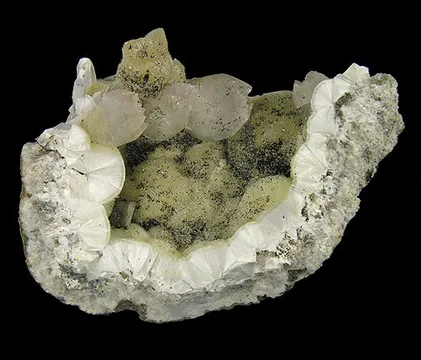
Braen Quarry stellerite is the species that most sharply separates this locality from the general run of New Jersey trap-rock zeolite occurrences: the best specimens show lustrous, colorless to milky, translucent to gemmy radiating spheres and botryoidal druses on dark basalt, commonly described as “jelly-like” in appearance. Individual crystal aggregates on photographed and auctioned examples are commonly in the millimeter range, with high-quality spheres around 6–10 mm, while larger documented locality pieces include stellerite spheres of roughly 3 cm on stellerite druse or micro-stellerite crusts. The strongest Braen specimens are clean, sparkling, undamaged balls on contrasting basalt, especially where repeated spheres cover a sculptural matrix; ordinary pieces are duller, more opaque, or visually lost in pale zeolite druse. Associations include calcite, datolite, chabazite, analcime, and other zeolites, and several important pieces trace to Sam Braen, Kurt Hennig, John Geiges, Rich Kosnar, and Frank Imbriacco-documented material from the early 2000s collecting era.
Datolite from Braen Quarry is prized in two contrasting forms: lustrous pale water-green to green crystals lining basalt cavities, and sharp sculptural casts after anhydrite where datolite preserves the negative geometry of former sulfate blades. Fine crystal specimens are typically cabinet to miniature plates carrying many transparent to nearly water-clear crystals; published and auctioned examples record individual datolite crystals up to about 0.7, 0.9, and 1.2 cm, with the value lying less in size than in luster, clarity, crisp faces, and saturated green color. The cast specimens can be more architectural, showing blocky, hollow, striated datolite forms after dissolved anhydrite, sometimes with pockets of gemmy datolite crystals still present. Associations include anhydrite, gypsum, calcite, quartz, chalcopyrite, pyrite, chlorite-group spheres, chabazite, analcime, stellerite, apophyllite-group minerals, and possibly thaumasite; the best pieces combine bright green datolite, sharp crystal definition or unmistakable casting texture, and minimal bruising on the exposed vug surfaces.
Braen Quarry calcite is a companion mineral that occasionally becomes the main specimen: pale golden to richer golden rhombohedra and scalenohedra occur on basalt, quartz, datolite, and pyrite-bearing matrix, with photographed and auctioned pieces recording crystals from sub-centimeter sharp rhombs to approximately 2.3 cm rhombs, and one gallery specimen noting a much larger calcite crystal on a 6 x 4 1/4 inch quartz specimen. The most distinctive Braen calcite specimens are not simply yellow calcite; they are tied to the quarry’s anhydrite-cast story, with golden calcite perched among quartz casts after dissolved anhydrite blades, or with pyrite and quartz adding sparkle and contrast. Ordinary calcites are small, scattered, or bruised; good pieces show clean, translucent crystals, strong golden color, a balanced position on matrix, and preferably a recognizable locality association such as quartz after anhydrite, datolite, or pyrite.
Heulandite from Braen Quarry is best treated by collectors as heulandite subgroup material unless analytically narrowed, and it is most familiar as a companion to stilbite in scoria-hosted pockets. Documented specimens show translucent brown rounded crystal aggregates mixed with white rosettes of colorless stilbite, individual heulandite crystals in the 2–5 mm range on an 8 x 6 x 4 cm specimen, micro brown heulandite associated with large stilbite spheres, and white heulandite crystals reported to about 1 cm with stilbite spheres and bow ties. The attractive pieces are those where heulandite forms a sparkling, undamaged field that enhances the stilbite rather than disappearing beneath it; collector-grade examples show crisp small plates or aggregates with visible color contrast, especially brown heulandite against white or cream stilbite on dark vesicular basalt.
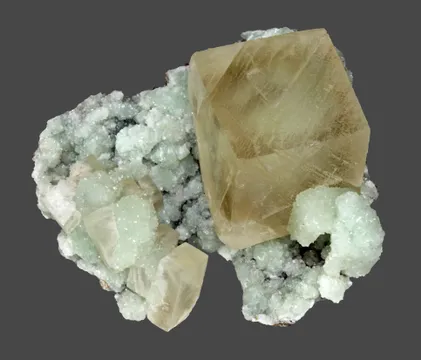
Braen Quarry stilbite is the locality’s warm-toned, rounded zeolite: cream, white, caramel, yellow, and orange balls, rosettes, clusters, and bow-tie forms on scoriaceous basalt, commonly accompanied by heulandite. Documented examples include a 3.5 cm caramel-colored sphere on scoria, two interpenetrating spheres to 6.3 cm with micro brown heulandite collected by James Zigras on March 31, 2002, a 3.9 cm sphere and 2.3 cm bow tie on scoria with white heulandite to 1 cm, cream-colored groups to 3.0 cm with heulandite collected by Kurt Hennig in 2004, and smaller spheres around 2.3–2.7 cm. Compared with the stellerite, Braen stilbite is generally less glassy and more cream to caramel in look; the best pieces have complete rounded balls, clean bow ties, good luster, and an undamaged scoria matrix that frames the aggregates rather than overpowering them.
Other minerals documented from Braen Quarry make it one of the more interesting Preakness Basalt suites. Mindat and the 2009 Mineralogical Record article record albite, amethyst, analcime, anhydrite, baryte, calcite, chabazite, chalcopyrite, chamosite, datolite, epidote, fluorapophyllite-(K), galena, goethite, gypsum including selenite, hematite, hemimorphite, heulandite subgroup, laumontite, mesolite, natrolite, prehnite, pumpellyite-(Fe), pumpellyite-(Fe3+), pyrite, quartz varieties including rock crystal and smoky quartz, sphalerite, stellerite, stilbite subgroup, thaumasite, and wurtzite. Particularly notable rarities include a reported 1.2 cm wurtzite crystal on datolite matrix, rare natrolite vugs with bright terminated sprays, chabazite with analcime and stellerite on datolite, baryte on smoky quartz, deep-blue anhydrite with gypsum and datolite, very gemmy yellow-green sphalerite on prehnite, and pyrite on datolite. Braen is sometimes encountered in older canaphite discussions, but current locality work treats canaphite from Braen as an erroneous report based on a mislabeled specimen; the valid type locality for canaphite is Great Notch, not Haledon.
The chief authenticity issue for Braen Quarry is locality precision, not artificial treatment. Labels may read Braen Quarry, Braen’s Quarry, Sam Braen Quarry, Braen Stone Industry Quarry, Stone Industries Quarry, or Haledon Quarry, and these can all refer to the Haledon Passaic County trap-rock locality. However, “Braen” also appears in New Jersey quarry contexts outside Haledon, especially the Braen Franklin/Lime Crest operation, so collectors should not accept a shortened “Braen Quarry, NJ” label without county and town. The Haledon locality is Passaic County basalt; the Franklin/Lime Crest locality is a very different Sussex County carbonate/skarn/marble setting.
The most important mineralogical mislabel is canaphite. Early literature associated canaphite with Braen/Haledon, but later review of the discovery history found the specimen to have been mislabeled and traced the occurrence to Great Notch. Braen canaphite should therefore be treated skeptically unless accompanied by exceptional analytical documentation and a clear chain of custody; in ordinary collecting practice, it is safer to regard Braen canaphite labels as legacy errors.
Species-level names can also be tricky. Heulandite and stilbite are often sold as subgroup or visual identifications from Braen, and the stellerite–stilbite distinction matters because high-quality Braen stellerite is a premium locality item. Stellerite here should show the characteristic colorless to milky, lustrous, radiating spherical habit seen in well-documented pieces, but visual habit alone is not absolute. For high-value specimens, old labels from recognized collections, publication history, or analytical confirmation are meaningful. Thaumasite labels should be handled cautiously where they are based on visual identification only.
Condition is a major value factor. The zeolites are delicate and commonly sit exposed on dark basalt or scoria, so edge bruising, flattened tops on spheres, broken bow ties, and rubbed druse are easy to miss in poor photographs. Stellerite balls should be checked under magnification for bruised high points and cleaved or frosted patches. Stilbite rosettes and bow ties should retain full terminations and radiating form. Datolite vugs should be examined for chipped crystal faces, repaired matrix, and damage to thin hollow casts after anhydrite. Calcite is more robust, but golden rhombs and scalenohedra can chip at edges and terminations; iron staining is common in basalt cavities and may be natural rather than a flaw if it does not obscure the crystal faces.
Gypsum and anhydrite specimens need extra care. Gypsum cleavages and selenite are soft and easily scratched, and anhydrite can be vulnerable to humidity-related surface alteration over long storage. Laumontite, where present, may dehydrate and crumble if not stabilized or stored carefully. Pyrite-bearing pieces should be kept dry and observed for any sign of pyrite decay, though Braen pyrite is not widely notorious for instability. Fluorescence is not the locality’s main selling point, but datolite from New Jersey trap-rock environments may show fluorescence in some cases; collectors buying Braen datolite should still evaluate it first as a visible-light specimen, not as a fluorescent display piece.
Market availability is limited. Braen is an active industrial quarry with restricted access, so specimens tend to appear from older collections, particularly from the late 1990s and 2000s pockets documented by New Jersey collectors. Stellerite, datolite, stilbite/heulandite combinations, and golden calcite are the most recognizable market categories. Strong cabinet specimens with intact stellerite balls, large stilbite spheres, gemmy green datolite, datolite-after-anhydrite casts, or calcite on quartz-after-anhydrite are not common and should be treated as classic locality pieces rather than routine basalt-quarry material.
Braen’s best mineral stories have the odd character of many eastern trap-rock classics: not a romantic open hillside, but a working quarry where the good rock appeared only when blasting cut through the right part of the basalt. For years the place was described again and again as seldom collected. Then, in the early 2000s, specimens began to surface that made collectors look twice. The striking surprise was stellerite: not dull, sugary crusts, but lustrous, colorless, jelly-like spheres scattered over basalt. One small-cabinet specimen from the Rich Kosnar collection carried radiating stellerite balls to about 10 mm; another measured 11.0 x 8.3 x 6.3 cm overall with colorless spheres to about 6 mm. The language used for those pieces is unusually emphatic for a New Jersey trap-rock zeolite: gemmy, lustrous, jelly-like, and good enough to challenge the assumption that stellerite is normally opaque.
The collector names give the locality a second story. Sam Braen himself is tied to important stellerite pieces: a 3.3 cm stellerite sphere on micro stellerite formerly in the Kurt Hennig collection, and a 3.0 cm stellerite sphere on crystallized stellerite druse formerly in the John Geiges collection. That matters because the quarry is not an abandoned locality detached from its owners; the specimens came from a living industrial operation whose family name is on the label. In a field where many labels become cryptic after decades, a Braen piece with a Sam Braen, Hennig, Geiges, Kosnar, Imbriacco, or Stanchich provenance carries real locality texture.
On March 31, 2002, James Zigras collected one of the most memorable stilbite specimens recorded from the quarry: two interpenetrating stilbite spheres to 6.3 cm on scoria, accompanied by micro brown heulandite crystals. The specimen was later pictured on page 522 of the November–December 2009 issue of The Mineralogical Record. Another documented piece showed a 3.9 cm stilbite sphere and a 2.3 cm bow tie on scoria with white heulandite crystals to 1 cm. These are not merely “stilbite from New Jersey” in the generic sense; they capture the Braen look precisely—rounded zeolite forms perched on vesicular, scoriaceous basalt, with heulandite providing a fine crystalline ground.
Kurt Hennig’s name appears repeatedly in the better Braen material. A prehnite sphere 2.5 cm across on basalt was collected by him on August 10, 1997 and later illustrated in the same Mineralogical Record article. In 2004, Hennig-collected cream-colored stilbite groups to 3.0 cm with heulandite were documented from the quarry. Other pieces listed as ex-Hennig or ex-Curt Hennig in collector records include yellow stilbite and heulandite, large stilbite clusters, smoky quartz with hematite, apophyllite with thaumasite on datolite, and pyrite on datolite. The repeated pattern is important: Braen’s reputation did not rest on one isolated pocket, but on a sequence of small, distinct, collectible cavity assemblages recovered over years.
The datolite story is more architectural. Some Braen datolite vugs are simply beautiful—pale water-green crystals, gemmy in places, with sharp faces and a clean glow unusual enough that dealers singled out crystals of only 0.7 to 1.2 cm as exceptional. Other pieces are stranger: datolite preserving hollow, blocky, striated casts after anhydrite. One specimen measured 8.1 x 7.4 x 5.7 cm and was filled with datolite casts, while another 5.4 x 4.2 x 3.0 cm example showed sharp hollow forms with gemmy datolite crystals in places. The appeal is half mineralogy, half ghost story—the vanished sulfate crystal is no longer there, but its geometry remains in datolite.
The quarry also produced surprises that would be easy to overlook if Braen were filed mentally under “stellerite locality.” A large amethyst-and-hematite specimen was described as a 9 x 6 inch “geode” with deep purple color, collected by Curt Hennig in 2004 and later part of the Eric Stanchich New Jersey mineral collection. A deep-blue anhydrite with gypsum and datolite measured 6 1/4 x 3 1/2 inches; another anhydrite-on-datolite-and-calcite vug measured 7 x 5 inches. A natrolite vug in basalt measured 5 x 3 1/2 inches, with bright white terminated sprays. A chabazite, analcime, and stellerite specimen on datolite measured 3 x 2 3/4 inches and was described by its collector as one of only four chabazite specimens he had seen from the locality. These are the kinds of details that make Braen rewarding to study: each pocket seems to have had its own chemistry, texture, and personality.