






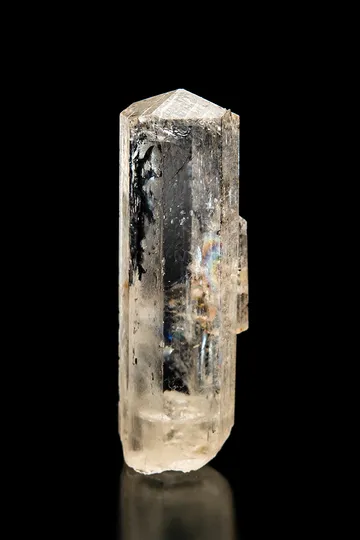
Natrolite: snowy-white to colorless silky needles forming radiating sprays in basalt cavities; prized for graceful habit, contrast with matrices, and rarity.
Key facts
Natrolite is a classic zeolite mineral beloved for its snowy-white to colorless, silky needles and radiating sprays. An orthorhombic tectosilicate (Na2Al2Si3O10·2H2O), it typically forms in cavities of basaltic lavas and in miarolitic pockets of alkaline plutonic rocks. Aesthetic specimens range from delicate, hairlike sprays to robust, porcelain-white sheaves, often perched on dark basalt or contrasting against lustrous aegirine, feldspars, or other zeolites. Luster is vitreous to silky; transparency ranges from translucent to near-gemmy at the tips. These crisp radial clusters and snowball-like aggregates light beautifully under case lighting and are staples of zeolite and alkaline-suite collections worldwide.
Hardness is 5–5.5, density is around 2.2 g/cm3, and cleavage can be perfect on one direction—so the species is notably brittle. Associations include analcime, chabazite, thomsonite, mesolite/scolecite (related zeolites), heulandite, apophyllite, prehnite, serandite, aegirine, and microcline. While many natrolites are affordable, superb sprays with strong contrast and top condition from classic localities are decidedly scarce and highly sought-after.
Natrolite is a cornerstone of zeolite collecting due to its graceful crystal habit and range of world-class localities spanning two very different geological environments: basaltic trap lavas (India, Faroe Islands, Nova Scotia, New Jersey) and peralkaline complexes (Mont Saint-Hilaire, Kola Peninsula). Collectors prize:
Historic quarries in New Jersey and Nova Scotia, dramatic sea-cliff finds in the Faroe Islands, and modern classics from Mont Saint-Hilaire and the Kola Peninsula collectively anchor the species’ reputation. While small sprays abound, pristine cabinet displays from top sources are scarce and strongly compete for attention in any case of zeolites or alkaline-suite minerals.
Mont Saint-Hilaire is a benchmark for aesthetic natrolite in the alkaline environment. Natrolite occurs as elegant sprays and sheaves on dark green aegirine, with albite, microcline, serandite, and a plethora of rare species nearby. The best pieces show stark white sprays floating over black-green aegirine “forests” with mirror-bright luster and perfect, undisturbed tips. Clusters can be incredibly sculptural and three-dimensional, a hallmark of the locality’s miarolitic pocket mineralization. Because pockets often yielded fragile coatings and sprays, pristine, unrepaired matrix specimens are limited and command a premium.
By focusing on crisp luster, balanced composition, strong contrast, and impeccable condition—while respecting the species’ fragility—you can assemble an elegant, representative suite of natrolites spanning both basaltic and alkaline environments.