






A collector's guide to Central Mine, USA: its geology, mining history and notable minerals, illustrated with the 46 specimens documented from this locality on EarthWonders.
Key facts
Central Mine stands on the greenstone bluff of northern Michigan’s Keweenaw Peninsula, above the East Branch of the Eagle River, in the old fissure-vein country that gave the Lake Superior native-copper district its first great run of profitable mines. For collectors, Central matters because it is not merely another Keweenaw copper locality: it is one of the classic early fissure mines, a place where native copper occurred as masses, shot copper, and handsome crystallized groups in vugs and vein openings rather than only as disseminations in the later, larger amygdaloid and conglomerate lodes farther south.
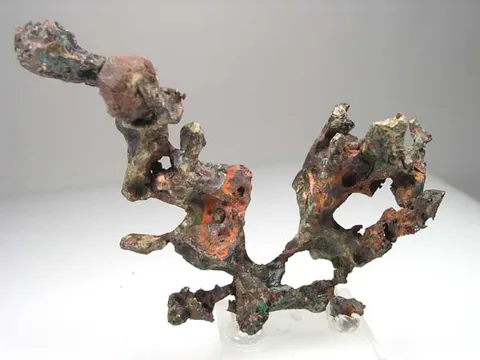
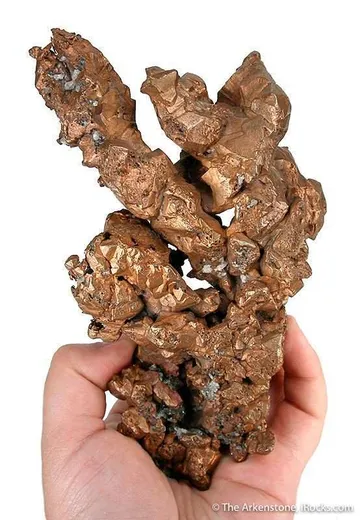
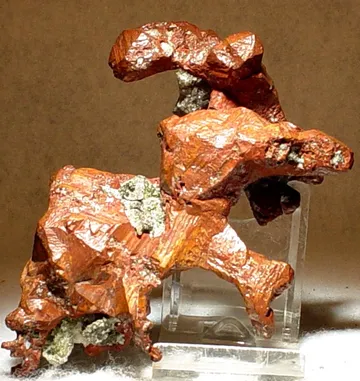
The best Central specimens have the unmistakable look of the northern Keweenaw fissure veins: bright to oxidized native copper in sculptural, branching, hackly, or sharply crystallized forms, often rising from brecciated basaltic matrix with calcite, quartz, epidote, prehnite, pumpellyite, datolite, and zeolites. Fine pieces show crisp copper crystals rather than merely flattened sheet copper or battered mine-run fragments. The old classics include dodecahedral groups, twinned tetrahexahedral crystals, hoppered cubic copper, and cabinet-size crystal groups that carry both nineteenth-century mining history and modern dump-collecting romance.
Historically, Central is one of the keystone names of the Michigan Copper Country. Organized in 1854 and worked into 1898, it produced nearly 52 million pounds of copper, paid substantial dividends, and supported a company town whose Cornish character is still visible in the restored Methodist church, miners’ houses, and annual reunion. Mineralogically, its reputation did not end when the pumps stopped: the poor-rock piles have continued to yield collectible copper and associated minerals to generations of collectors with shovels, patience, and metal detectors.
Regional View
Country View
Central belongs to the Mesoproterozoic volcanic terrane of the Lake Superior district, where basaltic flows, amygdaloidal flow tops, breccias, and fissures were mineralized by copper-bearing hydrothermal solutions. The fissure-vein mines of Keweenaw County were smaller than the great stratiform lodes of the Portage Lake district, but they could be spectacularly rich where open fractures, brecciated wall rock, and reactive amygdaloidal zones focused copper deposition. That is the geological reason Central’s mineral specimens can be so theatrical: the ore formed in cavities, seams, splices, and open spaces where copper could grow as crystals instead of simply filling rock pores.

Photo: Wikimedia Commons
Search for specimens: View all specimens from Central Mine, USA
Central Mine is at Central, Houghton Township, Keweenaw County, Michigan, just north of US 41 between Phoenix and Delaware. The mine workings lie on the greenstone bluff, with the old village site below and west of the workings. The locality is part of the northern Keweenaw fissure-vein belt, where mineralized fractures cut the volcanic section near the Greenstone Flow and associated basaltic rocks of the Lake Superior native-copper district.
The deposit was a native-copper fissure vein rather than one of the later great stratiform conglomerate or amygdaloid lodes. Early descriptions place the vein roughly at right angles to the local formation and note an initial fissure about twenty inches wide. The discovery was tied directly to ancient workings: an old Indigenous mining pit exposed copper-bearing ground, and when nineteenth-century miners reopened the pit they found mass copper and a well-defined vein. That relationship between ancient pits and rich copper ground was well understood by early Keweenaw prospectors, and it was one reason the Central property was taken seriously from the beginning.
The ore was won from a system of shafts and levels following the fissure and its mineralized branches. Central’s profitability depended heavily on masses of native copper, but it also produced stamp rock and collectible crystallized copper from vugs and openings. Nineteenth-century geological discussions of Keweenaw fissures describe “spliced” vein structures, detached lenses of wall rock, seams of chlorite, laumontite, calcite, clay, and places where large copper masses formed in irregular cavities. Central was specifically cited in connection with copper-rich fissure behavior: where a horse of ground split the vein, regular filling could follow one wall while a younger branch on the other side carried calcite and mass copper.
The paragenesis at Central fits the broader Keweenaw fissure-vein pattern. Altered basalt supplied cavities and reactive wall rock; early secondary silicates such as laumontite, prehnite, epidote, and related minerals were followed by quartz, calcite, copper, and later zeolitic or feldspathic phases in favorable openings. This explains the collector assemblage: native copper is the centerpiece, but good Central material may also carry calcite, quartz, epidote, datolite, analcime, prehnite, natrolite, adularia, pumpellyite, and minor oxidation products such as cuprite, tenorite, malachite, and azurite.
The Central Mining Company was organized on November 15, 1854. Work began quickly, and the first year was extraordinary: copper raised from the shaft more than covered the company’s expenses, making Central famous as the first Lake Superior copper mine to turn a profit in its first year of operation. Early production was hauled by wagon to Eagle Harbor for shipment. The company used neighboring facilities at first, including buildings and milling capacity associated with nearby Winthrop and Northwestern operations, before building more of its own plant and town infrastructure.
Through the 1860s and 1870s, Central grew into one of the leading communities of northern Keweenaw County. The mine had multiple shafts, its own mill, a growing work force, and a town of miners’ houses, school, churches, stores, workshops, lodges, and transport links. Much of the work force was Cornish, part of the “Cousin Jack” hard-rock mining tradition that shaped so many early Lake Superior copper towns. By the early 1880s Central was still a significant producer, but the economics of fissure mining were changing as the great copper masses became fewer and deeper work became more expensive.
Central’s most productive period ran from the mid-1850s through the early 1890s. Work was suspended on August 1, 1894, while a smaller underground force explored for new copper-rich ground. The hoped-for extension did not restore the mine’s old strength, and little copper was mined from 1895 through 1898. The mine closed in July 1898; the stamp mill continued briefly to treat rock already on hand. Calumet & Hecla later acquired the land, but the Central mine was never reopened as a producing operation.
The site today is both a mineral locality and a preserved historic landscape. Keweenaw County Historical Society maintains the Central Mine village site, visitor center, restored houses, and associated interpretive resources. Collecting access is not the same as in the free-for-all dump days: most old mine properties in the Keweenaw are private, restricted, or unsafe, and collectors should treat Central as a managed historic site. Current public guidance allows picking at Central only under specific conditions, particularly when gates are closed and no work is being done, and certain piles may be rotated or opened for surface collecting during organized Keweenaw Mineral Days. Underground entry is not appropriate; the remaining collector interest is in old poor-rock piles, float, and historically dispersed material.
The notable specimen finds at Central are not tied to a single named pocket in the way collectors might discuss a modern pegmatite or alpine cleft. Instead, the locality’s reputation rests on repeated recoveries from the mine workings and dumps: crystallized native copper from vugs, shot copper, copper groups with calcite and quartz, green pumpellyite-rich amygdaloids, datolite nodules and seams, zeolite-bearing basalt fractures, and occasional pieces of native silver. The Central No. 2 shaft area has also been documented in recent mineralogical reporting for a suite including albite, epidote, hematite, manganite, native copper, and pumpellyite subgroup minerals.
Native copper is the defining Central Mine mineral, occurring as masses, shot copper, vug crystals, branching groups, and crystallized aggregates in the fissure-vein system and associated poor rock. The best Central coppers show sharp crystal form rather than merely hackly metal: dodecahedral groups are documented, as are twinned tetrahexahedrons, hoppered cubic crystals, and sculptural copper groups ranging from small miniatures to major cabinet specimens. Associations include calcite, quartz, epidote, prehnite, datolite, pumpellyite-rich greenstone, and local dark oxide coatings such as tenorite. Ordinary pieces from the dumps may be flattened, bruised, heavily oxidized, or isolated from matrix; superior specimens keep bright metallic surfaces or attractive natural patina, show distinct crystal faces or arborescent architecture, and carry an old or otherwise credible Central provenance.
Calcite from Central Mine is a classic companion mineral to the copper rather than the locality’s main trophy species, but it is important because it records the carbonate stage of the fissure-vein filling and gives many Central specimens their visual contrast. Documented Central calcite includes crystals twinned parallel to the base, with epidote flecks in outer portions, and calcite also occurs with native copper in vugs and breccia matrix. On good specimens, pale to grayish or lightly iron-stained calcite provides open-space crystals beside copper rather than merely massive vein carbonate; the best pieces balance form, association, and stability, with intact calcite faces and copper not excessively acid-cleaned or detached from its original matrix.
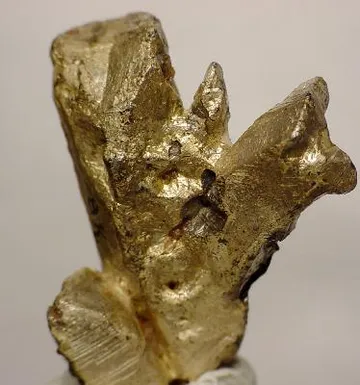
Other documented Central Mine minerals include native silver, datolite, analcime, prehnite, pumpellyite-(Mg), pumpellyite-(Mn2+), chlorastrolite, natrolite, laumontite, fluorapophyllite-(K), stilbite subgroup minerals, heulandite subgroup minerals, muscovite and sericite, albite, K-feldspar variety adularia, epidote, quartz, hematite, ilmenite, manganite, tenorite, cuprite, malachite, azurite, and a reported rhodochrosite occurrence. Among these, native silver and datolite are the most collector-significant accessories, while chlorastrolite and pumpellyite-rich greenstones connect Central to Michigan’s famous green gem material. Natrolite has been verified from Central as beige radiating tufts on basalt fracture surfaces, and the Central No. 2 shaft has a recently documented suite of albite, epidote, hematite, manganite, native copper, and pumpellyite subgroup minerals. Central is not chiefly known as an accepted type locality for an IMA mineral species; its importance lies in its classic native-copper specimens and historically documented Keweenaw fissure assemblage.
Central Mine specimens are common enough in the market that a collector can usually find some representation of the locality, but truly fine examples are not common. Small copper groups, copper in matrix, and dump-collected pieces appear with some regularity; sharp crystallized copper with strong form, pleasing matrix, and reliable old provenance is much scarcer. Pieces with older labels from recognized Michigan collections, museum duplicates, or long-established Copper Country dealers carry a premium because so many historic Keweenaw coppers have lost their exact mine attribution.
The main authenticity issue is not usually outright fabrication but overconfident locality assignment. Many native-copper specimens from the Keweenaw fissure mines resemble one another, and old labels may say only “Lake Superior,” “Keweenaw,” or “Michigan.” A Central label should be treated as strongest when supported by collection history, matrix style consistent with the fissure veins, associated minerals, and absence of contradictory old labeling. Loose copper with no matrix is especially vulnerable to optimistic relabeling as Central, Cliff, Phoenix, or Copper Falls.
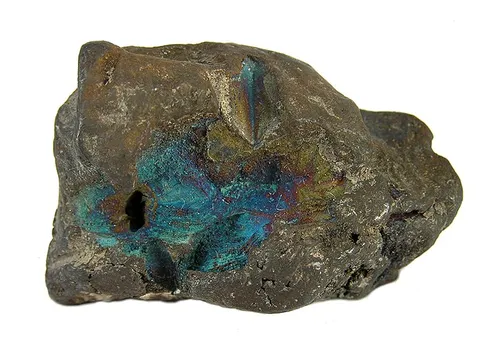
Condition is a serious part of value. Central copper can be naturally ragged, but collector-grade pieces should be judged for broken crystal tips, crushed edges from mining or dump recovery, unnatural brightening, and loss of associated calcite or quartz. Some copper specimens from the district have been acid-cleaned to remove calcite or oxides; cleaning is not automatically disqualifying, but harsh treatment can leave a raw, pinkish, overbright surface and may erase the natural patina that many collectors prefer. Conversely, heavy tenorite, cuprite, or malachite coatings may either add character or obscure crystal form, depending on the specimen.
Calcite on Central pieces should be inspected for bruising, cleavage cracks, and acid etching. Because copper and calcite often respond very differently to cleaning, specimens where calcite remains sharp and undulled beside copper are especially appealing. Zeolitic accessories such as natrolite, laumontite, stilbite, or analcime are more delicate than the copper itself; avoid soaking mixed-mineral specimens casually, and store friable basalt-matrix pieces where vibration will not loosen crystals.
For handling, remember that the copper may be tough but the specimen is often not: thin arborescent projections bend, matrix can shed, and calcite or zeolite associations chip easily. Display pieces are best supported from the matrix rather than by delicate copper branches. Fluorescence is not a major buying criterion for Central material, though individual calcite or zeolite-bearing specimens may show minor responses; form, provenance, association, and condition matter far more.
The story of Central begins with an older story underfoot. Nineteenth-century miners did not simply stumble onto a blank wilderness; they reopened ancient copper workings. On the land that became Central, an old pit marked the place where earlier Indigenous miners had already recognized native copper. When John Robinson’s party opened that ancient excavation in 1855, they found large pieces of mass copper and exposed the vein that would make the Central Mining Company famous. In the first year, the mine produced 83,836 pounds of copper, hauled by wagon to Eagle Harbor and shipped “below” down the Great Lakes for smelting. The young company ended that first year with copper sales exceeding expenses, a startling exception in a district where most mines burned through assessments for years before paying back.
Central’s company town grew quickly from that copper. The work force included many Cornish miners, and the town’s accent was strong enough that later accounts joked an American visitor might wish he had brought an interpreter. By 1870 the community counted about 950 people; by the early 1880s, more than 1,200 people lived in about 130 homes. The school served 352 students. There were Catholic and Methodist congregations, fraternal lodges, a post office, blacksmiths, builders, shoemakers, boarding houses, a doctor, a lawyer, a tailor, and a livery large enough for more than 100 horses. This was not a camp of tents around a prospect hole; it was a self-contained mining village perched in the Lake Superior snow belt.
Alfred Nicholls, who had mined at Central before an accident changed the course of his life, later became a teacher and principal at the Central school. His memory of the town is valuable because it preserves the domestic texture behind the copper statistics. He described the houses as neat and modest, with whitewashed walls, bare clean kitchen floors, homemade furniture, a black shining cook stove, and a front room whose cane-seated chairs wore little tidies fastened with pink ribbon. The one extravagance was a wood rocking chair with a cushion stuffed with chicken feathers, reserved for company or convalescence. It was understood, he wrote, that if a wife used that chair daily, it was “an unquestionable sign of neglected household duties.”
The frontier could be severe. Central houses had no insulation. In winter, sawdust might be poured over bedroom windows and boarded in to keep out the cold. Supplies came by boat from “down below,” and once Lake Superior iced over, no dependable shipments could be expected until spring. In November 1860, the company wharf at Eagle Harbor burned, destroying winter stores. Replacement supplies came by ship, but the ship was caught in a storm and had to throw much of the cargo overboard to avoid sinking. The alternative to the lake route was an overnight stagecoach ride over rough road to Calumet.
The darkest Central story is the No. 2 shaft disaster of April 22, 1872. Thirteen men were being lowered underground in a skip, the same rail car used to bring copper rock to the surface, when the wire rope snapped. The accident became one of the great tragedies of the Keweenaw mines. A Cornish poem, “Sad News From Central Mine,” carried the news across the ocean with terrible specificity: “Thirteen miners in the skip—‘all right;’ / Down the shaft were lowered apace.” Ten men were on top of the skip and three inside. When the rope broke, two men fell at the ten-fathom level; the guides from the skip fell to the fifty-fathom level and jammed across the shaft. The poem records that the shaft went down 120 fathoms, so the wreck could have fallen much deeper.
The dead named in the poem were not abstractions. Philip Roberts and Thomas Champion came from Bovey Tracey in Devonshire. Joel Eade came from Ludgvan. Thomas Berriman, John Berriman, and Thomas Bone were first cousins from Zennor. Jacob Grey and William Barritt came from Callington; John Ivey from Camborne; Edward Thomas from Marazion. Three survived in the skip: Edward Trezise of Gwinear, John Pearce of Crowan, and John Rowe of Camborne. The poem’s grief is sharpened by distance. Some families were left at Lake Superior, others back home in Cornwall. Central, to many of these men, was still “that foreign land.”
After the tragedy, the mine recovered and continued for another quarter-century, but the fissure was finite. The big copper masses that had made Central profitable became fewer as the workings deepened. In 1882, Central still managed a record production year of 2,512,886 pounds of copper, but costs were high enough that only $40,000 in dividends were paid. New power drills, a Rand compressor, and man engines could improve efficiency, but they could not create a new ore body. James P. Edwards, Michigan’s Commissioner of Mineral Statistics, later called Central “The Last of the Mohicans” because it remained the state’s last working fissure mine.
When Central closed in 1898, the mine stopped but the town did not vanish at once. Houses were abandoned, moved, stripped for lumber, or slowly reclaimed by forest. The school, stores, and daily services faded as families left for other Keweenaw mines or other mining districts. Yet former residents began returning in 1907 for a reunion at the Methodist church, and that annual gathering kept Central from becoming just another set of cellar holes in the woods. The old church still opens for reunion services, and on the last Sunday in July the ghost town briefly becomes a living community again.
For collectors, the last chapter is written on the dumps. Central’s underground workings are closed and unsafe, but the poor-rock piles have long been a proving ground for Copper Country collectors. A good day there is quiet, slow work: basalt fragments, greenstone amygdules, calcite seams, rusty coatings, and the occasional signal from a detector that turns into a piece of native copper. That is part of Central’s enduring appeal. It is a major historic mine, a preserved company town, and still, in modest ways, a living mineral locality.
.JPG)