






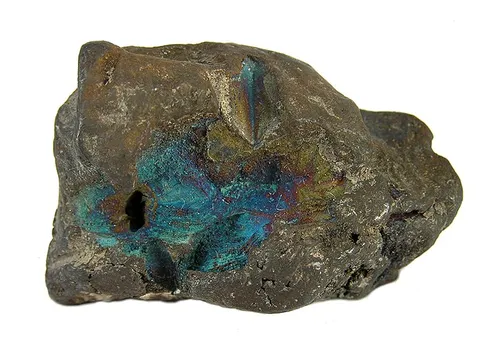
Calumet & Hecla Mine, USA - iconic Lake Superior copper locality yielding native copper in conglomerate and copper-silver; prized by collectors for form.
Key facts
Calumet & Hecla is one of the grand names in American mineral collecting: a mine complex whose best specimens carry the look of the Lake Superior native-copper province at its most industrial and unmistakable. In the strict Michigan sense, the locality is the Calumet & Hecla mine at Calumet, Houghton County, Michigan, where the famous Calumet Conglomerate lode yielded native copper on a scale that made the company a world copper power. The ore was not a conventional sulfide vein, but native copper deposited through a coarse volcanic conglomerate interbedded with the Portage Lake volcanic sequence of the Midcontinent Rift. For collectors, that geology matters immediately: good pieces are not just “copper from Michigan,” but copper in and on rounded conglomerate pebbles, copper replacing or coating cobbles, copper in quartz-epidote-calcite gangue, and the celebrated copper-silver “halfbreed” material that belongs to the Lake Superior copper district’s native-metal chemistry.
Regional View
Country View
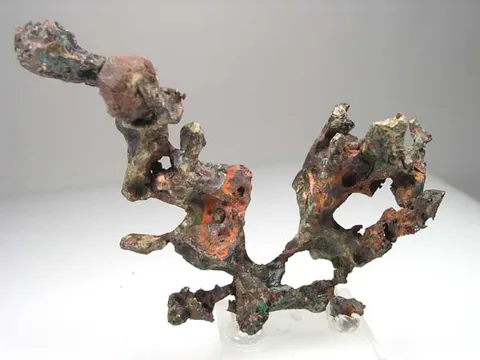
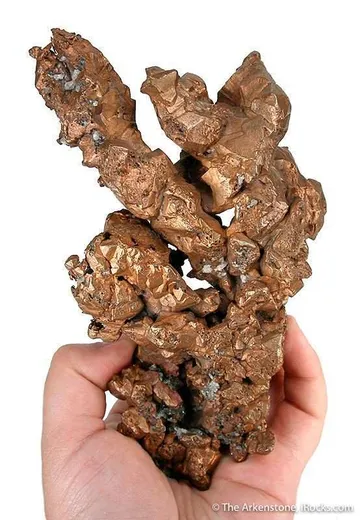
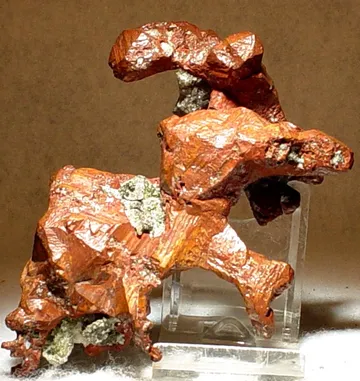
The strongest Calumet & Hecla copper specimens have a dense, architectural presence: hackly masses with reddish metallic highlights under old brown patina; sharp dodecahedral or modified dodecahedral crystals; slabs showing copper threaded between conglomerate clasts; and “boulder cases,” where native copper outlines a rounded pebble like a cast. Silver-bearing pieces can be visually subtler but are prized when bright white native silver stands cleanly against copper or dark matrix. The classic Michigan assemblage includes native copper, native silver, calcite, quartz, epidote, chlorite-group minerals, laumontite, prehnite, pumpellyite-subgroup minerals, microcline, chalcocite, chalcopyrite, cuprite, marcasite, and related secondary copper minerals recorded from particular shafts.

Photo: James St. John / Wikimedia Commons
There is one important label caution at this locality. In collector circulation, “Calumet,” “Hecla,” and “Calumet-Hecla” can also appear on specimens from the Calumet Iron Mine of Chaffee County, Colorado, whose alternate names include the Calumet-Hecla-Smithville magnetite deposit. That Colorado skarn locality is famous for epidote, quartz, magnetite, diopside, and actinolite pseudomorphs after diopside—the very minerals that do not define the Michigan copper mine. A serious Calumet & Hecla label should therefore be read with its state, county, and mineral suite in mind: Michigan for native copper and silver in the Keweenaw conglomerate; Colorado for epidote-quartz, magnetite, diopside, and “uralite” actinolite material.

Search for specimens: View all specimens from Calumet & Hecla Mine, USA
The Michigan Calumet & Hecla mine worked the Calumet Conglomerate lode beneath and along the old industrial corridor of Calumet, formerly Red Jacket, in Houghton County. The host was a copper-bearing conglomerate interbed in the Portage Lake volcanic series, a thick pile of basaltic lava flows and interbedded clastic horizons formed in the Midcontinent Rift. The productive bed was a coarse, permeable conglomerate: rounded volcanic pebbles and cobbles in a matrix that gave mineralizing fluids the physical pathways needed to deposit native copper. At Calumet the bed was commonly described as several feet to more than 25 feet thick, dipping northwestward under town at roughly the same attitude as the regional lode system. Copper occurred as cement between clasts, as coatings around pebbles and cobbles, as replacements of feldspar and volcanic fragments, as masses in matrix, and as crystal groups where open space permitted.
Historically, the lode was the great economic surprise of the Keweenaw. Edwin J. Hulbert identified the Calumet Conglomerate lode in 1864, and the Calumet and Hecla companies, originally neighboring operations on the same ore horizon, were brought together under the management of Alexander Agassiz. Calumet & Hecla formally became the dominant corporate name in 1871, and the operation rapidly turned from early open-pit and shallow work into a deep-shaft industrial mine. The old Calumet shafts lay north of Red Jacket Road, the Hecla shafts south of it, and later company operations extended through additional lodes and neighboring properties as C&H grew into the controlling force north of Portage Lake.
Production from the Calumet Conglomerate was immense. The mine was developed for roughly two miles along strike and to great depth down dip, with the conglomerate workings counted among the great ore shoots of the world. By the early twentieth century Calumet & Hecla and its neighboring Tamarack workings were famous for deep mining; some shafts in the district reached vertical depths of several thousand feet, while inclined workings followed the lode still farther. Conglomerate-lode operations finally ceased in 1939 after producing billions of pounds of copper. The company continued in other Keweenaw operations and through consolidation, but the native-copper era effectively ended after the 1968 labor dispute and the closing of the C&H division under Universal Oil Products.
Collectors should not think of Calumet & Hecla as a modern fee-digging locality. The historic mine landscape is a mixture of National Historical Park interpretation, local public spaces, preserved industrial buildings, capped shafts, private property, and hazardous abandoned workings. Most old Keweenaw mine sites are private or restricted, and the legal collecting opportunities in the region are specific, limited, and often event-based. Loose copper and mineralized mine rock from the Calumet area can still enter collections through old estate material, documented museum deaccessions, historic mine-run pieces, and responsibly sourced dealer stock, but the days of casually working C&H dumps as an open collecting ground are gone.
Specimen finds from the Michigan mine are best understood by ore texture rather than by pocket stories. The lode produced copper-rich conglomerate, copper-coated cobbles, copper-filled interstices, crystal groups, “shot copper,” and silver-bearing halfbreed material. Museum and literature references also record vein rock of epidote, quartz, and calcite carrying free copper, as well as pumpellyite-subgroup material dusting small epidote crystals from a Calumet & Hecla specimen studied in the British Museum. By contrast, showy epidote-quartz plates, magnetite masses, and actinolite-after-diopside “uralites” usually point to the Colorado Calumet Iron Mine label tradition, not to the Michigan native-copper mine.
Copper is the defining mineral of the Michigan Calumet & Hecla mine, occurring as native copper in the Calumet Conglomerate rather than as a typical sulfide ore. It appears as reddish to brown-patinated hackly masses, copper-filled seams between conglomerate pebbles, coatings around cobbles, replacements of clasts and feldspar, compact “shot copper,” and, more rarely, sharp crystals including dodecahedral forms modified by trapezohedral faces. Associated minerals include quartz, epidote, calcite, chlorite-group minerals, laumontite, prehnite, pumpellyite-subgroup species, and native silver. The best specimens are those that show form as well as mass: crisp crystallization, attractive old patina, visible conglomerate texture, or a clean copper-silver contrast. Ordinary pieces are merely heavy copper-bearing rock; fine Calumet & Hecla pieces tell the whole geologic story in one hand specimen.
Epidote is documented from the Michigan Calumet & Hecla suite as a green gangue mineral with quartz, calcite, and native copper, including vein rock described from mine levels and small epidote aggregates that served as matrix for pumpellyite-subgroup needles in studied museum material. Michigan C&H epidote is usually a supporting mineral—granular to small crystalline, olive to dark green, and valued most when it sets off copper, silver, quartz, or calcite. Large, lustrous, blocky epidote crystals with smoky quartz are a different collector idiom and are best checked carefully, because that look is strongly associated with the Calumet Iron Mine of Chaffee County, Colorado, whose alternate “Calumet-Hecla” naming has caused confusion on specimen labels.
Silver from the Michigan Calumet & Hecla mine is native silver in the Lake Superior “halfbreed” association, intimately intergrown with native copper rather than occurring as the dominant ore mineral. It may show as bright silvery patches, irregular blebs, seams, small wires or ragged masses against copper and dark conglomerate matrix. Fresh silver is white and highly reflective, but old pieces may be dulled by tarnish while the copper carries a red-brown to chocolate patina. The strongest specimens show unmistakable, natural contact between copper and silver, with enough exposed silver to be seen without magnification and enough matrix or copper texture to anchor the locality. Because silver-colored sulfides, polished high spots, and artificial composites can deceive at a glance, provenance and close inspection matter more here than sheer shine.
Quartz at Michigan Calumet & Hecla occurs as a gangue mineral in copper-bearing vein rock and matrix, associated with epidote, calcite, prehnite, pumpellyite-subgroup minerals, and native copper; collector pieces may show small clear to milky crystals, granular quartz matrix, or quartz enclosing or accompanying copper and iron-oxide inclusions. In C&H copper specimens, quartz is most valuable when it frames native copper or helps preserve an open-space texture rather than appearing as anonymous white gangue. Clear, lustrous quartz crystals with abundant deep green epidote, especially larger plates and cabinet pieces, again deserve label scrutiny, because that association is one of the trademarks of the Colorado Calumet Iron Mine rather than the Michigan copper conglomerate.
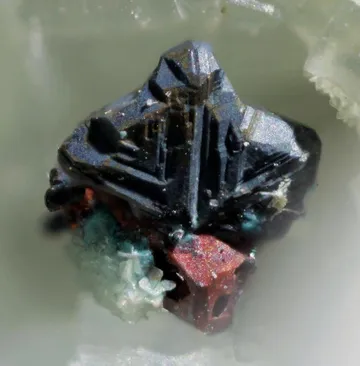
Magnetite is not a signature collector species of the Michigan Calumet & Hecla copper mine; when magnetite-rich specimens are offered under a “Calumet-Hecla” style label, the mineralogical fit is far stronger for the Calumet Iron Mine, the Calumet-Hecla-Smithville magnetite deposit in Chaffee County, Colorado. In that material, magnetite occurs as massive black bands, seams, and ore blocks in contact-metamorphic limestone and tactite, associated with epidote, actinolite, diopside, garnet, quartz, pyrite, chalcopyrite, and calcite. Good collector pieces show crisp contrast—black magnetite with green epidote or actinolite, visible banding, and undamaged crystal-lined surfaces—rather than plain heavy iron ore. A Michigan C&H label on such a specimen should be treated as suspect unless backed by an old, unambiguous provenance chain.
Diopside likewise belongs to the Colorado Calumet label tradition, not to the classic Michigan native-copper assemblage. At the Calumet Iron Mine near Salida, contact metamorphism of carbonate rocks by granodioritic intrusive rocks produced prismatic pyroxene crystals that may be preserved as diopside or altered to actinolite while retaining the diopside shape. Specimens range from small thumbnails to cabinet pieces, with green to dark green prismatic crystals associated with epidote, magnetite, calcite, quartz, garnet, and actinolite. The best examples show recognizable blocky pyroxene form, sharp terminations or pseudomorph outlines, and minimal bruising after calcite removal; dull, massive green skarn with no crystal definition is much less desirable. For any piece sold as “Calumet & Hecla, Michigan,” diopside should trigger an immediate locality check.
Actinolite from the Calumet-Hecla name complex is best known from the Colorado Calumet Iron Mine as “uralite,” a traditional but invalid varietal name for amphibole pseudomorphs after pyroxene, commonly after diopside or augite. These specimens form pale to dark green prismatic, fibrous, or splintery crystals and sprays, commonly on or with magnetite, epidote, calcite, quartz, and diopside relics. Many attractive pieces were originally coated in calcite and later etched in dilute hydrochloric acid to expose the actinolite-after-diopside forms, so good examples combine well-preserved pseudomorph shape with clean surfaces and no etched-out, chalky scars. Because fibrous amphibole habits can be hazardous if abraded or powdered, specimens should be handled intact and not aggressively trimmed dry. Actinolite is not a normal indicator mineral for Michigan Calumet & Hecla copper specimens.
Other minerals documented from the Michigan Calumet & Hecla mine include calcite, chlorite-group minerals, laumontite, microcline, prehnite, pumpellyite-subgroup minerals, chalcocite, chalcopyrite, cuprite, and marcasite, with specific shaft-level references for some sulfides. The pumpellyite connection is especially notable: a British Museum specimen from Calumet & Hecla, originally tied to the Lake Superior type-region material studied by Palache and later examined in pumpellyite-series work, consisted of small epidote crystals with a bluish-green dusting of tiny bladed pumpellyite needles. Type-locality minerals from the broader Calumet Township copper district—especially Centennial Mine species such as calumetite and anthonyite—are sometimes encountered in the same regional collecting conversation, but they should not be folded into Calumet & Hecla labels unless the original label actually says C&H.
The chief authenticity issue is not fake copper but locality confusion. A specimen labeled simply “Calumet,” “Hecla,” or “Calumet & Hecla” must be checked against its mineral suite. Native copper, native silver, copper-bearing conglomerate, halfbreed material, and copper with quartz-epidote-calcite gangue are plausible for Michigan Calumet & Hecla. Epidote-quartz showpieces, magnetite ore, diopside, and actinolite-after-diopside pseudomorphs almost always point to the Colorado Calumet Iron Mine or Calumet-Hecla-Smithville magnetite deposit. Both are legitimate classic American localities, but they are not interchangeable.
Michigan C&H copper is often cleaned, and cleaning quality makes a large difference. Natural patina can be brown, red-brown, dull blackish, or greenish where altered; a light mechanical cleaning or careful removal of loose dirt is normal, but over-brightened copper loses much of the historical character collectors want. Acid-bright copper that looks unnaturally pink, polished high spots on otherwise rough pieces, and lacquered surfaces should be disclosed. “Halfbreed” specimens deserve special caution: true copper-silver intergrowth is highly collectible, and assembled or enhanced pieces exist in the wider market. Examine the contact between metals under magnification; natural intergrowth should not look like a silvery soldered patch or foil pressed into a crack.
Condition problems are predictable. Native copper bends and bruises rather than cleaving, so crystal edges may be flattened, rubbed, or clipped. Conglomerate matrix can shed grains, and copper-coated cobbles may have unstable matrix around the metal skin. Silver tarnishes and can be obscured by copper oxides, but aggressive polishing can destroy evidence of natural surface. Quartz, calcite, prehnite, laumontite, and pumpellyite-bearing matrix minerals are more brittle than the copper and may chip during trimming. On Colorado “Calumet-Hecla” skarn specimens, hydrochloric-acid etching of calcite is common and can expose good actinolite or diopside forms, but poor etching leaves chalky residue, undercut crystals, or weak surfaces.
Fluorescence is not a collecting driver for Michigan Calumet & Hecla copper, though associated calcite in the broader Lake Superior copper suite may respond variably. Handling is simple but worth doing carefully: copper is dense, protruding crystal groups catch on wrapping, and silver-bearing areas should not be rubbed with metal tools. For actinolite-rich Colorado material, avoid sawing, grinding, or dry brushing fibrous surfaces; keep the specimen intact and use gentle dust control.
Market availability is steady for ordinary Michigan C&H copper ore and small native copper pieces, but fine crystallized copper, convincing halfbreed specimens, and old-labeled pieces from major collections are much less common. The mine’s fame means labels add value only when they are specific and credible—“Calumet & Hecla Mine, Calumet, Houghton County, Michigan” for copper and silver; “Calumet Mine, Turret district, Chaffee County, Colorado” or “Calumet-Hecla-Smithville magnetite deposit” for epidote, magnetite, diopside, and actinolite. When the mineral suite and the label disagree, trust the geology before the tag.
The founding story of Calumet & Hecla has the quality of a mineral collector’s myth, except that its bones are historical. Edwin J. Hulbert, a surveyor, was working in the Keweenaw in 1864 when he identified the Calumet Conglomerate lode and began securing land. One local retelling places the discovery beside an old Indigenous copper storage pit filled with copper-rich boulders—an ancient cache sitting, by extraordinary luck, above the very conglomerate bed that would become one of the richest native-copper lodes on the continent. Whether told as geology, chance, or both, the point is the same: the ore was not a narrow silver vein or a glittering oxidized outcrop, but a copper-soaked bed of ordinary-looking conglomerate that required the right eye to recognize.
Alexander Agassiz transformed that recognition into a mining empire. Under his management, the separate Calumet and Hecla operations were fused into a single industrial system, with shafts, hoists, rockhouses, tramways, mills, shops, libraries, bathhouses, and company housing turning Red Jacket into a planned mining town. The company’s physical order mirrored the geology: Mine Street traced the lode, and the industrial corridor sat above the copper-bearing bed. As the shallow workings gave way to deep mining, Calumet became a town literally undercut by its ore body—copper below, company life above, and the mine’s machinery and social institutions knitted into the same landscape.
Deep mining produced its own legends. By the 1890s and early 1900s, the Calumet and Tamarack workings were among the deep-mining showpieces of the world. The Red Jacket shaft, driven as a vertical engineering answer to the inclined lode, reached roughly 4,900 feet in vertical depth, with sub-shafts extending the working system still farther down dip. A National Park Service account notes that in 1896 it was considered the deepest mine shaft in the world, with later inclined sub-shafts bringing the final reach to about 9,600 feet—nearly two miles. That depth is not an abstract number when holding a C&H specimen: every old copper mass was part of a mining culture that chased a single conglomerate horizon downward under a company town.
The darker story attached to Calumet is the 1913-1914 Copper Country strike and the Italian Hall disaster. By late 1913, the strike had dragged into winter. On Christmas Eve, the Women’s Auxiliary of the Western Federation of Miners held a party for children of striking workers at Italian Hall in Calumet. Someone falsely cried “fire,” and panic surged toward the stairway. More than 70 people died, many of them children. The disaster became one of the defining tragedies of American labor history, and in Calumet it is not separate from the mine’s mineral story; it is part of the human cost behind the copper that filled cabinets, museums, and industrial ledgers.
The Colorado Calumet story, often tangled into C&H specimen labels, has its own vivid details. The Calumet Iron Mine near Salida was an iron skarn operation rather than a copper conglomerate mine. It opened in 1881 and worked into the late nineteenth century, shipping magnetite ore toward Pueblo for iron and steel. The Denver & Rio Grande built a narrow-gauge Calumet Branch from Hecla Junction up a severe grade to the mine; collector accounts describe the line as roughly seven to eight miles long, steep enough that empty cars were pushed uphill and loaded cars descended with brakemen stationed on the cars. After the mine closed, a 1901 flood erased the railroad, but concrete remnants of loading docks and the grade survived long after the ore trains stopped.
Modern collectors know the Colorado locality for green minerals rather than iron tonnage. Field accounts describe open cuts on a steep hillside, limestone blocks covered with epidote and diopside-actinolite, and specimens hidden under calcite coatings that only reveal their “uralite” forms after careful acid preparation. That is why the label problem is so persistent: both localities carry Calumet and Hecla words, both are historically real, and both produced desirable specimens—but the minerals themselves tell which story they belong to.
_1_(16693425853).jpg)
