Buffalo, USA — Linwood Mine and LaFarge/Buffalo quarry yield calcite, barite, marcasite, pyrite, sphalerite; prized glassy calcite pockets draw collectors.
Key facts
Buffalo, on the Iowa side of the Mississippi River in Scott County, is a collector locality whose name is tied above all to the Linwood Mine and, more quietly, to the adjacent LaFarge/Buffalo quarry. The setting is not a metal mine in the romantic western sense, but a vast industrial limestone operation cut into Middle Devonian carbonate rocks where ancient karst openings, fractures, bedding-plane partings and stylolites became the stage for a distinctive Midwestern suite: calcite, marcasite, barite, pyrite, sphalerite, dolomite, gypsum, quartz and rare chalcopyrite. The best Buffalo specimens have the paradoxical look collectors love from carbonate quarries: hard commercial limestone giving way to open pockets lined with glassy calcite, metallic marcasite and unusually fine barite.
At Linwood, paleokarst is the governing word. Cavities developed in Devonian limestone before later sediment filling and mineralization; some larger Davenport-Spring Grove cavities are reported as long sediment-filled voids, while smaller Cedar Rapids Limestone cavities more commonly remained open enough to grow collectible crystals. The mineralization is epigenetic and open-space in character, with calcite dominant, marcasite and pyrite common, barite widespread and locally important, and sphalerite and chalcopyrite much less common. It is a locality that connects the look of Upper Mississippi Valley-style carbonate mineralization with the modern collecting world of quarry and underground-mine recovery.
Regional View
Country View
Historically, Buffalo’s importance to collectors grew in stages. Linwood was long known for handsome calcite, especially lustrous scalenohedra and rhombs, many carrying golden marcasite inclusions or surface sprays. Then large barite finds—especially the 2008 material and later pockets—moved the locality into a higher tier for American barite collectors. Fine Linwood barites can be thick, wedge-terminated, doubly terminated, smoky to pale golden-brown, lustrous and translucent to transparent, with crystal sizes documented well into cabinet-scale territory. Modern fluorescent collectors also know Buffalo for barite that can glow blue-white and phosphoresce greenish or blue after UV exposure, including material from the September 2020 “Glow Stick Pocket.”
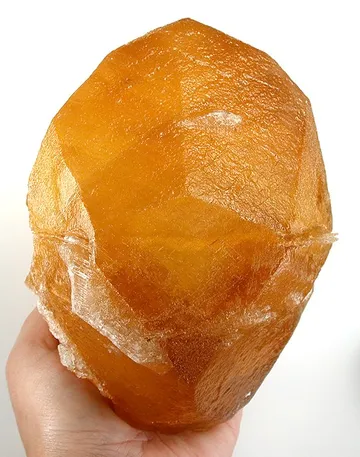
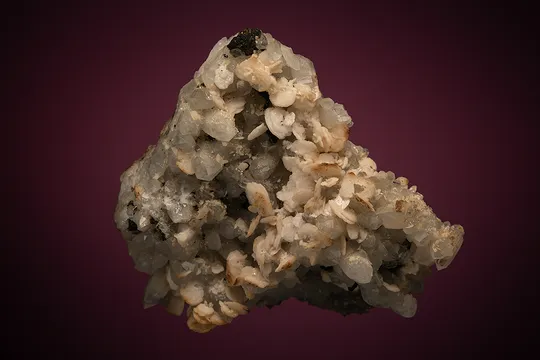
The best Buffalo specimens are immediately recognizable. Calcite often appears as pale golden, colorless or lightly honey-toned dogtooth scalenohedra and rhombs, sometimes with marcasite phantoms running through the crystals. Marcasite can form bright brassy blades, sprays, botryoidal masses, stalactitic-looking “snakes,” and glittering coatings that turn a simple carbonate plate into a miniature landscape. Barite ranges from blocky to bladed to rosette-like or dendritic habits; on superior pieces the crystals stand cleanly on limestone or siltstone matrix, with undamaged terminations and a glassy, smoky glow that feels far more gemmy than most collectors expect from Iowa limestone.
Search for specimens: View all specimens from Buffalo, USA
The Buffalo mineral locality is best understood as a small cluster of limestone operations near the Mississippi River, with Linwood Mine by far the dominant specimen producer and the LaFarge/Buffalo quarry contributing scarcer calcite, marcasite, pyrite, sphalerite, dolomite, gypsum and barite material. Linwood lies in Buffalo Township, Scott County, Iowa, close to the river and the Quad Cities industrial corridor. It is an active underground limestone mine operated by Linwood Mining & Minerals Corporation, part of the McCarthy-Bush corporate group, and is described by the company as one of the largest underground limestone mines in the United States.
The commercial product is high-calcium limestone, dolomitic lime, calcium carbonate, lime products and aggregate, but the collector interest lies in the mine’s intersection with pre-Pennsylvanian paleokarst in Middle Devonian limestone. Garvin’s 1995 study describes two working levels exposing extensive karst features in Davenport-Spring Grove and Cedar Rapids host rocks. Dissolution followed high-angle fractures, bedding-plane partings and stylolitic seams, producing cavities, breccias and sediment-filled voids. In the Cedar Rapids Limestone, many cavities remained open or partly open enough to receive mineral linings; in the Davenport-Spring Grove rocks, some cavities reached remarkable lengths but were commonly filled with fluvial sediment.
The ore-body language of metallic mining is not quite right here, yet the mineralization behaves like a classic carbonate open-space system. Minerals occur as cavity linings, fracture coatings and fillings, breccia cements, disseminations in cavity-wall rock and even crystals enclosed in mudstone. Iron sulfides began early and continued intermittently; calcite formed in multiple intermediate-to-late generations; barite is interpreted as late. The assemblage indicates changing oxidizing and reducing conditions during karst filling and mineral deposition, with much of the mineralization forming under reducing phreatic conditions. The comparison to the Upper Mississippi Valley zinc-lead district is apt in broad paragenesis, even though Buffalo is not a lead-zinc mining camp.
Mining history is unusually well documented for an industrial aggregate locality. Limestone quarrying at or near Linwood began by the late nineteenth century; the modern Linwood company traces its roots to 1944, while published locality accounts describe the site as beginning as an open-cut quarry and later extending underground as higher-purity limestone was pursued. Underground mining is reported to have begun around the mid-1950s to 1960s, using room-and-pillar methods on two principal levels. Current company information describes two operational ledges, year-round mining, roughly 32 acres mined annually, underground shop and office facilities, and transport by truck, rail and barge from the Mississippi River setting.
Specimen recovery is incidental to mining. Pockets are opened during blasting and production, and worthwhile crystals are saved only when they are recognized and can be safely extracted without interfering with operations. This explains the episodic nature of Buffalo material on the market: periods of relative scarcity are punctuated by pocket releases, dealer lots and collector-distributed finds. The 2008 barite influx and a later 2012 online appearance of about two dozen high-quality barite specimens brought national attention to Linwood barite. More recent collector lore centers on named or recognizable pockets such as the “Glow Stick Pocket,” a September 2020 barite find distributed by Everett Harrington, notable for strong fluorescence and phosphorescence.
Collecting access today should be treated as closed industrial access unless permission is explicitly arranged through the operator. Linwood is an active underground limestone mine, not a public fee-collecting site. Entry involves mine-safety rules, training, insurance and operational constraints; casual collecting is not appropriate. Most serious collectors acquire Buffalo specimens through dealers, collection dispersals, club networks, or directly from individuals with mine-approved relationships. LaFarge/Buffalo quarry material is significantly less common in the specimen market than Linwood material, and older labels can be vague, sometimes giving only “Buffalo, Iowa” or “Scott County, Iowa” rather than a precise sub-locality.
Calcite is the dominant and most visually familiar Buffalo mineral, especially from Linwood, where multiple generations produced both acute scalenohedral “dogtooth” forms and more obtuse rhombohedral forms in open karst cavities of the Devonian limestone. Good examples range from thumbnails to substantial cabinet plates, with individual crystals documented to several centimeters and exceptional clusters reaching display size; colors run from colorless and glassy to pale golden or honey-toned, and the finest pieces show high luster, transparency, sharp faces and marcasite inclusions arranged as glittering internal dustings, blades or phantom zones. Calcite from Buffalo is strongest when it is not merely a broken limestone vug fragment but a balanced cluster, often with marcasite or barite accenting the composition; rare twinned or “butterfly” forms and clean, complete scalenohedra on minimal matrix are especially desirable.
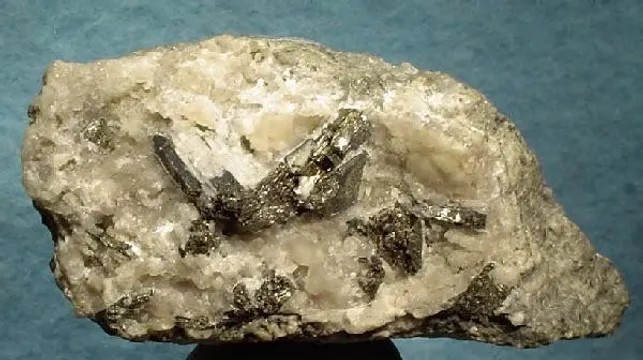
Marcasite gives Buffalo specimens their characteristic metallic sparkle, occurring at Linwood as brassy blades, sprays, coatings, botryoidal to globular masses, and distinctive stalactitic-looking aggregates often described by collectors as “snakes.” It is commonly associated with calcite—both included inside crystals and exposed on crystal surfaces—and also appears with barite and pyrite; good miniature and cabinet pieces show bright luster, fresh golden to bronze color, sharp bladed texture and a composition that is stable and dry rather than powdery or decomposing. The best Buffalo marcasite specimens stand apart from ordinary sulfide-coated limestone by their sculptural form: isolated sprays on barite, glittering inclusions suspended in calcite, mounded 360-degree masses from the scarcer LaFarge/Buffalo quarry, or elegant curved aggregates that are visually unmistakable as Linwood material.
Barite is Buffalo’s world-class calling card, particularly from Linwood, where fine crystals occur in a range of habits including thick wedge-terminated prisms, flattened prismatic crystals, bladed aggregates, rosettes, blocky groups and dendritic-looking clusters. The best crystals are smoky gray-brown, pale yellow-brown, cognac, light golden or nearly colorless, commonly translucent and sometimes transparent, with documented crystals around 8 cm and larger, and published market reports noting elongated crystals to about 12 cm; many are doubly terminated or clustered in sharp groups on limestone or siltstone matrix. Superior Linwood barites combine size, luster, transparency, undamaged terminations, strong separation of individual crystals and, in certain pocket material, striking UV response: blue-white fluorescence and greenish to blue phosphorescent afterglow, especially on frosted or etched crystal surfaces.
Beyond calcite, marcasite and barite, Buffalo has a compact but meaningful supporting suite. Linwood records include pyrite, dolomite, gypsum, melanterite, sphalerite, quartz and rare chalcopyrite; the chalcopyrite is documented as microcrystals, in some cases included in calcite, while sphalerite is uncommon and quartz rare. The LaFarge/Buffalo quarry adds collector interest through fluorescent calcite, marcasite crystals, iridescent pyrite, sphalerite, gypsum including selenite, dolomite, goethite and limonite-like oxidation products. No type-locality mineral defines Buffalo in the way iowaite defines its Sioux County locality, but Linwood barite is significant enough in American collecting literature to have received a dedicated Rocks & Minerals article and repeated attention in modern market reports.
Buffalo specimens are generally not a locality plagued by elaborate fakes, but they do demand careful reading of preparation, stability and labeling. The most common authenticity issue is not fabrication but vague locality attribution. Older or reseller labels may say only “Buffalo, Iowa,” “Scott County, Iowa,” or “Linwood Quarry,” and such labels can blur the distinction between Linwood Mine and the adjacent LaFarge/Buffalo quarry. Because Linwood material is far more abundant and market-familiar than LaFarge material, a label claiming LaFarge should carry stronger provenance, especially for marcasite or calcite pieces.
Preparation is normal and should not be mistaken automatically for deception. Linwood barite plates and calcite-marcasite groups may be saw-trimmed from larger pocket sections and then worked with abrasion or hand tools to remove saw marks, excess matrix or distracting breakage. On a well-prepared piece the trimming should improve display without creating artificial “natural” edges that mislead the buyer. Ask whether a flat back, sawn base or cleaned matrix edge is original to recovery or later preparation; this matters more for high-end barite and major calcite plates than for modest thumbnails.
Condition is central. Calcite from Buffalo is prone to cleavage bruises, chipped tips and edge dings, especially on tall scalenohedra. Marcasite inclusions can make calcite visually richer, but they also reveal growth zones and small internal fractures, so inspect transparency and terminations rather than assuming every internal line is damage. Barite is denser and tougher in hand but still chips at exposed terminations and along thin blades; look closely at the ends of doubly terminated crystals, as those are the first places to suffer in extraction and trimming.
Marcasite deserves a dry, stable storage environment. Fresh Linwood marcasite can be attractive and stable, but marcasite as a species is more reactive than pyrite under humid conditions, and sulfide decay can stain associated calcite or barite. Avoid damp display cases, garages, basements and sealed boxes with trapped moisture. Specimens with white or greenish sulfate efflorescence, acidic odor, crumbling metallic grains or spreading stains should be isolated and evaluated before being placed beside other minerals.
Fluorescence adds a premium for certain barites, but response varies strongly by pocket and even by crystal surface. Some Linwood barite fluoresces bright blue-white and shows short-lived greenish or bluish phosphorescence; other smoky gem barites may be stronger under shortwave or midwave than longwave, and some ordinary-looking pieces are only weakly responsive. Fluorescent value is highest when the specimen is also a strong natural-light mineral: sharp, aesthetic, undamaged, well-crystallized and correctly labeled.
Market availability is better than for many American underground-mine specimen localities because Linwood has produced periodically over many years and material continues to circulate through Midwestern dealers and collector networks. Still, the top end is not common. Ordinary calcite with marcasite inclusions remains obtainable, as do modest barite clusters and marcasite pieces. Large transparent barite crystals, sculptural “snake” marcasite, excellent calcite with strong marcasite phantoms, and old LaFarge/Buffalo quarry specimens are much less frequently encountered and deserve careful provenance.
The story collectors still repeat about modern Buffalo barite is the September 2020 “Glow Stick Pocket.” The name is unusually apt: the material was not merely fluorescent in the way many carbonates and sulfates are fluorescent, but memorably so. A documented specimen from the pocket measured 11.2 x 2.3 x 14.2 cm and weighed 151 g, with flat, pale yellow-tan prismatic barite crystals on light gray siltstone matrix. Under longwave UV at 365 nm it showed bright blue-white fluorescence, followed by a short-lived green afterglow; under shortwave UV at 254 nm the fluorescence was similar but less bright, followed by pale blue-green phosphorescence. The pocket was distributed by mineral dealer Everett Harrington, whose name has become closely associated with modern Linwood collecting and preparation.
Another Linwood story is less about discovery than the unglamorous craft that turns a mine-run pocket section into a specimen. In 2017 Harrington described the “anatomy of a trim job” on Linwood barite: first a complete plate, then the marked and cut section, then the finished specimen returned to show where it had come from. The tools were practical rather than romantic—a gas-powered diamond cutoff saw, micro-abrasion tools and pen-type engraving tools—and one attractive piece required about six hours of preparation. The telling detail is that the straight saw lines had to be removed and the specimen made to look natural again. That is a useful lesson for collectors: many good Buffalo specimens are not simply picked up and boxed; they are rescued from quarry-scale rock, then carefully reduced to reveal the crystal group that was hidden in it.
Buffalo’s barite reputation also took a public leap in the late 2000s and early 2010s. In summer 2008, abundant barite specimens from Linwood reached the market; by 2012 another notable release appeared online, with roughly 25 excellent specimens from miniature to large-cabinet size. Those pieces included thick, elongated, wedge-terminated barite crystals in gray-brown, very pale yellow-brown and cognac colors. Some were loose single crystals, but the better display pieces carried two to eight sharp crystals in clusters. For a locality already known in collector circles for calcite, this helped shift Linwood from “good Iowa calcite mine” to one of the most important modern American barite sources.
The LaFarge/Buffalo quarry has its own quieter kind of collector drama: scarcity and label uncertainty. One auctioned LaFarge marcasite was described as a complete, mounded, globular, brassy-bronzy mass from a quarry whose specimens are rare compared with the adjacent and much better-known Linwood Mine. Another auctioned calcite carried an old Miller Collection label that did not neatly match the modern locality data, and the cataloger had to reason through whether it was likely from one of the two well-known Buffalo-area limestone operations. This is the less glamorous but very real field-note side of Buffalo collecting: in a district with active industrial quarries, neighboring operations and decades of casual labels, a specimen’s beauty is only half the story; the other half is the confidence of its locality.