Brumado, Brazil — renowned magnesite district in Serra das Éguas, yielding glassy magnesite rhombs and tourmalines; a key collector locality with rare minerals.
Key facts
Brumado is one of those rare mineral districts where an industrial ore body and a collector locality are inseparable. The specimens come from the magnesite deposits of the Serra das Éguas, a dry, rugged range west to southwest of Brumado in Bahia, within the São Francisco Craton. The ore is not a little showy vein system but a major metamorphic magnesite district: stratabound to lenticular bodies of magnesitic marble and associated dolomitic marble, calc-silicate rocks, amphibolite, quartzite, talc-rich rocks, and hydrothermal fracture assemblages. In collectors’ shorthand, “Brumado” usually means the Pomba and Pedra Preta areas, with Pirajá, Catiboaba, Cabeceiras, Cordeiro, Jatobá, Coité, and other Serra das Éguas names appearing on older or more precise labels.
Its fame rests first on magnesite and the Ca-Mg tourmalines sold for decades as uvite. The finest pieces have a look that is unmistakable: glassy white to colorless magnesite rhombs, sometimes amber or faintly lavender, carrying lustrous green, olive, yellow-green, wine-red, reddish-brown, or nearly black tourmaline crystals; quartz sprays and Japan-law twins add architecture, while hematite, dolomite, florencite, svanbergite, topaz, emerald, sellaite, and rare uranium, phosphate, arsenate, tellurate, and titanium minerals provide the collector’s depth. Brumado is also a serious reference locality, not merely a pretty specimen source: its sellaite crystals are among the most important ever found, brumadoite was described from Pedra Preta, and the complicated story of Brumado “uvite” helped reshape how collectors and mineralogists think about the uvite–fluor-uvite–dravite problem.
Regional View
Country View
The best Brumado specimens reward close looking. At arm’s length, a fine piece may read as simple contrast—green tourmaline on white carbonate, or red-brown tourmaline over a sparkling magnesite bed. Under magnification the locality becomes much more individual: shortened triangular tourmaline terminations, sharply stepped magnesite rhombs, drusy quartz skins, tiny pale phosphates on carbonate, and iron-oxide staining that can be either an aesthetic accent or a condition problem depending on placement. The district’s greatest specimens are balanced combinations rather than one-species showpieces: the magnesite is not just matrix, and the tourmaline is not just decoration.

Photo: Wikimedia Commons

Photo: Wikimedia Commons
Search for specimens: View all specimens from Brumado, Brazil
The collectible Brumado material is centered on the Serra das Éguas district, a hilly belt of magnesite and talc workings near Brumado, Bahia. The most familiar specimen labels are Pomba pit and Pedra Preta pit, but older labels may simply say Brumado, Serra das Éguas, Bom Jesus dos Meiras, or one of the individual deposits named in mid-20th-century geological work: Pedra Preta, Bate-Pé, Boa Vista, Gravatá, Pirajá, Noroeste, Fábrica, Jatobá, Catiboaba, Cabeceiras, Coité, and Cordeiro. For collectors, this label geography matters. “Brumado” can be a precise enough locality for older specimens, but a Pomba or Pedra Preta attribution carries additional information about assemblage, color, and likely style.
Geologically, the deposits are metamorphic magnesite bodies in a carbonate-rich volcano-sedimentary sequence. The enclosing rocks include dolomitic marble, magnesitic marble, calc-silicate rocks, quartzite, amphibolite, talc-rich rocks, and associated schists and gneisses of the São Francisco Craton. Classic work interpreted much of the magnesite as replacement of dolomite, with additional coarse magnesite deposited in fractures and open spaces. More recent fluid-inclusion and petrologic work emphasizes metamorphic, highly saline H2O-CO2 fluids and distinguishes reddish Pedra Preta–Pedra de Ferro magnesite, colored by finely dispersed hematite, from the cleaner white magnesite of Pomba and Pirajá.
The ore bodies are lens-shaped and structurally complicated. The broader Serra das Éguas system was described as a tightly folded sequence, with magnesite lenses, dolomitic host rocks, quartzites forming prominent outcrops, and later fractures that became channels for quartz, tourmaline, topaz, carbonates, phosphates, arsenates, sulfates, uranium minerals, copper minerals, tellurates, and iron oxides. The collector pockets are not the ore body in the abstract; they are the open spaces, fracture fillings, soft magnesite “sand,” and weathered zones where crystals survived liberation from the industrial rock mass.
Mining history at Brumado has several layers. Iron ore activity in the Serra das Éguas area predates the magnesite industry, and emeralds in the Pirajá valley were known before magnesite became the dominant commodity. The modern magnesite story was built by Pierre Cahen and Georges Minvielle, naturalized Brazilians of French origin, whose search for the mineral led to the organization of Magnesita S.A. The Brumado operation became one of Brazil’s great refractory raw-material sources, with industrial operations centered on Pedra Preta, Pomba, and the Catiboaba processing area. Company records describe the Brumado unit beginning operations in 1943 with the opening of the Pedra Preta mine; Pomba followed later, and modern operations continue under RHI Magnesita.
The district remains an active industrial mining area, not a casual collecting site. Modern Pedra Preta and Pomba are open-pit bench operations, and access is controlled by the operator. Historic field-collecting accounts, old dealer lots, mine-employee recoveries, and occasional controlled visits account for much of the collector material that reached the market. Today, collectors should treat Brumado specimens as market acquisitions rather than a practical field-collecting target unless they have explicit permission through the mine operator or an organized professional visit.
The most important specimen finds appear to have come from a handful of productive zones rather than evenly across the district. Pomba is the great label for the classic uvite–magnesite–quartz combinations, florencite, svanbergite, topaz, beryl, and several of the rare phosphate-arsenate-uranium species. Pedra Preta is critical for magnesite, hematite, sellaite, copper minerals, brumadoite, barite, malachite, rutile, tremolite, talc, and some tourmaline material. Pirajá is important historically for emerald-bearing beryl and for silicates such as kyanite and enstatite. The Brumado collector suite is therefore best understood as a district assemblage: the label “Brumado” is common, but the sublocality can transform the mineralogical significance of a specimen.
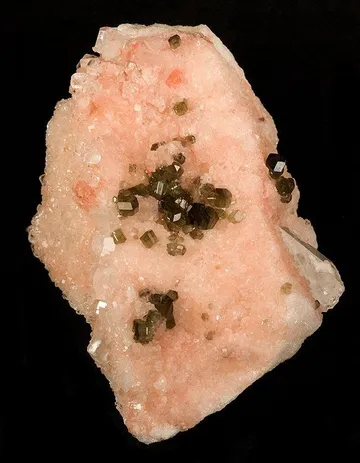
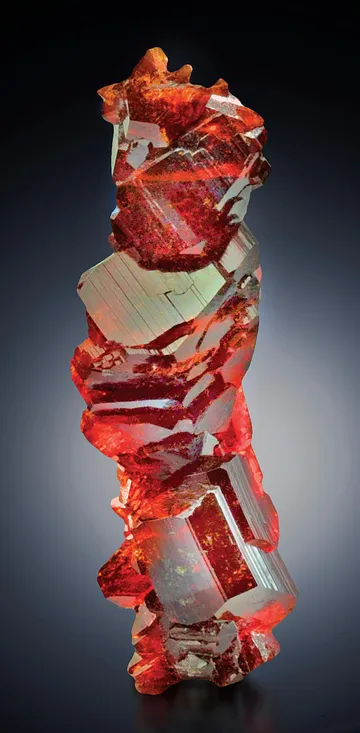
The Brumado “uvites” are the district’s signature collector mineral, though serious labels should acknowledge that many specimens require analysis to separate uvite, fluor-uvite, and dravite reliably. The classic specimens are from the Pomba and Pedra Preta areas, where lustrous short-prismatic to equant crystals sit on white, colorless, amber, or faintly lavender magnesite and, less commonly, on quartz. Colors range from olive and moss green through yellow-green to reddish-brown, wine-red, and nearly black; crystals may be sharp thumbnails, sparkling microcrystal carpets, or individual crystals several centimeters across, with the literature reporting Brumado tourmalines to about 8 cm. The best pieces combine saturated color, glassy luster, distinct undamaged terminations, and a bright carbonate or quartz matrix; ordinary pieces tend to be dark, crowded, contacted, or buried in massive magnesite without the sculptural contrast that makes Brumado famous.
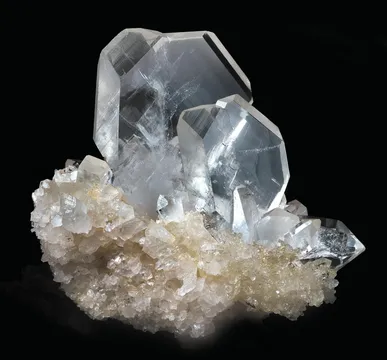
Magnesite is both the ore and one of the great specimen minerals of Brumado. At Pomba and Pedra Preta it occurs as white, colorless, translucent, amber, and locally reddish rhombohedra and pinacoidal forms, with exceptional crystals reported to 30 cm on edge and many fine cabinet specimens showing glassy rhombs partly embedded in drusy carbonate. The collector classics are magnesite with green or red-brown tourmaline, but the mineral also hosts hematite, dolomite, quartz, florencite, svanbergite, topaz, sellaite, malachite, and brumadoite. Choice pieces have isolated, undamaged, translucent rhombs, good luster, and crisp contrast with accessory minerals; lesser examples are merely massive white carbonate, cleaved rhombs, or ore fragments without a display face.
Quartz is widespread in the Serra das Éguas deposits and is much more than background gangue. Brumado produced colorless to milky crystals, reddish hematite-included quartz, drusy coatings, and well-developed Japan-law twins, with crystals reported to about 30 cm; untwinned crystals may show a slender Tessin-like habit. The most desirable specimens are architectural groups where transparent quartz spears carry green tourmaline, magnesite rhombs, florencite, svanbergite, or hematite accents, especially from Pomba and Pedra Preta. Clean Japan-law twins, hematite-included crystals with attractive internal color, and jackstraw quartz groups hosting tourmaline and magnesite are the collector prizes, while bruised, iron-stained, or massive quartz fragments are commoner and far less compelling.
Dolomite is fundamental to the geology of Brumado and locally forms excellent specimens in its own right. The magnesite bodies are hosted in dolomitic rocks, and collector-quality dolomite occurs as flattened crystals, “pseudocube” forms, twins, and pale to white or bicolored crystals on magnesite and quartz, with crystals in the literature exceeding 5 cm across. It is especially effective when perched as sharp rhombs among magnesite or paired with hematite and other late-stage minerals. The best Brumado dolomites are crisp, lustrous, and clearly crystallized rather than simply host rock; condition is judged by edge sharpness, freedom from bruising, and whether the dolomite adds geometry instead of dull carbonate bulk.
Hematite is one of the minerals that gives Brumado specimens their bite. It occurs as inclusions coloring magnesite and quartz reddish, as platy aggregates, and as sharp tabular crystals that may be perched on white magnesite; specimens from the Pedra Preta area are especially important, and classic literature records crystals more than 10 cm across. Some hematite is epitaxially intergrown with rutile, a combination that is scarce and highly prized. Good hematite pieces show metallic luster, sharp tabular form, strong contrast against carbonate, and minimal oxidation dulling; lesser pieces may be no more than red dusting, iron staining, or battered black plates.
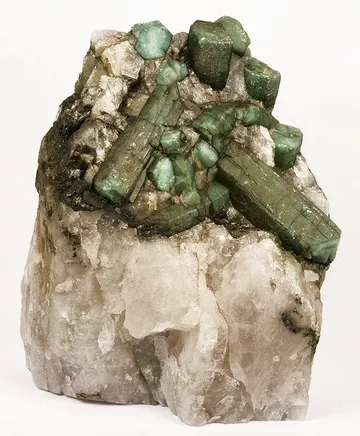
Emerald from Brumado belongs to the district’s early and often underappreciated history. Beryl was among the first collectible minerals recognized there, occurring as blue-gray aquamarine and pale to medium green emerald, with vanadium considered a likely contributor to the vivid green in some crystals. Productive areas include the Pomba area and Pirajá, and crystals may reach several centimeters, commonly in association with magnesite, quartz, talc-rich material, and the broader carbonate-silicate assemblage. The best Brumado emerald specimens are valued as locality pieces rather than as gem rough: color, crystal outline, attachment in matrix, and credible Brumado sublocality provenance matter more than cutting potential.
Generic “tourmaline” from Brumado usually refers to Ca-Mg tourmaline-group crystals from the uvite–fluor-uvite–dravite compositional field, with Pomba and Pedra Preta producing the best-known specimens. The locality’s tourmalines are typically short-prismatic, equant, or flattened, with colors from dark green and yellow-green to reddish-brown, wine-red, and blackish green; associations with magnesite, quartz, dolomite, hematite, florencite, and svanbergite are characteristic. Good tourmaline specimens from Brumado are not judged like pegmatite elbaite: the appeal lies in luster, stout morphology, saturated earth colors, and carbonate contrast. Because the species name is analytically treacherous here, a specimen sold simply as “tourmaline on magnesite” may be more honest than an unsupported uvite or dravite label.
Florencite, particularly florencite-(Ce) and florencite-(La), is a distinctive Pomba accessory that adds pale yellow, cream, tan, or grayish phosphate accents to magnesite, quartz, and tourmaline specimens. Mindat records florencite-(Ce) and florencite-(La) from the Pomba pit, and the classic Rocks & Minerals treatment illustrated florencite-(Ce) on magnesite from Pomba at 7.2 cm maximum dimension. Most pieces are not large, freestanding florencite specimens; they are combination pieces where sharp small crystals or crusts add rarity and texture to a carbonate-tourmaline matrix. The best examples have identifiable, well-formed florencite crystals in attractive placement, rather than dull earthy coatings that need analysis to be appreciated.
Topaz is an abundant accessory in the Brumado magnesite deposits, especially in the Pomba area, where it occurs as colorless, yellow, pink, and purple crystals, sprays, and matrix specimens with magnesite or quartz. Classic descriptions note prismatic crystals to about 3 cm, while illustrated specimens include small sprays and individual crystals on Pomba matrix. Brumado topaz is not the imperial-topaz story of Ouro Preto; its appeal is locality, association, and contrast in a chemically unusual magnesite system. The best pieces show distinct, lustrous, undamaged topaz crystals sitting visibly on carbonate or quartz, while ordinary examples are isolated small prisms or pale fragments lost in a busy matrix.
Beryl from Brumado includes blue-gray aquamarine and green emerald, with Pomba and Pirajá documented as productive areas. Crystals may reach several centimeters, and the best examples are meaningful because beryl is woven into the early collecting and mining history of the district rather than being a high-volume gem product. In collections, Brumado beryl is most convincing when it retains matrix or a documented association with the carbonate-silicate assemblage, particularly magnesite, quartz, talc-rich material, or tourmaline. Fine pieces need recognizable hexagonal habit, pleasing color, and credible locality data; otherwise, loose green or blue beryl from Bahia can be difficult to separate from better-known Brazilian sources on appearance alone.
Sellaite, MgF2, is one of Brumado’s great mineralogical trophies. The first celebrated find came in 1979 from a pocket in the Pedra Preta quarry, where crystals to about 5 cm were found loose in soft magnesite “sand,” colorless and clear to whitish translucent, with inclusions of greenish-brown dravite, quartz, and translucent magnesite noted. Later Pomba material produced sellaite to about 6.5 cm, including nearly black crystals and geniculate twins. The best Brumado sellaites are major species pieces—sharp, transparent to translucent, well-formed, and clearly larger than the species norm—whereas ordinary fragments or included crystals need strong documentation to carry their value.
Dravite is documented from the Pomba and Pedra Preta areas and is visually inseparable from much Brumado “uvite” without analysis. The crystals can resemble uvite in color and morphology: short-prismatic to equant, lustrous, and green, brown, red-brown, yellowish, or dark. Dravite occurs with magnesite, quartz, hematite, and other late fracture minerals, and greenish-brown dravite inclusions were noted in the classic sellaite pocket material from Pedra Preta. The best collector pieces have laboratory support or conservative labeling, along with sharp crystal form, color contrast, and display-quality matrix; unsupported “dravite” labels on Brumado specimens should be treated cautiously unless the specimen’s provenance or analysis justifies the name.
Goethite at Brumado is mostly a weathering and replacement mineral, important both as a species and as a clue to alteration. It commonly replaces pyrite and occurs as iron-oxide staining on minerals exposed to weathering, particularly in the Pomba and broader Serra das Éguas assemblage. Collectible goethite specimens are less common than goethite-bearing or goethite-stained specimens; it may appear as brown to black coatings, earthy replacements, or small botryoidal to crustiform patches on quartz, magnesite, or phosphate-bearing matrix. Good pieces require attractive texture, clear identity, and an aesthetic relationship to the host; excessive goethite staining can lower the value of magnesite, quartz, or tourmaline specimens by dulling luster and obscuring form.
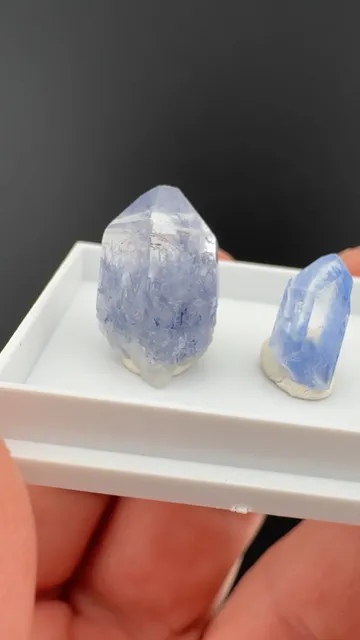
Euclase from Brumado is a modern rarity rather than part of the old magnesite-specimen canon. Mindat records euclase from Brumado, and recent work on Bahia euclase discusses a pale violet-hued Brumado occurrence, including a specimen associated with quartz and fragments of magnesite, a clue tying it back to the Brumado magnesite environment. The material is scarce, and some Bahia euclase has been mislabeled “Brumado” despite coming from other areas such as Abaíra, so provenance is unusually important. Fine Brumado euclase specimens are expected to be small but sharp, pale violet to pinkish or color-zoned, and ideally associated with quartz or magnesite; loose crystals without documentation should be approached conservatively.
Rutile is rare at Brumado but can be excellent. It occurs mainly at Pedra Preta and in the Pomba area as sharp black to dark reddish-black single crystals, twins, and occasional cyclic twins, with classic descriptions noting crystals to about 3 cm. Its most famous presentation is with hematite, including epitaxial intergrowths on magnesite-bearing matrix. Good Brumado rutile pieces are sharp, lustrous, and clearly crystallized, ideally on a contrasting carbonate or hematite matrix; small black grains in magnesite or broken twins are mineralogically interesting but far less desirable as display specimens.
Svanbergite is a characteristic Pomba phosphate-sulfate accessory, commonly of interest on combination pieces rather than as isolated large crystals. Classic Brumado literature illustrated svanbergite crystals on quartz from Pomba at 2.7 cm tall, and Mindat records it from Pomba with associations including magnesite, quartz, tourmaline, florencite, and dolomite. It typically appears as small pale, tan, grayish, or yellowish crystals that require good magnification and careful labeling to appreciate. The best pieces show discrete crystals in attractive placement on quartz or magnesite, especially when paired with tourmaline or florencite; indistinct crusts are easily overlooked and should be confirmed if the species drives the specimen’s value.
Talc is both an industrial product of the Serra das Éguas district and a specimen mineral in the Brumado assemblage. It occurs in the Pomba, Pedra Preta, Catiboaba, Jatobá, and related deposits, and classic descriptions note thin pale-green pseudohexagonal plates to several centimeters across, sometimes naturally reinforced by a thin quartz coating. Talc also forms fine-grained masses associated with amphiboles, magnesite, tremolite-actinolite, and tourmaline-bearing pockets. The best talc specimens are delicate, platy, and visibly crystallized, with clean pale color and protection from abrasion; because talc is soft, many pieces are scuffed, greasy, or simply massive ore material rather than collector-grade crystals.
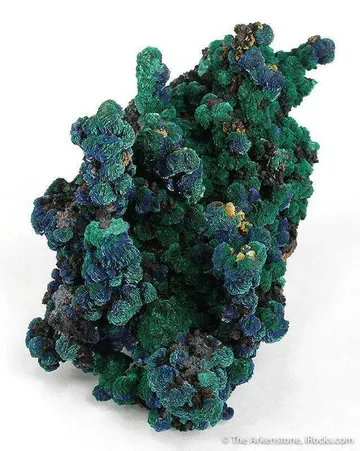
Other documented Brumado minerals make the district far richer than its familiar uvite-on-magnesite image suggests. Brumadoite, Cu3Te6+O4(OH)4·5H2O, is the district’s namesake type-locality mineral from the Pedra Preta mine, occurring as blue microcrystalline aggregates on or rarely after coarse-grained magnesite with mottramite and quartz. The Pomba and Pedra Preta assemblages also include hydronováčekite, nováčekite, metazeunerite, zeunerite, sklodowskite, chernovite-(Y), wakefieldite-(Y), woodhouseite, monazite-group minerals, thorutite, zunyite, anatase, barite, celestine, anhydrite, gypsum, malachite, azurite, native copper, cuprite, chalcocite, pyrite, magnetite, tremolite, actinolite, kyanite, enstatite, brucite, dickite, pyrophyllite, chrysocolla, zircon, petalite, and manganese oxides. Several of these are micromount or analytical species, but in aggregate they explain why Brumado has remained important to systematic collectors long after the first wave of showy tourmaline-carbonate specimens reached the market.
The most important authenticity issue at Brumado is nomenclature, not outright fakery. Many specimens long sold as “uvite” are better labeled “uvite–fluor-uvite series,” “fluor-uvite–uvite series,” “tourmaline on magnesite,” or “Ca-Mg tourmaline” unless analyzed. Some Brumado tourmalines are OH-dominant, some F-dominant, and some may fall close enough to boundaries that a species name based only on appearance is unsafe. Dravite adds another layer of difficulty because it can resemble uvite in color and habit at this locality. For high-value specimens, a confident species label should be backed by analysis or by a reputable old label tied to a studied specimen lot.
Condition issues are predictable but important. Magnesite rhombs have perfect cleavage and commonly show bruised edges, cleaved faces, or contact points where crystals were attached to the pocket wall. Tourmaline crystals may be contacted on one side, especially in dense drusy carpets; the best Brumado pieces are cleanly exposed, not merely dark crystal ends emerging from carbonate. Quartz tips, Japan-law twin corners, and dolomite “pseudocubes” are easy to nick. Hematite and goethite can be aesthetic when they create reddish inclusions or metallic contrast, but pervasive iron staining can turn a good combination into a dull brown mass.
Fluorescence is worth checking but should not be over-sold. Some Brumado magnesite may show reddish ultraviolet fluorescence, and apatite-group members and anhydrite from the district have also been noted for UV response. As always with uranium-bearing species such as nováčekite, metazeunerite, zeunerite, hydronováčekite, uraninite, and sklodowskite, keep specimens boxed, avoid inhaling dust, wash hands after handling, and do not grind, trim, or clean aggressively without proper precautions.
Market availability is uneven. Uvite/fluor-uvite series on magnesite remains available, from modest thumbnails to high-end cabinet combinations, because the locality produced heavily for decades and specimens were widely distributed by Brazilian dealers. Truly fine examples—balanced matrix pieces with glassy magnesite, saturated green or red tourmaline, and minimal damage—are much scarcer than ordinary Brumado material. Magnesite-only specimens, good Japan-law quartz, analyzed dravite, sellaite, euclase, brumadoite, rutile, florencite, svanbergite, and uranium-phosphate species are significantly less common and should be judged with more attention to documentation.
Mislabelling is common beyond tourmaline nomenclature. “Brumado” may be used broadly for Serra das Éguas, but it may also be attached to Bahia material from other districts, particularly emerald, euclase, and beryl. A specimen with a Pomba, Pedra Preta, Pirajá, or Catiboaba label is preferable to a vague “Brazil” label later upgraded to Brumado by assumption. Euclase deserves special caution because documented Bahia material from other localities has circulated with Brumado labels.
The Brumado story begins like a prospecting tale from another century: a remote Bahian range, a white carbonate that local people had seen before the mining world understood its value, and two men trying to turn rumor into ore. Pierre Cahen and Georges Minvielle heard of magnesite in the Serra das Éguas and went looking for it with a sample in hand, showing it to local prospectors and miners as a visual key. After months of frustration, a local prospector reportedly told them that it was “extraordinarily simple” to discover the Serra das Éguas deposits. The remark sounds almost mocking in retrospect, because once the right ground was recognized the deposits proved enormous. From that recognition grew Magnesita S.A. and the industrial identity of modern Brumado.
Before magnesite became the name attached to the district, emeralds had already drawn attention to the Pirajá valley. The occurrence was worked for nearly thirty years, and the associated magnesite was noticed, then effectively forgotten, before the refractory industry made it the real prize. That sequence is part of Brumado’s charm for collectors: a district first valued for green beryl later became world-famous for white carbonate and green to red-brown tourmaline. The mineral that looked like matrix became the economic engine, and the accessory minerals became museum specimens.
One of the great Brumado pocket stories belongs to sellaite. In 1979, a pocket at the Pedra Preta quarry yielded loose crystals lying in soft magnesite “sand.” The best reached about 5 cm, colorless to whitish and translucent, some carrying inclusions of greenish-brown dravite, quartz, and translucent magnesite. For most mineral collectors, sellaite had been a name in systematic lists rather than a display species. Brumado changed that. Later, Pomba produced still larger material—reported to 6.5 cm, including nearly black crystals and geniculate twins—turning a rare magnesium fluoride into one of the district’s most surprising claims to world-class status.
Brumadoite adds a different kind of drama: not the spectacle of a big cabinet specimen, but the thrill of a new mineral hiding in plain sight. The material came from Pedra Preta, blue and microscopic on magnesite, associated with mottramite and quartz. It was not a glamorous hand-specimen mineral in the way uvite is, but it carried the locality’s name into formal mineralogy. The type material ended up divided among major institutions, including collections in São Paulo, Santos, Ottawa, and London, a fitting afterlife for a mineral born from a working magnesite mine in rural Bahia.
The modern mine story is still being written. Brumado is not an abandoned locality preserved only on old labels; it remains a strategic raw-material center. RHI Magnesita has continued investing in the unit, including major rotary-kiln infrastructure and processing improvements intended to extend the life of Pedra Preta. That creates a tension familiar to collectors of active industrial localities: the geology is still being exposed, but access is controlled, production priorities are industrial, and the survival of specimen pockets depends on timing, permission, and alert people who recognize crystals before they become feedstock.