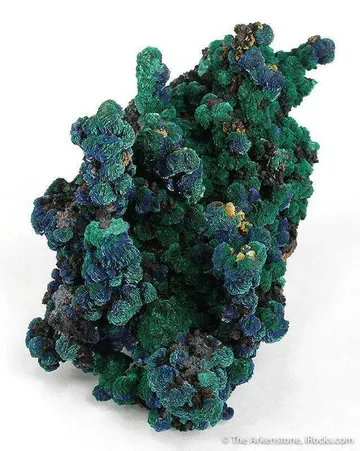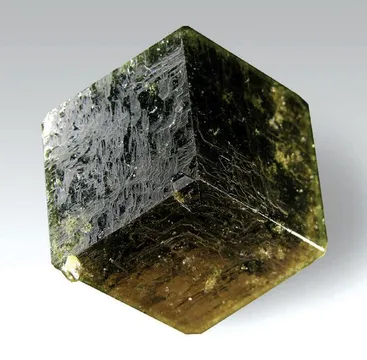
Pomba Pit, Serra das Éguas, Brazil — classic magnesite locality and collector landmark, with white to colorless magnesite rhombohedra and gemmy tourmaline.
Key facts
Pomba Pit is one of the collector landmarks of the Brumado magnesite district in Bahia: an active open-pit magnesite mine on the Serra das Éguas, a hilly magnesite-and-talc belt west of Brumado that older labels may still call “Bom Jesus dos Meiras.” For specimen collectors, Pomba matters because it is not merely an industrial magnesite quarry that happened to produce crystals; it is one of the classic modern sources for sculptural white to colorless magnesite rhombohedra carrying gemmy, stubby, red-brown to green tourmaline of the fluor-uvite–uvite series, with quartz, dolomite, hematite, calcite, florencite, svanbergite, and other rarities adding a distinctive Serra das Éguas signature.
The geologic setting is a metamorphosed magnesian carbonate sequence within the São Francisco Craton. The Brumado deposits are large, folded, stratabound magnesite bodies developed in dolomitic carbonate rocks; recent fluid-inclusion work treats them as metamorphic, sparry magnesite deposits formed from highly saline H2O-CO2 fluids rather than as simple low-temperature replacements. Pomba belongs to the whiter, finer-grained magnesite style of the district, contrasting with the more hematite-stained reddish magnesite historically emphasized at Pedra Preta and Pedra de Ferro.
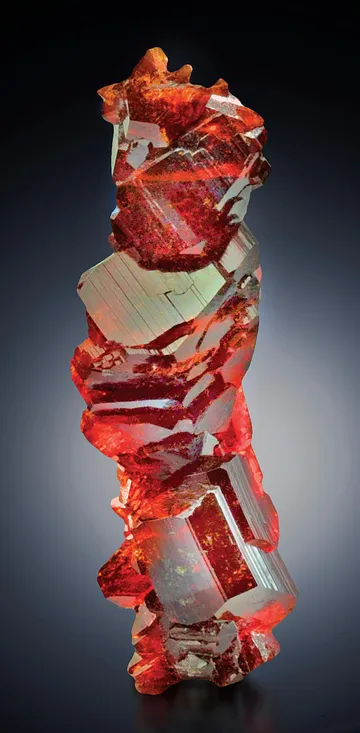
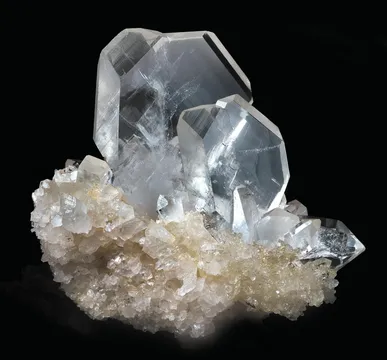
The best Pomba specimens have an unmistakable look: bright, blocky rhombohedra of magnesite, often snowy white or nearly water-clear, edged by short, almost garnet-like tourmaline crystals in green, reddish brown, or deep red tones. Quartz prisms can sit through the carbonate like glassy punctuation marks. Fine hematite pieces from the same pit are thin, metallic, platey floaters or bladed aggregates, while rarer phosphate and sulfate-phosphate species appear as tiny but compositionally important crystals on magnesite or quartz. The aesthetic standard is contrast: dark transparent tourmaline on white magnesite, orange to tan rare phosphates on pale carbonate, or silvery hematite blades set off by small rhombohedra.
Regional View
Country View
The locality’s collecting fame grew with the Brumado district as a whole. Early geological work established Serra das Éguas as one of Brazil’s great magnesite resources; later collector literature documented its extraordinary accessory mineral suite. Pomba, above the Pedra Preta open pit on the mountain, became especially important for the clean white magnesite matrix and for the small, sharp tourmaline crystals that collectors long labeled simply “uvite.” Modern nomenclature is more cautious: without analysis, many Pomba “uvites” are best regarded as fluor-uvite–uvite series specimens, because F-dominant and OH-dominant compositions have both been recognized in Brumado material.

Search for specimens: View all specimens from Pomba Pit, Serra das Éguas, Brazil
Pomba Pit lies in the Serra das Éguas magnesite district near Brumado, Bahia, in northeastern Brazil. The district is a compact but geologically substantial belt of magnesite and talc workings, roughly 5 by 15 km in the collector literature, with Pomba situated uphill from the better-known Pedra Preta open pit. On labels, the locality may appear as Pomba Pit, Pomba mine, Serra das Éguas, Brumado, Bahia, or more generally “Brumado”; older labels may use “Bom Jesus dos Meiras,” the older name associated with the town.
The deposit is a metamorphic magnesite deposit hosted by magnesian carbonate rocks of the Serra das Éguas sequence. In the broader district, magnesite occurs as lenses, strata, and replacement bodies within dolomitic marble and associated silicate-rich rocks. The Pomba ore is characteristically pale, comparatively homogeneous, and fine-grained relative to the reddish magnesite seen at some neighboring pits. Modern genetic work on Brumado magnesite distinguishes the white Pomba-Pirajá style from the red to light-colored Pedra Preta-Pedra de Ferro style, with the red color tied to finely dispersed hematite that is nearly absent in the white Pomba material.
Mining is open-pit, by benching, and Pomba remains part of the modern industrial magnesite landscape at Brumado. The older Magnesita S.A. operation began in the district with Pedra Preta in the 1940s; Pomba was opened later, during the expansion of the Brumado refractory raw-material operation in the 1970s, and current industrial sources list Pomba as an active producing magnesite mine under RHI Magnesita. Pomba and Pedra Preta have long been the two mine names most likely to appear on collector labels from the Serra das Éguas magnesite deposits.
The specimen-producing zones are cavities, fractures, and mineralized seams in the magnesite-dolomite-quartz system rather than pegmatite pockets in the usual Minas Gerais sense. Fine specimens commonly show magnesite as the structural matrix, with tourmaline of the fluor-uvite–uvite series perched on rhombohedral carbonate crystals. Quartz crystals, calcite, dolomite, and hematite occur with the main assemblage, while small rare phosphates and sulfate-phosphates such as florencite-(Ce), svanbergite, and woodhouseite make Pomba specimens especially interesting to systematic collectors. The rare-species pockets are generally modest in scale but high in mineralogical significance; Pomba is one of the few localities where a collector may see aesthetic carbonate-tourmaline specimens and serious micromount-level rarity on the same tray.
Access today should be treated as industrial mine access, not open recreational collecting. Pomba is an active open-pit magnesite operation with safety controls, blasting, heavy equipment, and company property restrictions. Specimens now reach the market primarily through old collections, Brazilian dealers, and material recovered historically during mining activity; casual field collecting should not be assumed possible without permission.
Pomba “uvite” is the locality’s signature collector mineral, though serious labels increasingly use fluor-uvite–uvite series unless a specimen has been analyzed. The crystals are typically very short prismatic to lenticular, with dominant rhombohedral or dipyramidal terminations that can make them look almost like tiny garnets set on magnesite; colors range from deep green and yellowish green to reddish brown, wine red, and nearly black in thicker crystals. Most crystals on display specimens are only a few millimeters across, although larger Brumado tourmalines are known, and the best Pomba pieces are judged by glassy luster, transparency at the edges, undamaged terminations, lively color, and clean placement on bright white or colorless magnesite. The most desirable associations show isolated or clustered tourmalines on sharp magnesite rhombohedra, sometimes with quartz, calcite, florencite, or svanbergite, and they command a premium when the contrast is crisp and the old “uvite” label is backed by modern analytical caution rather than overconfident species naming.
Magnesite is the ore mineral and the aesthetic foundation of Pomba specimens, occurring as white, colorless, pale pinkish, or slightly frosted rhombohedral crystals and crystal druses. Pomba is famous for sharp rhombs that form bright beds, sculptural aggregates, and matrix plates for fluor-uvite–uvite series tourmaline; individual crystals on display pieces are often sub-centimeter, but major Brumado magnesite specimens can reach cabinet scale, and exceptional crystals from the district have been reported to very large sizes. Good Pomba magnesite is not merely “matrix”: it is lustrous, well formed, and visually clean, with translucent to gemmy faces and enough relief to make associated tourmaline, quartz, calcite, or rare phosphates stand out. Ordinary pieces are sugary, bruised, massive, or chalky; the fine ones show crisp rhombohedral architecture, minimal iron staining unless aesthetically useful, and a clean white ground that instantly identifies the Pomba style.
Quartz at Pomba is an accessory rather than the ore, but it is important because it gives many specimens vertical structure and transparency against the carbonate matrix. It occurs as clear to milky prisms, sometimes doubly terminated or flattened-looking, and is documented in association with magnesite, fluor-uvite–uvite series tourmaline, dolomite, hematite, florencite-(Ce), and other small rare species. Collector-quality quartz pieces from Pomba are valued when the crystals are glassy, undamaged, and compositionally integrated with the magnesite-tourmaline assemblage rather than being plain isolated quartz; the best examples use quartz as a transparent bridge between the white rhombohedra and the dark tourmalines or as a host for small rare phosphate crystals.
Dolomite from Pomba appears as white to pale rhombohedral crystals, flattened crystals, and platey carbonate matrix in the magnesite system, and it is a recurring companion to magnesite, quartz, hematite, and fluor-uvite–uvite series tourmaline. In the wider Brumado district, dolomite can form superb crystals more than 5 cm across, including flattened “pseudocube” habits and twins; Pomba specimens tend to be most collectible when dolomite contributes clean, sharp geometry rather than a dull carbonate crust. Fine pieces show bright dolomite rhombs supporting or framing magnesite and tourmaline, or a sharp dolomite crystal paired with a clear doubly terminated quartz, while ordinary pieces suffer from bruised edges, powdery surfaces, or ambiguous carbonate identification.
Hematite is both a geological colorant in parts of the Brumado magnesite system and a collectible species at Pomba, where specimens can show bright metallic, lamellar, platey, or bladed crystals, sometimes in floater groups. The Pomba material ranges from silvery to black metallic plates and rosette-like aggregates to hematite associated with magnesite, quartz, dolomite, and red tourmaline of the fluor-uvite–uvite series. The best pieces have thin, highly lustrous, well-profiled plates with clean edges and little crushing; lesser examples are dull, granular, heavily stained, or simply iron oxide coatings on carbonate. When red gemmy tourmaline sits on metallic hematite, the association is especially desirable because it differs from the more familiar dark-tourmaline-on-white-magnesite look.
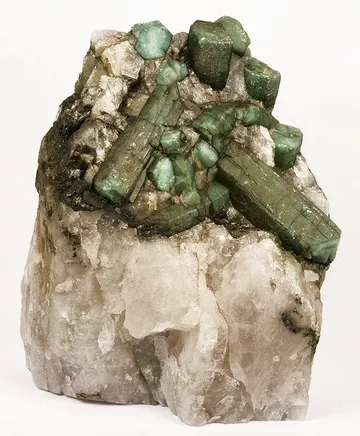
Beyond the major display species, Pomba is a systematic collector’s locality. Documented minerals include fluor-uvite, dravite, calcite, florencite-(Ce), florencite-(La), svanbergite, woodhouseite, zunyite, topaz, anatase, baryte, beryl including emerald, petalite, kyanite, zircon, talc, goethite, malachite, hydronováčekite, thorutite, zeunerite, and manganese oxides. The rare phosphate and sulfate-phosphate suite is especially noteworthy: svanbergite occurs as small orange to yellowish brown rhombs on magnesite and quartz; florencite-(Ce) can form sharp cream to orange crystals on quartz or magnesite; woodhouseite has been reported as minute crystals in uvite and on quartz. No currently accepted IMA mineral species is securely a Pomba Pit type-locality mineral in the modern sources, but the Brumado district has an important and complicated role in tourmaline nomenclature because “uvite” from Brumado was once treated as type material before later work showed that many Brumado specimens require fluorine-versus-hydroxyl analysis.
The chief authenticity problem with Pomba specimens is not wholesale fakery but naming precision. Many old labels say “uvite,” and the market still uses the name freely, but Brumado tourmalines may be fluor-uvite, uvite, dravite, or best left as fluor-uvite–uvite series without analytical work. A careful label should preserve the old name if historically important while adding the modern series designation when appropriate.
Locality precision is the second major issue. “Brumado,” “Serra das Éguas,” “Pomba,” “Pedra Preta,” and “Bom Jesus dos Meiras” have all appeared on specimen labels, and the district’s pits are close enough that older material is often generalized. Pomba labels are most convincing when supported by an old dealer label, a collection pedigree, or a characteristic assemblage: white magnesite with stubby green to red tourmaline, quartz, calcite, florencite, svanbergite, or thin metallic hematite. Reddish magnesite-rich material or certain rare species may belong better to neighboring Pedra Preta unless the label history is strong.
Condition is easy to underestimate. Magnesite rhombohedra bruise and cleave; edges that look merely frosted may be small conchoidal bruises or cleavages. Tourmaline crystals are harder but commonly small and exposed, so check terminations under magnification. Hematite plates are thin and prone to edge chipping. Quartz associations should be checked for contact damage where crystals emerge from carbonate. Clean, unrepaired, high-contrast miniatures from Pomba are scarcer than the number of loose “Brumado uvite” labels in circulation suggests.
Fluorescence is specimen-specific. Some Brumado magnesite shows reddish fluorescence under ultraviolet light, and apatite-group or carbonate-associated pieces may fluoresce, but fluorescence should not be used as a sole locality test. Rare uranium-bearing species reported from the Pomba area and broader Brumado district, including zeunerite, hydronováčekite or nováčekite-type material, and sklodowskite, require sensible handling: store boxed, avoid inhaling dust, wash hands after handling, and keep friable radioactive micro specimens away from living spaces.
Market availability is intermittent. Pomba material appears regularly enough that patient collectors can find small tourmaline-on-magnesite pieces, but the finest cabinet plates, sharp magnesite-only specimens, analyzed rare phosphate associations, and undamaged hematite floaters are much less common. Provenanced older specimens from collections such as Bob Noble, Chester Lemanski, or European dealer reference stocks carry added value, especially when they preserve the exact Pomba label rather than a broad Brumado designation.
One of Pomba’s quiet dramas is that an ore body mined for refractory raw material became a locality where millimeter-scale rarities changed the way collectors looked at Brumado. In the mid-1970s, the Pomba area produced exceptional yellow uranium minerals: tabular nováčekite-type crystals reported up to 3 cm on edge and up to 1 cm thick on matrix, along with bright yellow zeunerite/metazeunerite and drusy yellow sklodowskite needles. These were not the big showy magnesite-tourmaline plates that made dealers’ cases glow from across a room, but they gave the district a second identity: a carbonate mine whose small secondary minerals could be world-class for their species.
The modern specimen memory of Pomba also has a distinct 2008 chapter. Dealers recorded a September 2008 pulse of fluor-uvite material in which short, transparent, green to reddish crystals appeared on white or pinkish magnesite, with orange calcite and right-handed quartz crystals on some pieces. The most characteristic crystals were only about 4 to 5 mm across, but their shape made them memorable: very short prisms with bright rhombohedral terminations, so equidimensional that several descriptions compared them to garnets. That comparison has stuck because it captures the paradox of Pomba tourmaline: chemically a tourmaline, visually sometimes a tiny jewel-like rhomb on carbonate.