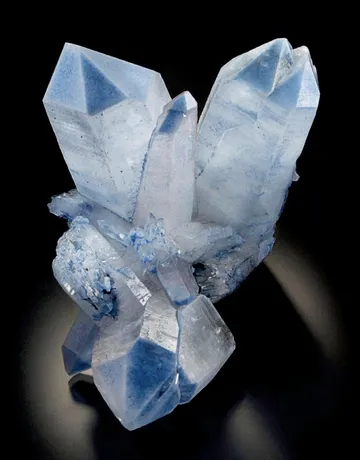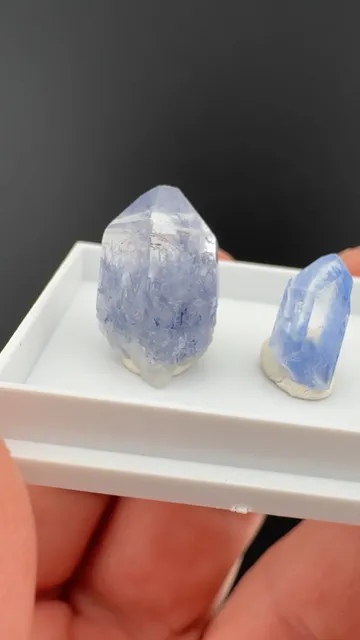
Carnaíba mining district, Brazil — renowned emerald locality famed for chrome-green hexagonal beryl crystals set in dark mica schist, plus matrix pieces.
Key facts
Carnaíba is one of the essential names in Brazilian emerald collecting: a rugged garimpo district on the western flank of the Serra de Jacobina, in northern Bahia, where beryllium-bearing pegmatitic fluids met chromium-bearing ultramafic rocks and produced emerald in dark mica schist. To a collector’s eye, the locality has a very particular look. The best pieces are not the glassy Colombian-style singles that float in calcite, but stout, chrome-green hexagonal beryl crystals locked in glittering black phlogopite-biotite schist, white quartz, or micaceous matrix—specimens that show the geology at a glance. Carnaíba also matters because it made Brazil a major emerald producer in the modern gem era: mining began in the early 1960s, grew into a classic artisan-mining district, and generated both cuttable emerald and dramatic matrix pieces, including enormous “canga” masses with emerald crystals in schist.
Regional View
Country View
Geologically, Carnaíba is a textbook example of the emerald-forming marriage between Be-rich felsic bodies and Cr-bearing mafic-ultramafic host rocks. The district lies in the Serra de Jacobina terrain, where quartzites, serpentinites, gneisses, granites, pegmatites, and metasomatic mica-rich rocks are arranged in a structurally complicated north-south belt. The emerald host rock—the garimpeiro “sludite” of older descriptions—is essentially a phlogopite- to biotite-rich schist formed by metasomatism at pegmatite and quartz-vein contacts. That mica schist is the reason Carnaíba specimens are so recognizable: saturated green beryl emerging from black mica, commonly with quartz and occasional metallic molybdenite or specks of scheelite.

Photo: Géry PARENT / Wikimedia Commons
Carnaíba’s companion collector mineral is chrysoberyl, especially the alexandrite variety. Fine Carnaíba alexandrites are usually not loose alluvial gems but matrix specimens: cyclic twins and partial twins, dark green to blue-green by strong light, embedded in the same schistose host that carries emerald. Their color change is commonly modest compared with the most famous Uralian or Sri Lankan gems, but the association—alexandrite, emerald, phlogopite schist, pegmatite, and ultramafic rock—makes them highly locality-characteristic.
Search for specimens: View all specimens from Carnaíba mining district, Brazil
The Carnaíba mining district is in the municipality of Pindobaçu, Bahia, roughly 30 km south of Campo Formoso and about 400 km inland from Salvador by the classic route through Feira de Santana, Capim Grosso, and Senhor do Bonfim. The district occupies part of the western border of the north-south Serra de Jacobina mountain belt, between the communities of Pindobaçu, Saúde, and Mirangaba, and older gemological descriptions give the productive Carnaíba region an area on the order of 200 km2. Carnaíba and Socotó, the other famous northern Bahia emerald district, are separate but related deposits about 40 km apart; Carnaíba belongs to the Pindobaçu side, while Socotó lies toward Campo Formoso.
The deposit is best understood as a granitic-pegmatitic emerald system developed in and around ultramafic rocks. Granitic bodies intruded the Serra de Jacobina sequence and sent pegmatite and quartz veins into serpentinite, peridotite, quartzite, and related rocks. The pegmatite veins are typically narrow—older descriptions cite bodies generally not more than about two meters thick—and are made chiefly of oligoclase, muscovite, and variable quartz. At the contacts with chromium-bearing ultramafic rocks, metasomatism transformed the host into phlogopite or biotite-phlogopite schist. That schist is the emerald host; the pegmatites supplied beryllium, while the ultramafic rocks supplied chromium and iron, with local vanadium also present in the emerald chemistry.
The ore is not one simple vein but a structurally controlled network of productive mica-schist zones, quartz veins, pegmatite contacts, and altered ultramafic bodies. In Carnaíba de Cima, the emerald-bearing schist was described in two horizontal levels and also in vertical layers. In Carnaíba de Baixo, productive zones include less completely schistified ultramafic belts at the granite-quartzite contact and ultrabasic bodies enclosed within or influenced by the Carnaíba granite. Named mining sectors and claims repeatedly cited in older gemological and geological work include Braúlia, Marota, Trecho Novo, Trecho Velho, Bode, Gavião, Lagarta, Formiga, and Mundé. The Formiga sector was especially productive in the mid-1980s and was noted for emeralds of above-average quality.
Mining began in late 1963 after the first discoveries in the Braúlia sector. Marota, in Carnaíba de Baixo, followed in 1964, and Trecho Novo in Carnaíba de Cima was discovered in 1972. The district’s boom years made Carnaíba the most important emerald mining region in Brazil until the rise of Santa Terezinha de Goiás in the early 1980s. Carnaíba’s fortunes then dipped as many garimpeiros left Bahia for Goiás, before later work resumed and deepened. The older workings were simple garimpo shafts, pits, and trenches; by the 1980s many vertical shafts had reached depths around 150 m, and water inflow was already a serious problem. Modern reporting shows that the district has remained active, with mining organized through the Cooperativa Mineral da Bahia and with registered underground workings continuing to produce emerald-bearing schist.
Carnaíba’s specimen output reflects that mining style. Much of the mine-run material is schist, quartz, and mica carrying included or fractured emerald; the best collector pieces are selected when crystals are well exposed, richly colored, and firmly seated in matrix. In Marota, older descriptions note that open-pit work was easier than the deeper mountain shafts and that crystals could be large—sometimes reaching hundreds of carats—but commonly paler or colored mainly at the surface. The higher-grade uphill material is more often prized for stronger green color, though transparency is frequently compromised by abundant inclusions and healed fractures.
Today, collecting access should be treated as mining access, not recreational collecting. This is an active gem district with underground workings, cooperative and private interests, legal mining titles, safety controls, and a functioning rough-stone trade. Serious collectors normally acquire Carnaíba specimens through established dealers, miners, or the local trade network rather than by field collecting. For high-value material—especially large emerald-in-schist “canga” masses—documentation of origin, ownership, and export legality is not a formality; it is part of the specimen.
At Carnaíba, beryl is most famous as emerald but also occurs as paler green beryl in pegmatitic and quartz-rich zones. The collector habit is typically stout hexagonal prisms, from small embedded crystals to cabinet-scale crystals several centimeters long, set in black phlogopite-biotite schist or white quartz; older descriptions note that many emerald crystals reach a few centimeters in diameter, and individual matrix specimens can show far larger exposed crystals. Color ranges from pale green and color-zoned material to rich chrome green, with the strongest pieces showing greasy to vitreous luster, thick crystal form, and enough translucency at the edges to glow under strong light. Good Carnaíba beryl specimens are separated from ordinary mine-run pieces by saturated color through more than just the skin of the crystal, sharp natural faces, minimal bruising from extraction, and a matrix that preserves the phlogopite-quartz contact assemblage rather than presenting isolated broken lumps.
Carnaíba chrysoberyl is prized chiefly as alexandrite on matrix, occurring in the same metasomatic schist environment as the emeralds. Specimens are commonly tabular or twinned crystals—especially cyclic “sixling” aggregates, more precisely built from repeated twinning—embedded in black biotite-phlogopite schist. The color is typically dark green, blue-green, or nearly black-green in hand, with the alexandrite effect often visible only under strong, contrasting light; the change may be subtle, shifting toward purplish, reddish, or warmer tones rather than the dramatic textbook green-to-red of the finest faceted gems. The best collector pieces have complete undamaged twins, well-developed arms, sharp luster, and visible matrix association; ordinary examples are dark, incomplete, poorly exposed, or show little color response even with backlighting.
Carnaíba emerald is the district’s signature mineral: green beryl formed in metasomatic phlogopite-biotite schist at contacts between Be-bearing pegmatites or quartz veins and Cr-bearing ultramafic rocks. Crystals are most often thick, hexagonal, and included, with colors ranging from medium green to deep chrome green; microprobe studies of Carnaíba emeralds recorded chromium contents up to about 0.73 wt% Cr2O3, with iron, magnesium, sodium, and minor vanadium contributing to their chemistry and gemological identity. The classic specimen look is emerald in black schist, emerald on quartz and schist, or emerald with phlogopite, molybdenite, apatite, and other accessories. Fine pieces are intensely colored, lustrous, and naturally exposed, with solid crystal geometry and attractive contrast against matrix; most material is fractured or cloudy, so even partial translucency in a richly colored Carnaíba crystal is a premium feature.
Beyond the beryl-chrysoberyl pair, Carnaíba has a distinctive emerald-deposit accessory suite. Documented minerals include phlogopite, biotite, muscovite, quartz, albite/oligoclase, K-feldspar, talc, actinolite-tremolite, chlorite, calcite, dolomite, apatite, schorl, chromite, rutile, molybdenite, scheelite, chalcopyrite, pyrite or pyrrhotite in older inclusion work, goethite, lepidocrocite, fluorite, phenakite, rhodonite, and allanite-group material. Molybdenite and scheelite are especially meaningful accessories because they belong to the same Be-Mo-W mineralizing system that produced the emeralds; on specimens, even small lead-gray molybdenite plates or pale scheelite specks can strengthen a Carnaíba attribution when they occur with emerald in the black mica schist.
Carnaíba specimens reward locality literacy. The classic matrix is dark phlogopite-biotite schist, often with white quartz and sometimes molybdenite; if a specimen is simply labeled “Brazil emerald” without matrix context, it may be from Bahia, Minas Gerais, Goiás, or another source. Conversely, Carnaíba alexandrite is sometimes mislabelled as Minas Gerais material in older collections or dealer stock; complete cyclic twins in black schist are a strong clue for Carnaíba, but the label should still be checked against provenance.
Condition is a central issue. Emerald from Carnaíba is commonly included, cloudy, fractured, and broken during extraction from hard schist or quartz. Edges and terminations are easily bruised, and many attractive crystals are actually partly embedded cross sections rather than complete freestanding prisms. Matrix pieces should be inspected for repaired schist, glued crystal fragments, sawed bases disguised by mica, and old oil or resin residues around fractures. In cut stones, treatment with oil or resin should be expected unless documentation says otherwise; for mineral specimens, treatment is less standardized, so strong light and magnification are useful for detecting filled cracks or enhanced surface gloss.
Carnaíba emeralds are usually bought for color and geological presence rather than water-clear transparency. A thick, lustrous, intensely green crystal on quartz and black mica can be far more desirable as a mineral specimen than a cleaner but pale fragment. For alexandrite, the premium is not only color change but crystal completeness: undamaged sixling or trilling twins on matrix are much scarcer than dark broken pieces. Do not overpay for claims of dramatic color change unless you have seen the specimen under daylight-equivalent, incandescent/warm, and strong backlighting conditions.
Legal provenance matters more at Carnaíba than at many classic localities because the district has produced several famous large emerald-in-schist masses involved in seizures, disputed ownership, or repatriation proceedings. Large “canga” specimens, especially those promoted with spectacular valuations, should come with clear mine-origin documentation, ownership papers, invoices, and export compliance. For serious collecting, a modest but well-provenanced crystal on matrix is preferable to an impressive but legally ambiguous mass.
The origin story of Carnaíba has the plainness of a garimpo legend because it begins not with a company drill program but with a small farmer clearing land. In 1963, according to local reporting from Pindobaçu, he found green, shining stones at the foot of a clump of grass and handed them to a local authority. They were emeralds. The news moved through the region “like gunpowder,” and within months Pindobaçu was flooded with garimpeiros arriving from across Bahia to search the Serra da Carnaíba. A town that had grown from muleteer stops and muddy tracks became, in local speech and self-image, the capital of emeralds.
The boom created its own vocabulary. By the mid-1970s, Carnaíba was in full swing, and the verb “bamburrar” entered local mining speech with the force of a dream: to strike it rich. Families built hopes around that word. Lucivaldo Cunha of the Cooperativa Mineral da Bahia later recalled that his own father was among the men chasing the possibility. Then came the barrier every miner in Carnaíba had to understand: quartz. When the miners reached quartz at depth, progress became difficult; in 1981, as news arrived of emerald at Campos Verdes in Goiás, many left Bahia and headed roughly 1,500 km west. There, in contact with other garimpeiros, they learned how to get through the quartz and reach the emerald-bearing ground below. Then they returned to Pindobaçu with that hard-won practical knowledge, and production revived.
Carnaíba’s modern folklore is dominated by giants. One report in 2017 described a 1.30 m, roughly 365 kg emerald-bearing rock found about 200 m underground; broadcast crews entered the mine to show the source. In 2024, another spectacular canga—the “Coração da Bahia”—was described as a 225 kg emerald-bearing mass from Pindobaçu, reportedly recovered from about 230 m depth and offered with origin and ownership documents. Local coverage called it the sixth giant emerald found in the same region over 23 years. Such pieces are not “one emerald” in the gem-cutter’s sense; they are geological monuments, schist masses with green beryl crystals grown into them, objects halfway between specimen, ore block, and legal artifact.
The most notorious of all is the Bahia Emerald, the giant mass discovered in 2001 in the Carnaíba range and later smuggled out of Brazil. Its story reads less like mineralogy than a courtroom novel: a huge black schist rock with multiple emerald crystals, a trail through the United States, Hurricane Katrina, competing claims by speculators, allegations of false documents, and years in law-enforcement custody. By late 2024, a U.S. federal judge cleared the way for the stone’s return to Brazil. For collectors, the lesson is sober. Carnaíba can produce emerald objects of astonishing scale, but the larger the stone and the louder the valuation, the more the geology must be accompanied by paperwork.
Dietmar Schwarz and Thomas Eidt, “The Brazilian emeralds and their occurrences: Carnaíba, Bahia,” The Journal of Gemmology, 21, no. 8, 1989, pp. 474–487. A core English-language gemological and geological treatment of the district, with geology, mine sectors, chemistry, inclusions, and references. PDF
Luc Rudowski, Gaston Giuliani, and Pierre Sabaté, “Les phlogopitites à émeraude au voisinage des granites de Campo Formoso et Carnaíba (Bahia, Brésil): un exemple de minéralisations protérozoïques à Be, Mo et W dans des ultrabasites métasomatisées,” Comptes Rendus de l’Académie des Sciences, 304, Série II, no. 18, 1987, pp. 1129–1134. Important paper framing Carnaíba and Campo Formoso emerald phlogopitites as Be-Mo-W mineralization related to hydrothermal fluids from Transamazonian granites and aplopegmatites. ResearchGate page
Pedro A. Couto and J. T. Almeida, “Geologia e mineralizações na área do garimpo de Carnaíba (Bahia),” Anais do 32º Congresso Brasileiro de Geologia, Salvador, 1982, vol. 3, pp. 850–861. Frequently cited Brazilian geological work on the Carnaíba garimpo area and its emerald mineralization.
M. D. Moreira and A. J. Santana, “O garimpo de Carnaíba: geologia e perspectivas,” Anais do 32º Congresso Brasileiro de Geologia, Salvador, 1982, vol. 3, pp. 850–861. Frequently cited in later gemological descriptions for geology and production outlook.
J. C. Griffon, M. R. Kremer, and A. Misla, “Estudo estrutural e genético da jazida de esmeralda de Carnaíba/BA,” Anais da Academia Brasileira de Ciências, 39, no. 1, 1967, pp. 153–161. Early structural and genetic study of the Carnaíba emerald deposit, cited in later Carnaíba literature.
Dietmar Schwarz, “Estudo comparativo das inclusões em esmeraldas naturais e sintéticas. Parte A: Esmeraldas de Carnaíba/BA, Socotó/BA e da Colômbia,” Anais do 33º Congresso Brasileiro de Geologia, Rio de Janeiro, 1984, vol. 4, pp. 931–944. Inclusion study relevant to distinguishing Carnaíba emeralds from synthetic emeralds and from other natural sources.
Dietmar Schwarz, Esmeraldas: Inclusões em Gemas, Imprensa Universitária, Ouro Preto, 1987, 440 pp. A broader emerald-inclusion work cited by Schwarz and Eidt for Carnaíba inclusion features.
“The gemstone deposits of Brazil: occurrences, production and economic impact,” Boletín de la Sociedad Geológica Mexicana, 2010. Includes a concise synthesis of Carnaíba geology, reserve estimates, and the mining method of opening galleries and washing extracted schist. Article
Gaston Giuliani and Lee A. Groat, “Geology of Corundum and Emerald Gem Deposits: A Review,” Gems & Gemology, Winter 2019. Useful broader context for classifying emerald deposits, including pegmatite-schist systems like those represented in Brazil. Article
“A Jornada das Esmeraldas - Serra da Carnaíba - Diário de Campo #2,” Eduardo Gama. A field-style mini documentary filmed in 2021 and released in 2024, centered on a research trip to the Serra da Carnaíba and the Mina Laranjeiras context. URL: https://www.youtube.com/watch?v=MNrUGUcp8JY
“Domingo Espetacular entra na mina onde foi achada a rocha de 365 kg cravejada de esmeraldas,” Record/R7. Television segment on the 365 kg emerald-bearing rock from Pindobaçu, including mine footage and discussion of the find. URL: https://record.r7.com/domingo-espetacular/videos/domingo-espetacular-entra-na-mina-onde-foi-achada-a-rocha-de-365-kg-cravejada-de-esmeraldas-29062022/
“Reportagem especial acompanha a extração de esmeraldas na Serra da Carnaíba, na BA,” Bahia Meio Dia / Globoplay. Short regional TV report following emerald extraction in the Serra da Carnaíba. URL: https://globoplay.globo.com/v/9809534/
Mindat: Carnaíba mining district, Pindobaçu, Bahia, Brazil — The essential locality database entry, with coordinates, mineral list, sublocalities, and specimen photos.
Gemdat: Carnaíba mining district — Gem-focused locality summary for emerald and alexandrite from the district.
The Journal of Gemmology: “The Brazilian emeralds and their occurrences: Carnaíba, Bahia” — Best single technical article for collectors who want geology, habits, mine sectors, inclusions, and analytical data in one place.
ResearchGate: Rudowski, Giuliani & Sabaté on emerald phlogopitites near Campo Formoso and Carnaíba — Important genetic paper connecting the Be-Mo-W mineralization to metasomatized ultramafic rocks.
SciELO: “The gemstone deposits of Brazil: occurrences, production and economic impact” — Broader Brazilian gem-deposit overview with useful Carnaíba reserve and geology discussion.
Cooperativa Mineral da Bahia: importance of the Serra da Carnaíba emerald garimpo — Local cooperative perspective on mining, workers, and the regional emerald economy.
Jornal Correio: history of Pindobaçu and the emerald garimpo — Rich local reporting on the discovery story, garimpeiro migration, cooperative structure, and recent giant finds.
Wikimedia Commons: Minerals of the Carnaíba mine — Useful open-image gallery of emerald and alexandrite specimens from the district.
Los Angeles Times: the Bahia Emerald saga — Detailed narrative account of the famous giant Carnaíba emerald mass and its long legal history.
Washington Post: U.S. judge clears way for Bahia Emerald to return to Brazil — Current account of the repatriation ruling and the legal importance of provenance.