






Brumado uvite — Brumado, Serra das Éguas magnesite district; glassy green to red-brown tourmaline on magnesite/quartz, a classic, collectible uvite locality.
Key facts
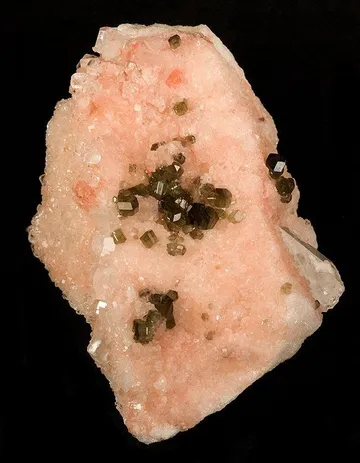
Brumado uvite is one of those locality names that serious collectors learn by sight before they learn the mine map. The best pieces have a look all their own: glassy, blocky tourmaline crystals in deep olive green, forest green, root-beer brown, cherry-red, wine-red, and occasionally complex bicolored or dichroic tones, perched on sparkling white to colorless magnesite rhombs or bright quartz. The contrast is the point. A good Brumado specimen is not merely “tourmaline on matrix”; it is dark, saturated tourmaline set against the clean carbonate-and-quartz architecture of one of the world’s classic magnesite districts.

Photo: Wikimedia Commons
The collecting locality is the Serra das Éguas district west of Brumado, historically also called Bom Jesus dos Meiras. Industrially, it is a magnesite and talc district; mineralogically, it is a much richer system of magnesite, dolomite, quartz, hematite, tourmaline, topaz, kyanite, beryl, phosphates, uranium minerals, rare tellurates, and other late-stage pocket minerals. The productive collector names most often attached to uvite specimens are Pomba pit and Pedra Preta, both within the Serra das Éguas magnesite field.
The reason Brumado matters for uvite is partly beauty and partly nomenclature. For decades, collectors called these Ca-Mg tourmalines “uvite.” Modern tourmaline nomenclature has made the label more exacting: many unanalysed Brumado crystals should be treated as members of the fluor-uvite–uvite series, and at least some Brumado material has been analytically confirmed as fluor-uvite. The best collector labels acknowledge that reality. In the marketplace, however, “Brumado uvite” remains the traditional and practical name for the classic green and red-brown crystals from this district.

Photo: Wikimedia Commons
Collectors look first for luster, color, and crystallization. The finest crystals are sharp and glassy, with short prismatic to nearly equant habits, strong trigonal terminations, and lively transparency at edges or through faces. Rich green examples have long been the most emblematic; red to wine-red examples on magnesite are scarcer-looking and especially attractive when individual crystals stand proud and undamaged. Matrix is a major value factor. Uvite crystals on undamaged magnesite rhombs, quartz points, or mixed magnesite-quartz bases are much more desirable than loose or contacted singles unless the single crystal is unusually large, complete, and gemmy.

Photo: Wikimedia Commons
Search for specimens: View all uvite specimens from Brumado, Bahia, Brazil
Brumado is the town and municipality; the mineral district that produced the classic uvite specimens is the Serra das Éguas range, a hilly mining area west of town. The district includes multiple magnesite and talc operations and prospects, among them Pedra Preta, Pomba, Pirajá, Catiboaba, Cabeceiras, and others that appear in the older geological and mineralogical literature. Mindat places the Pomba pit at approximately 14° 9' 25" S, 41° 41' 54" W and notes that it lies above the Pedra Preta open pit, farther up the hill.
Geologically, the Brumado magnesite field sits in an old metamorphic terrain of gneiss, schist, and amphibolite basement overlain by a metamorphosed carbonate-quartzite sequence. The classic descriptions emphasize dolomite below and quartzite above, with complex folding into a large synclinal structure. The magnesite deposits are generally interpreted as replacement bodies in dolomite, with additional fracture filling and later hydrothermal or metasomatic mineralization. That setting explains why the showiest collector specimens are pocket pieces: magnesite, quartz, and tourmaline grew in open spaces and fractures rather than as simple disseminations in massive ore.
The mining history is longer than the specimen history. Early iron mining in the area is recorded around 1912 or 1913, and emeralds in the Pirajá Valley were reportedly worked for nearly three decades. Magnesite was recognized early but became the district’s defining commodity only after prospecting by Pierre Cahen and Georges Minvielle, who organized the enterprise that became associated with Magnesita S.A. Large-scale magnesite mining in the Serra das Éguas district became the economic backbone of the area, and Brumado remains an active industrial mineral center rather than an abandoned collector locality.
Today the district is not a casual rockhounding area. Pedra Preta, Pomba, and related workings are industrial mine properties, and collecting depends on mine permission, relationships with operators, or specimens recovered through local miners and dealers. The most productive specimen periods for collector-quality uvite were not continuous; many of the fine pieces circulating today are from older production and dealer stock. New specimens still appear, but premium matrix pieces with clean magnesite, quartz, and sharp tourmaline are far less abundant than the number of historical Brumado labels might suggest.
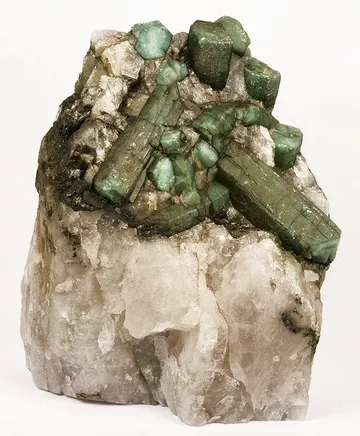
Notable finds from the district go well beyond uvite. Brumado has produced world-class magnesite crystals, hematite on magnesite, quartz including Japan-law twins, rare sellaite, topaz, kyanite, emerald, svanbergite, florencite-group minerals, hydronováčekite, metazeunerite, nováčekite, and the tellurate brumadoite from Pedra Preta. For uvite collectors, the most important associated minerals are magnesite and quartz, followed by dolomite, calcite, hematite, svanbergite, florencite-(Ce), topaz, and rare beryl or emerald associations.
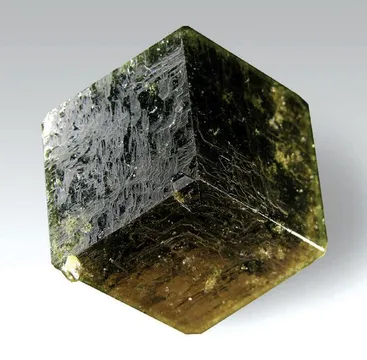
The classic Brumado crystal is short, stout, and glassy. Many crystals are so equant that they can look almost garnet-like at first glance, especially isolated dark green singles with broad, lustrous faces. Others show short prism faces beneath trigonal terminations, with striations, interrupted growth lines, and rehealed growth surfaces that are natural features rather than damage. Long-prismatic crystals do occur in the broader uvite-dravite series from the district, but the iconic collector habit is blocky, compact, and sharply terminated.
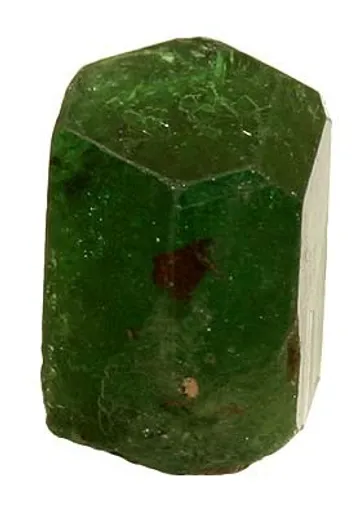
Color is one of the great attractions of the locality. Green is the signature color, ranging from olive to deep forest green and, in the finest crystals, showing bright green transmitted light at the edges. Red-brown, orange-brown, wine-red, and cherry-red crystals are also classic. Some Brumado tourmalines show strong pleochroism or dichroism, including pinkish to green directional colors in studied samples. Analytical work on colored Brumado uvite/dravite-series tourmalines has tied green coloration to vanadium-related centers in some samples, while red and brown tones are associated with iron. That chemistry is one reason Brumado material can feel visually richer than many other Ca-Mg tourmalines.
Size varies widely. Thumbnails with 5–15 mm crystals are common in the marketplace; fine miniatures and small cabinets may carry 1–2 cm crystals on magnesite or quartz. Literature reports Brumado uvite-group crystals up to several centimeters, with older descriptions giving maximum sizes up to about 8 cm for uvite-like material in the district. Large single crystals are seldom flawless; contacts, growth interruptions, and edge wear become increasingly important as size increases.
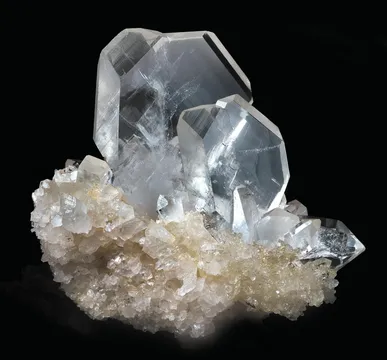
Associations are central to value. The best-known combination is uvite on magnesite: dark red-brown or green crystals cresting over white to colorless rhombohedra. Uvite on quartz is also highly desirable, especially when the tourmaline sits cleanly on clear or milky quartz points. Less common and more specialized associations include svanbergite with magnesite and uvite, florencite-(Ce) with magnesite and uvite, topaz with uvite, and rare beryl or emerald associations from the district. Such combinations should be judged carefully, because the most valuable examples are not merely multi-species; they show clear, identifiable, undamaged crystals of each mineral in a balanced composition.
Quality factors are straightforward but unforgiving. The best Brumado uvites have high vitreous luster, saturated color, sharp terminations, minimal edge bruising, attractive contrast against matrix, and credible locality/provenance. Green crystals should not be so dark that they read as black except under intense lighting. Red-brown crystals are especially good when the color is visible without backlighting. Matrix pieces should be checked for crushed magnesite, broken quartz tips, repaired tourmaline crystals, and hidden contacts along the backs or sides.
The most important authenticity issue with Brumado uvite is not fakery; it is nomenclature. Older labels reading “uvite” are historically normal, but modern collectors should understand that many specimens cannot be assigned confidently to uvite sensu stricto without analytical work. Fluor-uvite, uvite, dravite, and intermediate members of the series can be visually indistinguishable. A precise contemporary label such as “fluor-uvite–uvite series,” “uvite-group tourmaline,” or “fluor-uvite/uvite series, formerly labeled uvite” is often more scientifically honest than an unsupported species-level claim.
For high-end specimens, ask whether the specimen has been analyzed and by what method. Standard EDS is useful for major elements but does not directly solve the OH versus F dominance problem. Raman, infrared, electron microprobe including fluorine, and well-documented provenance can help, but most collector specimens will remain best treated as series material unless a credible analysis accompanies that exact specimen.
Documented treatments or manufactured fakes specific to Brumado uvite are not a major theme in the literature or specimen trade. The practical risks are more ordinary: repaired crystals, glued matrix attachments, reconstructed clusters, over-cleaned carbonate matrix, and optimistic relabeling. Magnesite and calcite matrices are vulnerable to acid and abrasion; a specimen with strangely etched carbonate, dulled rhombs, or residue in recesses deserves close inspection. Uvite itself is relatively hard as a tourmaline, but the contrast matrix is often the fragile part.
Condition problems commonly include chipped magnesite rhombs, bruised tourmaline edges, broken quartz tips, contacted backs where crystals grew against a pocket wall, and small missing crystals in dense clusters. Growth lines, natural rehealing, and irregular terminations are not automatically damage. On Brumado pieces, one often sees natural interrupted growth features that cross faces but retain luster and crystallization; these should be distinguished from open cracks or impact fractures.
Rarity is tiered. Small loose or matrix-associated Brumado uvites are obtainable. Attractive miniatures with good green or red-brown crystals on magnesite are scarcer. Fine cabinet pieces with multiple sharp crystals, undamaged magnesite or quartz, strong color, and old provenance are genuinely competitive specimens. Unusual associations—especially topaz, florencite-(Ce), svanbergite, or rare phosphates with uvite—are specialist pieces and should be evaluated with extra attention to species identification and whether the accessory mineral is truly visible and well crystallized.
Market availability is intermittent. Brumado is still an active mining district, but much of the collector-grade uvite seen today comes from older finds, old dealer inventories, or collection recycling. Fresh-looking, inexpensive pieces appear regularly, yet the top tier—clean, lustrous, well-composed matrix specimens with undamaged tourmaline—is not abundant. For serious collectors, a superior Brumado uvite is worth waiting for: strong color, honest labeling, and a good matrix make a far better specimen than a larger but battered or over-dark crystal.
The Brumado story begins before the tourmalines became famous. In 1912 or 1913, the first recorded mining activity in the area was not for magnesite or uvite at all, but for itabirite, a banded iron formation that a local inhabitant mined and smelted. Soon afterward, emeralds were found in the Pirajá Valley. Those emeralds were worked for nearly thirty years, while the magnesite—now the industrial identity of Brumado—was noticed and then effectively forgotten.
The turning point came with Pierre Cahen and Georges Minvielle, two naturalized Brazilian citizens who became interested in reports of magnesite in the Serra das Éguas. They went prospecting with a sample of magnesite in hand, showing it to local prospectors and miners as a clue to what they were seeking. For months the search continued. Then a local prospector reportedly told them that it was “extraordinarily simple” to discover the Serra das Éguas deposits. The line has the dry humor of a field story: once the right person recognized the rock, the obvious deposit had been sitting in the hills all along. From that effort came Magnesita S.A., the great industrial development of the district, and eventually the stream of specimen minerals that carried Brumado into cabinets around the world.
By the time collectors began to know the district through mineral shows and dealer lists, Brumado had already become a place of contrasts. It was a heavy industrial magnesite field, but its pockets yielded delicate things: clear magnesite rhombs, quartz twins, red and green tourmalines, rare uranium minerals, sellaite, svanbergite, topaz, and bright accessory phosphates. Some of the most memorable uvite specimens preserve that contrast perfectly—dark, hard tourmaline crystals standing on a snowfield of magnesite that began as an ore body.
One of the collector myths of Brumado is that the uvites are “old production,” and in many cases that is true enough to affect the market. Dealer descriptions repeatedly point to early 1990s or older finds, with the best green clusters and red-brown magnesite combinations having circulated through collections for decades. Modern listings still appear, but fine specimens often feel like returning travelers rather than fresh arrivals: old collection pieces, old dealer stock, or carefully held examples from the classic years of the district.

_1.JPG)
