Vaca Morta quarry, Brazil - a key collector locality famous for blue dumortierite in quartz, sharp crystals with electric-blue needles, and its metamorphic tal…
Key facts
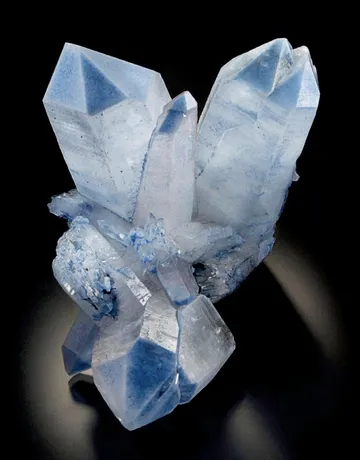
Vaca Morta quarry is one of those modern localities that changed the way collectors think about an otherwise familiar species. For decades the Serra da Vereda of western Bahia was known chiefly for blue ornamental quartzite: tough Proterozoic metamorphic rock colored by dumortierite, quarried under commercial stone names such as Blue Macaúbas and related blue quartzites. The collector breakthrough came when transparent rock-crystal quartz appeared with visible dumortierite needles and sprays suspended inside it. In the best pieces the quartz is colorless to water-clear, and the dumortierite forms electric blue, lavender-blue, indigo, or bluish-gray acicular clusters that look like tiny fireworks, moss gardens, snowdrifts, or phantom planes frozen in ice.
The quarry lies in the Serra da Vereda district near Boquira, Bahia, northwest of Macaúbas, within the Northern Espinhaço fold belt along the São Francisco Craton. Its host rocks are Al-, P-, and B-enriched quartzites of the Veredas/Santo Onofre–Sítio Novo stratigraphic framework, metamorphosed and deformed during the long Proterozoic-to-Neoproterozoic history of the Espinhaço basin. The stone quarried here is not a simple vein quartz occurrence: it is part of a larger metamorphic and sedimentary story involving boron-rich quartzites, phosphates, kyanite, mica, hematite, lazulite, and accessory zircon. That is why the locality matters both as a specimen source and as a small but useful mineralogical laboratory.
Regional View
Country View
The specimen-producing reputation of Vaca Morta rests on two related but distinct materials. The older, industrially important material is massive to banded dumortierite quartzite, often cut as ornamental stone. The newer collector material is crystallized quartz containing eye-visible dumortierite. That distinction is critical: many blue quartzites contain dumortierite, but very few localities have yielded sharp quartz crystals in which the dumortierite occurs as isolated, displayable, visibly crystalline inclusions. Fine Vaca Morta examples are judged less like ordinary quartz and more like inclusion specimens: clarity, depth, three-dimensional placement of the blue needles, and lack of distracting fractures are everything.
Search for specimens: View all specimens from Vaca Morta quarry, Brazil
Vaca Morta quarry is recorded as a quarry in the Serra da Vereda, Boquira municipality, Bahia, Brazil, at approximately 12°55′S, 42°52′W. Older references commonly place it near Macaúbas because the area was historically tied to Macaúbas administrative geography before Boquira became the present municipality; collector labels may therefore read “Macaúbas,” “Boquira,” “Serra da Vereda,” “Vaca Morta,” or simply “Bahia.” The locality is roughly 20 km northwest of Macaúbas, in a dry tropical savanna setting on the western Bahian part of the Espinhaço Range.
The deposit is best described as a dumortierite-rich blue quartzite quarry with associated quartz crystal pockets and quartz-rich zones. The blue quartzites occur within the northern Espinhaço Supergroup region and are commonly assigned in modern work to the Veredas Formation, at or near the base of the Sítio Novo Group, though older and parallel stratigraphic schemes place related rocks within the Santo Onofre or Boquira/Tiros framework. For the collector, the essential geological point is straightforward: these are highly quartzose, aluminous, boron-bearing metasedimentary rocks that were folded, recrystallized, and mineralogically upgraded. Dumortierite supplies much of the blue color; quartz supplies the resistant framework; muscovite, kyanite, lazulite, crandallite, augelite, hematite, rutile, zircon, and related accessories record the unusual Al-B-P-rich chemistry.
Regional studies describe the dumortierite-rich quartzites along the eastern flank of the Serra da Vereda as extending for more than 15 km, with thicknesses on the order of tens of meters. One classic subdivision recognizes three field types: finely layered quartzite with blue layers 20–50 cm thick; fine, highly recrystallized, homogeneous blue quartzite with conchoidal fracture; and a more poorly recrystallized quartzitic microconglomerate in which dumortierite and kyanite occur together in blue stains and irregular veins. More recent petrographic summaries of Blue Macaúbas from Vaca Morta give a typical composition near 80% quartz, 10% dumortierite, 5% kyanite, and 5% muscovite, while related Veredas quartzites can vary substantially in quartz, dumortierite, kyanite, and white mica content.
The ore, in the industrial-stone sense, is the blue quartzite itself. Blocks and slabs were quarried for ornamental use, prized for blue to bluish-gray color, banding, cross-bedding, and bookmatched patterns. From a mineral-specimen standpoint, the important bodies are the quartz-rich seams, fractures, pockets, and crystal zones that intersect or border the dumortierite-bearing rock. These produced detached crystals, clusters, and matrix pieces in which dumortierite appears as internal needles, sprays, coatings on one side of quartz crystals, or deeper inclusion planes. Some pieces show the dumortierite concentrated near the base or one side of the quartz, giving the classic “blue carpet” or “snow-on-the-roof” effect; others show radial sprays floating in the crystal interior.
The better-documented scientific work predates the inclusion-specimen boom. In 1966, Cassedanne and Franco reported dumortierite occurrences in the Serra da Vereda. Cassedanne, Cassedanne, and Freire de Carvalho later discussed lazulite tied to ferriferous irregularities in the dumortierite quartzites. In 1997, Visser, Felius, and Moree described augelite and cerian crandallite in dumortierite quartzites from Vaca Morta, noting a granoblastic quartzite rich in quartz, muscovite, and dumortierite with minor kyanite, crandallite, augelite, hematite, rutile, and zircon. That paper is particularly useful because it places Vaca Morta among rare Al-phosphate-bearing quartzite assemblages rather than treating it merely as a decorative stone quarry.
The modern specimen chapter begins around late 2013, when quartz containing very fine blue hair-like inclusions and blue clouds entered the gem and mineral trade. By 2014 demand had already outrun supply. A later pulse in late 2014 to early 2015 brought slightly larger quartz pieces with thicker bluish-gray needles and a smaller number of deep blue examples. Raman work by GIA gemologists confirmed the blue and bluish-gray needles as dumortierite, and contemporary gemological reporting emphasized that these were among the first well-formed, eye-visible dumortierite crystals known in rock-crystal quartz. That is the find that made Vaca Morta a serious collector locality rather than just a name attached to blue quartzite.
Mining access should be treated as private industrial quarry access, not casual public collecting. The site is an active or intermittently worked stone and mineral locality in a quarry district, with the usual hazards of highwalls, unstable blocks, machinery, blasting history, and private mineral rights. Specimens on the market have generally come through miners, dealers, lapidary channels, and Tucson/Munich-style trade circulation rather than from open recreational collecting. A field collector should assume that permission from landowners and mineral-rights holders is required before any visit, and that undocumented “Vaca Morta” material without a trustworthy chain of custody deserves caution.
At Vaca Morta, dumortierite is the signature species both as the blue pigmenting mineral of quartzite and as the spectacular inclusion mineral in rock crystal; petrographic work records euhedral to acicular blue dumortierite dispersed through granoblastic quartzite, especially in muscovite-rich layers, while collector pieces show visible needles, sprays, clustered tufts, and one-sided coatings in colorless to translucent quartz. In thin section the rock-hosted dumortierite is tiny, commonly around tenths of a millimeter, but the collector material can show eye-visible acicular crystals and radial groups in quartz crystals from small thumbnails to cabinet-size specimens; documented examples range from roughly 17–35 mm included points to large quartz crystals and clusters exceeding 10 cm. The strongest pieces have sharp blue to indigo needles floating in clean quartz, a pleasing three-dimensional distribution, natural terminations, and minimal bruising; ordinary pieces are cloudy quartz chunks, heavily polished fragments, or blue patches that read more as lapidary material than as crystallized inclusion specimens.
Quartz from Vaca Morta ranges from massive quartzite and milky matrix to prismatic, colorless rock-crystal specimens that owe their collector value to dumortierite inclusions; the most desirable crystals are transparent, glassy, terminated or doubly terminated, and internally decorated with blue needles, phantom-like planes, radial clusters, or stripes of different color intensity. Crystal specimens may be loose points, parallel-growth clusters, floaters, or quartz on dumortierite-rich/milky quartz matrix, with individual marketed examples spanning thumbnails near 1.5–3 cm, small cabinets around 5–9 cm, and occasional large cabinet specimens above 10 cm. Good Vaca Morta quartz is not merely included but legible: the host must be clear enough to reveal the dumortierite at depth, and the best examples avoid the common problems of contacted terminations, polished faces, cloudy interiors, brown epigenetic staining, and edge-wear that obscure the blue inclusions.
Other documented minerals from Vaca Morta and the immediate Serra da Vereda assemblage include albite, augelite, crandallite, lazulite, muscovite, schorl, zircon, and petrographically noted kyanite, hematite, rutile, and kaolinite after muscovite. The rarest systematic interest lies in the phosphate assemblage: augelite and cerian crandallite were specifically reported from Vaca Morta dumortierite quartzites, with crandallite associated with hematite pebbles and lenses and augelite interpreted as a product of continued phosphate transformation under elevated pressure-temperature conditions. Vaca Morta is not important because it is a type locality for a named species; it is important because it combines a commercial blue quartzite deposit, a rare Al-B-P metamorphic assemblage, and one of the world’s defining occurrences of visible dumortierite inclusions in crystallized quartz.
The principal authenticity issue is not synthetic material but labeling precision. “Dumortierite quartz,” “blue quartz,” “Blue Macaúbas,” “dumortierite in quartz,” and “dumortierite quartzite” are often used loosely in the trade. A massive blue slab or cabochon from the Veredas quartzites is not equivalent to a transparent rock-crystal quartz specimen with visible dumortierite needles. Conversely, a clear quartz crystal with blue inclusions should not be sold as a pure dumortierite crystal. The host is quartz; the blue acicular inclusions are dumortierite. Serious labels should say “quartz with dumortierite inclusions,” “dumortierite in quartz,” or “dumortierite-bearing quartzite,” depending on the object.
Documented analytical work is reassuring for the classic blue and bluish-gray needles: GIA confirmed them as dumortierite by Raman spectroscopy in the material examined from the Vaca Morta area. Still, collectors should be alert to look-alikes and over-broad locality claims. Blue inclusions in quartz from other Brazilian or world localities can be riebeckite, tourmaline, lazulite-group minerals, fibrous amphiboles, rutile coatings, or unidentified clay/iron phases. For expensive specimens, insist on clear locality provenance, old dealer labels where possible, or laboratory confirmation if the inclusion identity is central to the price.
Polishing is common. Many gem and lapidary pieces are intentionally cut as cabochons, tablets, windows, or polished points to display inclusion planes. That is not a “fake,” but it changes the specimen category. Natural, unpolished, fully crystallized quartz with strong dumortierite inclusions is scarcer and normally commands a premium over polished included quartz of comparable size. A polished window can be desirable if disclosed, especially when it reveals a hidden blue spray, but undisclosed polishing on a supposedly natural crystal should reduce confidence.
Condition problems are typical of included quartz. Look for bruised terminations, contacted edges, internal fractures, rehealed cracks, chips hidden by luster, and brown staining along the quartz-dumortierite interface. The blue inclusions themselves may be concentrated on one side or at the base of the quartz; that is normal for the locality, but it means orientation is critical. A specimen that looks spectacular from one viewing angle may appear nearly empty from another. Before buying, rotate the piece under a strong light and judge whether the blue distribution has depth or is merely a thin back coating.
Fluorescence can add interest. Some Vaca Morta dumortierite-on-quartz specimens have been reported as blue-white fluorescent under shortwave ultraviolet light at 254 nm, and at least one documented 2016 floater quartz specimen was described as very fluorescent under shortwave UV. Do not assume all pieces fluoresce. Shortwave UV should be used with proper eye and skin protection, and fluorescence should be treated as a bonus rather than a diagnostic substitute for microscopy or spectroscopy.
Market availability is uneven. Small thumbnails and modest included quartz points appear regularly enough through dealer inventories and online auctions, often in the low hundreds of dollars when the crystal is small, partly polished, or lightly included. Strong miniature and small-cabinet pieces with clean quartz, intense blue sprays, and natural crystal form are much less common and can move quickly. Exceptional cabinet specimens with transparent quartz crystals rising from matrix, saturated dumortierite networks, or unusually three-dimensional inclusion scenes may be priced in the thousands. The supply history explains the premium: early production yielded plenty of quartz but relatively little desirable included material, and even among better rough only a minority showed the blue inclusions collectors want.
The modern Vaca Morta story began quietly, not with a classic mine report but with small quantities of quartz that looked as if blue smoke had been trapped inside. Luciana Barbosa, then associated with the Gemological Center in Minas Gerais and active in the North American gem-show circuit, first encountered the material in late 2013. The rough from that first appearance was frustrating: about 100 kg of quartz had reportedly been produced, but most of it lacked the desirable inclusions. The pieces that did show something were subtle—very fine, hair-like needles or blue clouds, sometimes arranged in phantom-like shapes reminiscent of famous included quartz from other localities.
By mid-2014, the collector and gem markets had caught on. The supply was too thin for the demand, and prices rose sharply. In late 2014 and early 2015 another production reached the market, this time with slightly larger pieces and thicker bluish-gray needles. A small number of deep blue pieces appeared as well. Dealers and collectors quickly learned that the dumortierite was often concentrated on one side of the quartz, commonly the bottom; cutters responded by leaving that side uncut or orienting cabochons and tablets so the blue inclusion layer would survive.
At the 2015 Tucson gem shows, Barbosa displayed the new material prominently. It was not just another blue quartzite—Brazil has long supplied blue dumortierite-bearing rock—but clear quartz with visible dumortierite crystals. GIA’s Nathan Renfro, Ziyin Sun, and John Koivula later examined examples at the Carlsbad laboratory. Their article illustrated a group of Brazilian rock crystal with vibrant blue dumortierite inclusions, including a 139.79 ct rough crystal and a 15.47 ct faceted stone. Under magnification they saw phantom planes, clusters of acicular needles, very strong blue-to-colorless pleochroism, and even pale blue to colorless dumortierite needles. Raman spectroscopy confirmed the identity.
The small Smithsonian display of two cabochons preserves the same moment in a museum setting. The pair, gifted by Luciana Barbosa in 2015, consists of quartz with dumortierite from western Bahia near Vaca Morta: an oval cabochon of 9.08 ct and a triangular cabochon of 15.56 ct. Their note captures why the find mattered: late-2013 material showed fine needles or blue clouds; late-2014 to early-2015 material showed thicker bluish-gray needles; and the find appeared to mark the first time well-formed, eye-visible dumortierite crystals had been found in rock-crystal quartz.
One of the collector trade’s most memorable descriptions came from a 2019 Mindat-listed specimen: a 3.9 x 3.5 x 3.2 cm quartz crystal with sprays of acicular dumortierite described as “blue exploding fireworks trapped in a water-clear quartz crystal.” That phrasing stuck because it is exactly what the best Vaca Morta pieces do. They turn mineral inclusions—normally something viewed through a loupe—into miniature blue landscapes visible at arm’s length.
J. P. Cassedanne and R. R. Franco, “Indices de dumortierite de la Serra da Vereda (Municipio de Macaúbas et Boquira, Etat de Bahia),” Anais da Academia Brasileira de Ciências, 38(1), 47–52, 1966 — Early published record of dumortierite in the Serra da Vereda district, cited repeatedly in later work on Vaca Morta and related blue quartzites.
J. P. Cassedanne, J. O. Cassedanne, and H. Freire de Carvalho, “Origine des lazulites liées á des accidents ferriféres dans des quartzites à dumortierite (Serra da Vereda, Bahia, Brésil),” Anais da Academia Brasileira de Ciências, 61, 59–72, 1989 — Classic paper on lazulite associated with ferriferous irregularities in Serra da Vereda dumortierite quartzites.
D. Visser, R. O. Felius, and M. Moree, “Augelite and cerian crandallite in dumortierite quartzites, Vaca Morta quarry, Vereda range, Macaúbas, Bahia, Brazil,” Mineralogical Magazine, 61(407), 607–609, 1997 — The key locality-specific mineralogical paper, documenting augelite, cerian crandallite, and the detailed dumortierite-quartzite assemblage at Vaca Morta.
D. Visser, R. O. Felius, and M. Moree, RRUFF-hosted PDF of the 1997 Mineralogical Magazine short communication — Accessible copy of the augelite-crandallite paper with petrographic and microprobe details.
G. Franz, G. Morteani, A. Gerdes, and D. Rhede, “Ages of protolith and Neoproterozoic metamorphism of Al-P-bearing quartzites of the Veredas formation (Northern Espinhaço, Brazil): LA-ICP-MS age determinations on relict and recrystallized zircon and geodynamic consequences,” Precambrian Research, 250, 6–26, 2014 — Important regional geochronology and metamorphic context for Al-P-bearing Veredas Formation quartzites, including Vaca Morta among the studied quarry localities.
Nathan Renfro, Ziyin Sun, and John Koivula, “Dumortierite in Rock Crystal Quartz,” Gems & Gemology, Spring 2015, Vol. 51, No. 1 — GIA’s concise analytical report confirming dumortierite inclusions in quartz by Raman spectroscopy and documenting the first notable gemological examination of the new material.
Brendan M. Laurs, “Dumortierite Inclusions in Quartz from Brazil,” Journal of Gemmology, 34(5), 391–392, 2015 — Gem-A field-and-market note preserving production history, Tucson-show context, and rough-quality estimates from Luciana Barbosa.
Smithsonian National Museum of Natural History, GeoGallery object record: “Quartz with dumortierite” — Museum record for two cabochons of quartz with dumortierite from western Bahia near Vaca Morta, gifted by Luciana Barbosa in 2015.
“1713776” — Weinrich Minerals Auction / Vimeo — Rotating specimen video for a pair of glassy quartz crystals with blue dumortierite inclusions from Vaca Morta, useful for seeing how small included quartz behaves under moving light.
“Quartz with Dumortierite inclusions, Vaca Morta, Bahia, Brazil” — Les Minéraux / Minerals-and-Crystals — Dealer-hosted video of a 3.9 x 2.3 x 2 cm quartz crystal with fine acicular blue dumortierite inclusions.
“Quartz with Dumortierite inclusions — Vaca Morta mine” — Catawiki/Barnebys listing with Vimeo specimen video — Short sales video associated with a Vaca Morta quartz specimen described as bright neon-blue dumortierite included quartz.
Mindat locality page: Vaca Morta quarry, Serra da Vereda, Boquira, Bahia, Brazil — Core locality database entry with coordinates, hierarchy, and verified mineral list.
Mindat gallery: Vaca Morta quarry — Useful visual survey of crystallized quartz, dumortierite inclusions, matrix pieces, and documented collector examples.
GIA: “Dumortierite in Rock Crystal Quartz” — Best concise gemological source on Raman-confirmed dumortierite needles in Brazilian rock crystal.
Smithsonian GeoGallery: “Quartz with dumortierite” — Museum record for the 2015 Barbosa cabochons from western Bahia near Vaca Morta.
Mineralogical Magazine / Cambridge Core: Visser, Felius, and Moree, 1997 — Primary scientific publication for augelite and cerian crandallite in Vaca Morta dumortierite quartzite.
RRUFF PDF: “Augelite and cerian crandallite in dumortierite quartzites...” — Direct PDF access to the short communication and its petrographic details.
TUM research portal: Franz et al., 2014, Precambrian Research — Regional geochronology and metamorphic setting for Veredas Formation Al-P-bearing quartzites.
CETEM-hosted Geoheritage paper: “The Blue Quartzites and Syenites from Bahia, Brazil” — Geological and technological overview of Bahia blue dimension stones, including Blue Macaúbas from Vaca Morta.
Revista Espinhaço: “A ocorrência de dumortierita na Serra do Espinhaço...” — Comparative mineralogical-crystallographic study including Macaúbas/Bahia dumortierite.
Luciana Barbosa blog post: “Quartz with Dumortierite Inclusions” — Contemporary dealer-field account of the 2013–2015 discovery history and early market response.