Seabra, Brazil: blue azurite rosettes with malachite replacements from Chapada Diamantina, offering oxidized copper specimens for collectors.
Key facts
“Seabra” is one of those Brazilian locality names that collectors remember less for tonnage than for a single, unforgettable look: rounded, dark royal-blue azurite aggregates, commonly altered in whole or in part to plush green malachite, perched on iron-rich gossan. The locality sits in Bahia’s Chapada Diamantina collecting orbit, a region far better known internationally for diamonds, quartz, and pegmatite gems than for oxidized copper classics. That contrast is precisely why the Seabra material caused such excitement when it appeared on the mineral market in the late 1990s. Good specimens have the sculptural mass and color contrast of a copper district miniature in miniature-to-cabinet scale: blue azurite rosettes or botryoids, green malachite replacements after the original azurite blades, limonitic brown matrix, and, in the best examples, a second generation of lighter green nonpseudomorphous malachite spherules dusting the replaced azurite.
Collector usage of “Seabra” deserves a little care. The broad locality is the municipality of Seabra, Bahia, but the best-documented classic material is tied in specialist literature and dealer records to the Ibiajara mine or Ibiajara district in the Rio do Pires–Ibitiara area of Bahia. Older specimen labels often simply read “Seabra, Bahia, Brazil,” which is the name under which these pieces entered many collections. In practical collecting terms, Seabra is the traditional label for a small, late-1990s oxidized copper occurrence from the Chapada Diamantina region, notable for malachite after azurite and for unusually rich azurite from a country not normally associated with major copper-carbonate specimen production.
Regional View
Country View
The mineralogical setting is an oxidized copper system developed in iron-rich, weathered rock above copper-bearing sulfides. Geological work in the Ibiajara–Baixa Funda area describes Archean supracrustal rocks of the Ibiajara Complex—graphitic and carbonaceous schists and phyllites, chlorite schist, sericite schist, banded iron formation, quartz-carbonate veins, hydrothermally altered metabasic rocks, and granitoid contacts—cut and reworked by shearing, fracturing, and hydrothermal alteration. In that environment, copper released from primary sulfides formed secondary copper carbonates and arsenates in the oxidized zone. For collectors, that translates to azurite, malachite, olivenite, cornwallite, and cornubite: a compact but very recognizable supergene copper suite.
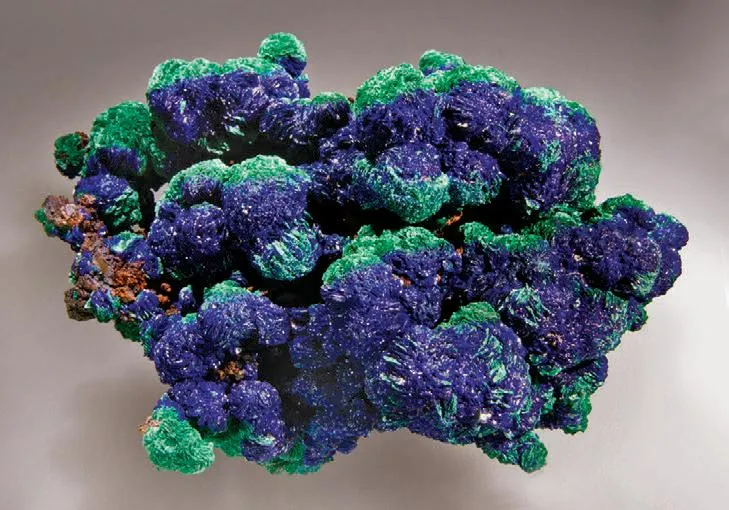
Photo: EarthWonders
Search for specimens: View all specimens from Seabra, Brazil
The Seabra label in mineral collections refers to oxidized copper mineralization from central Bahia, most famously the late-1990s azurite–malachite material attributed in later literature and dealer descriptions to the Ibiajara mine or Ibiajara district. The name entered the collector vocabulary because specimens were marketed at first under the simpler locality “Seabra, Bahia, Brazil,” even though more detailed sources place the source around Ibiajara, a rural district associated with the Rio do Pires–Ibitiara area. Serious labels should ideally preserve both traditions: “Seabra, Bahia” for continuity with older collections, and “Ibiajara mine/district, Bahia” where that information is documented by provenance.
The geological setting belongs to the western Chapada Diamantina/Paramirim domain, where old basement and supracrustal rocks are broken by shears and hydrothermal systems. Official geological reports on the nearby Ibiajara–Baixa Funda mineralization describe the Ibiajara Complex as a low-grade metamorphic supracrustal sequence containing carbonaceous schists, chlorite schists, sericite schists, graphitic phyllites, banded iron formation, metarhythmite, quartzites, quartz-carbonate veins, altered metabasic rocks, and granitoid intrusions. Hydrothermal alteration is a major theme: sericitization, chloritization, carbonatization, tourmalinization, and pyritization are all recorded. That is important for collectors because the specimen minerals are not random surface stains; they are the colorful supergene expression of a copper-bearing hydrothermal system in strongly fractured, iron-rich rock.
The primary ore assemblage documented in the Ibiajara–Baixa Funda area includes pyrite and magnetite with chalcopyrite, pyrrhotite, arsenopyrite, and lesser species, while the oxidized zone carries iron oxides and copper oxides/carbonates including malachite and azurite. In the best Seabra specimens, the brown to black gossan matrix supplies both the physical base and the visual contrast. The blue azurite occurs as lustrous, bladed, rosette-like and botryoidal aggregates; the green malachite commonly preserves the azurite morphology as a pseudomorph, so that the eye still reads the original azurite crystal habit even where the chemistry and color have changed.
Mining history around the relevant Ibiajara–Baixa Funda district predates the specimen boom. The village of Ibiajara was historically known as Santa Maria do Ouro, and the region has a long gold-mining background in the western Chapada Diamantina. Modern exploration in the area involved Billiton Metais S.A. in the late 1970s for base-metal work, followed by Unagem Mineração e Metalurgia S.A., which took over the prospect in November 1988 after the emphasis had shifted toward defining gold and silver reserves. At Baixa Funda, open-pit gold mining ran only from December 1994 to March 1996; the operation was expected to last longer, but economic problems increased as the pit deepened and sulfide content rose. Those dates are useful context because the collector specimens appeared almost immediately afterward in the late 1990s, when small quantities of colorful oxidized copper material reached dealers.
The classic specimen event was the 1997 appearance of Seabra azurite and malachite at the Denver Show. Contemporary and later accounts agree that the find was small, memorable, and quickly absorbed. Mineralogical Record index entries from 1998 record large clusters of azurite spheres with malachite, botryoidal clusters with malachite, and some large malachite/azurite spheres. Later dealer records describe one-time or short-lived production, with some smaller or lesser later finds, including pieces attributed to the 2000s. Even so, the collector identity of the locality rests on the 1997 material: rounded blue azurite balls and rosettes, green malachite replacement zones, and the unusual Bahia provenance.
Collecting access should not be assumed. This is not a public fee-dig locality, and the relevant mines and prospects are private or concessionary mineral ground in rural Bahia. Official sources describe the Baixa Funda operation as inactive by 2018, with only sporadic informal activity by local prospectors using metal detectors, pans, and even improvised explosives in existing excavations. Those are not collecting conditions. Any visit would require permission from landowners and mineral-rights holders, local safety knowledge, and an understanding that abandoned pits, fractured gossan, and sulfide-bearing waste are hazardous. For most collectors, legitimate acquisition is through older collection pieces and reputable dealers with transparent provenance.
Seabra malachite is prized chiefly as a pseudomorph after azurite: green, velvety to finely crystalline replacements preserving rosettes, sheaves, balls, and bladed aggregates of the original azurite, commonly on brown limonite/goethite-rich gossan and often in direct association with remaining deep-blue azurite. Published descriptions of the Ibiajara material emphasize rosettelike sheaves of tabular azurite crystals completely altered to vibrant green malachite, in some cases decorated by a later generation of paler green malachite spherules; dealer examples range from thumbnails and miniatures to substantial cabinet pieces, with recorded specimens around 5–10 cm and rare larger plates to more than 20 cm across. The finest pieces are not merely green crusts: they retain crisp azurite form, show undamaged velvety surfaces, carry attractive contrast against blue azurite or rusty gossan, and display naturally from more than one angle.
Azurite from Seabra occurs as very dark royal-blue to violet-blue rounded aggregates, bladed rosettes, botryoidal crusts, and sparkling crystalline balls, typically with malachite replacement or overgrowth on iron-rich gossan; older descriptions note azurite spheres only a few millimeters across on some specimens, while cabinet examples show botryoidal or rosette fields across many centimeters and rare large plates. Compared with ordinary Seabra pieces that are mostly malachite pseudomorphs, a strong azurite example is valued for keeping a high proportion of intense blue, lustrous azurite rather than being completely replaced; the best specimens combine saturated blue azurite, sharply preserved rosette or ball structure, green malachite accents, minimal bruising, and a stable matrix that does not visually overpower the copper minerals.
Beyond azurite and malachite, the documented Seabra mineral list is small but interesting: olivenite, cornwallite, and cornubite round out the oxidized copper suite. All three are copper arsenates, exactly the sort of accessory species one expects where arsenic-bearing primary sulfides such as arsenopyrite occur in a weathered copper-bearing system. These are not the minerals that made Seabra famous, and they are far less commonly encountered as attractive macro specimens, but they matter to systematic collectors because they show the chemistry of the deposit extending beyond simple copper carbonates. The locality is not known as a type locality; its distinction is instead aesthetic and historical—a brief Brazilian source of fine azurite–malachite combinations and malachite after azurite.
The main authenticity issue with Seabra specimens is not widespread fakery but label precision. Older pieces may be labeled “Seabra, Bahia, Brazil,” while later literature and dealer records identify the classic source as the Ibiajara mine or district. A label saying only “Brazil” is too vague; a label saying “Seabra” is traditional; a label connecting Seabra with Ibiajara is best when supported by provenance. Conversely, do not automatically relabel every Seabra azurite–malachite as Ibiajara unless the specimen history, dealer record, or collection documentation supports it.
Condition is crucial. The best malachite surfaces are velvety and easily flattened by rubbing; azurite aggregates can have bruised high points, chipped rosette edges, or abraded botryoids that appear dull rather than sparkling. Rusty gossan matrices are often heavy, fractured, and irregular, so check the back and base for old repairs, unstable cracks, and friable iron-oxide zones. A large Seabra specimen should be examined under strong side light: damaged azurite balls show pale scuffs, while broken malachite pseudomorphs lose the crisp original blade edges that make the locality desirable.
Treatments are not especially documented for Seabra, but collectors should still watch for consolidation of friable matrix, glued repairs to projecting botryoids, and excessive oiling or wetting used to deepen azurite color in sales photographs. The presence of copper arsenates such as olivenite, cornwallite, and cornubite in the locality suite also argues for sensible handling: avoid making dust, do not trim without proper precautions, wash hands after handling, and keep specimens away from children and pets.
Rarity is real. The finest Seabra material was a small late-1990s market event, not a continuous mine output, and high-quality specimens now appear mainly from older collections. Pieces that are mostly green malachite after azurite are obtainable with patience, but strongly blue, lustrous azurite-rich specimens with vivid green contrast and little damage are much scarcer. Large cabinet pieces with two-sided display, sharp pseudomorph form, and solid provenance are the top tier.
At the 1997 Denver Show, a locality name that few copper collectors had on their wish lists suddenly mattered. The specimens were labeled Seabra, Bahia, Brazil: blue and green rounded masses unlike the tourmalines, quartzes, beryls, and gem pegmatite minerals most buyers expected from Brazil. Reports from the time describe azurite spheres with malachite and botryoidal azurite–malachite clusters, and later accounts remember the find as small enough that the material seemed to vanish almost as soon as collectors learned what it was.
One collector’s memory captures the speed of that disappearance. Michael Shaw later recalled seeing “several flats of these Brazilian azurites” in Luis Leite’s room at the Denver Show in the early 1990s, not buying one, and then realizing the find must have been limited because the pieces “disappeared quickly.” Years later he found an example from an old collection: a 7.2 x 11.5 cm piece with rosette-shaped malachite pseudomorphs after azurite scattered over blue azurite crystals and brown limonite. That is the Seabra story in miniature—brief availability, delayed regret, and the pleasure of a second chance when one resurfaces from an older cabinet.
The mining backdrop is less glamorous but gives the specimens weight. In the Ibiajara–Baixa Funda district, official reports describe a gold-copper system in sheared, altered rocks, with oxidized copper colors visible at the surface and sulfides increasing at depth. The Baixa Funda open pit operated from December 1994 until March 1996, then became uneconomic as the pit reached about 50 meters and sulfide concentration rose. The collector specimens emerged into the market at just the moment when oxidation, small-scale extraction, and old exploration had exposed the colorful upper part of the system—but before sustained specimen production could ever become routine.