






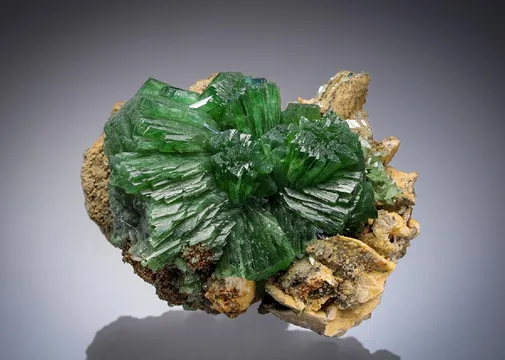
Ludlamite: vivid emerald-green crystals with glassy luster; prized for color, rarity, and localities like Huanggang, Huanuni, Huanzala for collecting value.
Key facts
Ludlamite is a hydrated iron phosphate prized for its vivid, saturated green color and unexpectedly high luster. Well-formed crystals can look almost glassy—often transparent to gemmy—and occur as sharp wedges, blades, or blocky prisms. The best specimens show rich emerald to yellow‑green hues with bright reflections, frequently perched on contrasting matrix such as brown siderite, metallic sulfides (pyrite, sphalerite), or snowy quartz. Though typically a thumbnail to miniature species, a handful of pockets have yielded multi-centimeter crystals and beautiful clusters, making ludlamite a boutique favorite among collectors of phosphates and sulfide-vein species.
Crystallizing in low-temperature hydrothermal environments, ludlamite is closely associated with iron-rich deposits and polymetallic veins. Color, clarity, and luster can be outstanding; however, the mineral is relatively soft and brittle, so pristine terminations and damage-free clusters are rarer than they look. Fine modern finds from China’s Huanggang Mine and classic material from Bolivia’s Huanuni Mine and Peru’s Huanzala Mine set the standard.
Ludlamite’s appeal lies in its combination of color, brilliance, and scarcity of top-quality specimens. It is less common on the market than many carbonates and silicates, and fine crystals are concentrated in a few notable mining districts. Collectors of phosphates and sulfosalt assemblages especially appreciate ludlamite’s aesthetic contrasts—bright green crystals against bronze siderite or metallic sulfides. Over the past decade, transparent, sharply terminated crystals from Huanggang invigorated interest, while older classics from Huanuni and Huanzala remain benchmarks. Prices range widely: small but sharp thumbnails can be accessible, yet larger, lustrous, transparent crystals on attractive matrix can command strong premiums.
While ludlamite occurs at scattered localities worldwide, a few districts are renowned for producing the most desirable specimens.
A Bolivian classic. The Huanuni Mine (Oruro Department) has long produced lustrous, saturated green ludlamite in sharp wedge- to blade-like crystals, typically associated with siderite, pyrite, sphalerite, and quartz. Many specimens show excellent contrast—bright green perched on chocolate-brown siderite or nestled among metallic sulfides. Crystal size is usually modest, but clusters with multiple terminations and textbook form are well known from the district. Because pockets often occur in brittle, sulfide-rich vein environments, undamaged, unrepaired specimens are relatively scarce, and matrix pieces with good balance are strongly valued by collectors.
Aesthetics Checklist:
Ludlamite is a hydrated iron phosphate (Mohs ~3.5–4) and, despite its bright luster, is relatively soft and brittle. Handle and clean with care.
With thoughtful selection and careful handling, a vibrant green ludlamite—especially a sharp, lustrous cluster on contrasting matrix—can become a centerpiece in any phosphate or sulfide-vein suite.