Bisbee, USA: a historic copper-ore district famed for blue-green malachite, azurite roses, cuprite, native copper, and sculptural copper-carbonate forms.
Key facts
Bisbee is one of the great American copper camps and one of the classic mineral localities of the world: a porphyry-centered, carbonate-replacement district where copper-rich hypogene ores, deep supergene enrichment, reactive limestone, intrusive breccias, clay zones, and open oxidation caves combined to make specimens of extraordinary color and complexity. The locality is not a single mine in the collector’s sense, but a dense cluster of historically connected workings in the Warren mining district of the Mule Mountains, including the Copper Queen, Czar, Holbrook, Sacramento, Gardner, Cole, Campbell, Junction, Southwest, Shattuck, Dallas, Higgins, and Lavender Pit areas.
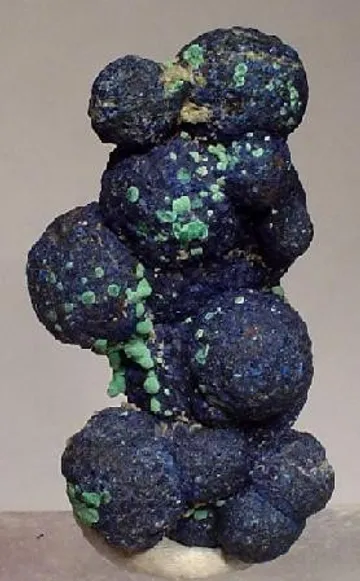
Collectors know Bisbee first for blue and green copper carbonates: velvety malachite stalactites, azurite roses and botryoids, malachite pseudomorphs after azurite, and old cabinet specimens whose color reads as a saturated contrast between midnight blue, emerald green, iron-stained brown, and pale carbonate gangue. The district is equally important for cuprite, native copper, calcite, aragonite, connellite, brochantite, chalcoalumite, turquoise, spangolite, shattuckite, rare tellurium minerals, and a long list of type-locality or near-type-locality species. Its best pieces have the unmistakable “Bisbee look”: sculptural copper-carbonate forms built in cavities, often on goethite or altered limestone, with glassy to velvety luster and a patina of age that separates them from newer, brighter but less historically resonant material.
Regional View
Country View
The geology is central to the collecting story. Bisbee’s Paleozoic carbonate section—especially limestone units favorable to replacement—was cut by Jurassic intrusive rocks and later by the Sacramento Stock complex, porphyry dikes, sills, faults, and breccia bodies. Copper-bearing sulfides and iron sulfides were emplaced in and around this fractured carbonate environment, then oxidized and locally reworked into spectacular secondary assemblages. The same geological architecture that made Bisbee a major copper producer also produced pockets where azurite, malachite, cuprite, calcite, aragonite, goethite, and rare copper chlorides and sulfates could grow in open space.

Photo: Wikimedia Commons
Search for specimens: View all specimens from Bisbee, USA
Bisbee lies in southeastern Arizona near the Mexican border, in the Mule Mountains of Cochise County. Mineral collectors usually use “Bisbee” broadly, covering the old Warren district mine groups rather than only the present city limits. The early mines were underground carbonate-replacement copper mines, while later production included the Sacramento Pit and the Lavender Pit, where lower-grade disseminated and breccia-hosted ores were mined by open-pit methods.
The district’s basement is Precambrian Pinal Schist, overlain by a thick Paleozoic carbonate and clastic sequence that includes the Bolsa Quartzite, Abrigo Limestone, Martin Limestone, Escabrosa Limestone, Naco Limestone, and related units. The Martin Limestone was especially important in the underground mines because it hosted many replacement deposits and oxidation caves. Jurassic intrusive rocks and the Sacramento Stock complex cut this section, and intrusive breccias, contact breccias, silica breccias, faults, and dikes provided the plumbing and preparation for ore. The economic copper orebodies were commonly arranged around the Sacramento Stock in crescent-like and spoke-like patterns controlled by fracture zones and faults.
Bisbee’s ores formed in multiple mineralizing episodes. Early silicification and pyritization created immense masses of pyrite and iron oxides; later copper-bearing solutions formed bornite, chalcopyrite, chalcocite, and related sulfides in limestone replacement bodies, breccias, and intrusive rocks. A final, more elementally diverse phase introduced precious metals and rarer elements such as tin, bismuth, tungsten, vanadium, arsenic, antimony, and tellurium. Near-surface oxidation and supergene enrichment then transformed large parts of the district into the carbonate, oxide, sulfate, chloride, and silicate assemblages prized by collectors.
Mining began after mineralization was noticed in 1877 by Jack Dunn during an Army scouting expedition in the Mule Mountains. Claims followed rapidly, and the Copper Queen became the foundational mine of the camp. Bisbee was incorporated in 1902 and by 1910 had become one of the largest communities in Arizona Territory. Over nearly a century of mining, the district produced roughly 8 billion pounds of copper, 102 million ounces of silver, 2.8 million ounces of gold, and significant zinc, lead, and manganese. Phelps Dodge became the dominant operator through the Copper Queen Consolidated Mining Company, while Calumet & Arizona, Shattuck-Arizona, Denn-Arizona, and other companies also played major roles in the district’s history.
The Czar Mine is one of the most important specimen names attached to Bisbee. Although old labels often say “Copper Queen,” many specimens hoisted through or traded under the Copper Queen name likely came from Czar workings after the mid-1880s, when ore extraction shifted into the more efficient Czar Shaft. Classic Czar specimens include azurite and malachite stalactites, goethite boxwork with copper carbonates, cuprite with connellite, malachite pseudomorphs after azurite, and many of the old-time cabinet pieces that established Bisbee’s reputation in late nineteenth-century collections.
The Holbrook Mine and Holbrook Extension are essential for collectors of zincian azurite, malachite, chalcoalumite, and altered copper-carbonate assemblages. The Holbrook area produced light blue and green zinc-bearing azurite and malachite specimens, banded azurite-malachite material, and later, when the Lavender Pit cut through older underground workings, thousands of specimens were recovered from old stopes, crosscuts, and clay-rich oxidized zones. The Holbrook Extension of the Lavender Pit is also the key locality for much of Bisbee’s chalcoalumite, especially thin blue-green replacement crusts and pseudomorphs after azurite.
The Southwest Mine and Campbell Mine are best known to collectors for calcite, aragonite, cuprite, copper, post-mining cave minerals, and delicate secondary assemblages. The Southwest Mine produced handsome calcite forms—loops, helictitic growths, tinted stalactites, pseudohexagonal crystals, and copper-stained carbonate specimens—as well as cuprite from the 5th level 14 stope and aragonite from the 6th and 7th levels. The Campbell Mine produced calcite, aragonite, copper, and, in its deeper sulfide environment, the highly specialized telluride assemblage that later yielded henryite and co-type kiddcreekite.
The Cole Mine is a collector’s locality in two very different ways. In the oxidized zones it produced cuprite, native copper, connellite, wulfenite, malachite, brochantite, and rare species, including the graemite holotype from the 1200 level 202 stope. In the sulfide zones it produced pyrite, chalcocite, chalcopyrite, bornite, gold, silver, and minor rare telluride and tungsten-bearing minerals. The Shattuck Mine is equally famous scientifically, as the source of shattuckite and the discredited but historically important bisbeeite from the 200-level type-locality material.
Collecting access today is very different from the historic period. Bisbee specimens on the market are overwhelmingly old mine material, former miner or company pieces, museum deaccessions, private-collection specimens, and material recovered when open-pit mining exposed older underground workings. The major mines and pits are not casual collecting sites. The Queen Mine Tour preserves a controlled underground visitor experience, but it is a heritage tour rather than a collecting opportunity. Any field collecting around old dumps, prospects, or private holdings requires current permission, careful land-status checks, and respect for safety closures; many Bisbee mine workings, dumps, and pit margins are dangerous, unstable, private, or restricted.
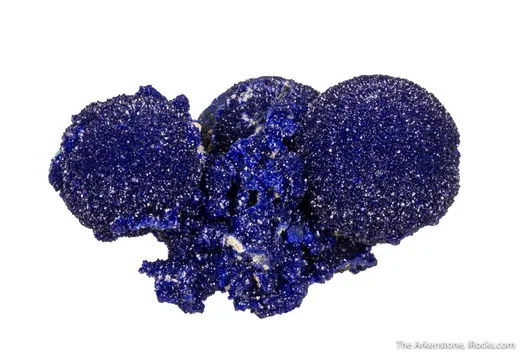
Bisbee azurite ranges from tiny sparkling crystals in goethite-lined vugs to cabinet-size masses of rosettes, bladed botryoids, stalactitic crusts, spherical aggregates, and epitaxial overgrowths on earlier malachite pseudomorphs after azurite. The classic color is a very deep, saturated blue to blue-black, but Holbrook and related material can show lighter, zincian blue to blue-green tones. Noted occurrences include the Czar Mine, Holbrook Mine, Holbrook Extension, Sacramento Mine, Gardner Mine, Higgins Mine, Junction Mine, Southwest Mine, and Spray Mine; associations include malachite, goethite, calcite, quartz, chalcocite, cuprite, and altered limestone. Ordinary Bisbee azurite is plentiful as fragments or dull crusts, but fine specimens combine rich color, intact velvet or glassy luster, sharp rosettes or botryoids, contrasting malachite, and old labels tying them to named mines or levels.
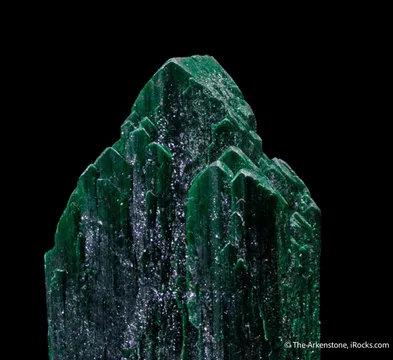
Bisbee malachite is famous for velvety stalactites, botryoidal crusts, chatoyant banded slabs, acicular sprays, pseudomorphs after azurite, replacements of copper, and green coatings or masses on goethite, calcite, and altered limestone. Czar, Holbrook, Sacramento, Gardner, Cole, Southwest, Campbell, and the Holbrook Extension all produced memorable malachite, including stalactites several centimeters long, pseudomorphs retaining azurite rose and blade forms, and large display specimens such as Holbrook pieces with malachite and azurite on the 400 level. Fine examples show undamaged velvet, strong three-dimensional form, natural contrast with azurite or goethite, and clear pseudomorphic structure; common pieces tend to be massive, rubbed, broken stalactitic material or attractive but non-specific green coatings.
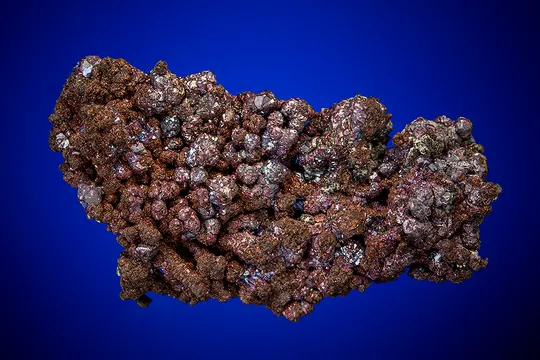
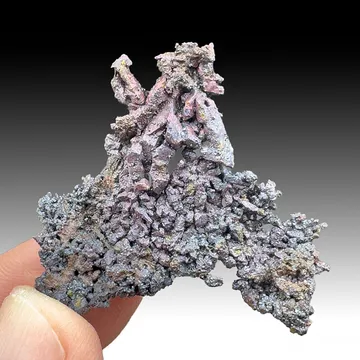
Native copper from Bisbee occurs as spongy masses, arborescent clusters, elongated crystals, spinel twins, botryoidal-looking pit material, and remarkable pseudomorphic or overgrown combinations with cuprite and malachite. Named occurrences include the Holbrook Mine, Lavender Pit Holbrook Extension, Czar Mine, Cole Mine, Campbell Mine, and Dallas Mine; one notable Dallas specimen is described as copper pseudomorphs after dodecahedral cuprite crystals on copper from the 10D stope, 1400 level, while Campbell material includes large spinel-twin copper from the 2200 level. The best Bisbee copper is not merely native metal: it has sculptural crystal form, old patina, cuprite veneer, malachite or silver association, or a documented mine-and-level provenance that anchors it in the district’s complicated underground history.
Cuprite is one of Bisbee’s signature collector minerals, occurring as massive red ore, small octahedral crystals, coatings on copper, malachite-coated crystals, and the hairlike variety chalcotrichite in oxidized copper zones. The Czar, Cole, Southwest, and Copper Queen-associated workings are especially important, with examples including chalcotrichite on goethite from the 400 level of the Czar Mine, cuprite on atacamite from the 14 stope on the 5th level of the Southwest Mine, and cuprite with connellite, atacamite, goethite, and malachite from Cole and Southwest pockets. Fine Bisbee cuprite is judged by crystal integrity, red translucency where present, contrast with blue connellite or green malachite, and the rarity of the assemblage; many specimens are massive, altered, or partially replaced and appeal more as ore-suite pieces than as crystallized cuprite.
Calcite at Bisbee is not just gangue; it is one of the district’s most expressive cavity minerals, forming white to colorless rhombohedra, pseudohexagonal crystals, loops, helictitic sprays, stalactites, butterfly twins, copper-tinted masses, and crystals with inclusions of cuprite or goethite phantoms. The Southwest Mine is the premier calcite name, particularly the 6th, 7th, and 8th levels, but important pieces also came from the Holbrook Mine, Czar Mine, Campbell Mine, and other oxidation-cave environments. The strongest calcites have eccentric growth forms, copper-green staining, included cuprite, hematite or goethite contrast, and undamaged delicate terminations; ordinary pieces are common white carbonate without the strange forms or copper associations that make Bisbee calcite distinctive.
Goethite at Bisbee is both a specimen mineral and the stage on which many copper secondaries grew: black to brown boxwork, stalactites, botryoidal crusts, iridescent coatings, hard vug linings, and pseudomorphs after calcite occur throughout the oxidized ores. Czar specimens include goethite boxwork with malachite and azurite, stalactites with bright acicular malachite, and classic goethite supporting copper-carbonate assemblages, while Southwest Mine material includes goethite stalactites coated with calcite and 6th-level pieces associated with malachite. Fine goethite from Bisbee is rarely valued as a plain brown iron oxide; it becomes important when it preserves open-space texture, stalactitic growth, iridescence, or high-contrast associations with azurite, malachite, calcite, chalcoalumite, or cuprite.
Bisbee is the type locality for chalcoalumite, and the finest material is tied to the Holbrook Mine and the Holbrook Extension of the Lavender Pit, where pale turquoise-blue to blue-green crusts replaced malachite and azurite in a narrow, chemically specialized environment close to the Sacramento Stock. It occurs as thin friable crusts, drusy coatings, cast pseudomorphs after azurite, replacements of botryoidal azurite or malachite, small stalactitic forms, and tiny clusters in hard goethite vugs; typical thickness is only a few millimeters, and the material often flakes from its copper-carbonate substrate. Good pieces are unusually difficult to obtain undamaged: the best show recognizable azurite pseudomorph form, fresh blue-green color, minimal iron-clay staining, and stable attachment, while many old specimens were mislabeled chrysocolla, allophane, or later confused with gibbsite and related pale alteration products.
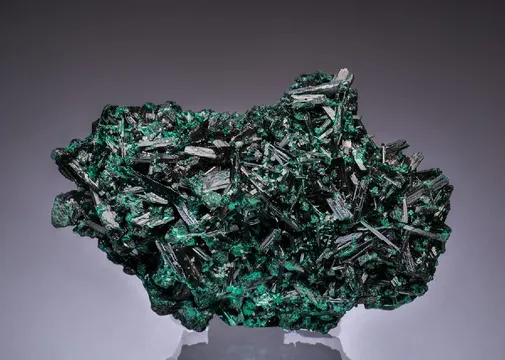
Brochantite is a rarer but respected Bisbee copper sulfate, occurring in oxidized copper environments as dark green crystals, crusts, and associated micro- to small-cabinet assemblages rather than as the large display pieces for which azurite and malachite are known. Documented Bisbee associations include jarosite on brochantite from the Uncle Sam Mine, brochantite with wulfenite and anglesite in Cole Mine material, and occurrences in the Shattuck and Copper Queen-related mineral lists. Fine examples are judged by sharp crystal development, diagnostic dark green color, and reliable association or analysis, because brochantite can be visually confused with other green copper secondaries in Bisbee’s complex oxidation suite.
Bisbee aragonite is best known from cave and post-mining environments, especially the Southwest and Campbell mines, where it forms white, colorless, copper-tinted, bluish, acicular, helical, anthodite, and “bird’s nest” growths. The 6th and 7th levels of the Southwest Mine produced attractive aragonite with calcite, dolomite, rosasite, malachite, and conichalcite staining, while Campbell Mine examples include post-mining bird’s nest forms from the 2200 level. The most desirable pieces are airy, sculptural, and intact, with copper tinting or associated secondary minerals; ordinary aragonite from Bisbee is fragile, pale, and easily broken, making undamaged specimens with precise level data especially collectible.
Quartz at Bisbee appears as vein quartz, chert remnants from replaced limestone, silica-breccia matrix, small colorless crystals, amethystine material in limited pockets, and epimorphs or casts after calcite. Collector pieces include azurite with malachite and quartz from the Holbrook Mine, quartz epimorph casts after large calcite crystals from the 2200 level of the Campbell Mine, and amethyst with calcite and malachite from the Junction Mine. The best Bisbee quartz is valued for context rather than size: residual chert fragments recording carbonate replacement, epimorphs after calcite, or unusual associations with azurite, malachite, gold, sulfides, or copper minerals are far more interesting than plain quartz from the district.
Connellite from Bisbee is a rare, delicate blue copper chloro-sulfate, classically found with cuprite, atacamite, goethite, and malachite in oxidized copper pockets. The Czar, Cole, Southwest, and Calumet & Arizona-related material are central to its Bisbee story; typical specimens show blue sprays of tightly intergrown acicular crystals in massive cuprite, and Southwest material includes crystals to several millimeters with atacamite and spertiniite in cuprite from the 14 stope on the 5th level. Fine pieces are small but vivid, with undamaged blue sprays and strong contrast against red cuprite; ordinary examples require magnification and can be overlooked or misidentified unless the cuprite association is clear.
Siderite is a minor Bisbee carbonate of collector interest, documented in the district’s complex carbonate and oxidation assemblages and especially notable as epimorph casts after calcite from the Holbrook Extension of the Lavender Pit. Bisbee siderite specimens are not generally large display minerals; they matter because they preserve replacement textures and tell a localized story of changing carbonate chemistry in the same altered environment that produced copper carbonates, clay-rich supergene assemblages, and late cavity minerals. The best pieces show clear calcite-cast form, fresh brown carbonate surfaces, and precise Holbrook Extension provenance, while unremarkable massive siderite is easily lost among the district’s more colorful copper species.
Bisbee wulfenite is a scarce accessory mineral of the lead-bearing oxidized zones, most prominently documented from the Cole Mine, where it occurs as small tabular to blocky crystals with calcite, malachite, azurite, hematite, anglesite, brochantite, or corroded galena. Known examples include a 1.1 cm multi-zoned crystal in a hematite vug and colorless crystals on corroded galena with minor brochantite. Fine Bisbee wulfenite is uncommon and should be judged differently from the famous Arizona lead-mine wulfenites: provenance, association, and crystal completeness matter more than size or orange color, and even small Cole pieces are desirable when well documented.
Scheelite is a rare Bisbee tungsten mineral tied to the district’s late, multi-element mineralization and documented particularly from the Cole Mine and an unnamed prospect pit in the Warren area. In the collector market, Bisbee scheelite is usually a small, locality-driven specimen rather than a dramatic display piece, and it may occur with other late-stage or lead-zinc-copper assemblage minerals. The best examples have confirmed identification, fluorescence if observable, and precise mine provenance; without those, small pale scheelite can be visually unconvincing among Bisbee’s crowded suite of light carbonates, quartz, fluorite, powellite, and other accessory minerals.
Chrysocolla from Bisbee occurs as blue to green copper silicate coatings, massive material, vein fillings, replacements, and mixtures with malachite, azurite, and quartz, especially in oxidized copper zones and lapidary material. It is important partly because the Bisbee name has long been attached to copper-silicate material, including the historically disputed “bisbeeite,” which was ultimately discredited and often involved shattuckite, planchéite, or chrysocolla-like mixtures. Fine chrysocolla from Bisbee is attractive when it shows rich color, strong association with azurite or malachite, tight matrix, or good polish as “Bisbee blue” style lapidary material; ordinary pieces are difficult to separate visually from other southwestern chrysocolla without reliable provenance.
Beyond these species, Bisbee’s mineralogical importance rests on a remarkable list of rarities and type-locality or near-type-locality minerals. Chalcoalumite is a confirmed Bisbee type-locality species from the Holbrook area. Shattuckite was named for the Shattuck Mine, where it occurs as pale blue to gray-blue pseudomorphs after malachite and associated spherulitic sprays; the historical bisbeeite material from the same Shattuck occurrence has been discredited but remains a famous problem in copper-silicate mineralogy. Paramelaconite, one of the legendary Bisbee species, is represented by only a handful of pieces, including type material associated with connellite, goethite, cuprite, copper, and malachite. Graemite, named for Richard Graeme, came from the 1200 level 202 stope of the Cole Mine as a tellurium-bearing mineral replacing teineite on a malachite-cuprite specimen. Henryite is known from microscopic grains in drill core from the Campbell orebody, and kiddcreekite has Bisbee Campbell material as co-type material. Spangolite, although historically debated in its exact type-locality attribution, is strongly tied to Bisbee material in appearance, association, and collector tradition, with Czar Mine specimens among the finest known.
Bisbee is a locality where labels matter. Old specimens marked “Copper Queen” may actually represent Czar, Holbrook, or other Copper Queen Consolidated workings, because “Copper Queen” was used both as a mine name and as a company/camp shorthand. That does not necessarily make such a label wrong in the historical trade sense, but a specimen with a precise mine, stope, level, or old collection pedigree is more informative and usually more desirable.
The most important mislabeling issue is not geographic but mineralogical. Chalcoalumite was historically labeled chrysocolla or allophane, and some pale alteration products such as gibbsite, nordstrandite, halloysite, allophane, or alunite-like crusts can resemble it. True Bisbee chalcoalumite is commonly a late blue-green replacement crust on malachite or azurite, often friable and poorly attached. It should not be bought as a premium specimen without convincing morphology, association, and, for high-value examples, analytical confidence or a strong old pedigree.
Shattuckite also requires caution. Genuine Bisbee shattuckite from the Shattuck Mine is typically pale blue to gray-blue, porous to boxwork-like, and often a replacement of malachite; it does not usually resemble the richer blue, vein-style, quartz-bounded material familiar from Ajo and other Arizona localities. Ajo shattuckite has been sold as Bisbee, and the difference matters because Bisbee is the namesake locality and true material is far less common.
Condition is a major pricing factor. Azurite roses and botryoids can have rubbed high points, edge bruises, dull surfaces, or repaired breaks. Malachite velvet is easily abraded and may be dusty or flattened on exposed ridges. Cuprite may be massive, partially altered, or coated; chalcotrichite and connellite sprays are extremely delicate. Calcite and aragonite from Bisbee oxidation caves can be highly sculptural but brittle, cleaved, or incomplete. Chalcoalumite flakes, stains, and detaches. Old Bisbee specimens may have minor historic bruising that collectors tolerate when the form, color, provenance, or rarity is exceptional, but fresh-looking repairs and glued fragments should be disclosed.
Fluorescence can be useful but should not be overemphasized. Calcite, aragonite, scheelite, and some post-mining or secondary species may respond to ultraviolet light, but Bisbee’s collector value is usually built on mineral association, locality precision, and visual quality rather than fluorescence alone. Handle all copper minerals with dry hands, avoid soaking friable specimens, keep malachite velvet and chalcoalumite away from ultrasonic cleaning, and store delicate blue-green copper chlorides and sulfates in stable, dry conditions.
Market availability is uneven. Small azurite-malachite pieces, massive copper carbonate ore, and modest malachite pseudomorphs appear regularly. Fine old Czar, Holbrook, Copper Queen, and Sacramento azurite-malachite cabinets are much scarcer and command strong premiums. Top chalcoalumite, connellite on cuprite, fine Bisbee cuprite, documented copper twins, excellent Southwest calcite, and rare type-locality species are substantially harder to replace. Museum-grade Bisbee pieces with old labels from Foote, Bement, Vaux, Shattuck, Douglas, Graeme, Smithsonian, Harvard, or major private collections should be treated as historical objects as much as mineral specimens.
The Bisbee story begins, as many western mining stories do, with somebody looking for one thing and finding another. In 1877, an Army reconnaissance detail entered the Mule Mountains searching for Apaches; civilian tracker Jack Dunn noticed mineralization instead—lead, copper, perhaps silver. Claims followed, George Warren’s name became attached to the district, and the Copper Queen turned a remote canyon camp into the “Queen of the Copper Camps.” By 1910, Bisbee was one of the largest communities in Arizona Territory, built on copper but remembered by collectors for the blue and green minerals that rode out of the stopes in ore cars, lunch pails, company sacks, and, later, museum crates.
The old Copper Queen and Czar workings produced one of the strangest chapters in American mineral collecting: the paramelaconite story. In 1890, Philadelphia dealer A. E. Foote visited Bisbee and acquired two specimens of an unknown black tetragonal copper oxide. Local tradition places them on a shelf in the Copper Queen assay office when Foote saw them. He sold them for $50 apiece—serious money in the 1890s—to Clarence S. Bement, whose collection would later pass through J. P. Morgan to the American Museum of Natural History. George A. Koenig studied the material in 1891 and named paramelaconite. One co-type piece bore a magnificent black crystal about 3 cm across on goethite-covered cuprite, with blue connellite then thought to be “footeite” and a silvery-green coating later identified as malachite. Bisbee continued mining for roughly 85 more years, through stopes full of cuprite-like environments, yet no comparable paramelaconite was ever found again.
The chalcoalumite story is quieter but equally Bisbee. For decades, pale blue-green crusts from the Holbrook area sat in collections under other names—chrysocolla, allophane, sometimes simply “blue copper mineral.” In 1925, Esper Larsen and Helen Vassar described chalcoalumite from Bisbee material sent through Ward’s Natural Science Establishment. Later work and district knowledge tied the source to the Holbrook Mine between the 200 and 300 levels, near the Sacramento Stock complex. When the Lavender Pit’s Holbrook Extension cut through old ground from late 1969 into the early 1970s, electric shovels sliced through clay-rich oxidized ore that earlier underground miners had found difficult and treacherous. Delicate crusts of chalcoalumite on malachite and azurite were salvaged as specimens, but the same blast and shovel work that exposed them often damaged them. A thin crust only 1 to 7 mm thick, poorly attached to its host and stained by iron-rich clay, is a hard thing to bring home whole.
Richard Graeme’s graemite discovery has the feel of a miner-collector adventure from another age. In July 1959, during a summer maintenance shutdown, the teenage Graeme entered the Cole Mine to look for minerals in the 202 stope on the 1200 level. The stope had been cleaned, but three loaded mine cars nearby still held oxide ore from the area. He dug through the muddy rock, wrapped a few promising pieces in newspaper, and faced the climb back up 1,200 feet of manway followed by a several-mile walk home in the dark. One cleaned specimen was different: spongy malachite with small cuprite crystals, a prominent blue-green crystal about 2 cm long, and small electric-blue crystals protruding nearby. For years, knowledgeable collectors and geologists thought the odd minerals might be chalcophyllite and connellite. In the 1970s, Sidney Williams and Phillip Matter studied the piece and recognized a new species replacing teineite. In 1975 they named it graemite, after the collector who had carried it out of the mine as a muddy curiosity.
Bisbee’s mines also left a hard civic memory. On July 12, 1917, after a strike in which nearly half of Bisbee’s 4,700 miners had walked out, armed groups rounded up miners and supporters beginning in the downtown plaza. Men who refused to return to work were marched about four miles to the Warren Ball Park. There, 1,186 deportees were loaded into a special train of 23 cattle and box cars on the Phelps Dodge-controlled El Paso & Southwestern line. The train left Warren around noon for Columbus, New Mexico, 174 miles away; when Columbus officials refused them, the train backtracked to Hermanas, where the men were abandoned near an Army camp. The event became the Bisbee Deportation, argued for years in courts and newspapers as patriotism in wartime copper production or as a violation of basic rights.
The Lavender Pit changed Bisbee’s landscape almost as dramatically as the underground mines had built it. Open-pit mining first removed Sacramento Hill, once a landmark; production from the Sacramento Pit began in 1921, and within 12 years more than 32 million tons of material had been moved. Work on the Lavender Pit began in 1951. Its benches spiraled outward to swallow the Sacramento Pit and much of Lowell, ultimately reaching about 900 feet deep, a mile long, and a half-mile wide. Hundreds of houses were moved, U.S. 80 was shifted north, and the rail line into Bisbee disappeared. To collectors, those huge cuts were destructive and revealing at the same time: they erased old ground but also reopened old underground stopes, crosscuts, clay pockets, calcite caves, Holbrook workings, and specimen zones that would otherwise have remained sealed.