Holbrook Extension, USA - Bisbee-area locality known for azurite, malachite, cuprite and other oxidation copper minerals, prized for its Bisbee-era color, rari…
Key facts
Holbrook Extension is the collector’s name for the northwestern extension of the Lavender Pit at Bisbee, in the Warren Mining District of Cochise County, Arizona. It matters because it cut directly through the ground of the old Holbrook Mine, one of Bisbee’s classic underground sources of azurite and malachite, and then exposed the same oxidized copper system to large-scale open-pit mining in the late 1960s and early 1970s. For specimen collectors, the locality sits at the intersection of two Bisbee eras: the romantic underground period of stopes, oxidation caves, and timbered crosscuts, and the mechanized Phelps Dodge open-pit period that sliced through old workings and released thousands of specimens that otherwise would have remained underground or gone straight to the smelter.
Geologically, this is Bisbee in miniature: copper replacement and breccia-hosted ore related to the Sacramento Stock complex, developed in Paleozoic carbonate rocks and intrusive breccias, then profoundly overprinted by oxidation. The Holbrook Extension exploited oxidized ore rather than fresh sulphide ore, so its collector identity is built around secondary copper minerals—especially dark to light blue azurite, rich green malachite, cuprite, iron oxides, calcite, and the rarer aluminum sulphate assemblages that mark the Holbrook ground. Its best pieces have the unmistakable Bisbee look: botryoidal and spherical blue azurite, velvety or chatoyant malachite, vuggy copper-stained carbonate matrix, brown to black goethitic crusts, and, rarely, pale blue-green chalcoalumite replacing or coating earlier copper carbonates.
Regional View
Country View
Holbrook Extension material is not merely “Bisbee azurite-malachite” in a loose marketing sense. The locality name is meaningful because the extension re-mined a very specific portion of the Holbrook Mine area, close to the Sacramento Stock complex, where old underground workings, oxidation caves, clay-rich supergene ground, and high-grade copper oxide ore all converged. Labels may vary—Holbrook Extension, Holbrook Pit, Lavender Pit, Holbrook Mine, Copper Queen Mine, or simply Bisbee—but the best documented pieces tie back to the late-1969 through early-1974 open-pit mining of this Holbrook ground, or to older Holbrook Mine material later exposed and consumed by the extension.
Search for specimens: View all specimens from Holbrook Extension, USA
Holbrook Extension is part of the Lavender Pit at Bisbee, within the Warren Mining District of the Mule Mountains. In specimen literature it is normally given as Holbrook Extension, Lavender Pit, Bisbee, Cochise County, Arizona, USA. The locality is physically and historically inseparable from the older Holbrook Mine: the open pit advanced into the area of the Holbrook workings, mined out both Holbrook shafts in 1969, and exposed stopes, crosscuts, oxidation cavities, and remnant oxide ore left by underground mining.
The broader Bisbee system is a complex copper-lead-zinc replacement and porphyry-related district centered on the Sacramento Stock complex. Paleozoic carbonate rocks—especially the Abrigo, Martin, Escabrosa, and lower Naco limestones—were cut by Jurassic intrusions, breccias, and fault systems. Ore deposition took place in several stages, with large pyritic replacement bodies, copper-bearing replacement ore, later lead-zinc mineralization, and a small but mineralogically rich multi-element phase. At Holbrook Extension, the collector minerals are products of oxidation of copper ore: azurite, malachite, cuprite, iron oxides, calcite, and aluminum-rich sulphates and silicates formed where copper solutions moved through cavities, breccia, clay zones, and carbonate host rocks.
The Holbrook ground was unusually favorable for specimen formation because it combined high-grade copper oxide ore with open space. Bisbee’s oxidation caves are not casual vugs; some were large solution cavities in limestone above or beside oxidized ore bodies, lined with calcite, iron oxides, and copper carbonates. The Holbrook Mine history records one early cave encountered in 1883 on the Cave Claim, reached from a working about 30 feet down, then explored by candlelight after a man was lowered another 50 feet. That cave was described as roughly two acres in extent and about 50 feet high, with copper-stained stalactites, stalagmites, and velvety copper carbonate coatings. Those are precisely the environments that produced the spherical azurite, malachite crusts, calcite-lined cavities, and goethitic matrices collectors associate with old Bisbee.
The Lavender Pit began as Phelps Dodge’s major open-pit answer to lower-grade copper ore at Bisbee. Stripping began in 1951, the pit was named for Harrison M. Lavender after his death in 1952, and ore production began in 1954. As the operation expanded, exploration moved toward the old Holbrook Mine area: an air raise into the Holbrook Mine was rehabilitated, underground diamond drilling was undertaken, and enough ore was outlined that the Holbrook Extension was announced in 1965. The extension mined mainly copper oxide ore—especially azurite, malachite, and cuprite—which was sent directly to the smelter. Mining in the Lavender Pit continued until December 14, 1974.
The key specimen-producing period for the Holbrook Extension was late 1969 through the early 1970s, when the pit cut through old Holbrook ground. Large electric shovels moved through clay-rich supergene zones and old stopes that had been difficult or dangerous for underground miners. This open-pit phase recovered thousands of specimens, many reportedly salvaged by Phelps Dodge personnel as mining exposed them. Some pieces entered museums, some were sold through the company store, and many others circulated locally or through Arizona dealers with varying levels of label precision.
Documented Holbrook Extension finds include azurite spheres to about 2 cm, azurite crystal clusters and vugs, malachite crusts on siliceous breccia, malachite pseudomorphs after azurite, calcite stained green by copper, native copper nodules in clay zones, and rare chalcoalumite on or replacing azurite and malachite. The extension also exposed remnants of old workings in its walls. In the late 1980s and early 1990s, collectors entered a stope on the old Holbrook 100 level from the pit wall and found mostly calcite, but also malachite pseudomorphs after azurite, small azurite crystals on calcite, a powder-magazine area, and an oxidation cave with iron-stained calcite crystals reportedly reaching six inches in the lower portions and green copper staining higher up.
Collecting access today should be regarded as closed unless explicit permission is obtained from the land and mineral-rights holder. The Holbrook Extension is part of an inactive open-pit mine complex with unstable highwalls, exposed old underground workings, loose rock, possible hazardous water, and metalliferous mine waste. Modern collecting is not a casual rockhounding proposition; the locality is represented in the market almost entirely by older collected material, estate specimens, dealer stock, and pieces with Phelps Dodge, Bisbee, or Arizona collector provenance.
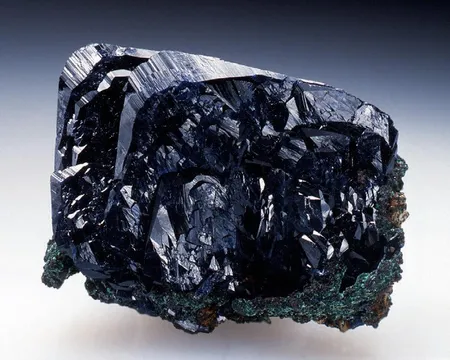
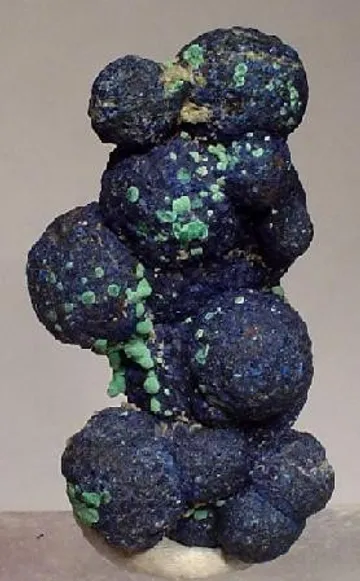
Azurite from Holbrook Extension is prized for the classic Bisbee habit of deep blue to lighter blue botryoids, spheres, rosettes, crusts, and vug linings rather than for large isolated prismatic crystals. Documented extension material includes spherical azurite aggregates to about 2 cm, sparkly bladed botryoidal linings in vugs, etched azurite with microscopic cuprite and chalcoalumite, and blue azurite preserved with malachite, goethite, calcite, and copper-stained carbonate or breccia matrix. The best pieces show strong three-dimensional form: open pockets, grape-like blue spheres, sharp contrast with green malachite, and minimal bruising on the high points. Ordinary pieces tend to be thin crusts, broken oxide ore, or dark azurite patches without relief; the most desirable examples retain the sculptural Holbrook/Lavender character and, ideally, old provenance from the 1969–1974 open-pit recovery period or older Holbrook Mine labels.
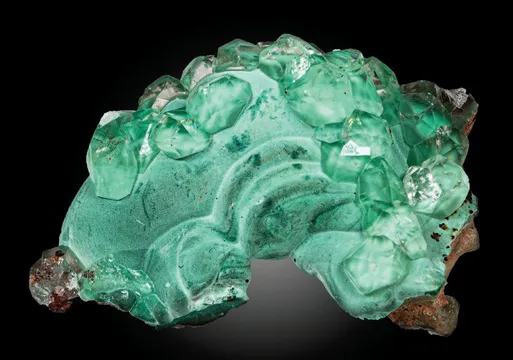
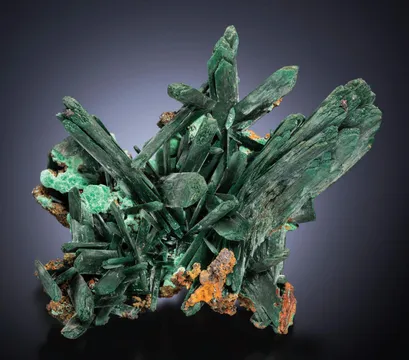
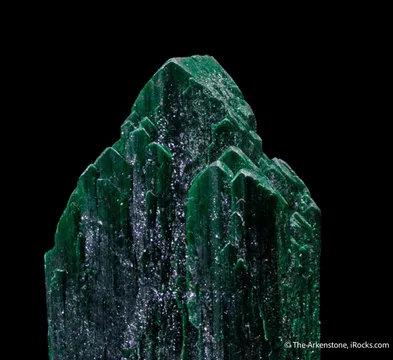
Malachite from Holbrook Extension ranges from massive and banded material to botryoidal crusts, chatoyant layers, acicular coatings, boxwork, and pseudomorphs after azurite. The locality produced malachite-rich oxide ore in substantial masses, with some reports of very large pieces exceeding 200 pounds, but fine collector specimens are those that preserve texture: silky green chatoyance, banded “eye” sections, velvety botryoids, replacement crusts over azurite forms, or malachite boxwork with blue azurite spheres in the open spaces. Associations with azurite, goethite, cuprite, calcite, chrysocolla, and siliceous breccia are important for locality character. Good Holbrook Extension malachite is judged less by size alone than by surface quality, undamaged fibrous sheen, strong green color, visible banding, and a convincing Bisbee oxide matrix; polished slabs can be attractive, but the most serious specimen value remains with natural crusts, vugs, and pseudomorphs that preserve the mining-period context.
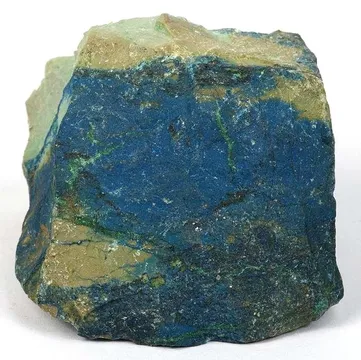
Other minerals documented from Holbrook Extension and its immediate Holbrook Mine/Lavender Pit context include cuprite, calcite, aragonite, smithsonite, clinochrysotile, stevensite, felsőbányaite, hydrobasaluminite, and chalcoalumite. Chalcoalumite is the most important rarity for specialists: the formal type locality is the Holbrook Mine area of the Copper Queen Mine, and later Holbrook Extension mining reworked the same ground. It occurs as delicate pale blue to blue-green crusts, rosettes, and replacement material on azurite and malachite, commonly in thin friable layers and occasionally in tiny crystals in hard goethite vugs. The aluminum sulphates felsőbányaite and hydrobasaluminite are also significant as quiet, easily overlooked species of the altered oxidized environment, while stevensite and clinochrysotile record the magnesium-silicate side of the oxide ore assemblage rather than the showier copper-carbonate suite.
The main authenticity problem with Holbrook Extension specimens is not a famous, locality-specific fake tradition; it is label discipline. A specimen may be correctly labeled Holbrook Extension, Holbrook Pit, Lavender Pit, Holbrook Mine, Copper Queen Mine, or Bisbee depending on when it was collected, who labeled it, and whether the label refers to the original underground mine or the open-pit operation that later consumed it. For serious collecting, “Bisbee” alone is too broad for a premium Holbrook Extension claim unless supported by old labels, collection history, dealer notes, or a matrix and association that make sense for the Holbrook/Lavender ground.
Condition is critical. Azurite botryoids and spheres commonly show rubs on exposed high points, especially on pieces recovered from blasted ore or moved by shovels. Malachite can be bruised, flattened, or dulled along silky fibrous surfaces, and polished malachite “eye” slabs should not be valued like undisturbed natural specimens unless the lapidary format is the stated purpose. Chalcoalumite is especially vulnerable: many Bisbee examples are thin, friable crusts only a few millimeters thick, poorly attached to azurite or malachite, and easily flaked by impact, cleaning, or careless wrapping. Iron-rich clay staining is common and often cannot be removed without harming the specimen.
Be cautious with unusually bright green or blue copper-carbonate specimens offered with vague “Bisbee” labels. Holbrook Extension pieces can superficially resemble material from other Arizona copper districts, especially Morenci, and also some foreign azurite-malachite combinations. Matrix, habit, and provenance matter. Bisbee/Holbrook material commonly shows oxide replacement textures, goethitic crusts, carbonate or breccia matrix, and old-style Arizona labels; matrix-free blue-green decorator pieces with no chain of ownership deserve skepticism. Conversely, do not dismiss darker, less glossy specimens too quickly: much authentic Holbrook material is rugged oxide ore, and a well-documented vug or pseudomorph can be more important than a brighter but poorly attributed piece.
Handling should be conservative. Keep azurite and malachite away from acids, aggressive cleaners, prolonged soaking, and high humidity swings. Avoid ultrasonic cleaning. Copper carbonates are not particularly hard, and many Holbrook specimens are crusts on fractured or clay-altered matrix rather than robust single crystals. Store fragile chalcoalumite-bearing pieces in fitted boxes with minimal movement, and never wrap delicate blue-green crusts directly in cotton that can snag.
Market availability is limited but not impossible. Small to miniature azurite-malachite specimens from the Holbrook Extension appear periodically in older Arizona collections, online dealer inventories, and auction archives. Better pieces with sculptural blue azurite, silky malachite, old labels, or chalcoalumite association are much scarcer and are usually treated as premium Bisbee locality specimens. Large historic Holbrook Mine/Holbrook Extension cabinet pieces, especially those with chalcoalumite or outstanding botryoidal azurite, can bring strong competition because they combine display appeal with one of the most desirable sublocality names in the Bisbee district.
The first great Holbrook story belongs to the cave era, when the Bisbee oxide deposits were still being discovered by men working shallow shafts and following color. In 1883, Walker Williams and Joe Russell were developing the Cave Claim when they broke into a large oxidation cavity from workings only about 30 feet down. After the opening was enlarged, a man was lowered another 50 feet and explored by candlelight. What he entered was the sort of chamber that made Bisbee legendary: an oxidation cave about two acres in area and roughly 50 feet tall, with stalactites and stalagmites stained green by copper and walls coated with velvety “copper carbonate.” To a collector, that description is more than a mining anecdote; it is a field sketch of the environment that made Holbrook specimens possible—open limestone space, copper-charged solutions, iron oxides, carbonate deposition, and enough room for botryoids, crusts, and later calcite to grow.
The Holbrook Mine did not have a quiet life. In November 1902, a fire broke out in a stope in the Neptune ground and was put out with water, but sulphide fires continued to plague the mine. By 1906, the Holbrook had become a main hoisting shaft for the Copper Queen operations and was interconnected with the Spray, Gardner, Czar, Hayes, and Copper Queen workings. Expansion was ambitious: plans were made to enlarge the shaft from four compartments to six, a tall enclosed headframe was attached to the older one, and a massive two-story change house was built with 450 lockers, sinks, and showers. Then the ground began to fail. Around July 10, 1906, the heavily mined ground around the shaft started to cave; by July 16, the shaft had caved from the 200 level to the surface. Rather than repair it, engineers decided to raise a new shaft 150 feet away. That new shaft was raised in only 75 days, and when a later connection was driven to the 500 level, the survey error was only 1 3/16 inches in length and 3/8 inch in width—an extraordinary piece of underground precision in a mine remembered for caving ground and oxide chaos.
Fire returned in 1913, this time in abandoned stopes between the 400 and 500 levels. Gas flooded the 600 level and the mine was temporarily shut down. A churn-drill hole was eventually driven from the surface between the machine shop and the Holbrook No. 2 shaft to intercept the fire. When the drill reached it, poisonous gases reportedly came hissing out of the hole at thousands of cubic feet per hour. The mine later used those same burned zones economically: water was drained through the fire areas, picked up copper as acid solutions, and was then piped to vats filled with scrap iron, where copper precipitated as the iron dissolved. It is a very Bisbee image—dangerous underground fire, improvised metallurgical recovery, and copper literally plating out of mine water.
By the time the Holbrook Extension arrived, the old underground mine was already a ghost in places. In 1948, only scattered concrete foundations and one uncertain wooden headframe still marked much of the surface. Yet underground, tools, explosives, and forgotten workings remained. When Phelps Dodge cancelled leases in late 1943, the company bought the lessees’ equipment “as is—where is,” including explosives. On the 400 level, a cap magazine still held large numbers of blasting caps, with red and gold Western No. 6 cap tins scattered about; each cardboard box had once held 1,000 caps in ten tins of 100. Empty cap tins became convenient little boxes for carrying specimens out of the mine. It is hard to imagine a more perfectly Bisbee collecting detail: fine copper minerals coming out in discarded blasting-cap cans from abandoned levels.
The open-pit phase changed the scale completely. Exploration for the Holbrook Extension began after an air raise into the Holbrook Mine was reconditioned and a diamond drill set up underground. When the extension advanced in 1969, both Holbrook shafts were mined out. Shovels cut into old stopes and crosscuts, and the specimen yield was immense. Contemporary accounts and later interviews describe thousands of minerals being recovered, with Phelps Dodge assigning employees to collect specimens as they appeared. Mining could reportedly stop for days so specimen recovery could take place. Some specimens were donated or sold to museums; others went to the company store; still others left with miners and local collectors. The irony is sharp: ore that underground miners had avoided because of treacherous clay and caving ground was finally removed by electric shovels, and in the process the district released a last great wave of Bisbee copper specimens.
The afterlife of the Holbrook Extension was quieter but not empty. In the late 1980s and early 1990s, erosion exposed stopes in the pit walls, and collectors sometimes entered a large stope connected to the old 100 level. Most of what they found was calcite, but there were important traces of the older copper-carbonate environment: malachite pseudomorphs after azurite, a small cave filled with copper-stained calcite, and a crosscut that led past a powder magazine to an area of small azurite crystals on calcite. At the end of that crosscut was an unusual little stope with no raises in the bottom and an incline arranged for hoisting, suggesting that there were no workings beneath it. Near the top, a hole opened into a larger oxidation cave filled with calcite. The lower part yielded iron-stained crystals up to six inches, while higher areas were stained green by copper. Around the same period, massive copper-tinted calcite was briefly collected and sold locally under the name “Bisbee Ice,” one of those short-lived lapidary fads that could only have come from a town where mine walls, tourist shops, and mineral collectors were never far apart.
F. L. Ransome, 1904, “The geology and ore deposits of the Bisbee quadrangle, Arizona,” U.S. Geological Survey Professional Paper 21 — The foundational geological study of the Bisbee quadrangle and its ore deposits; essential background for understanding the replacement and oxidation setting of the Holbrook ground.
E. S. Larsen and H. E. Vassar, 1925, “Chalcoalumite, a new mineral from Bisbee, Arizona,” American Mineralogist, 10, 79–83 — The original description of chalcoalumite from Bisbee; later locality work ties the source of the type material to the Holbrook Mine area later re-mined by the Holbrook Extension.
S. A. Williams and Ba Saw Khin, 1971, “Chalcoalumite from Bisbee, Arizona,” The Mineralogical Record, 2, 126–127 — Crystallographic work on better Bisbee chalcoalumite crystals, including material found after the original description and central to modern understanding of the species.
Richard W. Graeme, 1993, “Bisbee Revisited: An Update on the Mineralogy of This Famous Locality,” The Mineralogical Record, 24(6), 421–436 — A major modern mineralogical update for Bisbee, especially useful for understanding rarities and late-stage supergene species in the district.
John W. Anthony, Sidney A. Williams, Richard A. Bideaux, and Raymond W. Grant, 1995, Mineralogy of Arizona, 3rd edition, University of Arizona Press — The standard Arizona mineral reference cited for Holbrook Extension occurrences of clinochrysotile, felsőbányaite, hydrobasaluminite, and stevensite.
Mindat: Holbrook Extension, Lavender Pit, Bisbee, Cochise County, Arizona, USA — Locality entry documenting the Holbrook Extension as a pit within the Lavender Pit, with coordinates, alternate name Holbrook Pit, and mineral entries for the site.
Mindat: Chalcoalumite mineral data — Mineral data page listing chalcoalumite, its formula CuAl4(SO4)(OH)12 · 3H2O, and the Holbrook Mine/Copper Queen Mine area as the type locality.
Bisbee Mining & Minerals: Type Species from Bisbee — Detailed discussion of Bisbee type-species history, including the evidence placing chalcoalumite type material in the Holbrook Mine area and noting later Holbrook Extension recovery.
Bisbee Mining & Minerals: Holbrook Mine — The best narrative source for the Holbrook Mine itself, including shaft history, fires, cave discoveries, 1969 open-pit removal, and later specimen finds in exposed workings.
Bisbee Mining & Minerals: Lavender Pit — Concise history of the Lavender Pit and Holbrook Extension, including mining equipment, production period, oxide ore, and post-mining exposure of Holbrook stopes.
Bisbee Mining & Minerals: Geology — Detailed district geology covering the Sacramento Stock complex, Paleozoic carbonate hosts, breccias, faulting, and the mineralization sequence that controls the Holbrook Extension setting.
Bisbee Mining & Minerals: Gallery by Species — Useful visual reference for Bisbee species, including Holbrook Extension azurite spheres and chalcoalumite pseudomorph material.
Bisbee Mining & Minerals: Mineral Gallery — Photo-rich reference for Bisbee specimens, including Holbrook Extension malachite crusts and chalcoalumite replacing azurite and malachite.
Mindat: Holbrook Extension, Lavender Pit — Standard locality page for coordinates, hierarchy, alternate names, and documented mineral entries.
Mindat photo gallery: Lavender Pit — Includes specimen photos labeled from the Holbrook Extension, including azurite, aragonite-calcite, and azurite-cuprite-chalcoalumite material.
Mineral Auctions: Azurite and Malachite, Holbrook Extension, Urish Collection — Auction archive documenting a large-cabinet Holbrook Extension azurite-malachite vug specimen with older collection provenance.
Mineral Auctions: Azurite & Malachite, Holbrook Extension, Trimingham Collection — Auction archive for a miniature collected circa 1969–1972, useful for period labeling and market context.
Mineral Auctions: Fine polished malachite “eye” slab, Holbrook Extension — Example of lapidary-grade banded Holbrook Extension malachite and how such material appears in the collector market.
UC Minerals: Azurite, Malachite and Chrysocolla Vug, Holbrook Extension — Dealer archive showing a small Holbrook Extension vug specimen and modern retail-style locality wording.
Bisbee Mining & Historical Museum postcard archive: Holbrook Mine — Short historical note on the Holbrook Mine, including its production rate and reputation for azurite and malachite specimens.