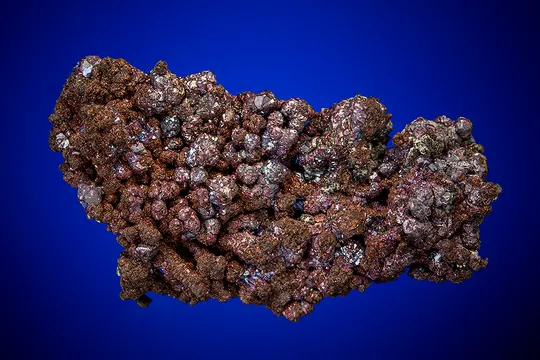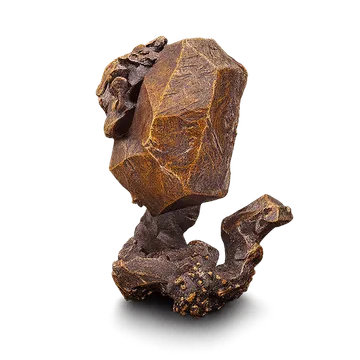
Bisbee copper, Arizona — arborescent native copper with cuprite and malachite patina from the Warren district; prized for provenance, crystal form, and oxidize…
Key facts
Bisbee copper has a different personality from the familiar basalt-hosted coppers of Michigan’s Keweenaw Peninsula. The best Bisbee pieces are not broad sheet copper or glacially worn masses, but sculptural oxidized-zone specimens: branching, arborescent, hackly, spongy, and crystalline native copper from a limestone-replacement copper camp better known to the general public for azurite and malachite. The appeal lies in that contrast. A fine Bisbee copper specimen often looks as though it grew in a chemical furnace at the edge of a sulfide orebody—copper-red metal, brown to mahogany patina, ruby cuprite, green malachite, black iron oxides, and pale calcite all recording the downward migration of copper-bearing solutions through broken Paleozoic carbonate rocks.

Photo: Wikimedia Commons
The district sits in the Mule Mountains of Cochise County, southeastern Arizona, in the historic Warren mining district. Its great ore bodies were not simple fissure veins. They were irregular replacement bodies in limestone, structurally guided by faults, intrusions, and reactive carbonate beds. In the deeper parts of the oxidized zone, native copper and cuprite developed near chalcocite and other sulfides; in some ores the copper formed a metallic mesh through crystalline cuprite, while elsewhere it appeared as branching crystalline masses later coated or accompanied by cuprite.
For collectors, Bisbee copper is desirable because it combines three things rarely found together: classic American provenance, attractive native-metal crystallization, and association with a world-famous oxidized copper mineral suite. The best specimens are old, three-dimensional, and unquestionably from Bisbee, with documented sub-localities such as the Copper Queen, Czar, Holbrook, Spray, Irish Mag, Junction, Campbell, Southwest, or related Warren district mines. Pieces with strong crystal form, natural patina, cuprite association, or malachite accents are especially prized.

Photo: Wikimedia Commons
Bisbee’s fame rests on a mining history as large as its mineralogy. From the first mineral discoveries in the late 1870s to the closure of the last underground copper mines in 1975, the camp produced roughly 8 billion pounds of copper, along with major silver and gold and significant lead, zinc, and manganese. That scale matters to specimen collectors: enormous quantities of ore were mined, but only a small fraction of the native copper was saved as display-quality crystallized specimens, and many of the finest examples left the mines in the late nineteenth and early twentieth centuries.
Search for specimens: View all copper specimens from Bisbee, Arizona, USA
Bisbee is the classic collecting name for a cluster of mines in and around the Warren mining district of the Mule Mountains, Cochise County, Arizona. The most famous group centers on Queen Hill and the Copper Queen system, including the Czar, Holbrook, Spray, and Gardner workings, with important neighboring mines and claims in the Calumet and Arizona group, the Irish Mag, Junction, Campbell, Lowell, Southwest, Shattuck, Dallas, Cole, and related operations.
Geologically, Bisbee’s old high-grade ores were chiefly irregular limestone-replacement deposits rather than continuous veins. The important host rocks included Paleozoic carbonate units cut and disturbed by faulting and by intrusive rocks associated with Sacramento Hill. Early mineralization introduced pyrite and copper-bearing sulfides with contact-metamorphic and replacement silicates such as tremolite, diopside, grossularite, vesuvianite, chlorite, and quartz in altered limestone. Later supergene processes enriched and oxidized the ore, producing the celebrated suite of chalcocite, native copper, cuprite, malachite, azurite, chrysocolla, brochantite, and iron oxides.
Native copper belonged especially to the lower portions of the oxidized ore bodies, near the transition to sulfide ores. In the Copper Queen mine it was once abundant in the lower parts of rich oxidized masses, and historical descriptions record masses weighing several hundred pounds near the Czar shaft. By the time F. L. Ransome studied the camp in the early 1900s, native copper had become less common in the Copper Queen workings then accessible, but was abundant in the Calumet and Arizona mine, especially on the 950- and 1050-foot levels, where cuprite and native copper formed large rich stopes.
The district’s history begins with mineralization noticed in the Mule Mountains in 1877. Jack Dunn, attached to a military reconnaissance party, recognized promising signs of lead, copper, and silver, and George Warren’s claims soon helped draw prospectors into the area. The camp was named for Judge DeWitt Bisbee, a financial backer of the Copper Queen enterprise, and quickly became known as the “Queen of the Copper Camps.”
Underground mining dominated the early period. By 1902, the Copper Queen group alone had already produced more than 378 million pounds of copper, and the connected workings formed a maze entered by shafts such as the Czar, Holbrook, Spray, and Gardner. The Calumet and Arizona mine, adjoining the Copper Queen ground, developed major ore bodies at depth and became a major producer in its own right.
The twentieth century brought consolidation, mechanization, changing metals markets, and finally large-scale open-pit mining. The Sacramento Pit and later the Lavender Pit exploited lower-grade material at a scale unimaginable to the earliest miners. The Lavender Pit became the great late chapter of Bisbee mining; it produced tens of millions of tons of ore before open-pit mining ended in 1974. Underground mining continued briefly after the pit’s closure, but the last operating mines—Campbell, Cole, and Dallas—closed in June 1975.
Modern collecting access is essentially closed in the old mines. The major workings are historic, private, municipal, or otherwise restricted, and abandoned mine hazards are severe. The Copper Queen Mine Tour offers a legal underground experience into part of the old mine environment, but it is not a collecting trip. Contemporary Bisbee native copper specimens reach collectors almost entirely through old collections, dealer inventories, estate material, and occasional pieces with long local provenance.
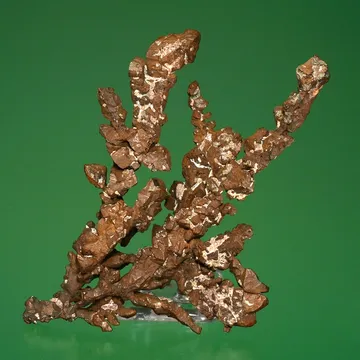
Bisbee native copper is most admired when it shows clear crystallization rather than massive ore texture. Good specimens may be dendritic, arborescent, hackly, branching, spongy, skeletal, or compactly crystallized. Some show small but sharp metallic crystals; others form larger sculptural aggregates composed of spinel twins, tetrahexahedral growths, and irregular copper branches. The finest examples have an open architecture, strong display orientation, and enough relief to look grown rather than merely broken from a mass.
Color varies with age and preservation. Fresh copper is pinkish to copper-red, but most authentic old Bisbee specimens show a natural patina in warm browns, mahogany, brick-red, or dull metallic copper. Brightly stripped or chemically cleaned pieces exist, but many collectors prefer a stable natural surface, especially where it preserves old cuprite or malachite associations. A subtle green malachite bloom on copper can be attractive; thick, powdery, or suspiciously uniform green coating should be examined carefully.
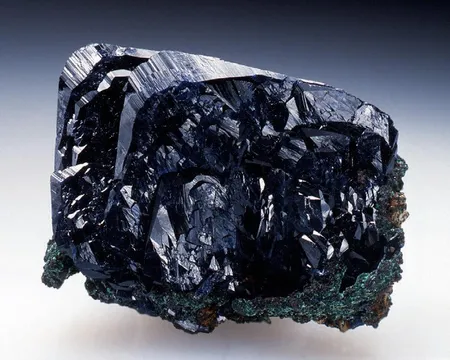
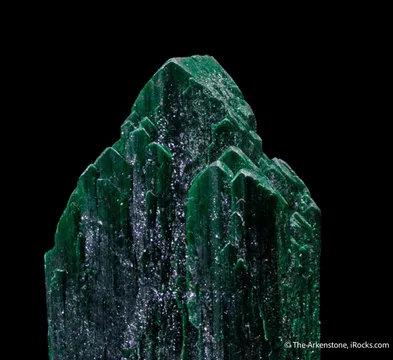
The classic associations are important. Cuprite is the most significant companion mineral for native copper from the deeper oxidized zone. It may occur as earthy red material, crystalline masses, or sharp ruby-red isometric crystals, and it was historically abundant in Bisbee ore bodies. Malachite, azurite, chrysocolla, brochantite, calcite, goethite, limonite, chalcocite, and other copper minerals are also part of the Bisbee context. Copper with chalcotrichite, calcite, cuprite, or malachite can make particularly satisfying Bisbee combinations.
Typical collector specimens range from thumbnails of a few centimeters to small cabinet and cabinet pieces. Large crystallized Bisbee coppers are much less common than large massive ore pieces. A 7 cm dendritic specimen is already a respectable display piece; a 9 to 10 cm crystallized, arborescent, well-provenanced specimen is significant; larger pieces with good crystallization and old provenance are uncommon and can be important.
Quality depends on several factors. First is crystallization: sharpness, branching habit, and visible crystal faces matter. Second is aesthetics: a balanced form with an obvious front is more desirable than a shapeless ore fragment. Third is association: cuprite and malachite can add both beauty and locality character. Fourth is surface: an old, undisturbed patina is often preferable to a harshly cleaned, unnaturally bright surface. Fifth is provenance: Bisbee specimens with old labels, mine-specific attribution, or collection history are far more valuable than similar copper described only as “Arizona.”
Sub-locality matters. “Bisbee” is useful, but “Copper Queen Mine,” “Czar Mine,” “Holbrook Mine,” “Irish Mag Mine,” “Junction Mine,” “Campbell Mine,” or another specific mine name is better when the attribution is credible. Native copper is recorded from multiple Bisbee mines, and the habit can vary: Copper Queen material may be associated with classic cuprite and oxide ores; Calumet and Arizona-related material is historically tied to deeper oxidized zones rich in native copper and cuprite; some old collection pieces are simply labeled “Bisbee,” reflecting nineteenth- or early twentieth-century collecting practice rather than modern locality precision.
The largest authenticity issue with Bisbee copper is not whether native copper occurs there—it unquestionably does—but whether a given specimen really came from Bisbee. Copper is found in many Arizona districts and in classic localities worldwide, so locality laundering is a real concern. A vague “old Arizona copper” label can easily become “Bisbee” in the marketplace. Serious collectors should favor pieces with old labels, recognizable collection history, reputable dealer handling, or mine-specific documentation.
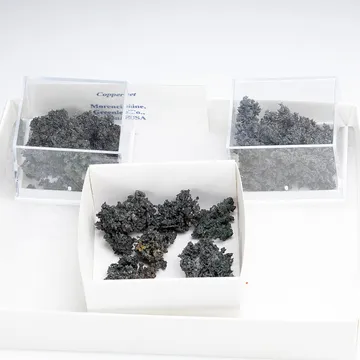
There is also a specific documented fake to know: copper-coated pyrite sold as “Bisbee” material has been reported in the mineral community. The described specimens used a Mexican-style pyrite-quartz-galena matrix with copper artificially roasted or plated onto the pyrite, accompanied by fabricated Bisbee locality labels. That style is inconsistent with normal Bisbee native copper occurrence and should be treated with suspicion. Native copper from Bisbee should make mineralogical sense in its matrix and associations; copper plated over bright pyrite cubes is a red flag.
Cleaning and patina are important. Some copper specimens are acid-cleaned or chemically brightened to produce an unnaturally fresh metallic surface. Cleaning is not automatically fraudulent if disclosed, but it can reduce collector appeal, remove delicate secondary minerals, and obscure age. Conversely, an artificial green patina can be applied to copper. On genuine old Bisbee pieces, malachite or cuprite should occur in plausible growth relationships, not as a paint-like film or residue concentrated only in convenient surface recesses.
Condition issues are typical for native copper: bent projections, rubbed high points, broken branches, and nicks on exposed crystals. Copper is malleable, so damage may appear as flattened or smeared metal rather than clean brittle breaks. Specimens with delicate cuprite or chalcotrichite require special care; cuprite crystals can be chipped, and fibrous or hairlike material can be crushed by careless handling.
Rarity depends strongly on form. Massive copper ore from Bisbee is not inherently rare, and small unattributed copper bits are not difficult to encounter. Well-crystallized, aesthetic, three-dimensional Bisbee native copper with strong provenance is another matter. Fine old pieces appear irregularly and are usually absorbed quickly into advanced Arizona, native-element, or classic American locality collections. The market especially rewards specimens that combine copper crystallization with cuprite, old labels, and specific mine attribution.
Bisbee’s first act began not with a planned mining expedition but with a military reconnaissance in 1877. A party of army scouts and cavalrymen entered the Mule Mountains looking for Apaches. Civilian tracker Jack Dunn noticed something else: signs of mineralization—lead, copper, and perhaps silver. The first claim followed in what would become Bisbee. George Warren then filed a multitude of claims, and prospectors poured into the canyon country. In a few years the place had gone from mineral hint to copper camp, and the name “Queen of the Copper Camps” no longer sounded like local boasting.
The geology hid its wealth with unusual modesty. F. L. Ransome, writing after the district had already produced nearly 400 million pounds of copper, emphasized how little the rocky slopes betrayed. The useful clues were not grand glittering veins but rusty limonitic outcrops—dark, iron-stained masses in Hendricks Gulch, Queen Hill, and along the Dividend fault. These gossans did not necessarily contain much visible copper near the surface. Their importance was subtler: they marked places where pyritic limestone had been fractured, mineralized, oxidized, and leached, with the copper carried downward and redeposited out of sight. In Bisbee, some of the richest ore bodies could have remained undiscovered if miners trusted only surface show.
The native copper itself was found in the strange borderland between oxidation and sulfide ore. In one old description, compact chalcocite kernels were encrusted by a spongy aggregate of tiny sparkling native-copper crystals, and the copper penetrated inward as little vugs and stringers. Elsewhere, in the Calumet and Arizona mine, branching copper masses were beautifully encrusted with cuprite. In still other ore, the two minerals were so intergrown that the copper formed a metallic sponge filled with crystalline cuprite. These are not just attractive collector associations; they are snapshots of a chemical sequence, with chalcocite giving way to native copper and cuprite in the deep oxidized zone.
A particularly vivid underground scene came not from a specimen pocket but from a cavern. Ransome described black dendritic efflorescences so fragile that stems broke off under their own weight when they grew longer than about half an inch. The cavern floor was covered with a fluffy carpet of black material, built from copper and manganese oxides. It is the sort of image that explains why Bisbee became a mineralogical rather than merely industrial locality: even the mine walls were active chemistry.
On November 12, 1897, the Copper Queen mine briefly became a ceremonial hall. The Masonic Grand Lodge of Arizona met in a cave in the mine of the Copper Queen Consolidated Mining Company at Bisbee, an event recorded in a historic photograph now held by the Library of Congress. The image is astonishing: formally dressed men gathered underground in a space normally reserved for drilling, mucking, timbering, and ore. It captures the confidence of a mining camp that had become not just a workplace but a civic world built around copper.
The camp’s history also has a darker chapter. On July 12, 1917, during labor conflict in the district, nearly 1,200 Industrial Workers of the World strikers and others were rounded up in Bisbee by county officials and citizen posses, loaded into cattle cars, and deported to Hermanas, New Mexico, without money or transportation. The Bisbee Deportation remains inseparable from the history of the mines: the same copper that built fortunes and filled collections also powered a hard industrial world of dangerous labor, ethnic tension, company authority, and wartime fear.
The final day came much later, and more quietly. By June 1975, the pressures of high costs and low metal prices had ended underground copper mining at Bisbee. The last operating mines—Campbell, Cole, and Dallas—closed, and several years later pumping stopped and the mines were allowed to flood. The end had been predicted many times before, so some miners did not believe it until it happened. A note from the last day records a motorman placing a sample on a trolley motor on June 12, 1975: a small, human gesture at the close of a ninety-five-year copper camp.
F. L. Ransome, “Description of the Bisbee Quadrangle,” U.S. Geological Survey Geologic Atlas Folio 112, 1904 — Classic USGS treatment of the district’s geology, ore bodies, mining status, production, and oxidized copper mineralogy.
F. L. Ransome, “The Geology and Ore Deposits of the Bisbee Quadrangle, Arizona,” U.S. Geological Survey Professional Paper 21, 1904 — The fundamental detailed monograph on Bisbee’s replacement ores, structural setting, and mineral paragenesis.
A. H. Petereit, “Crystallized native copper from Bisbee, Arizona,” American Journal of Science, 23, 232–233, 1907 — Early specific publication on crystallized native copper from the Copper Queen locality, cited in the Mindat reference list for the mine.
Richard W. Graeme, “Famous Mineral Localities: Bisbee, Arizona,” The Mineralogical Record, 12(5), 258–319, 1981 — The key modern collector-oriented locality article, widely cited for Bisbee mineral specimens and mine-specific mineralogy.
John W. Anthony, Sidney A. Williams, Richard A. Bideaux, and Raymond W. Grant, “Mineralogy of Arizona,” 3rd edition, University of Arizona Press, 1995 — Standard Arizona mineral reference, cited for native copper and multiple Bisbee sub-localities.
George Melvin Schwartz, “Paragenesis of the oxidized ores of copper,” Economic Geology, 29(1), 55–75, 1934 — Important paper on oxidized copper ore paragenesis, cited by Mindat for Bisbee native copper occurrences including the Junction and Campbell mines.
George Melvin Schwartz and Charles Frederick Park, “A microscopic study of ores from the Campbell Mine, Bisbee, Arizona,” Economic Geology, 27(1), 39–51, 1932 — Detailed ore-mineral study of the Campbell mine, one of the important Bisbee sub-localities.
H. E. Merwin and E. Posnjak, “Sulphate incrustations in the Copper Queen Mine, Bisbee, Arizona,” American Mineralogist, 22(5), 567–571, 1937 — Specific study of post-mining and secondary sulfate incrustations in the Copper Queen Mine.
Mindat: Native Copper from Bisbee, Cochise County, Arizona, USA — Useful locality index for recorded Bisbee native copper sub-localities and cited references.
Mindat: Copper Queen Mine, Queen Hill, Bisbee, Cochise County, Arizona, USA — Principal online mineralogical locality page for the Copper Queen Mine, including mineral list, sub-localities, and references.
Wikimedia Commons: Copper from Bisbee, Warren District, Mule Mountains, Cochise County, Arizona — Licensed image and specimen data for a 9.5 x 9.2 x 6.0 cm arborescent crystallized copper from the Dennis Mullane Collection.
Wikimedia Commons: Copper from Bisbee, Warren District, Mule Mountains, Cochise County, Arizona — Licensed image and specimen data for a 7.4 x 5.2 x 2.6 cm dendritic copper with minor malachite, formerly from the Chuck Youngblood Bisbee collection.
Wikimedia Commons: Malachite-Copper from Bisbee — Licensed image and description of a large old-time malachite specimen cored with copper from the Dennis Mullane Bisbee Collection.
COPPER QUEEN MINE (Bisbee, AZ) — Discover Bisbee — Short visitor video introducing the underground Copper Queen Mine Tour experience.
Queen Mine Tour — Visit Arizona — Official state tourism media page summarizing the mine tour, underground conditions, and historic mine setting.
The Masonic Grand Lodge of Arizona meeting in the cave in the mine of the Copper Queen Consolidated Mining Co. at Bisbee, Arizona, Nov. 12th 1897 — Library of Congress — Historic photograph of a formal Masonic meeting held underground in the Copper Queen mine.
The Bisbee Deportation of 1917 Digital Exhibit — University of Arizona Libraries — Digital exhibit drawing on archival materials related to the 1917 labor conflict in the Bisbee mining district.
Bisbee History — City of Bisbee — Concise civic history of the town, discovery, production totals, and 1974–1975 mine closures.
Lavender Pit, Bisbee, Arizona — Arizona Geological Survey — Useful geological summary of the Lavender Pit, including ore style and late open-pit production.
Mining at Bisbee — Bisbee Mining and Minerals — Detailed illustrated history of Bisbee mining from the Depression through the final mine closures.
Copper Queen Mine Underground Tours — Practical information for the legal underground tour of the historic Copper Queen workings.
Our History — Copper Queen Mine Tour — Background on the creation of the tour after mining ended.
Copper Queen Mine Tour — Discover Bisbee — Visitor-oriented overview of the tour and its interpretive value.
Native Copper from Bisbee — Mindat — Best quick reference for recorded native copper occurrences and Bisbee mine sub-localities.
Copper Queen Mine — Mindat — Main mineralogical database page for the Copper Queen Mine and its associated species.
Cuprite from Copper Queen Mine — Mindat — Helpful companion page for cuprite, the most important native-copper associate in Bisbee’s deeper oxidized ores.
Fake Bisbee Copper on Pyrite — Mindat Fakes & Frauds discussion — Specific collector warning about artificial copper-coated pyrite falsely labeled as Bisbee.
The Masonic Grand Lodge of Arizona meeting in the Copper Queen mine, 1897 — Library of Congress — A memorable historic image linking Bisbee’s mining world with the civic life of the camp.
This Day in Arizona History: Bisbee Deportation — Arizona Memory Project — Archival summary of the July 12, 1917 deportation of striking miners and others from Bisbee.