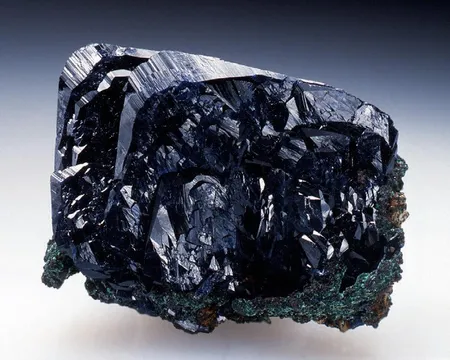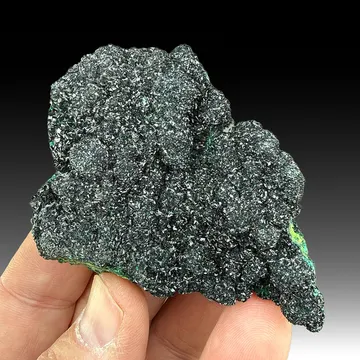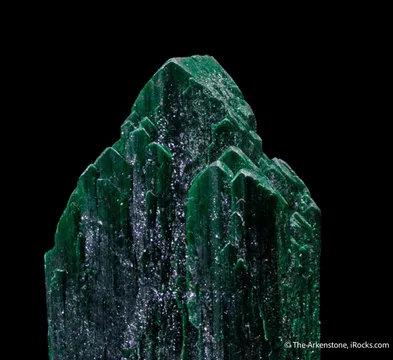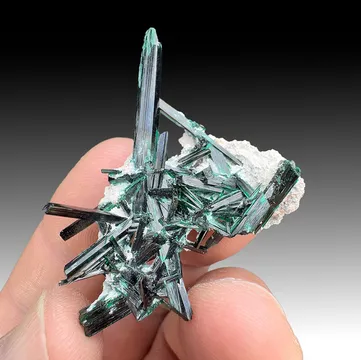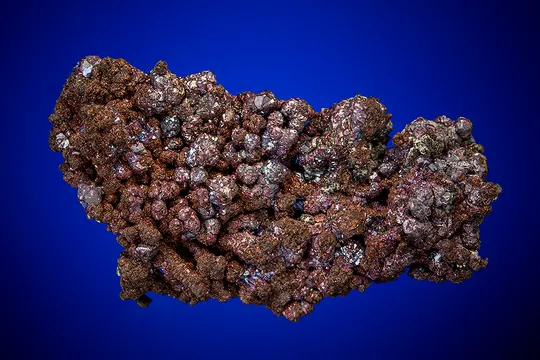
Brochantite from Bisbee, Arizona: dark emerald to blackish-green prismatic crystals in copper-oxide matrix, formed in oxidized copper deposits, a Bisbee classi…
Key facts
Bisbee brochantite is one of the quieter classics of a district otherwise famous for electric-blue azurite, velvety malachite, red cuprite, native copper, and turquoise. The appeal is not abundance; it is character. The best specimens show deep emerald to blackish-green, lustrous prismatic or lath-like crystals in dense, intergrown clusters, sometimes on copper-oxide matrix, sometimes in association with calcite, malachite, cuprite, or other secondary copper minerals. Good Bisbee brochantite has the look of a mineral that grew in the tense chemical boundary between sulfide ore, oxidizing copper, sulfate-bearing waters, and open space in limestone replacement ground.

Photo: Ra'ike / Wikimedia Commons
The locality name “Bisbee” covers a complex mining district in the Mule Mountains of Cochise County, southeastern Arizona. The old Warren mining district includes famous names that matter on specimen labels: Copper Queen, Czar, Holbrook, Spray, Gardner, Calumet & Arizona, Shattuck, Cole, Southwest, Junction, Campbell, and the later Lavender Pit. Brochantite is reported from several of these, but collectors especially prize the robust Shattuck Mine pieces and the older Copper Queen–Calumet style material tied to cuprite-rich oxidized ore.
Mineralogically, Bisbee brochantite sits in the secondary copper suite. It is Cu4(SO4)(OH)6, a basic copper sulfate, formed in the oxidized zone of copper deposits under conditions where sulfate was available and solutions were not too acidic for basic copper salts to persist. At Bisbee, early USGS work described brochantite as a small but diagnostic associate of malachite, chrysocolla, cuprite, and native copper, with its most characteristic occurrence as little nests and irregular veinlets in cuprite. That setting explains why it is so often dark, compact, and intimate with red-brown copper oxides rather than floating freely as isolated single crystals.
What makes the locality important is the contrast between the mineral’s general scarcity in the ores and the occasional quality of crystallized specimens. Fine examples are not merely green crusts: they can be lustrous, thick prismatic crystals over 1 cm, tightly packed into small-cabinet specimens. A few recorded Shattuck examples reach into the 1.5–2 cm range, and one gallery-described specimen is said to carry lath-like crystals to about 2.75 cm. For a mineral commonly represented by thin acicular coatings at many localities, Bisbee’s heavy, dark, architectural clusters have real cabinet presence.
Search for specimens: View all brochantite specimens from Bisbee, Arizona, USA
Bisbee is a limestone-replacement and porphyry-related copper district, not a single mine. The copper deposits occur as low-grade disseminated ore in the Sacramento Hill stock and as massive sulfide, secondary oxide, and carbonate replacement bodies in Paleozoic limestones intruded by the stock and related igneous bodies. That combination of intrusive heat, reactive carbonate host rock, sulfide mineralization, deep oxidation, open cavities, and later copper-rich solutions produced one of the most diverse mineral assemblages in North America.
The early underground mines worked rich replacement ore bodies in limestone. In the Copper Queen and Calumet & Arizona ground, oxidized zones yielded cuprite, native copper, malachite, azurite, chrysocolla, calcite, and small amounts of brochantite. Ransome’s classic USGS study placed brochantite close to cuprite in the paragenetic sequence, after native copper and cuprite and before melanochalcite, chrysocolla, malachite, and calcite in specimens from the Calumet & Arizona mine. That sequence is collector-useful: a Bisbee specimen with brochantite on or in cuprite, or with later carbonate and calcite, fits the district’s oxidized-zone story.
Mining began after the 1877 copper discovery that led to Bisbee’s development as one of Arizona’s great copper camps. The city was established in 1880 and named for Judge DeWitt Bisbee, a financial backer of the Copper Queen enterprise. Over nearly a century, Bisbee produced roughly 8 billion pounds of copper, 102 million ounces of silver, 2.8 million ounces of gold, and substantial zinc, lead, and manganese. The famous underground era was followed by large-scale open-pit work at Sacramento Hill and the Lavender Pit; the Lavender Pit began producing ore in 1954 and continued until December 14, 1974.
Collecting access today is fundamentally historical, not field-collecting oriented. The productive underground workings are not public collecting sites. The Queen Mine Tour preserves a controlled underground visitor experience, but it is a heritage tour, not a specimen-collecting opportunity. The Lavender Pit can be viewed from public overlooks, while dumps, shafts, stopes, and pit areas should be treated as private, restricted, unstable, or hazardous unless explicit legal permission and safe conditions are in place. Serious collectors should expect Bisbee brochantite to come through old collections, estate material, museum deaccession channels where applicable, and reputable dealers, not from casual modern field recovery.
Important brochantite labels include Bisbee, Shattuck Mine, Copper Queen Mine, Cole Mine, Southwest Mine, Campbell Mine, Junction Mine, and Lavender Pit. A precise mine label adds value because “Bisbee” alone can describe a broad district. Shattuck labels are especially desirable for robust crystallized brochantite, while Copper Queen and Calumet-related material has historical weight because those mines are central to the district’s early oxidized copper story.
Bisbee brochantite ranges from microscopic to cabinet-quality. The ordinary occurrence is small: green grains, nests, irregular veinlets, drusy patches, and compact intergrowths in or near cuprite, malachite, chrysocolla, and limonitic copper ore. In hand specimens it can be deceptively malachite-like, especially where it is fine-grained, dark green, or crusty. Under magnification, the better pieces show the diagnostic acicular to prismatic habit of brochantite: slender needles, matchstick crystals, lath-like blades, thick prisms, and tightly intergrown sprays.
The color is usually richer and darker than common Bisbee malachite. Good brochantite may be emerald green, deep forest green, blackish green, or nearly metallic dark green when the crystals are dense and lustrous. Fresh crystal faces can flash glassy to submetallic in strong light. Older examples may carry iron staining, cuprite-red matrix, brown limonite, pale calcite, or secondary green overgrowths that soften the visual contrast.
Crystal size is the key separator between ordinary and important Bisbee brochantite. Many pieces are micro or thumbnail-scale, with individual crystals only millimeters long. Attractive miniatures may show tight green clusters partly coated by calcite or perched in cavities. The best Shattuck material is much bolder: individual prismatic or lath-like crystals over 1 cm are recorded, with some examples described at about 1.5 cm, 2 cm, and exceptionally to roughly 2.75 cm. Cabinet specimens in the 5–8 cm range are known, but they are not common.
Associated minerals are central to the Bisbee look. Mindat photo-data and locality records repeatedly tie brochantite to calcite, cuprite, malachite, chalcoalumite, atacamite, claringbullite, azurite, linarite, bromargyrite, quartz, goethite, hematite, limonite, cyanotrichite, spangolite, siderite, chalcocite, and connellite. The strongest classic associations are cuprite, malachite, and calcite. Cole Mine material is notable for brochantite with cuprite, atacamite, and claringbullite. Copper Queen material is strongly tied to cuprite, malachite, and calcite. Shattuck material is the source of the most widely admired robust crystals.
Quality factors are straightforward but unforgiving. The most desirable pieces have rich, saturated green color; sharp, lustrous, visible crystals; minimal bruising; good three-dimensional clustering; and a matrix or association that confirms the Bisbee setting rather than hiding it. Calcite can add contrast, but heavy calcite may obscure the brochantite. Massive dark green lumps are less desirable unless they show distinct lath-like structure or come with exceptional provenance. Old labels from named Bisbee mines, especially Shattuck, Copper Queen, Cole, or Southwest, matter greatly.
The main authenticity issue with Bisbee brochantite is not a well-documented tradition of fakes; it is identification. Brochantite can be confused with malachite, antlerite, atacamite-group minerals, and other green secondary copper minerals. This problem is old: Ransome specifically noted that Bisbee brochantite could be mistaken for malachite on superficial examination, and much of the district’s green secondary mineralization is visually treacherous. For expensive specimens, especially those sold as Shattuck brochantite with unusually large crystals, ask for sharp magnified photos, old labels, analytical history if available, and a sensible locality chain.
Bisbee brochantite should be handled as a relatively delicate secondary copper mineral. Brochantite has perfect cleavage and moderate hardness, and Bisbee examples are often aggregates of intergrown blades or needles rather than single robust crystals. Broken terminations, abraded ridges, crushed edges, and calcite-coated damage are common condition concerns. Dense dark clusters can hide bruising until viewed under a strong lamp or microscope. On old specimens, check whether the best crystals are intact or whether the piece is a mass of broken laths.
Treatments are not a major documented issue for this locality, but cleaning can be. Acid or aggressive chemical cleaning may attack associated calcite, alter delicate secondary minerals, or leave a specimen looking unnaturally stripped. Some Bisbee pieces naturally carry limonite, clay, cuprite, or calcite; removing these may reduce locality character and can expose damage. Avoid soaking mixed secondary copper specimens unless you know exactly what every associated mineral will tolerate.
Rarity depends strongly on style. Small green brochantite occurrences from Bisbee are not exceptional in a district sense, but aesthetic crystallized specimens are scarce. Robust Shattuck brochantites are genuinely desirable, especially old-time examples with crystals over 1 cm. Large, lustrous, well-crystallized pieces from named mines appear only episodically on the market. Most available examples are miniatures, thumbnails, or old collection pieces with varying degrees of attribution.
When buying, prioritize provenance. “Bisbee, Arizona” is acceptable for modest specimens, but fine pieces deserve a mine name if one can be supported. Shattuck Mine labels should be treated seriously but not blindly; the same is true for Copper Queen, Cole, and Southwest. A strong specimen with an old handwritten label, auction history, or collection provenance is preferable to a brighter-looking piece with only a modern generic tag.
The old Copper Queen caves are the ghost behind many Bisbee secondary-copper specimens. In the early workings, miners broke into limestone caverns whose walls were coated with velvety moss-green malachite and sparkling blue azurite, while translucent calcite hung from the roofs in draped, copper-tinted curtains. By the time Ransome wrote his 1904 account, those caverns had already been stripped, filled with waste, or left to collapse. The point is worth lingering on: Bisbee’s most spectacular specimen environments were not carefully mined for collectors. They were ore ground first, and mineral localities second. What survives in cabinets is only a residue of spaces that were once much richer underground.
Brochantite entered the written Bisbee record almost modestly. Ransome did not present it as an ore mineral or a museum showpiece. He wrote of small amounts, a mineral easily mistaken for malachite, usually recognizable only by microscopic examination of thin sections. Its characteristic mode was a nest or irregular veinlet in cuprite. That is a wonderfully Bisbee detail: the mineral was not announced by a glittering pocket but by green threads in red copper oxide, in a district where the boundary between ore, alteration, and cabinet specimen was constantly shifting.
The Shattuck Mine gives the brochantite collector a more dramatic stage. The Shattuck & Arizona Copper Company formed in March 1904 and began sinking a two-compartment shaft on the Iron Prince claim. The first hoisting was by windlass. By October 23, 1904, the shaft was already 110 feet deep. Water became a problem at depth; on June 6, drill holes penetrated a water body that flooded the shaft at 250 gallons per minute. The mine pushed on. By September 10, 1905, the shaft was 825 feet deep, stations were being cut, and ore had been struck on the 500- and 700-foot levels. Soon native copper and cuprite appeared in altered limestone on the 800-foot level.
The same mine later became a landmark for both science and spectacle. Shattuckite was discovered there on the 300-foot level, giving the mine its namesake mineral. In April 1913, a crosscut on that same level intercepted the largest natural cave found in the local mines. It was decorated with cave formations and, for several years, became a tourist attraction inside an active mining world. Thousands visited. The company considered closing and backfilling it, and by 1915 the cave’s fate was largely sealed; specimens were given to the Michigan College of Mines instead of preserving the chamber itself.
Against that backdrop, the famous Shattuck brochantites feel less like isolated mineral specimens and more like survivors. One widely published old specimen from the Harold Urish collection measures 7.5 x 4.7 x 2.7 cm and carries thick crystals exceeding 1 cm. Other Shattuck examples have been described as sparkling clusters of intensely green crystals from classic finds, one reportedly obtained from a shaft miner, and still others as dark emerald lath-like masses, some hollow, with crystals to 1.6 cm or more. These are not the common Bisbee green smears that might pass as malachite. They are the district’s brochantite at its most forceful: dark, lustrous, heavy-looking, and unmistakably grown in the copper-rich underworld of the Shattuck.