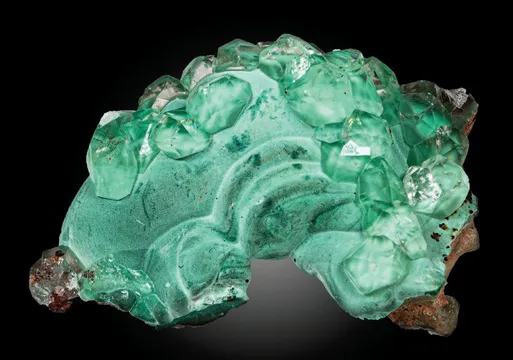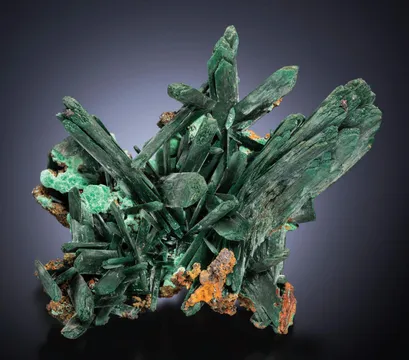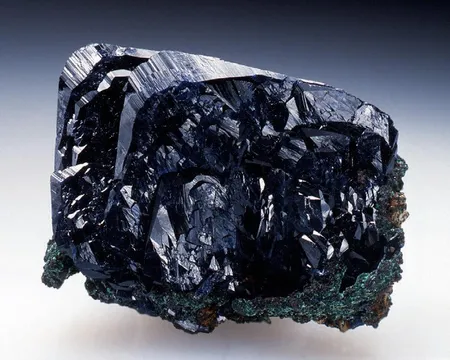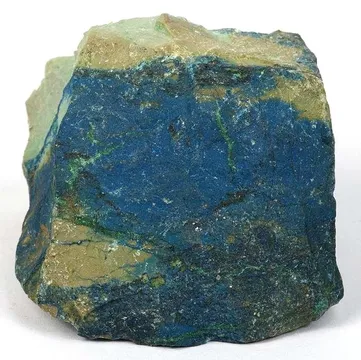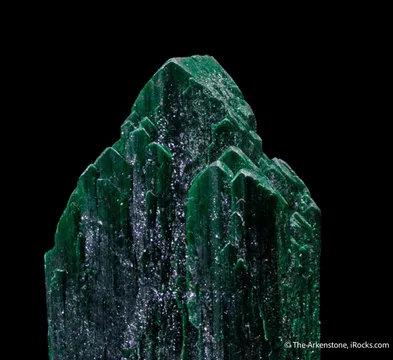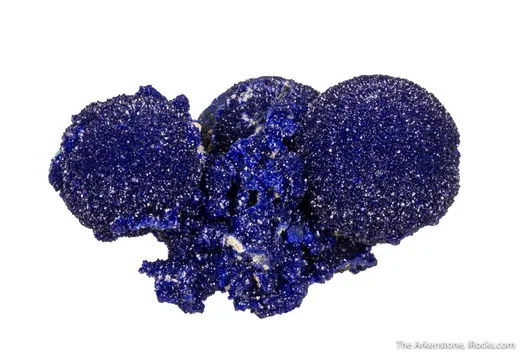
Lavender Pit, Bisbee, Arizona - a copper-porphyry locality famed for azurite and malachite, copper sulfides, and rare secondary minerals coveted by collectors.
Key facts
The Lavender Pit is the late open-pit chapter of Bisbee: not the romantic, narrow, high-grade stopes of the Copper Queen alone, but the moment when Phelps Dodge turned the low-grade disseminated copper of Sacramento Hill’s eastern porphyry orebody into a vast terraced amphitheater. For collectors, its importance lies in that collision of scales. The pit was engineered for tonnage—chalcocite-coated pyrite, bornite, chalcopyrite, copper oxides, and mixed sulfide-oxide ore—but it cut through older underground workings, oxidation caves, and the Holbrook ground that had already become legendary for zincian azurite, malachite, chalcoalumite, cuprite, calcite, and odd supergene rarities. The best specimens carry the unmistakable Bisbee look: saturated blue azurite botryoids, velvety rosettes, and sharp forms partly or wholly replaced by malachite; green pseudomorphs after azurite set on dark goethitic matrix; copper-stained calcite from exposed stopes; and highly localized crusts of rarer secondary species formed where acidic, aluminum-rich, copper-bearing waters attacked earlier carbonates.
Regional View
Country View
Geologically, the Lavender Pit sits in the Warren mining district of the Mule Mountains at Bisbee, Cochise County, Arizona. The ore mined by the pit was a porphyry-related copper-zinc system: a blanket of low-grade disseminated chalcocite and other copper sulfides in a brecciated intrusive porphyry plug adjoining altered Paleozoic limestones along the Dividend fault. That setting matters to specimen people because the pit was not merely a porphyry copper hole; it intersected the limestone-replacement and oxidized-cave world that had made Bisbee a world-class mineral locality long before the Lavender benches were cut.
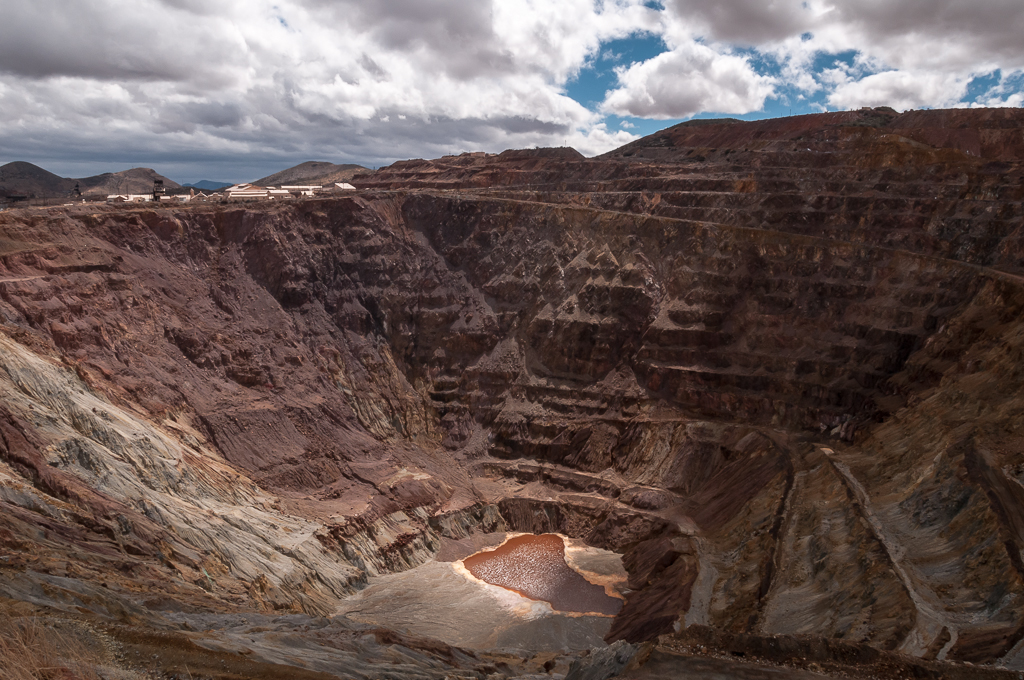
Photo: Wikimedia Commons

Photo: Wikimedia Commons

Photo: Wikimedia Commons
Search for specimens: View all specimens from Lavender Pit, USA
The Lavender Pit lies at the northwest edge of Lowell, immediately east of Old Bisbee, in the Warren mining district. Its coordinates are approximately 31°25'54" N, 109°53'54" W. The mine is on private land, and the present collector should treat the pit, dumps, exposed workings, benches, and old stopes as closed unless explicit permission and safe access have been arranged. It is readily viewed from public roadside overlooks on Arizona State Route 80, but collecting is not a normal public activity there today.
The deposit exploited by the Lavender Pit was the East orebody of the Sacramento stock complex. Earlier drilling and exploration had recognized two porphyry ore zones: the West orebody, later mined as the Sacramento open pit from 1917 to 1929, and the East orebody, which became the Lavender Pit. The copper was not a simple massive sulfide lens but a low-grade enriched blanket in porphyry, with chalcocite commonly occurring as films on pyrite. That textural relationship created metallurgical difficulty: the valuable chalcocite had to be separated from abundant pyrite, and the ore body became economic only when large-scale open-pit methods could be applied.
The country rock framework is classic Bisbee. Cambrian Abrigo limestone, Devonian Martin limestone, Mississippian Escabrosa limestone, and Pennsylvanian-Permian Naco Group carbonates and related units were cut by intrusive porphyry and breccia. The Martin and Escabrosa limestones were especially important hosts for replacement ore and oxidation caves in the wider district, while the younger quartz-feldspar porphyry of the Sacramento stock was the principal open-pit ore host. The Dividend fault zone, a major northeast-trending structure, helped localize and separate mineralized blocks. In the broader district, copper, lead-zinc, iron-sulfur, and late multi-element mineralizing episodes produced a remarkably complex hypogene and supergene mineral suite; the Lavender Pit is best understood as the open-pit exposure of that complicated system rather than as an isolated mine.
Planning for the Lavender operation began in March 1950. Before production could proceed, Jiggerville, Upper Lowell, and Johnson Addition had to be moved, and U.S. Highway 80 was relocated northward. Waste stripping began in 1951. The pit was named after Harrison M. Lavender, the Phelps Dodge vice-president and general manager whose plan made the low-grade ore commercial; he died in 1952, and the new pit was christened in his honor. Ore production began in 1954. Early operations used 25-ton haul trucks loaded by P&H 9-cubic-yard electric shovels. Because the waste haul initially exceeded the economical range of those trucks, waste was dumped into rail cars and carried to No. 7 dump. The first 35-ton trucks arrived in 1960, and 65-ton trucks were introduced in 1963, ending the rail-haul phase for waste.
The Lavender Pit was not static. The southeastern expansion near the abandoned Hoatson Mine followed the first phase of production, and attention later turned to the Holbrook mine region. Phelps Dodge reconditioned an air raise into the Holbrook mine and set up underground diamond drilling; a drift was also driven from the Lavender Pit toward the 400 level Gardner. The Holbrook Extension was announced in 1965. Much of its ore was oxide material—azurite, malachite, and cuprite—and this is the portion of the Lavender story that most strongly overlaps with the collector’s cabinet. The Holbrook Pit was an extension of the Lavender Pit, and by 1969 the extension mined into the old Holbrook shafts and workings. Thousands of specimens were recovered as the pit cut old stopes, crosscuts, crushed pillars, and oxidation-cave material.
Recorded Lavender Pit production began in 1954 and ended on December 14, 1974. Arizona Geological Survey summaries report about 75 million tons of ore produced from 1954 to 1970, while earlier Bureau of Mines-era reporting noted that, by 1959, the Lavender Pit had already produced 202,000 tons of copper. The historical reserve estimates were equally large for Bisbee: in 1954, the Lavender ore reserves were estimated at 41 million tons grading 1.14% copper, with an additional 31 million tons of lower-grade sulfide material suitable for leaching at 0.42% copper. The open-pit operation was the industrial finale of a district whose underground mines had been worked since 1880.
Specimen finds came most memorably where the pit intersected older Holbrook ground. The Holbrook mine had a long pre-Lavender history and was famous for light blue and green zincian azurite and malachite specimens. In 1883, workers on the Cave Claim reportedly broke into a large oxidation cave after enlarging an opening 30 feet down; a man lowered about 50 feet by candlelight found stalactites and stalagmites stained green by copper and walls coated with velvety “copper carbonate.” Decades later, the Lavender/Holbrook Extension cut through old workings and exposed new specimen opportunities: malachite pseudomorphs after azurite, small azurite crystals on calcite, copper-stained calcite, iron-stained calcite crystals up to six inches, chalcoalumite on or replacing azurite and malachite, and localized native copper nodules in clay zones. Some massive calcite tinted by copper was polished and sold locally in the early 1990s as “Bisbee Ice,” a brief lapidary fad rather than a major specimen tradition.
Lavender Pit azurite is most valued in compact, saturated, undamaged pieces: dark royal-blue botryoidal clusters, grape-like rosettes, velvet-textured overgrowths, and crystals associated with malachite, goethite, cuprite, calcite, and iron-rich matrix. The Holbrook Extension is central to the story because it mined through the old Holbrook ground, famous for light blue to greenish zincian azurite and malachite; in that material, the azurite can range from small sparkling vug linings on calcite to cabinet-size specimens where later malachite, chalcoalumite, or other copper alteration products partly overprint earlier carbonate. Good Lavender azurite is not merely “blue Bisbee”—it has tight form, undulled luster, strong color contrast against green malachite or brown-black goethite, and preferably a clear old Lavender Pit or Holbrook Extension pedigree rather than a vague Bisbee label.
Lavender Pit malachite is at its best as pseudomorphs after azurite, acicular to fibrous green crystal aggregates, botryoidal crusts, and richly banded or “eye” material from the Holbrook Extension and related oxidized workings. The classic specimen look is a sharp bladed azurite form preserved in green malachite, often set on goethite, calcite, or dark siliceous breccia, with occasional blue azurite remnants or later blue-green crusts of chalcoalumite. Ordinary pieces are dull green fracture coatings or massive copper-stained rock; superior ones show crisp pseudomorph morphology, silky or velvety surfaces, undamaged terminations, good three-dimensional placement on matrix, and a label that distinguishes Lavender Pit/Holbrook Extension material from the many excellent but different malachites from Czar, Southwest, Campbell, and other Bisbee mines.
Beyond azurite and malachite, the Lavender Pit and especially the Holbrook Extension have documented copper oxides and secondary copper minerals including cuprite, chalcotrichite, chrysocolla, brochantite, antlerite, native copper, and turquoise, along with calcite, aragonite, gypsum, goethite, hematite, pyrite, chalcopyrite, bornite, chalcocite, sphalerite, galena, enargite, and rare aluminum sulfate or clay-associated species such as felsőbányaite, hydrobasaluminite, halloysite, and stevensite. The Holbrook Extension is particularly important for chalcoalumite specimens from the zone that re-mined old Holbrook material; chalcoalumite there occurs as delicate blue-green crusts, replacements, and casts on azurite and malachite, often only 1–7 mm thick and easily damaged. The locality also sits within the wider Bisbee mineralogical universe, a district with more than 325 confirmed species and several type-locality species, although those type descriptions are generally tied to specific underground mines rather than to the Lavender Pit itself.
Lavender Pit labels deserve careful reading. “Bisbee” alone is too broad for serious provenance: a specimen from the Czar Mine, Copper Queen, Southwest Mine, Shattuck Mine, Holbrook Mine, Holbrook Extension, Sacramento Pit, or Lavender Pit may all be honestly “Bisbee,” but they are not interchangeable to collectors who care about paragenesis, specimen style, or market value. A precise old label reading “Lavender Pit,” “Holbrook Extension,” “Holbrook Pit,” or “Lavender Pit, Bisbee” is more meaningful than a modern dealer label that simply assigns any azurite-malachite from Bisbee to the open pit.
Condition is a major value factor. Azurite from Lavender and Bisbee can be bruised along exposed botryoidal ridges, rubbed to a duller blue, or micro-chipped on crystal crests. Malachite pseudomorphs after azurite often preserve attractive form but can be broken at tips, artificially trimmed around matrix, or dulled by over-cleaning. Chalcoalumite is especially fragile: it flakes from the underlying azurite or malachite with little provocation, and iron-rich clay associations can leave reddish staining that should not automatically be read as poor cleaning. Calcite specimens with copper staining or “Bisbee Ice” lapidary material are more decorative than rare unless they carry unusually strong form or documentation.
Mislabelling is most common in two directions: over-attribution to the Lavender Pit because the name is famous and scenic, and under-attribution to “Bisbee” when the specimen style and old label point specifically to the Holbrook Extension. Ajo shattuckite has also historically been sold as Bisbee shattuckite; while this does not directly concern the two featured Lavender species, it is a reminder that “Bisbee blue” is a marketable phrase and must be supported by provenance. Turquoise sold as “Bisbee” or “Lavender Pit” needs particular caution because genuine Bisbee turquoise exists and can be valuable, but much material in the trade is weakly documented or assigned by appearance.
A special authenticity concern applies to copper acetate minerals such as hoganite and paceite, which are known from Bisbee-area material but may also form anthropogenically when copper-bearing specimens are cleaned with acetic acid, including vinegar. Any claimed Lavender/Holbrook acetate rarity should be treated as a lab-verified micromineral, not as a casual label species.
Lavender Pit specimens remain available, but the market is historical rather than field-collected. Small azurite-malachite pieces and malachite pseudomorphs appear regularly; fine, undamaged, well-provenanced Lavender or Holbrook Extension specimens with strong aesthetics are much scarcer. The best pieces tend to reside in old Bisbee collections, museum holdings, and long-established dealer inventories.
The Lavender Pit began as a solution to a problem that had lingered since early porphyry exploration in 1909. The West orebody could be attacked by the Sacramento open pit, but the East orebody was intended for underground block-caving and top slicing. The rock refused to behave. The block-cave stopes did not collapse properly, leaving ore in place, and the ore itself complicated the mill’s work because chalcocite occurred as thin films coating pyrite. What looked like copper wealth in the ground became a separation problem at the plant: the desired copper sulfide was intimately tied to a mass of pyrite with little direct value.
The decision to mine the East orebody as an open pit reshaped Bisbee physically. In March 1950, planning began for the new pit, and before the first real tonnage could move, whole neighborhoods had to move. Jiggerville, Upper Lowell, and Johnson Addition stood in the way; Highway 80 did too. A postcard preserved by the Bisbee Mining & Historical Museum captures the strangeness of the operation in one sentence: the pit was being dug where, in 1953, U.S. Highway 80 had been lined with businesses and flanked by homes. Moving buildings to new sites south and west of town and relocating the highway along what became the east rim took two years. The open pit did not simply expose geology—it erased and rearranged streets.
The machinery tells the scale change in miniature. Bisbee’s earlier fame was built in shafts, raises, and stopes; the Lavender Pit worked by benches, shovels, trucks, and dumps. The topography prevented practical train haulage inside the pit, so 25-ton trucks carried rock from P&H 9-yard electric shovels. But even that was not quite enough at first. The waste haul exceeded what the 25-ton trucks could do economically, so waste was dumped into rail cars and hauled to No. 7 dump by train. By 1960, 35-ton trucks entered the operation; by 1963, 65-ton trucks arrived, and the rail link for waste haulage became unnecessary. When mining ended, those machines themselves became relics: in November 1976, thirteen 65-ton trucks, three 35-ton trucks, and four electric shovels were sent away to the Western Nuclear Mine near Spokane.
The Holbrook Extension gave the Lavender Pit its most collector-rich afterlife. The old Holbrook mine had always been a special corner of Bisbee, known for pale blue and green zincian azurite and malachite. In 1883, Walker Williams and Joe Russell broke into a large oxidation cave on the Cave Claim while working only about 30 feet down. After the opening was enlarged, a man was lowered roughly 50 feet by candlelight and found a two-acre cavern perhaps 50 feet high, with stalactites, stalagmites, green copper staining, and walls coated in velvety copper carbonate. Nearly ninety years later, the expanding Lavender operation cut into the Holbrook ground again. In 1969, both Holbrook shafts were mined out by the open pit extension, and old stopes, crosscuts, and pillars were bitten through by electric shovels. Thousands of specimens came out as the pit intersected the abandoned underground world.
Even after mining stopped on December 14, 1974, the pit walls kept opening old doors. Erosion exposed Holbrook stopes in the Extension, and in the late 1980s and early 1990s, collectors and local youngsters sometimes entered a stope on the 100 level. The finds were not grand commercial pockets in the romantic sense, but they were intensely Bisbee: calcite, malachite pseudomorphs after azurite, small azurites on calcite, and copper-stained cave calcite. One crosscut ran back to a powder magazine and a small stope arranged with an incline for hoisting, suggesting no workings beneath it. Near the top, a hole opened into a larger oxidation cave filled with calcite; the lower section yielded iron-stained crystals up to six inches, while the upper portions were green from copper.
Then there was “Bisbee Ice.” For a short time in the early 1990s, massive calcite tinted by copper was collected, polished, and sold locally under that name. It was not the sort of great mineral specimen that defines the Lavender Pit to advanced collectors, but it is a perfectly Bisbee footnote: a mining town, a scenic abandoned pit, oxidation minerals weathering out of old workings, and a sudden local lapidary fashion built around copper-colored calcite.
The Lavender Pit still reminds visitors that old mine ground is not scenic emptiness. On September 13, 2025, a 44-year-old Bisbee man called 911 at about 1:03 a.m. from the bottom of the pit, reporting that he was stuck. Mine security could not reach him because condemned roads prevented access. Cochise County Search and Rescue called in Arizona Department of Public Safety Air Rescue Ranger 2 from Tucson; the helicopter arrived around 2 a.m., made a reconnaissance flight, landed at the Pit Overlook to take a rescue specialist aboard, then used a hover ingress to retrieve the injured man and fly him to Copper Queen Hospital. For collectors, it is the modern cautionary tale attached to every beautiful forbidden bench and every dark old opening visible in the Holbrook wall.