A collector's guide to Beckermet Mine, UK: its geology, mining history and notable minerals, illustrated with the 49 specimens documented from this locality on EarthWonders.
Key facts
Beckermet Mine is one of the defining specimen localities of the West Cumbrian iron orefield: a deep, concealed hematite mine south-east of Egremont, developed not in the picturesque open fells but beneath Permo-Triassic cover, where high-grade hematite replaced Carboniferous limestone along faults and bedding planes. For industrial historians it marks the late, mechanized chapter of Cumbrian iron mining; for collectors it is the source of instantly recognizable combinations of deep red kidney ore, glittering black specularite, clear to iron-stained calcite, dipyramidal quartz, and saddle-shaped dolomite. The best Beckermet pieces have a very particular look: hard metallic sparkle over brick-red botryoidal hematite, with sharp colorless quartz or calcite perched on the ore, or tan-to-pink dolomite rosettes thrown across a black specularite ground.
Regional View
Country View
The mine belongs to the concealed southern part of the Egremont-area orefield, where the great West Cumbrian hematite bodies continued beneath younger rocks after many of the older, more northerly workings had declined. Beckermet’s Mildred and Winscales workings exploited the Winscales-Mildred orebody, later linked in the broader Florence-Ullcoats-Beckermet system. This distinction matters to collectors because labels reading simply “Egremont,” “West Cumberland,” “Florence,” “Beckermet,” or “Beckermet/Florence” may all occur on old material, especially after the mines became interconnected underground. Well-provenanced Beckermet labels are therefore unusually valuable, particularly for Banana Slide calcites and dolomite-specularite combinations.
Search for specimens: View all specimens from Beckermet Mine, UK
Beckermet Mine is recorded near Haile, south-east of Egremont in Cumbria, at approximately NY025086. It was a deep iron-ore mine in the West Cumbrian hematite field, a district whose commercially important ores were dominantly high-grade hematite replacing Carboniferous limestone. Beckermet lay in the concealed part of the field: unlike the older exposed ore workings farther north-east of Egremont, its Carboniferous limestones were overlain by Permo-Triassic cover including Brockram, magnesian limestone, St Bees Shales, and St Bees Sandstone, with Quaternary glacial deposits above. Early technical descriptions emphasize that the ore was localized near faulted ground, occurring in both vein-like and flatter replacement forms where iron-bearing solutions moved along fractures and bedding planes, attacked the limestone, and left hematite with gangue minerals such as quartz and baryte.
The Beckermet Mining Co. Ltd. was formed in 1903 after surface drilling proved hematite. No. 1 shaft, known as Mildred Pit, was sunk first and production began in 1906; it was later deepened to about 1,374 ft. No. 2 shaft, the Winscales Pit, was begun in 1916, bottomed at about 1,247 ft, and entered production in 1918. These shafts developed the Winscales-Mildred deposit, described in mid-twentieth-century accounts as one of the largest discovered in Cumberland. The Beckermet mines were taken over by United Steel Companies in 1920, and by the 1950s the Beckermet Mining Co. was operating as a subsidiary supplying hematite for the Workington steelworks. Haile Moor shaft, sunk in 1939 east of Haile village and producing by 1942, extended the Beckermet company’s reach into additional ore.
Geologically, Beckermet’s significance lies in the thickness and concealment of the ore system. Later hydrogeological work on the interconnected Florence-Beckermet mine complex records the Winscales-Mildred ore deposit as narrow but up to about 91 m tall. The orebody was dominated by hematite, with accessory quartz, barite, limonite, siderite, calcite, dolomite, and minor pyrite. Mining methods included upward room-and-pillar stoping followed by downward robbing, leaving a system of rubble-filled voids that later behaved as a hydraulically connected flooded mine reservoir.
Historically, Beckermet occupies the last great industrial phase of the West Cumbrian iron field. The district had produced enormous quantities of hematite, with modern geological summaries giving more than 100 million tons of high-grade ore from West Cumbria as a whole. By the twentieth century, production was increasingly concentrated in the concealed southern orebodies around Florence, Beckermet, and Haile Moor. Florence was acquired by British Steel in 1969, pumped out, and linked to Beckermet; ore from the combined system was drawn through Beckermet for the Workington works. Locality records often give 1973 as the closure date for Beckermet Mine itself, while mining histories record the broader Beckermet-Florence complex as closing under British Steel on October 3, 1980. After that, part of Florence was reopened by former miners as the Egremont Mining Company, surviving on a small scale until flooding and pumping costs ended the last phase in 2007.
For specimen collectors, Beckermet’s great finds came from vugs, faults, and ore-lined cavities rather than from tidy alpine-style veins. The best-known specimen episode was the Banana Slide fault-zone find in the early 1970s, which produced hematite-included and hematite-tinted calcite groups—clear, prismatic, nailhead to scalenohedral crystals with red and black internal phantoms. Beckermet also produced classic dolomite on specularite: tan, cream, or dark pink saddle-shaped rosettes scattered over a sparkling black hematite crust with brick-red kidney ore beneath. Quartz appears as colorless to smoky, often dipyramidal crystals on hematite and specularite, sometimes with hematite phantoms or iron staining. Today the workings are flooded and inaccessible, and the surface mine site has been redeveloped in industrial use; collecting is therefore from old miners’ pieces, dealer stock, museum holdings, and dispersals of British collections.
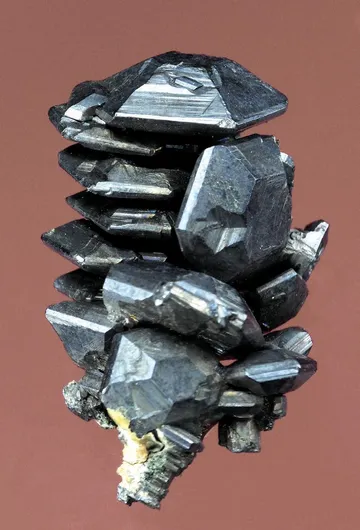
Beckermet hematite is the core species of the locality and occurs in the classic West Cumbrian modes: massive red ore, botryoidal kidney ore, and sparkling black specularite. Good pieces show contrast—scalloped brick-red hematite beneath a crust of glossy tabular or bladed specularite, sometimes carrying quartz, calcite, dolomite, or fluorite—whereas ordinary examples are simply heavy massive ore with little surface definition. Cabinet-sized kidney-ore masses were traded by British dealers during the mine’s working and immediately post-working era, and the most collectible Beckermet hematites today are those with sharp specularite sparkle, undamaged botryoidal curvature, and firm old labels tying them to Beckermet rather than the broader “Egremont” or “West Cumberland” field.
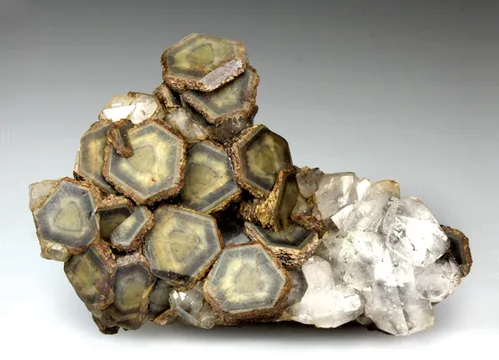
Quartz from Beckermet is prized less as a stand-alone species than as a visual partner to hematite: colorless, glassy, smoky, or faintly bluish dipyramidal crystals perched on layered hematite and specularite. Documented examples include small crystals scattered across hematite plates, crystals to about 15 mm on layered ore, and larger double-terminated crystals around 2.2 cm across on specularite-coated hematite matrix. The best pieces retain sharp tips and bright transparency, with the dark metallic ore providing contrast; hematite phantoms, red inclusions, and associations with calcite or dolomite add locality character, while chipped tips and vague “Egremont” labels reduce appeal.
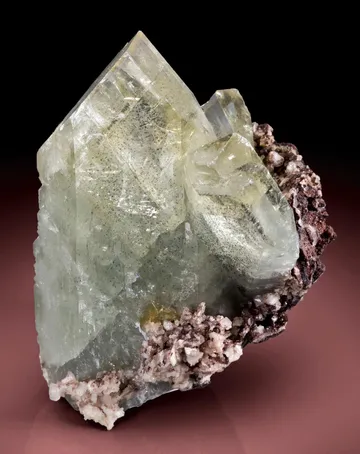
Beckermet calcite is most famous from the Banana Slide fault-zone find of the early 1970s, where collectors obtained hematite-stained and hematite-included crystals in groups that can be unmistakably Cumbrian. Habits include colorless to reddish-brown prismatic crystals, columnar nailhead forms, scalenohedral crystals, and groups with rhombohedral or “Mercedes” style terminations; recorded specimens include crystals to 3–5 cm and clusters around 13 cm across. The best examples are bright, transparent to translucent, internally zoned or phantom-rich with red hematite and black oxide inclusions, and preferably on hematite or quartz-bearing matrix; ordinary pieces are cloudy, heavily contacted, or detached crystals without the iron-phantom drama that made Banana Slide material famous.
Dolomite from Beckermet is a classic accessory mineral when it sits as curved, saddle-shaped crystals or rosettes on specular hematite. The characteristic color range is cream, tan, pink, to dark pink, and good examples show lustrous rosettes scattered aesthetically over a sparkling black specularite crust, sometimes with the reverse revealing scalloped red kidney ore. Documented cabinet specimens are around 9–10 cm across, and a typical desirable piece combines clean dolomite rosettes, strong contrast against metallic hematite, and minimal bruising to the delicate curved crystal edges; dull massive dolomite without the specularite association is far less distinctive.
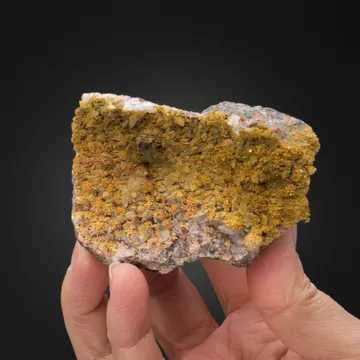
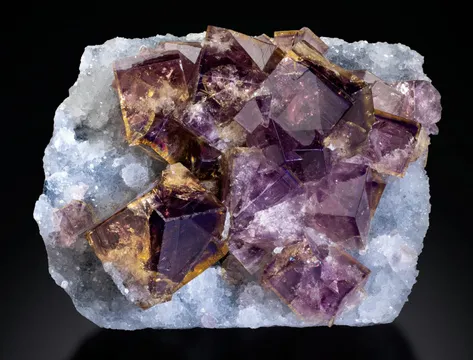
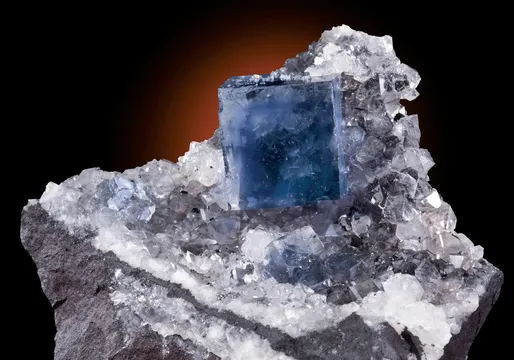
Other minerals documented from Beckermet include fluorite, pyrite, chalcopyrite, anglesite, chalcanthite, and smoky quartz, with barite, limonite, and siderite also reported in broader geological descriptions of the Florence-Beckermet ore system. Fluorite is particularly important mineralogically because Beckermet was the subject of a dedicated study on fluorite mineralization in the iron ore mine, and blue-grey fluorite is part of the classic West Cumbrian hematite-quartz-dolomite-fluorite assemblage. No recognized type-locality species is attached to Beckermet in the standard modern locality record; its importance is instead as a classic specimen locality for replacement-ore hematite assemblages and the uncommon Banana Slide calcite suite.
The main authenticity issue with Beckermet is locality precision. Many specimens from the interconnected Egremont-area workings were labelled broadly as “Egremont,” “West Cumberland,” “Florence,” “Florence/Beckermet,” or simply “Cumbria,” and some later labels may assign pieces to Beckermet because the style looks plausible. This is especially sensitive for calcite: the Banana Slide name is sometimes attractive enough that unrelated calcite has been paired with a Beckermet label. A well-known identification discussion rejected a supposed Banana Slide specimen as not West Cumbrian at all, with experienced collectors recognizing it as a paper-thin perimorph after calcite from Cavnic, Romania. Serious buyers should therefore look for label chains, old British dealer labels, miner provenance, or a habit matching documented Beckermet material.
Condition is another major factor. Specularite edges can be sharp but fragile, and the sparkle that makes these specimens so attractive is easily dulled by abrasion, oil, or careless cleaning. Quartz and calcite from Beckermet commonly sit on thin hematite crusts; broken tips, contacted prism faces, and detached crystals are common. Banana Slide calcites should be examined for tip damage and for natural contacts where crystals grew crowded in vugs. Dolomite rosettes on specularite often show bruising at exposed saddle edges, so pristine rosettes command a premium.
Cleaning should be conservative. Iron staining is part of the locality character, especially in calcite with hematite phantoms and quartz on ore, and aggressive acid treatment can flatten the very contrast collectors want. Calcite must not be exposed to acid cleaning. Hematite specimens are dense and generally stable, but thin specularite plates and ore crusts can shed small flakes if handled roughly. Chalcanthite, where present, is water-soluble and should be treated as a secondary, humidity-sensitive species rather than a display-stable cabinet mineral.
Market availability is limited but not exhausted. Beckermet was productive enough that old specimens still surface, especially hematite, quartz on hematite, and dolomite-specularite combinations. However, no modern collecting supply exists from the flooded underground workings, and the best pieces are now essentially collection-circulation minerals. Strongly labelled Banana Slide calcite, dolomite rosettes on black specularite, and sharp dipyramidal quartz on hematite are the locality’s most competitive collector targets.
The most memorable Beckermet story begins not with a crystal pocket but with depth. In 1903 the Beckermet Mining Co. formed after drilling proved hidden ore under the fields south-east of Egremont. The company’s No. 1 shaft—Mildred Pit—went down more than a thousand feet before production began in 1906, then was deepened again between 1912 and 1915. No. 2 shaft, Winscales, followed in 1916 and produced ore from 1918. Those two shafts opened the Winscales-Mildred deposit, a concealed extension of the Egremont hematite system so large that mid-century engineers described it among the great finds of Cumberland. The old romance of iron mining here is therefore inverted: not men following red ore at outcrop, but a company betting on boreholes, sinking through cover, and striking an orebody hidden under younger rock.
By the 1950s Beckermet was no relic. It was a modern industrial iron mine, mechanized, deep, and costly to run. A 1954 technical account describes standard 16-cubic-foot steel tubs made by Robert Hudson of Leeds, each carrying 20 cwt of hematite ore; three loaded tubs made one “pit ton” in company accounting. At the face, Eimco rocker shovels loaded ore where possible, while headings driven down grades as steep as 1 in 4 required modified machines and electric hoists. A dust-laying mist projector, improvised at the mine from a Gardner Denver air-line oiler charged with castor compound, tells a very Beckermet story: practical engineering in a red, dusty, deep ore mine where the difference between a good idea and a bad day could be measured in air quality.
The specimen story collectors repeat is the Banana Slide. Around 1971, along this fault zone, cavities yielded calcite so unlike ordinary industrial ore that it entered British collecting folklore: clear to reddish, prismatic crystals with hematite ghosts sealed inside them. Some crystals stand like little red-tinted columns; others show internal phantoms stained by hematite or specularite. One documented group measures about 13 cm across, with individual calcite crystals to 5 cm, and another large cabinet specimen carries well-formed prismatic crystals with sharp terminations and watery luster. The name sounds whimsical, but in specimen terms Banana Slide is one of the keys to separating Beckermet calcite from the general run of Cumberland calcite.
There is also the afterlife of Beckermet, inseparable from Florence. Once the underground links were made, ore, men, water, and later collectors’ labels moved through a shared system. Florence closed in 1968, was pumped out and linked to Beckermet after British Steel took it over in 1969, and the combined operation ended under British Steel in 1980. Former miners then put their redundancy money back into the pit and reopened part of Florence as the Egremont Mining Company. That final chapter kept the West Cumbrian iron-mining tradition alive into the twenty-first century, until pumping costs and flooding ended work in 2007. One collector who knew the owner of Florence later described watching water rise through the levels after the pumps were stopped and bringing out “the last rake of trucks” loaded with specimens; the two tubs and the loco, he wrote, were left at the bottom under a hundred feet of water. It is not Beckermet in the strict shaft-name sense, but it is the closing scene of the same underground world that Beckermet helped define.