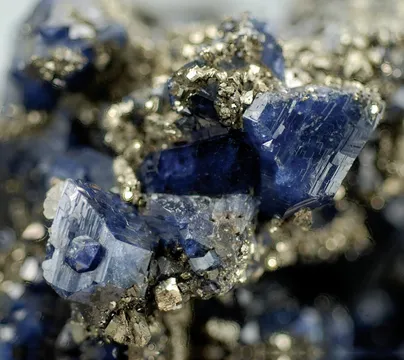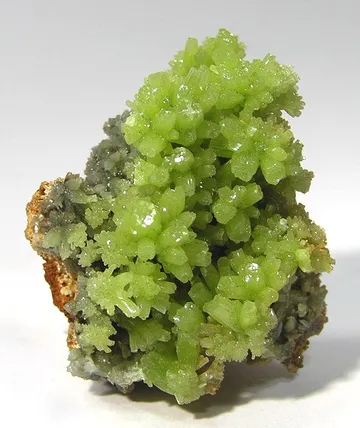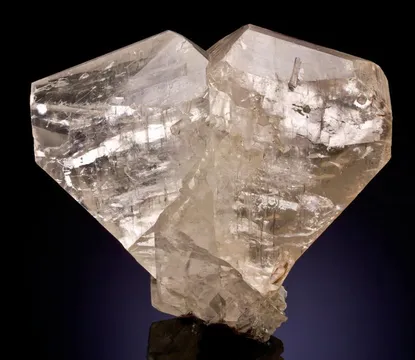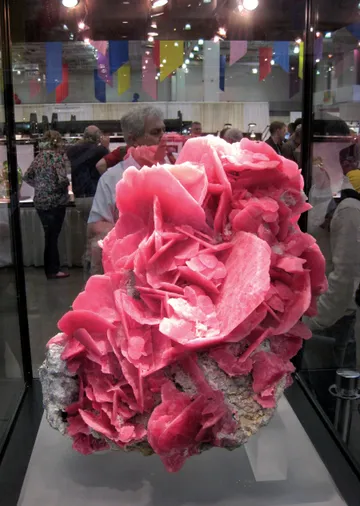
Wutong Mine, China - renowned rhodochrosite from Nanling locality, famed for large, floral pink-red crystals with fluorite and pyrite; prized by collectors.
Key facts
Wutong is the modern Chinese locality that forced serious rhodochrosite collectors to redraw the mental map of the species. The mine, also spelled Wudong, lies near Liubao in Cangwu County, Wuzhou, Guangxi Zhuang Autonomous Region, in the folded sedimentary country of South China’s Nanling metallogenic province. Economically it was a modest underground lead-zinc-silver mine with tungsten-bearing mineralization; aesthetically it became one of the world’s great rhodochrosite sources when pockets of rose-red to cherry-red crystals began reaching the Chinese mineral market in the early 2000s and the source was eventually traced to Wutong.
The deposit is a polymetallic, magmatic-hydrothermal system hosted chiefly by Cambrian clastic rocks: dark siltstone and shale, sandstone, and a locally important chert bed that helped control fracturing and open-space pocket formation. Its collector assemblage is instantly recognizable: rhodochrosite with fluorite, quartz, pyrite, sphalerite, baryte, calcite, fluorapatite, galena, hübnerite, chalcopyrite, acanthite, and rare native silver. The finest specimens show large, flattened rhombohedra or discoidal “petal” aggregates of rhodochrosite, commonly in warm pink-red to saturated cherry-red tones, set off by glassy purple, pale blue, green, or colorless fluorite, bright pyrite, black sphalerite, and clear to milky quartz. They rarely have the absolute glassiness of Sweet Home or N’Chwaning crystals, but Wutong’s best pieces have a scale, floral architecture, and mineralogical complexity that are uniquely their own.
Regional View
Country View
The mine’s collecting reputation rests above all on the late-2009 to April-2010 discoveries, including the celebrated “Emperor of China” and “Empress of China” specimens from the April 2010 pocket. Those pieces demonstrated that Wutong could produce crystallized rhodochrosite not merely as good cabinet specimens, but as world-scale mineral icons. For the working collector, however, the locality’s appeal is broader: Wutong produced everything from thumbnails with purple fluorite and pink rhodochrosite to large cabinet plates of rosetted carbonate, quartz, and sulfides. The locality is also important because its scientific study ties shallow Ag-Pb-Zn mineralization to Cretaceous granitic magmatism in the Nanling belt, making it one of the rare specimen mines where pocket aesthetics and ore-deposit research meet unusually well.


Photo: Wikimedia Commons
Search for specimens: View all specimens from Wutong Mine, China
Wutong is a small underground mine in the Liubao area of Cangwu County, Wuzhou Prefecture, eastern Guangxi. The nearest town cited in the principal mine account is Liubao, roughly 24 km from the mine, with access by dirt road through low, tree-covered hills and small terraced farms. Published locality coordinates for Wutong are approximate rather than survey-grade, and collector labels vary: Wutong Mine, Wudong Mine, Liubao, Cangwu, Wuzhou, Guangxi; older labels may say Babu District or Nandan, both now regarded as suspect for much of the early rhodochrosite material.
The deposit was discovered in 1958 and was worked for lead, zinc, and silver for most of its life. A Wuzhou City Land Resources Department reserve evaluation cited in the mine literature gave modest reserves of 4,676 tons of lead, 3,555 tons of zinc, and 6.65 tons of silver. The original ore operation used a declined shaft, ore carts, a small ball mill, and a six-cell flotation system to produce base-metal concentrates and small amounts of silver. As rhodochrosite became more valuable than the ore itself, management began stockpiling lead-zinc-silver ore and redirecting attention toward specimen and gem-rough recovery.
Geologically, Wutong belongs to a Cretaceous magmatic-hydrothermal system in the Nanling metallogenic belt. The host rocks are tectonically disturbed Cambrian sedimentary rocks: steeply dipping dark gray to black siltstones and shales, sandstone, and a distinctive pale gray chert bed up to about 50 cm thick. The sedimentary sequence is folded into complex synclinal and anticlinal structures, with bedding generally striking northwest and dipping steeply northeast. The main mineralized fracture zone is broadly bedding-parallel and may reach about 2 m wide in mine exposures. The chert bed matters because it behaved as a brittle unit within less competent shales and siltstones, allowing “ladder vein” style fractures, pods, and vugs to develop where specimen pockets could survive.
The mine exposed the mineralized structure over a vertical interval of roughly 170 m from surface outcrops and trenches near 350 m elevation down to lower mine workings around 180 m elevation. Fresh underground exposures were much more limited, roughly from the main level near 230 m down to about 175 m. Surface outcrops are weathered and oxidized; the important collector material came from underground open spaces in the rhodochrosite-bearing vein system.
The accepted paragenesis is multi-stage. Early mineralization included quartz and hübnerite in fractures and veins. This was followed by the major sulfide-carbonate-fluorite pulse that produced galena, sphalerite, pyrite, chalcopyrite, rhodochrosite, purple fluorite, and quartz. Later faulting and open-space filling introduced abundant green to colorless fluorite, fluorapatite, calcite, and baryte, locally coating earlier minerals. A final sparse silver stage produced native silver wires and acanthite with shiny white clay coatings. More recent geochronology places Wutong’s concealed monzogranite at about 93.64 Ma, hübnerite mineralization at about 95.5 Ma, and rhodochrosite mineralization at about 91.9 Ma, tightening the deposit into a Late Cretaceous mineralizing event.
The modern specimen chapter began quietly. From about 2000 to early 2006, rich red and deep pink Chinese rhodochrosites appeared in Guilin and Changsha mineral markets, but the actual mine source was uncertain or deliberately obscured. Specimens were commonly attributed to Babu in Hezhou or to Nandan in Hechi. In June 2006 Collector’s Edge representatives visited Wutong, and in autumn 2007 the company entered a collaborative arrangement with the mine owners. The American team brought specimen-mining techniques, geological evaluation, specialized equipment, and preparation services; the local owners and miners supplied access, underground labor, and the operating mine.
A major decline extension was driven to intersect the mineralized veins at depth, with the intention of raising on rhodochrosite structures known from the upper workings. The work was expensive and slow, and early results after the decline reached the target area were discouraging. Then late 2009 and early 2010 produced the pockets that made the mine famous. The April 2010 pocket yielded the two legendary giants: “Emperor of China,” approximately 40 × 60 cm and 63.5 kg after preparation, with a 22 cm crystal; and “Empress of China,” about 33 × 39 cm, with lustrous flower-like crystals to about 19 cm across. Other important pieces from the period include large rhodochrosite-fluorite combinations, discoidal rhodochrosite plates with pale blue fluorite and quartz, and named pieces such as “The Lips” and “The Blade.”
After the 2010 bonanza, later work produced only modest pockets. In summer 2011 Wutong was placed on care-and-maintenance status; published accounts state that the lower levels flooded and that no organized specimen mining by that partnership continued afterward. Collecting access today should be regarded as closed and non-public. Specimens on the market come from the 2000–2011 production, later dealer inventories, Chinese collections, and occasional subsequent releases. Reports of unusual newer combinations, including baryte-rich material recorded in the 2020s, should be evaluated specimen by specimen with provenance, because Wutong material has circulated through multiple dealer networks and older stock has often reappeared years after mining.
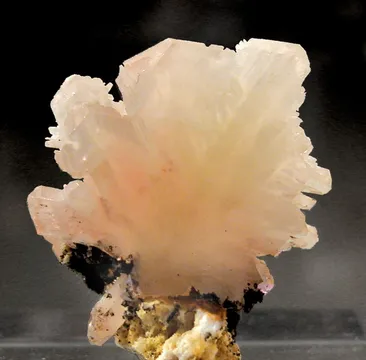
Wutong rhodochrosite is the locality’s signature mineral and occurs in several habits: simple rhombohedra, stepped rhombohedra with rounded corners, compressed flattened rhombs, twinned flattened crystals, discoidal plates, and flower-like rosettes. Documented crystal sizes range from sub-millimeter crystals to rhombohedral individuals over 6 cm on an edge, flattened twinned crystals to about 8 cm, discoidal forms to roughly 16 cm, and the extraordinary April 2010 crystals of the “Empress” and “Emperor” class to about 19–22 cm across. Color ranges from pale pink through medium rose to cherry red and purplish red; the best pieces have saturated color, translucency, undamaged rims, lively luster, and strong three-dimensional composition with fluorite, quartz, pyrite, sphalerite, or baryte rather than being simple massive or bruised carbonate plates. Wutong’s great rhodochrosites are not normally judged by Sweet Home standards of glassy, gem-clear scalenohedra; they are prized for large scale, sculptural flattened geometry, “petal” architecture, complex associations, and the visual contrast of red carbonate against purple or pale fluorite and sparkling quartz.
Fluorite from Wutong is an essential companion species rather than a mere accessory, and many of the most recognizable specimens use fluorite as a cool-toned counterpoint to red rhodochrosite. It occurs as sharp lustrous cubes, truncated cubes, cuboctahedra, and truncated octahedra, from microscopic crystals to about 6 cm. Fluorite from the rhodochrosite-sulfide stage is commonly smaller, roughly less than 1 mm to 3 cm, and may be sea-green, bluish purple, gray-blue, purple, pale lilac, or colorless; later fluorite is typically pale green to colorless and can reach larger sizes. The best Wutong fluorite pieces show transparent to glassy crystals perched cleanly on rhodochrosite or quartz, with desirable color zoning, undamaged cubic edges, and balanced composition; ordinary pieces have dull, damaged, or overly crowded fluorite that obscures the rhodochrosite rather than enhancing it.
Quartz is abundant at Wutong and occurs both early and late in the vein sequence, making it one of the main structural and aesthetic minerals in the specimens. Early quartz is tied to hübnerite-bearing veins, while later quartz accompanies the sulfide-rhodochrosite-fluorite assemblage and locally appears as transparent, slender, radiating, or prismatic crystals that brighten the red carbonate. Published descriptions give Wutong quartz as water-clear to milky prismatic crystals from about 1 mm to 3 cm, with some late tabular crystals showing faden-like lines. In collector terms, the finest quartz associations are clean, glassy sprays or architectural clusters that frame rhodochrosite without hiding it, especially where needle-like quartz creates contrast against a vivid red rhodochrosite face or pale fluorite cubes; low-value quartz is typically milky, broken, iron-stained, or merely a massive vein support.
Pyrite is widespread and well crystallized at Wutong, occurring as tiny bright crystals disseminated through rhodochrosite-bearing veins and as sharper pyritohedra or cubes in open vugs with rhodochrosite, fluorite, quartz, and sphalerite. Much of the pyrite is small, from microscopic grains to several millimeters, but specimens with brassy, lustrous pyrite crystals can give Wutong combinations a distinctive sparkle and a strong color contrast against red carbonate, purple fluorite, and black sphalerite. Better pieces have fresh metallic luster, crisp forms, and pyrite positioned as an accent or matrix rather than a dusty coating; ordinary examples may show dull sulfide, limonite staining, or tiny scattered pyrite that adds little visually. Large isolated pyrite is not the reason to collect Wutong, but well-placed pyrite is one of the locality’s key visual signatures.
Sphalerite is one of Wutong’s most abundant sulfides and belongs to the base-metal stage that helped define the mine long before specimen rhodochrosite became the economic prize. It typically forms highly lustrous twinned crystals from less than 1 mm to about 2 cm, and because of high iron content the crystals are commonly black and opaque. Sphalerite is found with pyrite, galena, chalcopyrite, quartz, fluorite, and rhodochrosite, and it can provide a dramatic dark anchor for pink-red carbonate and pale fluorite. Good Wutong sphalerite specimens show sharp, lustrous, well-separated crystals or black crystalline matrix with attractively placed rhodochrosite; lesser pieces are visually heavy, damaged, or dominated by black sulfide without enough contrasting color or form.
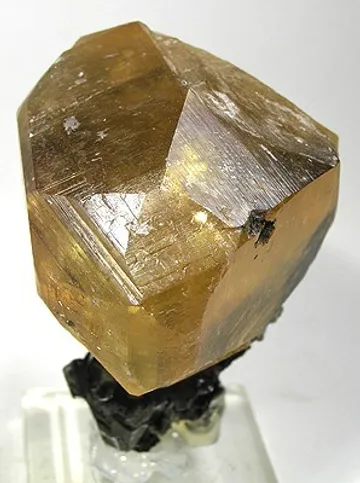
Calcite at Wutong is documented mainly as a late vein-filling gangue mineral, commonly white and massive, but collector specimens also show attractive golden-yellow to pale calcite crystals with striated faces and a style distinct from the rhodochrosite-dominant pieces. In the Wutong paragenesis, calcite belongs to the later open-space filling event with green to clear fluorite, fluorapatite, and baryte, and it may overgrow or partially coat earlier minerals along with clay and limonite coatings. For collectors, calcite is secondary in importance here, but good pieces are well-trimmed, lustrous, and undamaged, with crystal form and color strong enough to stand on their own or to complement the sulfide-fluorite-rhodochrosite assemblage. Common material is massive white calcite, pocket coating, or preparation residue rather than a true display mineral.
Under the American spelling “barite,” Wutong material refers to the same BaSO4 species more formally listed as baryte, and it is a scarce but important accessory on top-grade combination specimens. Published mine descriptions record white, lustrous, bladed crystals to about 6 cm, found sparingly and most often associated with cubic purple fluorite and rhombohedral rhodochrosite; some blades are overgrown by quartz microcrystals. Barite adds pale, blade-like geometry to a locality otherwise dominated by red carbonate, cubic fluorite, and sulfides. The best pieces show clean, bright, well-placed blades with rhodochrosite or fluorite, especially where the white blades make a crisp compositional accent; common or lower-grade examples are small, partly hidden, broken, or present only as minor white inclusions.
Baryte is the IMA-preferred spelling for the BaSO4 species known to many U.S. collectors as barite, and Wutong baryte has become especially interesting because of unusual intimate associations with rhodochrosite. Beyond the classic white bladed crystals described in the main mine study, more recent dealer-documented Wutong combinations include white baryte perched on or intergrown with rose-red rhodochrosite, in some cases with baryte terminations showing included rhodochrosite and layered growth. Such pieces are far less common than rhodochrosite with fluorite or quartz, and they appeal to collectors who already know the standard Wutong look and want an uncommon textural variation. Superior baryte specimens from Wutong have obvious, undamaged baryte crystals, clean contrast, and convincing association; weak examples show only small colorless or white fragments that could be overlooked without close inspection.
Other documented Wutong minerals include acanthite, native silver, galena, chalcopyrite, hübnerite, fluorapatite, kutnohorite, dolomite, bertrandite, and sellaite. No recognized type-locality mineral is associated with Wutong in standard locality listings, but the mine is significant for rarities within its own assemblage: rare wire silver with acanthite, seldom-seen reddish brown bladed hübnerite with quartz, pale pink kutnohorite sprays and coatings, fluorapatite in the late fluorite-calcite-baryte assemblage, and bertrandite specimens whose true Wutong origin matters because some were sold under the more famous Yaogangxian label. The mineral list is not enormous, but it is unusually coherent: nearly every desirable species relates directly to the same compact hydrothermal system that produced the rhodochrosite pockets.
Wutong rhodochrosite is heavily represented on the market, but top-grade material is not common. Small to mid-sized examples with pale pink rhodochrosite, quartz, pyrite, and fluorite are obtainable; strongly colored, undamaged, well-composed pieces with lustrous rhodochrosite and attractive fluorite remain competitive, and historic cabinet pieces from the 2009–2010 finds are serious collection objects. The locality’s best specimens trade partly on sculptural presence rather than pure gemminess, so do not dismiss a piece for slight translucency limits if the form, color, and association are exceptional.
The first authenticity issue is label history. Early Wutong rhodochrosites were often attributed to Babu or Nandan before the source was clarified. A “Babu,” “Nandan,” “Guangxi,” or even simply “China” label on a red rhodochrosite-fluorite-quartz-pyrite specimen may represent Wutong, but it should not automatically be upgraded without provenance. Conversely, not every Chinese rhodochrosite with fluorite is Wutong; similar-looking polymetallic vein assemblages occur elsewhere in Guangxi and the broader South China mineral province.
The second issue is mislabeling in the opposite direction: some Wutong bertrandite specimens have been sold as Yaogangxian, and the Yaogangxian label carries strong name recognition. For beryllium minerals and odd accessory species, analytical confirmation and provenance matter more than the dealer label. For rhodochrosite itself, association and style are useful clues—flattened red rhombs, purple to pale fluorite, quartz, pyrite, and black sphalerite are a familiar Wutong suite—but the safest high-value purchases include old labels, acquisition dates, publication references, or a clear ownership chain.
Condition is a major value separator. Wutong rhodochrosite commonly shows natural stepped or etched faces, rounded edges, and growth irregularities; these are not automatically damage. Actual damage tends to appear as bruised rhombohedral rims, cleaved corners, missing petal tips, dull abraded high points, and broken quartz or fluorite on the matrix. Because the rhodochrosite is relatively soft and cleavable, specimens should be handled by matrix or mount, never by a projecting carbonate crystal. Avoid prolonged strong light for intensely colored display pieces as a conservative practice, and keep specimens away from acids and aggressive cleaning methods; carbonate and fluorite associations can be unforgiving.
Preparation disclosure is especially important for high-end Wutong. Many major specimens required substantial professional cleaning to remove calcite, clay, and limonite coatings, and some large pieces were trimmed, repaired, or restored. Preparation does not disqualify a Wutong specimen—indeed, it is part of the history of the finest pieces—but undisclosed repair, filled cleavages, rebuilt tips, or artificial enhancement materially affect value. Ask specifically about repairs, restorations, glued contacts, sawed bases, acid cleaning, and stabilization. Sawed bases are seen on some market pieces and may be acceptable if disclosed and if the display face remains natural.
Fluorescence is not a primary reason to buy Wutong material, but baryte from some Wutong combinations has been reported as fluorescent in portions of the crystals, while fluorite behavior can be variable and should not be assumed. If fluorescence matters, test the actual specimen under shortwave and longwave UV rather than relying on the locality name.
The story begins not underground but in hotel rooms and mineral markets. Around 2000, rich red and deep pink rhodochrosite began appearing in Guilin and Changsha. The pieces were good enough to make seasoned buyers suspicious in the best possible way: China was producing something new, but the source was being kept vague. Dealers attached Babu or Nandan labels, and for several years the locality was a rumor wrapped in pink carbonate. Collector’s Edge representatives saw enough of the material to begin searching for the mine behind it. When they finally visited Wutong in June 2006, they found not a glamorous specimen mine but a small lead-zinc-silver operation with a ball mill, flotation cells, ore carts, and a mine owner’s problem: the red crystals had become more exciting than the ore.
One detail from Bryan Lees’s first meetings has become part of Wutong lore. When he visited the new mine owners in Changsha in 2006, he found a well-worn copy of the Mineralogical Record’s famous Sweet Home Mine issue being passed around. The Chinese owners knew the Colorado story. They were not merely selling accidental specimens; they were studying how a silver mine had been transformed into a rhodochrosite legend and wondering whether Wutong could be worked the same way. In autumn 2007, Collector’s Edge and the Wutong owners formalized a collaboration. The project brought in geological mapping, specialized specimen-recovery tools, and experienced pocket miners, but it still relied on slow underground work in a steep, compact polymetallic vein system.
The field scenes from the mine are wonderfully physical. Miners were lowered into workings; Graham Sutton, Collector’s Edge mine manager, descended a winze on a bosun’s chair to reach upper rhodochrosite workings; a diamond chain saw was used in 2008 to extract pockets more cleanly than conventional mining would allow. The mine itself was in low, rolling, tree-covered country, reached by a dirt road through small terraced farms where water buffalo were part of the landscape. That contrast—quiet rural Guangxi above, jewel-like red carbonate underground—is part of Wutong’s enduring charm.
The great gamble was a new decline driven to intersect the veins at depth. The work consumed months and operating capital, and when miners completed the extension in autumn 2009 the first results were discouraging. The predicted deeper rhodochrosite structures did not immediately appear with the quality or size hoped for. Then the mine changed character almost overnight. Late 2009 and early 2010 brought a series of pockets, culminating in April 2010 with the extraordinary pocket that produced the “Emperor of China” and “Empress of China.”
Those two specimens are almost impossible to discuss without sounding theatrical, because the measurements really are theatrical. The “Emperor of China” is about 60 cm tall by 40 cm across and weighs 63.5 kg after preparation; a single crystal is about 22 cm across. The “Empress of China” is about 33 cm tall by 39 cm across, formed as a fully blossomed flower of lustrous medium-red crystals to about 19 cm across. The pocket also yielded other large and aesthetic rhodochrosites, but these two pieces became the names everyone remembered.
Their afterlife was as dramatic as their discovery. At the Collector’s Edge laboratory in Golden, Colorado, the “Emperor” arrived with heavy calcite, clay, and limonite overgrowth and weighed more than 65 kg before preparation. Three technicians reportedly spent about six weeks removing the coating; remarkably, the specimen required no repairs or restoration. Robert Lorda worked on the “Empress” over roughly three months, spending nearly 50 hours to remove coatings; that piece required eight repairs and several restorations. This is a useful reminder for collectors: the world’s most famous Wutong pieces were not simply lifted pristine from the pocket and placed under lights. Their final appearance was the result of expert recovery, cleaning, trimming, and, in some cases, restoration.
When the great pieces appeared at the 2011 Tucson Gem and Mineral Show, they became show landmarks. Contemporary reports describe the Chinese rhodochrosites in the Collector’s Edge display as unexpected, over a foot across, and astonishing to visitors who thought they already knew the ceiling for the species. The “Emperor” and “Empress” were photographed obsessively, and for collectors accustomed to Colorado’s Sweet Home Mine as the rhodochrosite benchmark, Wutong suddenly offered a different kind of greatness: not the same glassy red crystals, but gigantic flower-like architecture from a small Chinese base-metal mine.
The public display history continued after Tucson. The “Empress of China” was exhibited at the Colorado School of Mines Geology Museum in 2011, where it was reported as valued at $1.6 million and described as one of the largest, highest-quality rhodochrosite specimens ever mined. Later reporting from Nanjing in 2023 singled out the “Empress of China” as the most eye-catching mineral exhibit at a show in the Nanjing International Exhibition Center, noting its blooming-rose shape. That journey—from a pocket in Guangxi, to a laboratory in Golden, to Tucson, Colorado, and Nanjing—captures how quickly Wutong moved from obscure ore mine to world-stage locality.
Lees, Bryan K.; Misantoni, Dean; Behling, Steven C.; Lüders, Volker; Romer, Rolf L.; Lecumberri Sanchez, Pilar; Cory, Paul. “The Wutong mine, Guangxi Zhuang Autonomous Region, China.” The Mineralogical Record, 42(6), 521–544, 2011. The essential specimen-mining, geology, paragenesis, and pocket-history article for the locality.
Mindat reference entry for Lees et al. 2011. Useful bibliographic record tying the article to Wutong’s documented mineral occurrences.
Lecumberri-Sanchez, Pilar; Romer, Rolf L.; Lüders, Volker; Bodnar, Robert J. “Genetic relationship between silver–lead–zinc mineralization in the Wutong deposit, Guangxi Province and Mesozoic granitic magmatism in the Nanling belt, southeast China.” Mineralium Deposita, 49(3), 353–369, 2014. DOI: 10.1007/s00126-013-0494-z. The key isotope and fluid-inclusion study linking Wutong’s Ag-Pb-Zn mineralization with Cretaceous granitic magmatism in the Nanling belt.
Hu, Li-Juan; Xiao, Chang-Hao; Tang, Yan-Wen; Zhang, Rong-Qing; Yu, Ping-Ping; Shan, Shi-Yu; Zhang, Yu. “Late Cretaceous W-Cu-Zn-Pb-Ag mineralization and concealed monzogranite in the Wutong deposit, eastern Guangxi, South China.” Ore Geology Reviews, 184, 106761, 2025. DOI: 10.1016/j.oregeorev.2025.106761. Open-access modern geochronology and ore-genesis paper documenting the concealed monzogranite, Late Cretaceous ages, and three-stage mineralization.
Ottens, A. “Rhodochrosit aus dem Blei/Zink-Bergwerk Wudong bei Liubao, Guangxi, China.” Lapis, 33(10), 53–56, 2008. Early European-language notice of Wudong/Wutong rhodochrosite, abstracted in The Journal of Gemmology.
“Geology Museum Welcomes the Empress of China.” Colorado School of Mines, 2011. Records the 2011 public display of the “Empress of China” at the Colorado School of Mines Geology Museum, including its April 2010 discovery and reported $1.6 million valuation.
CGTN, “Mineral gemstones, fossils on display in Nanjing,” 5 May 2023. Documents the “Empress of China” as a public exhibit in Nanjing, described as a blooming-rose-shaped rhodochrosite sample.
Mindat photo record: “Rhodochrosite ‘Emperor of China.’” Photo record and dimensions for the “Emperor of China,” including the 40 × 60 cm size and 63.5 kg weight.
EarthWonders specimen record: 23 cm rhodochrosite from the 2009 finds, published in The Mineralogical Record special issue Crystalline Treasures China. Documents a major 23 cm Wutong rhodochrosite specimen and its publication history.
EarthWonders specimen record: fluorite, rhodochrosite, and barite from Wutong, published in The Mineralogical Record, Vol. 42, No. 6. Documents a 13 cm color-zoned purple fluorite, cherry-red rhodochrosite, and white barite specimen.
Mindat locality page: Wutong Mine (Wudong Mine), Liubao, Cangwu Co., Wuzhou, Guangxi, China — The best single online locality index for Wutong’s mineral list, label variants, geology summary, and references.
Collector’s Edge: The Wutong Rhodochrosite Mine, Guangxi Zhuang Autonomous Region, China — Detailed field, mining, preparation, pocket, and species account from the partnership that recovered the major specimens.
ScienceDirect: Late Cretaceous W-Cu-Zn-Pb-Ag mineralization and concealed monzogranite in the Wutong deposit — Open-access 2025 ore-geology paper with modern dating and genetic interpretation.
ResearchGate: Genetic relationship between Ag-Pb-Zn mineralization in the Wutong deposit and Mesozoic granitic magmatism — Abstract and bibliographic access for the important 2014 Mineralium Deposita study.
Mineralogical Record back issue: China III, Vol. 42, No. 6 — Issue containing the definitive Wutong mine article on pages 521–544.
Wikimedia Commons category: Wutong Mine — Open image category with Wutong rhodochrosite, fluorite, and related specimen photographs, many from Rob Lavinsky/iRocks.
Mindat rhodochrosite occurrence page for Wutong — Species-specific page summarizing Wutong rhodochrosite habit, color, abundance, quality, and associated minerals.
Mindat baryte occurrence page for Wutong — Useful for Wutong baryte associations, especially rhodochrosite-quartz-fluorite combinations.
CGTN: Mineral gemstones, fossils on display in Nanjing — Public-media documentation of the “Empress of China” as a Nanjing exhibition highlight.
Trinity Mineral Co. Tucson 2011 report — Contemporary show report noting the dramatic Tucson debut of the giant Wutong rhodochrosites.