A collector's guide to Guangxi, China: its geology, mining history and notable minerals, illustrated with the 39 specimens documented from this locality on EarthWonders.
Key facts
Guangxi is not a single mineral locality so much as a collector’s province: a rugged, carbonate-rich, metalliferous belt in South China where lead-zinc oxidation zones, tin-polymetallic systems, tungsten-tin fields, manganese deposits, fluorite veins, and rhodochrosite-bearing base-metal mines have all produced specimens with a distinctly Chinese character. For collectors, its name is inseparable from the apple-green pyromorphite of Daoping and Yangshuo, the sky-blue plumbogummite pseudomorphs after pyromorphite now properly tied to Laohuan, the transparent “optic” calcites of Wuzhou and Guilin, the pink rhodochrosite-fluorite-quartz assemblages of Wutong, and the complex sulfide-sulfosalt suites of Dachang in Nandan County.
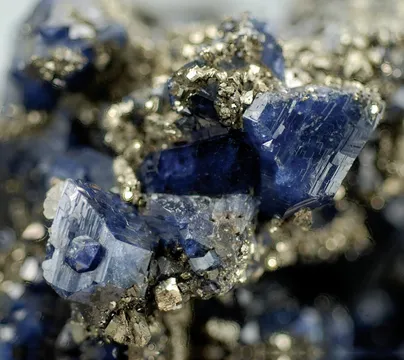
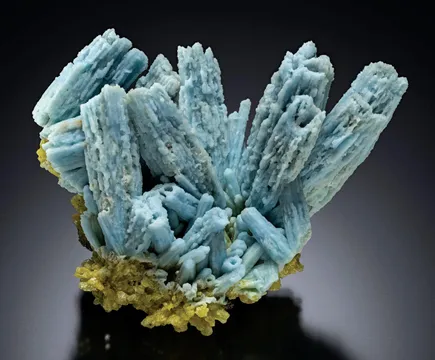
The setting is a geologically busy margin of South China: folded Paleozoic carbonate and clastic sequences, black shales, siliceous rocks, granitic intrusions, skarn systems, and later oxidation zones all play a role. This matters to specimens. Guangxi’s best pyromorphites are not isolated thumbnail novelties; they are three-dimensional sprays, barrelly or hoppered hexagonal prisms, glowing yellow-green to deep apple-green on gossanous matrix. Its Laohuan material is even more unusual: pale to vivid blue plumbogummite coating or replacing earlier pyromorphite, with surviving yellow-green cores or tips sometimes visible. Wutong rhodochrosite brings another visual language entirely—flattened pink to cherry-red rhombs and rosettes perched with quartz, pyrite, sphalerite, and pale fluorite. The result is a region whose specimens are instantly recognizable but whose labels demand care.
Regional View
Country View
Guangxi rose to international specimen prominence in the late 1990s and early 2000s, when large quantities of bright pyromorphite from the Daoping-Yangshuo area reached Western dealers and show tables. That material changed expectations for Chinese lead minerals: instead of small curiosities, collectors were suddenly seeing cabinet specimens with color rivaling classic European pyromorphites but with a looser, more sculptural habit. The subsequent clarification of Laohuan as the true source for many blue plumbogummite-after-pyromorphite specimens added another chapter: some of the most familiar labels in circulation turned out to be historically understandable but geographically imprecise.
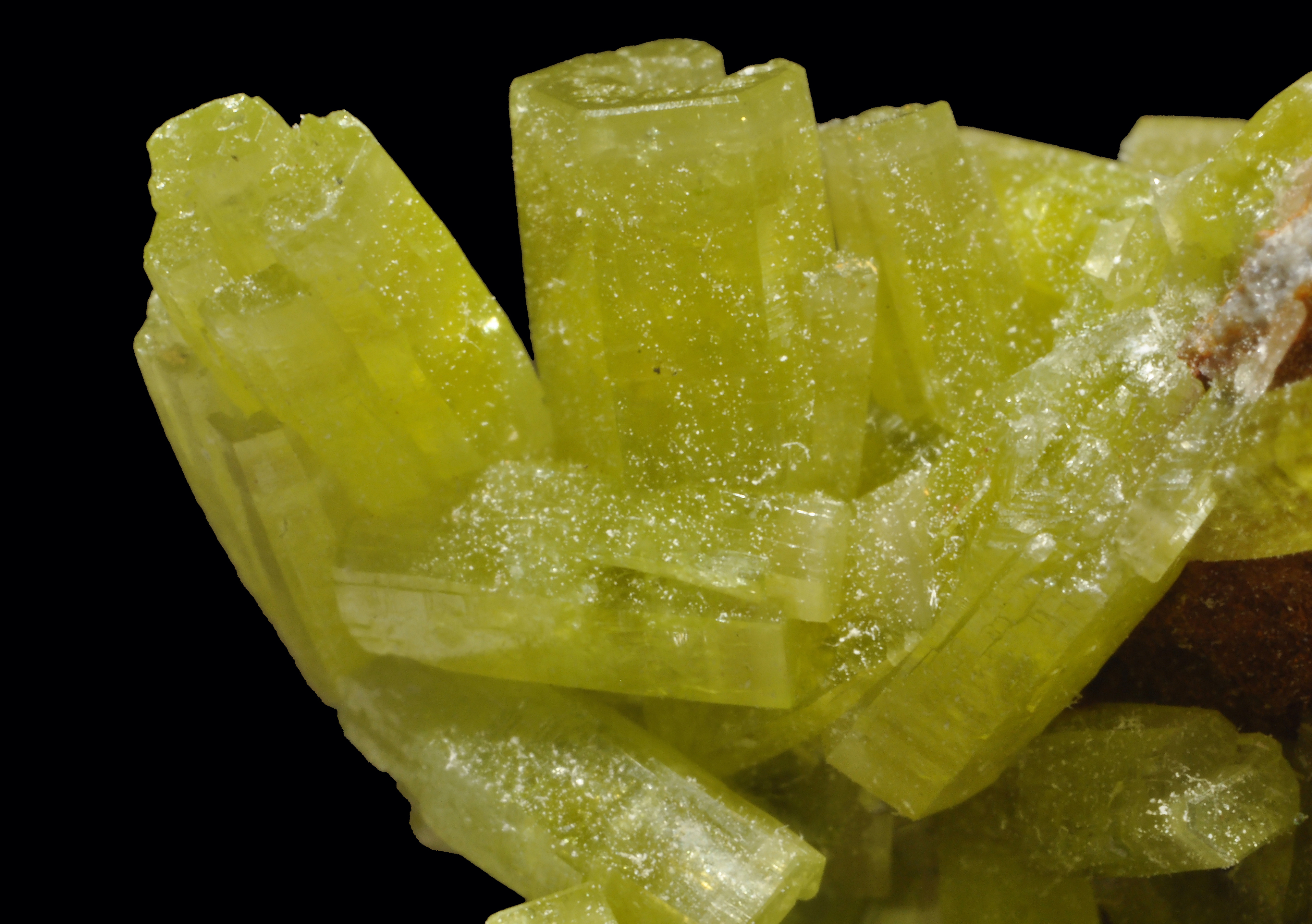
Photo: Géry Parent / Wikimedia Commons


Search for specimens: View all specimens from Guangxi, China
Guangxi Zhuang Autonomous Region occupies a mountainous part of southern China, bordering Vietnam and adjoining Yunnan, Guizhou, Hunan, and Guangdong. Its collector localities are scattered rather than concentrated in one mining camp. The most important specimen-producing districts fall into several broad types: lead-zinc deposits with oxidized phosphate and carbonate zones in the Guilin-Gongcheng-Yangshuo area; tin-polymetallic and skarn-related systems in the Danchi belt around Nandan and Hechi; Pb-Zn-Ag and rhodochrosite-bearing veins at Wutong near Liubao in Wuzhou Prefecture; fluorite-quartz-arsenopyrite occurrences around Daguishan in Hezhou; and manganese, antimony, bauxite, tungsten, uranium, and rare-metal deposits elsewhere in the province.
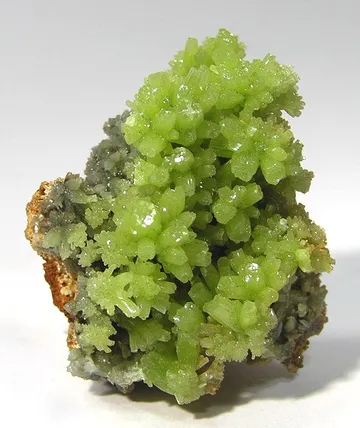
The Daoping and Yangshuo lead-zinc mines, near Guilin, are the essential names for Guangxi pyromorphite. The two workings have often been treated together by collectors because they are close, geologically related, and in some accounts connected underground or difficult to separate in older trade labels. The ore assemblage is simple enough at the collector level—galena, sphalerite, cerussite, malachite, and pyromorphite—but the specimen expression is exceptional. Oxidation of lead-bearing ore produced pyromorphite in cavities and fractures, commonly on iron-oxide-rich matrix. The finest pieces show free-standing, lustrous, translucent to opaque green crystals in sprays, plates, or hoppered aggregates rather than flat crusts.
Laohuan, on the slope of Laohu Hill at Haiyang Mountain in Gongcheng County, is the crucial locality for the blue plumbogummite-after-pyromorphite material. It was originally worked for lead, zinc, silver, and barite, but low-grade ore made ordinary commercial mining unattractive. Once local miners realized that crystal specimens could be worth more than ore, the workings shifted toward specimen recovery. The most important Laohuan material consists of plumbogummite coating or pseudomorphing earlier pyromorphite, with associated cerussite, sparse malachite, and rare wulfenite. Many older specimens were labelled Daoping or Yangshuo; current scholarship separates Laohuan from those famous pyromorphite mines and treats it as a distinct artisanal specimen locality.
Dachang, in Nandan County, is a very different kind of locality: a world-class tin-polymetallic ore field in the Danchi metallogenic belt. Research on the district describes Devonian black shale, limestone, and siliceous host rocks; granitic magmatism; stratiform, vein, stockwork, laminated, massive, and disseminated ore styles; and an enormous mineral inventory. The ore field is best known industrially for cassiterite with sulfides and sulfosalts, with important associated zinc, lead, antimony, indium, copper, and silver. To specimen collectors, Dachang and related Nandan-Hechi localities matter for stibnite, arsenopyrite, cassiterite, fluorite, rhodochrosite, quartz, calcite, axinite, sulfides, and rare sulfosalts, along with the type-locality antimony hydroxide mineral ottensite.
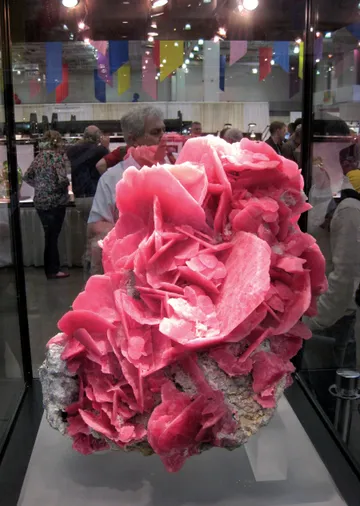
Wutong, also written Wudong, near Liubao in Cangwu County, Wuzhou Prefecture, became known to collectors for rhodochrosite on quartz, pyrite, sphalerite, galena, and fluorite. The mine began as a lead-zinc-silver operation, but specimen- and gem-grade rhodochrosite became important enough that collecting and selective pocket excavation attracted international attention. The mine workings include a network of tunnels, stopes, and shafts, and the productive veins vary from narrow seams only centimeters wide to structures over two meters across. Where the veins widened and remained open, rhodochrosite crystallized as discrete rhombs, flattened crystals, plates, rosettes, and in some cases gemmy masses. Quartz is a frequent visual counterpoint, making sharp white druses and prismatic crystals against pink to red carbonate.
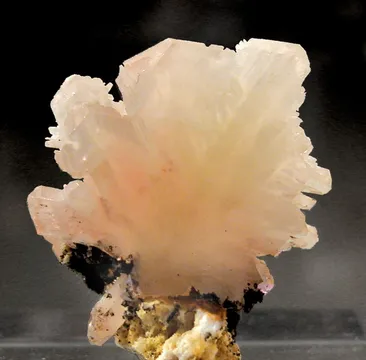
Wuzhou and Guilin have also supplied notable calcite. The best Wuzhou calcites are highly transparent, prismatic to scalenohedral crystals, commonly colorless to white, sometimes with basal terminations and strong internal clarity. Some older pieces from the early 2000s are prized for gemmy, water-clear crystals on quartz-covered matrix; others form freestanding clusters with minor edge chipping from pocket extraction and transport. Guilin and Gongcheng calcites can be more unusual in morphology, including quartz-like terminations, doubly terminated crystals, hollow cores, and growth phantoms.
Daguishan, in the Hezhou area, is a smaller but attractive contributor to Guangxi collecting. It is best known in the trade for fluorite with quartz, calcite, and arsenopyrite—assemblages that can be mistaken at a glance for better-known Hunan fluorite localities. The better Daguishan pieces are not just “Chinese fluorite”; their value lies in correct attribution to a less familiar Guangxi source and in the association of pale blue to purple fluorite with sharp quartz.
Collecting access today should be approached realistically. These are not casual public collecting areas. Most specimens have entered the market through mine production, local artisanal recovery, commercial purchase, or older dealer stocks. Laohuan’s main tunnel area has been described as largely mined out or intermittently inactive, with some smaller excavations still present in the broader area. Daoping and Yangshuo pyromorphite production has come in episodes; the great early finds are no longer a routine supply. Wutong rhodochrosite continues to appear in dealer inventories, but fine, undamaged, well-crystallized pieces are selective rather than common. As with many Chinese localities, old labels may give only “Guilin,” “Wuzhou,” “Guangxi,” “Daoping,” or “Yangshuo,” and refining the exact source is part of the collector’s work.
Guangxi calcite is most collectible when it breaks away from the generic Chinese “clear calcite” look and shows a locality-specific habit: Wuzhou pieces with sharp, lustrous, white to water-clear prismatic scalenohedral crystals on quartz-covered matrix; freestanding gemmy clusters with slight but typical edge bruising; and Guilin-Gongcheng specimens with yellowish cores, hollow interiors, growth phantoms, doubly terminated crystals, and terminations so quartz-like that they surprise even experienced calcite collectors. Cabinet specimens range from small matrix groups around 5 cm to larger transparent clusters and individual crystals several centimeters long. Good pieces are judged by transparency, undamaged terminations, crisp basal faces, contrast with quartz matrix, and the presence of phantoms or unusual morphology; ordinary pieces are simply pale, bruised, or compositionally interesting but visually flat.
Quartz from Guangxi is rarely the headline species by itself, but it is one of the region’s most important specimen partners. At Wutong it forms white to colorless prismatic druses and clusters with pink rhodochrosite, pyrite, sphalerite, fluorite, and calcite, giving those specimens their strongest color contrast. At Daguishan it supports pale blue to violet fluorite, calcite, and arsenopyrite in combinations that resemble—but should not be lazily relabelled as—better-known Hunan material. In the Danchi and Nandan-Hechi systems, quartz accompanies sulfides, rhodochrosite, fluorite, and polymetallic ore minerals. The best Guangxi quartz specimens are valued less for large single crystals than for sharpness, whiteness or clarity, clean association, and a balanced architecture that lets rhodochrosite, fluorite, pyrite, or sulfide crystals sit naturally rather than being swallowed in massive vein quartz.
Pyromorphite is Guangxi’s signature collector mineral. The classic Daoping-Yangshuo material occurs as lustrous hexagonal prisms, sprays, and hoppered or skeletal barrel-like crystals in colors from yellow-green and olive to vivid apple-green, commonly on oxidized matrix and associated with cerussite, galena, sphalerite, malachite, and iron oxides. Fine miniatures and cabinets show three-dimensional coverage, sharp terminations, satiny to glassy luster, and a saturated, even color; lesser pieces are dull, muddy, flattened, or broken along exposed crystal edges. Laohuan adds a second, highly prized expression: earlier pyromorphite partly coated or replaced by blue plumbogummite, sometimes leaving yellow-green pyromorphite visible at crystal tips or cores. Because the best finds were episodic and many older labels confuse Daoping, Yangshuo, and Laohuan, documented provenance and correct locality language matter almost as much as color.
Beyond these three species, Guangxi has an unusually deep bench. Wutong is a major modern Chinese rhodochrosite locality, especially for pink to cherry-red flattened rhombs and rosettes with quartz, pyrite, sphalerite, calcite, galena, fluorite, and occasional fluorapatite. Daoping and Laohuan also produced cerussite, plumbogummite, malachite, wulfenite, galena, and sphalerite. Dachang and the wider Nandan-Hechi district contribute cassiterite, stibnite, arsenopyrite, pyrrhotite, pyrite, marcasite, jamesonite, fluorite, rhodochrosite, wolframite-group minerals, scheelite, topaz, axinite, vesuvianite, garnet, pyroxene, amphibole, and numerous sulfosalts. Guangxi is also the type-locality region for ottensite from the Dachang Sn-polymetallic ore field and for the recently described NiBiS mineral guixiangite from the Longhua Ni-Co deposit in Xiangzhou County, Laibin.
The central authenticity issue for Guangxi is locality accuracy, not synthetic manufacture. The biggest trap is the long-standing Daoping-Yangshuo-Laohuan confusion. Many blue plumbogummite-after-pyromorphite specimens were sold for years as Daoping or Yangshuo; later work clarified Laohuan, on Laohu Hill in Gongcheng County, as the correct source for much of this material. Older labels should not be discarded, but they should be interpreted historically. A specimen labelled “Yangshuo” with sky-blue plumbogummite pseudomorphing yellow-green pyromorphite may be market-historic but locality-imprecise; a disciplined modern label can preserve the original wording while adding the corrected Laohuan attribution when justified.
Pyromorphite from Daoping and Yangshuo is a lead chlorophosphate, so it should be handled with the normal care given to lead minerals: do not ingest dust, keep it away from children, wash hands after handling, and avoid aggressive mechanical cleaning that could break tiny crystals or create particulate residue. The finest hoppered crystals can be surprisingly fragile along edges and terminations. Damage often occurs at exposed crystal tips, where a cabinet specimen may look excellent from the front but show bruising under magnification. Matrix pieces with open sprays are more vulnerable than compact crusts, and old repairs or glued reattachments are worth checking for on high-value pieces.
Laohuan plumbogummite-pyromorphite specimens need special lighting awareness. Under visible light they may show pale sky-blue, gray-blue, or deeper blue plumbogummite over yellow-green pyromorphite; under ultraviolet light, selected examples show strong fluorescence, especially under midwave UV, with green plumbogummite response and yellow to orange pyromorphite accents. This is a selling point, but it should not be assumed for every piece without testing. Some reported fluorescent specimens also show low-level radioactivity attributed to uranyl activation in the plumbogummite; collectors who specialize in UV or radioactive minerals should document the exact response of their own specimen rather than generalizing from one famous example.
Wutong rhodochrosite has different condition concerns. Many crystals are naturally etched, giving a silky, frosted, or opaque pink surface rather than glassy transparency. This is not automatically damage; it is part of the mine’s common style. However, broken rosette edges, detached plates, glued fluorite cubes, and bruised quartz points reduce value. Better pieces have visible crystal geometry, strong pink to red color, lively pyrite or sphalerite contrast, and fluorite or quartz arranged in a balanced way. Massive pink carbonate without crisp faces is far less desirable unless it has gem or lapidary value.
Guangxi calcites should be inspected carefully for cleavage bruises and small corner chips. Wuzhou’s transparent prismatic calcites are especially unforgiving: even minor edge damage catches the eye because the crystals are so clear. Pieces with phantoms, hollow cores, basal terminations, and quartz matrix carry a premium over simple clear clusters. Avoid overcleaned calcites with dulled faces; acid cleaning can improve iron staining but may soften luster if poorly done.
Market availability is uneven. Small Guangxi pyromorphites, Wutong rhodochrosites, and Wuzhou calcites appear regularly enough that collectors can be selective, but top Daoping-Yangshuo pyromorphites from the early classic finds are no longer abundant, and major Laohuan plumbogummite pseudomorphs with strong color and intact form command serious competition. Dachang rarities and type-locality ottensite specimens are specialist material: small, sometimes visually modest, but important when well documented.
The Laohuan story is one of those locality corrections that changes hundreds of labels at once. For more than two decades, collectors admired blue Chinese plumbogummite pseudomorphs after pyromorphite under the familiar names Daoping and Yangshuo. The pieces looked related to the green pyromorphites that had made the Guilin area famous, and the market’s shorthand seemed plausible. Then the locality was pinned down more carefully: the source was not the better-known mines to the south, but artisanal workings on Laohu Hill—“Old Tiger Hill”—at Haiyang Mountain in Gongcheng County. The confirmed site sits east of Guilin, and the famous Daoping and Yangshuo pyromorphite occurrences lie well away from it. The correction did not make the specimens less desirable; if anything, it gave them a sharper identity. A blue pseudomorph once lazily called “Daoping” became part of a distinct Laohuan chapter.
Laohuan also tells a rare economic story in Chinese specimen mining. The workings were originally for lead, zinc, silver, and barite, but the ore was low grade and ordinary commercial mining faded. The incentive changed when local miners discovered that pyromorphite—and then the blue plumbogummite replacing it—could be mined as specimens. Instead of ore, the valuable commodity became a pocket. Instead of tonnage, it was crystal form, color, and intact extraction. Small adits and excavations were driven into the hillside, and after the best tunnel areas were exhausted, other holes were tried in the same mountain. For collectors used to China’s enormous industrial mines, Laohuan is unusual precisely because it functioned, at least intermittently, as a specimen mine.
Wutong’s rhodochrosite story has a similar pivot from ore to beauty. The mine began as a lead-zinc-silver operation, but investors later shifted attention toward specimen- and gem-grade rhodochrosite. In 2008, Collector’s Edge Minerals arranged with the mine owners to excavate rhodochrosite pockets. The mine was not a simple scenic open cut; it reached more than 150 meters deep through a maze of tunnels, stopes, shafts, jack-leg drilling, explosives, and ore cars. Inside, the mineralized veins ranged from only a few centimeters wide to more than two meters, dipping steeply to nearly vertical. Solid rhodochrosite fillings appeared as red streaks in the veins, and only where the structure opened into pockets did the mine produce the crystalline specimens collectors wanted.
The comparison that followed was irresistible: Wutong reminded observers of Colorado’s Sweet Home Mine, not because the geology was the same, but because the visual promise was similar. Both could produce rhodochrosite with fluorite, galena, chalcopyrite, apatite, quartz, barite, and sphalerite. Both could yield crystals large enough and gemmy enough to excite fine-mineral collectors and cutters. Yet Wutong had its own fingerprint. Much of the material was slightly to heavily etched, turning many crystals pink and opaque rather than perfectly glass-clear. The best pieces overcame that tendency with strong color, sculptural flattened rhombs, and the contrast of white quartz, glittering pyrite, dark sphalerite, and pale fluorite.
Daoping’s most memorable chapter is the sudden arrival of green pyromorphite in quantity around the turn of the millennium. Collectors who had built their pyromorphite standards around European classics suddenly had to make room for Guangxi. The best Chinese specimens were not merely good “for China”; they were world-class pyromorphites—lustrous, saturated, sharply crystallized, and often large enough for serious display. Later cerussite discoveries added an unexpected coda. A mine celebrated for green pyromorphite also produced delicate, transparent to pale yellow cerussite twins and plates, some so fine that writers compared their surprise factor to Tsumeb-like quality emerging from a locality everyone thought they already understood.