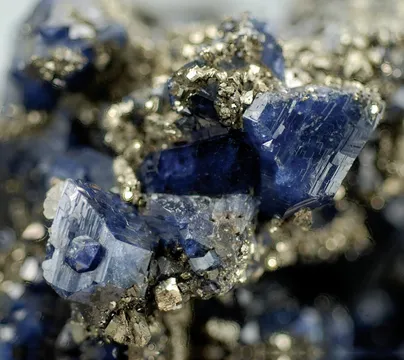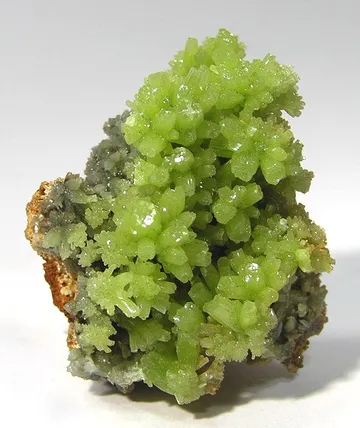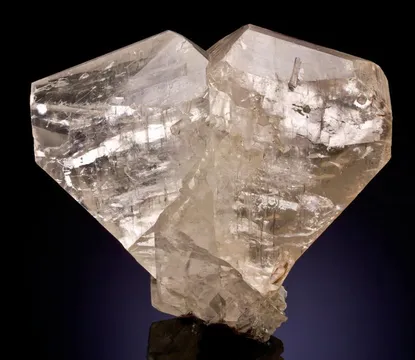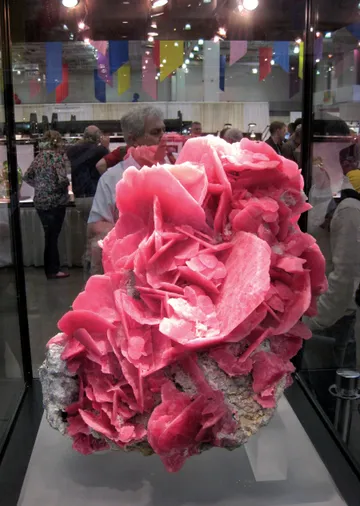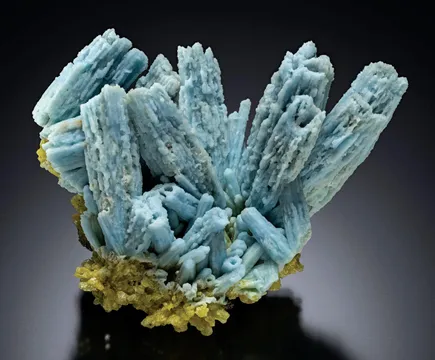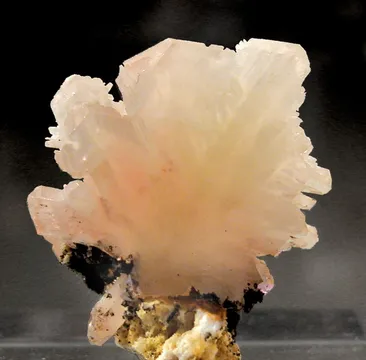
Nandan County, China — Dachang tin-polymetallic district and Nantan iron meteorite field, famed for sharp calcites, stibnite sprays, and limonite gossans.
Key facts
Nandan County, in the northwestern part of Guangxi, is one of the most consequential mineral districts in South China for collectors because it brings together two very different collecting worlds: the great Dachang tin-polymetallic ore field and the Nantan iron meteorite strewn field. The Dachang district is the mineralogically richer of the two. It is a classic Sn-Zn-Pb-Sb system in the Danchi metallogenic belt, developed in Devonian carbonate, siliceous, mudstone, shale and reef-limestone sequences cut and overprinted by Yanshanian granitic magmatism. To ore geologists it is a world-class cassiterite-sulfide district; to collectors it is best remembered for sharp golden to colorless calcites, metallic stibnite sprays, iridescent limonite/goethite gossans, fluorite-dolomite pieces, uncommon adamite on brown iron oxides, and a long list of sulfides and sulfosalts.
The specimen personality of Nandan is unmistakably Chinese but not interchangeable with the better-known Hunan and Guizhou stibnite localities. The finest Dachang-area calcites can look deceptively quartz-like: transparent, prismatic, silky-lustrous crystals with rhombohedral terminations and visible internal cleavage. Other pieces show warm honey-yellow calcite perched on dark massive stibnite, sometimes with stibnite needles penetrating the calcite itself. The Chashan Mine material, commonly sold under the shorthand “Nandan,” is more sulfide-forward: lustrous, silvery, striated blades of stibnite in sprays and starburst aggregates on limestone or quartz matrix. Limonite specimens from Gaofeng and related Dachang oxidation zones add another visual register entirely—mammillated, stalactitic, brown-to-bronze surfaces with red, gold and sometimes rainbow iridescence.
Regional View
Country View
Nandan’s other collector identity comes from the Nantan meteorite, an official iron meteorite name in the Meteoritical Bulletin database. The material is commonly represented in collections as weathered whole individuals or etched slices showing the kamacite-taenite Widmanstätten structure; its mineral list includes native iron as kamacite, taenite, schreibersite, troilite, cohenite, graphite and secondary alteration phases such as akaganeite, magnetite and limonite. This is why “iron” specimens from Nandan can mean something completely different from the county’s sulfide-ore suite: not a mine product at all, but extraterrestrial iron-nickel metal from the Lihu–Yaochai area.


Search for specimens: View all specimens from Nandan County, China
The collector locality “Nandan County” is best understood as an umbrella label. It can refer to mines and deposits of the Dachang Sn-polymetallic ore field and adjacent Nandan-Hechi metallogenic belt, to the Chashan antimony-tungsten mine in the northeastern part of the ore field, to Gaofeng/Longtoushan, Tongkeng-Changpo, Lamo, Dafulou, Huile, Kangma and other named Dachang deposits, or to the Nantan meteorite strewn field in the Lihu–Yaochai area. Good labels matter here: “Nandan Mine” is a common dealer shorthand, but it is not a precise mine name, and for stibnite it often points specifically to Chashan.
Geologically, the Dachang ore field is a complex tin-polymetallic district rather than a single vein. Published models describe multiple ore styles: carbonate-replacement and cassiterite-sulfide bodies in Devonian limestone and siliceous rocks; stratiform, veinlet and large-vein ore at Tongkeng-Changpo; massive sulfide ore at Gaofeng/Longtoushan in Middle Devonian reef limestone; skarn-type Cu-Zn-Sn mineralization at Lamo near contacts of Devonian limestone and Cretaceous granite; and quartz-vein or stockwork mineralization around Dafulou, Huile, Kangma and related deposits. The principal ore minerals across the district include cassiterite, sphalerite, pyrite, pyrrhotite, arsenopyrite, chalcopyrite, galena, stannite and a suite of lead-antimony-tin sulfosalts such as jamesonite and franckeite. Quartz, calcite, dolomite, fluorite, tourmaline and skarn silicates are the main gangue phases seen or reported from different parts of the system.
The district owes much of its importance to the Devonian stratigraphy. Alternating carbonate, shale, mudstone, siliceous and reef-limestone units provided reactive host rocks, mechanical contrasts, reservoirs, seals and fracture pathways. The best-studied orebodies are not random pockets in barren limestone; they sit in a strongly structured system where faults, folds, stratigraphic permeability and intrusive heat all helped focus mineralizing fluids. This is why the specimen assemblage is so varied: carbonate-hosted replacement zones can produce calcite and sulfides, oxidized gossan zones produce limonite/goethite and secondary arsenates, vein systems produce quartz-stibnite-calcite combinations, and the skarn environments add garnet, pyroxene-amphibole group minerals and fluorite-bearing associations.
Mining in the Dachang area has a modern industrial history stretching back to the early years of the People’s Republic of China. The Dachang Tin Mine was established in 1952, became the Dachang Mining Bureau in 1962, and later formed part of the Huaxi/China Tin industrial story. Dachang has been repeatedly cited in geological literature as one of the world’s great tin-polymetallic districts, with tin, zinc, lead, antimony, copper, indium and silver all important in different parts of the resource. Today the county’s nonferrous-metal economy also includes large smelting and processing operations; Nanfang Nonferrous Metals Group lists Nandan-based lead, zinc, antimony and resource-recovery businesses as central to its industrial base, along with mining subsidiaries tied to named local mines including Kengma, Wuyi, Chashan and Lamo.
For collectors, most fine specimens reached the market as by-products of active mining rather than from recreational collecting. Dachang-area calcites appeared only sparsely around the turn of the millennium and were noted again in dealer and show reports in the mid- to late 2000s. The celebrated calcite-chalcopyrite-stibnite pieces were reported from the Nandan mining area in 2006: modified rhombohedral calcite crystals, milky white to transparent and colorless, with oriented drusy chalcopyrite outlining the edges and small stibnite sprays scattered on the calcite. The best examples reached about 12 cm across as attractive matrixless clusters. Separate golden calcite-on-stibnite pieces from the early 2000s are now considered a small, finite find, and the strongest examples combine gemmy honey calcite with sharp, metallic stibnite sprays or dark massive stibnite bases.
Chashan is particularly important to the specimen record. It is described as a quartz vein-type antimony-tungsten deposit in the northeastern Dachang ore field, and it produced fine stibnite specimens often labelled simply “Nandan.” Dealer records from finds around 2005 describe silvery, striated stibnite blades in sprays on matrix; larger cabinet specimens show dark metallic starbursts rising from corroded cream limestone. Mindat notes that the mine appears to be closed and that no new specimens are being mined, which matches the current collector experience: good Chashan stibnites are not bulk Chinese stibnite commodities, but finite early-2000s material that now circulates through older collections, auctions and dealer stock.
Collecting access today should be treated as closed unless permission is explicitly obtained from the mine or landholder. These are industrial mines and smelting districts with underground workings, active or former ore rights, safety hazards, environmental controls and no general public collecting tradition. The Nantan meteorite strewn field is also not a casual collecting locality for exportable specimens; material on the market is usually older recovered meteorite, and export, authenticity and stability issues deserve scrutiny.
Nandan calcite is most prized when it carries the unmistakable Dachang look: transparent to milky or honey-yellow crystals, commonly prismatic or modified rhombohedral rather than simple dogtooth forms, associated with stibnite, chalcopyrite, quartz, fluorite, dolomite or dark sulfide matrix. The finest pieces documented from the mid-2000s include modified-rhombohedral calcite clusters to about 12 cm with drusy chalcopyrite sharply outlining crystal edges and small stibnite sprays on the surfaces; another prized style shows warm golden calcite perched on massive or bladed stibnite, with some examples showing stibnite needles penetrating the calcite. Later market notes also mention “quartz-like” transparent calcite prisms, some single crystals or parallel groups reaching about 7 cm, valued for clarity, sharp terminations, clean luster and undamaged tips. Ordinary Nandan calcite is merely a common gangue mineral; the collector-grade material is defined by glassy transparency, strong contrast against sulfides, unusual crystal morphology, and the scarce classic early-2000s associations.
“Limonite” from Nandan is a collector term for oxidized iron-rich gossan material—commonly goethite-dominant, but not always analytically separated—that comes from the weathered zones of the Dachang polymetallic system and, in some cases, from meteorite alteration. The most recognizable cabinet pieces are Gaofeng-area mammillated to stalactitic aggregates with brown, bronze, red-gold and locally rainbow iridescent surfaces; one well-published Gaofeng specimen is a large 10.7 x 10.7 x 8.7 cm mass with bumpy, cratered, iridescent botryoidal surfaces and a stalactitic projection. Limonite also forms the reddish-brown gossan matrix for uncommon Dachang adamite specimens, where soft yellow to pale green crystal aggregates stand out against porous iron oxides. The best limonite pieces here are sculptural and lustrous rather than earthy: rounded botryoids, stalactites, strong metallic iridescence, stable surfaces and attractive contrast with secondary minerals lift them far above ordinary rusty mine material.
Iron specimens from Nandan County are most credibly understood through the Nantan meteorite, from the Lihu–Yaochai area, where the collector species is native iron, chiefly kamacite, with taenite, plessite, schreibersite, troilite, cohenite, graphite and alteration minerals also documented. The Meteoritical Bulletin lists Nantan as an official iron meteorite name, found in 1958, with a mass of 9.5 tonnes and current recommended classification as Iron, IAB-MG; older catalogue history placed it in IIICD. Whole individuals are typically dark brown to black from terrestrial oxidation, while cut and etched slices can reveal coarse octahedral Widmanstätten patterns produced by kamacite-taenite intergrowths. Collector-grade pieces are those with solid metal, recognizable extraterrestrial texture, stable preparation, clear provenance and minimal active rusting; poor pieces are over-weathered, flaking, chloride-active, mislabelled simply as “Nandan iron ore,” or polished/etched so aggressively that structure and surface integrity are compromised.
Nandan stibnite is associated above all with the Chashan Mine and the broader Dachang Sn-Sb-W-polymetallic system, where it appears as lustrous silvery to dark lead-gray blades, striated crystals, radiating sprays, starburst aggregates, and in some pieces as massive metallic matrix beneath calcite. Chashan specimens from around 2005 include sharp blades to roughly 1.7 cm in spray-like aggregates on matrix, while larger show pieces display multiple dark metallic starbursts on corroded cream limestone; a documented cabinet specimen had a largest stibnite group about 6.6 cm across on a 21.2 cm specimen. Nandan’s most desirable stibnite associations are not necessarily the largest Chinese stibnites, but the most aesthetic: bright metallic sprays with good separation, stibnite piercing or framing golden calcite, quartz or limestone matrix that gives visual relief, and minimal bruising to the fragile blade terminations.
Beyond the four headline species above, Nandan County’s mineral record is unusually broad. Dachang and its satellite deposits have documented cassiterite, sphalerite including marmatite, pyrite, pyrrhotite, arsenopyrite, chalcopyrite, galena, stannite, jamesonite, franckeite, fluorite, quartz, dolomite, tourmaline, scheelite, wolframite-group minerals, skarn silicates and numerous sulfosalts. The oxidized zones add secondary arsenates and gossan species, including the scarce Dachang adamite on limonite that appeared in small numbers on the specimen market. The Nantan meteorite adds an entirely separate suite of meteoritic phases: kamacite, taenite, plessite, schreibersite, troilite, cohenite, graphite and secondary iron alteration minerals. A notable type-mineral connection to the broader Nandan-Hechi metallogenic belt is pengite, a lead-antimony oxide approved as IMA 2022-068 from the Wuxu ore field, with type material deposited at the Geological Museum of China and the Crystal Structure Laboratory at China University of Geosciences, Beijing.
The biggest authenticity issue is not usually outright fakery of Dachang calcite or Chashan stibnite, but imprecise locality labelling. “Nandan,” “Nandan Mine,” “Dachang,” “Dachang Mine,” “Chashan,” “Gaofeng,” “Tongkeng,” and even “Nantan” are often confused in commerce. A stibnite spray labelled “Nandan Mine” may well be Chashan; an iron specimen labelled “Nandan iron” may be Nantan meteorite; a calcite-stibnite piece may be a general Dachang-area specimen rather than traceable to a named pocket. Serious collectors should preserve old dealer labels, ask for mine-level provenance where possible, and distinguish “Nandan County” as a regional label from a true mine name.
Condition is a major value driver. Stibnite is soft, brittle and easily bruised; bright terminations and unbent sprays command premiums. Avoid ultrasonic cleaning, aggressive brushing or acid work on stibnite-calcite combinations. Calcite is also soft and acid-reactive, so many pieces show nicks, cleavage bruises or etched surfaces if poorly cleaned. Transparent “quartz-like” Dachang calcites should be inspected for cleavage cracks, rehealed-looking internal planes, edge chipping and subtle repairs at the base. Chalcopyrite druses on calcite can be delicate; if the glittering edge-coatings are abraded, much of the locality character is lost.
Limonite/goethite pieces should be checked for stability. Good iridescent surfaces are natural and attractive, but some rusty gossan matrices can shed dust or stain mounts and drawers. Adamite-on-limonite specimens, when encountered, are small and easily mistaken at a glance for Mexican Ojuela material; the comparison is so strong that provenance is especially important. Adamite can fluoresce, and Nandan examples have been compared with Ojuela specimens in both appearance and fluorescence, but fluorescence should support identification rather than replace provenance or analysis.
Nantan meteorite specimens demand a different kind of caution. Iron meteorites from humid environments can suffer from active chloride-driven rusting, and Nantan material is well known on the market in heavily weathered pieces. Brightly polished slices should be monitored for weeping rust, orange powder, pitting and edge delamination. Stable, properly prepared etched slices showing clear Widmanstätten patterning are generally more desirable than crumbly, over-cleaned whole individuals unless the natural form is especially good. Be wary of industrial slag, terrestrial iron, and non-Nantan meteorites sold with a vague “China iron” story; density and magnetism alone do not prove meteoritic origin.
Market availability is uneven. Small Nantan meteorite fragments remain relatively available, though high-quality stable slices and attractive whole individuals are more selective purchases. Nandan/Dachang calcite, especially the classic golden calcite on stibnite and the chalcopyrite-edged calcite clusters, is much scarcer than its visual familiarity suggests. Chashan stibnite is finite early-2000s material in practical collector terms; it appears in auctions and old collections, not as a steady new mine supply. Iridescent limonite/goethite from Gaofeng and related Dachang oxidation zones surfaces intermittently, and the most sculptural, colorful pieces are now worth separating from generic “Chinese limonite” lots.
The oldest story attached to Nandan specimens does not come from a mine ledger but from the sky. The Nantan meteorite is commonly linked in collector literature to a Chinese historical record from the Ming period: in May of the Jiajing era, “stars fell from the northwest direction,” bright and sinuous, compared in translation to “snakes and dragons.” The modern meteorite was not officially found until 1958, when iron shortages during the Great Leap Forward led local people to dig up metallic masses in the Lihu–Yaochai area. The story has a wonderful metallurgical irony: the pieces were sought as possible furnace feed, but the iron meteorites survived because the neighborhood furnaces could not melt them. Once cleaned, the masses revealed octahedral metallic structure—cosmic iron preserved by the very failure of an improvised steelmaking campaign.
The strewn field itself is collector-scale geography with historic weight: an elongate fall area roughly 27 to 28 km long and about 8 km wide between Lihu and Yaochai, northeast and east-southeast of Nandan. Most mineral localities are fixed at a shaft, quarry face or vein exposure; Nantan is a trail of oxidized iron bodies spread across villages and hills. A small etched slice on a mineral shelf, if genuine and stable, is a cross-section through slow cooling in a parent asteroid, then violent atmospheric fragmentation, centuries of weathering in Guangxi, and finally human recovery during one of modern China’s most turbulent economic campaigns.
Nandan’s mining history has a much darker chapter. On July 17, 2001, the Lajiapo Mine in Nandan County suffered a catastrophic flooding accident after illegal blasting destroyed rock partitions separating active workings from water. The torrent did not stop at one workplace; it flooded Lajiapo as well as neighboring Longshan and Tianjiao workings. Official investigation placed the accident at 3:40 a.m. in the No. 3 working area of the No. 9 pit, 166 meters underground. The confirmed death toll was 81 miners.
The disaster became nationally notorious not only because men died underground, but because the accident was hidden. State investigators later concluded that mine and local officials had sealed the news from the public for about half a month. Reports described bribery, intimidation of survivors and relatives, and criminal gangs used to obstruct inquiry. One account called the cover-up “the biggest lie in China.” When reporters pressed the story, threats against them helped push the scandal into the open rather than bury it.
The physical recovery was grim. Pumping out the flooded mine system was reported to require around-the-clock work by roughly 1,500 people in heat, humidity and foul air. By late August, bodies had been recovered from the drained workings, but officials acknowledged that some remains could have been buried in mud. The investigation went far beyond a technical failure: it exposed illegal mining, local-government entanglement with mine owners, mismanagement, environmental damage, armed protection rackets and falsified silence around repeated accidents. For collectors, that history is not a reason to romanticize the mines; it is a reminder that Nandan specimens came from a district where ore, money, labor and danger were tightly bound together.
Yuejun Liao, Yaosong Xie, Shunbao Chen, and Yuegan Zhou, “Ore-controlling Characteristics of Devonian Stratum in the Dachang Sn Ore-field, Guangxi (South China),” Procedia Earth and Planetary Science, 2, 28–33, 2011 — Open-access overview of the Devonian stratigraphic control on the Dachang Sn-polymetallic system in Nandan County.
Kui-Dong Zhao and Shao-Yong Jiang, “Rare earth element and yttrium analyses of sulfides from the Dachang Sn-polymetallic ore field, Guangxi Province, China: Implication for ore genesis,” Geochemical Journal, 41, 121–134, 2007 — Key geochemical paper summarizing Lamo skarn, Changpo-Tongkeng stratiform Sn-Pb-Zn ores and Gaofeng massive sulfide ore.
Ore Geology Reviews abstract: “Geochemistry and origin of tin–polymetallic sulfide deposits hosted by the Devonian black shale series near Dachang, Guangxi, China,” Ore Geology Reviews, 24, 103–120, 2004 — Important abstract noting more than 180 minerals in the Dachang ores and outlining the Devonian black-shale-hosted system.
Kazuo Watanabe and coauthors, “Overview of Tin-bearing polymetallic mineralization in the Dachang ore field, Guangxi, China,” Resource Geology, 47, 331–345, 1997 — Classic district-scale overview giving the size of the ore field and reserves of the Changpo-Tongkeng deposits.
D. Wang, Y. Chen, W. Chen, H. Sang and coauthors, “Dating the Dachang giant tin-polymetallic deposit in Nandan, Guangxi,” 2004 abstract — Geochronology abstract reporting Late Yanshanian ages for No. 91 and No. 100 orebodies.
Guowu Li, Ningyue Sun, Qi Lu, Yuan Xue, Zhesheng Ma, Nicheng Shi, Jinhua Hao and Junjia Fan, “Pengite, IMA 2022-068,” in CNMNC Newsletter 70, European Journal of Mineralogy, 34, 591–601, 2022 — Formal IMA newsletter entry for pengite from the Wuxu ore field in the Nandan-Hechi metallogenic belt.
Meteoritical Bulletin Database: Nantan meteorite — Official meteorite record listing Nantan as an iron meteorite found in 1958 with a mass of 9.5 tonnes and recommended classification Iron, IAB-MG.
USGS, “The Mineral Industry of China in 2001” — Includes a concise summary of the July 17, 2001 Nandan mine flooding disaster and its relation to illegal mining around the Dachang district.
Mineralogical Record, “October 2006 What’s New” — Collector-market note documenting Nandan calcite-chalcopyrite-stibnite specimens, axinite-(Fe)-type material and adamite on limonite.
Mineralogical Record, “September 2010 What’s New” — Collector-market note on sparse Dachang “quartz-like” calcite prisms and their disappearance from the market.
Mindat: Nandan County, Hechi, Guangxi, China — Regional mineral inventory for Nandan County and its subordinate localities.
Mindat: Dachang ore field, Nandan-Hechi Sn-W metallogenic belt, Guangxi, China — Core reference page for the Dachang ore field and its documented mineral list.
Mindat: Chashan Mine, Nandan County, Hechi, Guangxi, China — Specific reference for the Chashan antimony-tungsten mine, the source of many “Nandan” stibnite specimens.
Mindat: Bali Sn-polymetallic deposit, Nandan County, Hechi, Guangxi, China — Useful example of a Dachang-area stratabound tin-polymetallic deposit hosted in Devonian reef limestones.
Mindat: Nandan meteorite (Nantan meteorite), Lihu–Yaochai area — Mineralogical locality page for the Nantan iron meteorite and its meteoritic minerals.
Meteoritical Bulletin Database: Nantan — Official meteorite name, classification, mass and coordinates.
Wikimedia Commons: Calcite-Stibnite-165738.jpg — Freely licensed photograph of golden calcite with stibnite from Nandan County.
Wikimedia Commons: Limonite-118338.jpg — Freely licensed photograph of iridescent limonite from the Gaofeng Mine, Dachang ore field.
Mineralogical Record: October 2006 What’s New — Market-era documentation of Nandan calcite-chalcopyrite-stibnite, adamite-on-limonite and axinite material.
Mineralogical Record: September 2010 What’s New — Notes on rare transparent, quartz-like Dachang calcite specimens.
People’s Daily: Investigation Unveils Cause of Tin Mine Flooding Accident — Contemporary English-language report on the official investigation into the 2001 Nandan mine flood.
China.org.cn: “Biggest Lie” in China Unravels to Expose Mine Culprits — Detailed contemporary account of the Nandan mine-disaster cover-up and investigation.
Nanfang Nonferrous Metals Group profile — Current corporate context for Nandan’s nonferrous-metal mining, smelting and resource-recovery industry.