A collector's guide to Guilin, China: its geology, mining history and notable minerals, illustrated with the 34 specimens documented from this locality on EarthWonders.
Key facts
For mineral collectors, “Guilin” is less a single mine than a trade shorthand for one of southern China’s most important lead-phosphate specimen districts: the Daoping–Yangshuo hydrothermal Pb-Zn system and the nearby Laohuan workings in Guangxi. The setting is classic and unusually productive—lead-zinc mineralization in Paleozoic carbonate and clastic rocks on the margin of Guilin’s celebrated karst country, where oxidation, open cavities, and later acidic phosphate-bearing fluids created specimens far more dramatic than the original ore would have suggested.
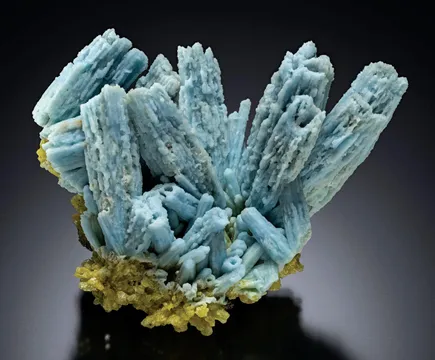
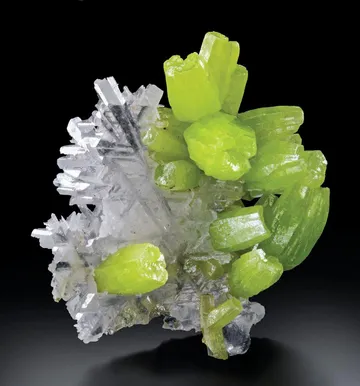
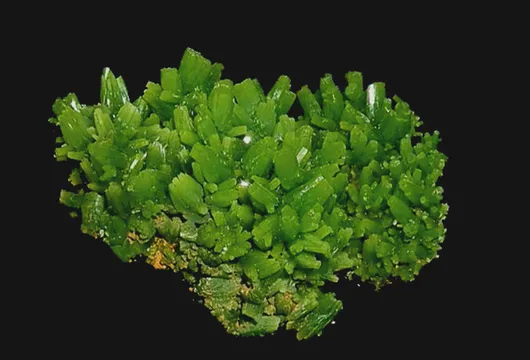
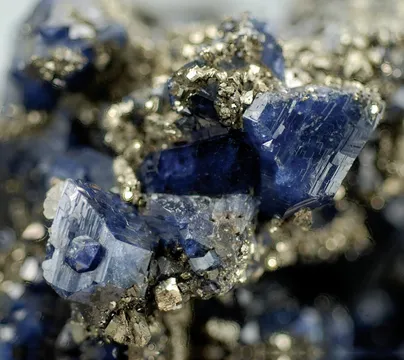
The locality’s fame rests first on pyromorphite. Daoping and Yangshuo produced brilliant grass-green to apple-green Pb5(PO4)3Cl in hexagonal prisms, barrel-shaped crystals, skeletal and hoppered forms, and divergent sprays that made China a front-rank modern pyromorphite source. Then came the blue: plumbogummite, PbAl3(PO4)(PO3OH)(OH)6, coating and partly replacing pyromorphite from Laohuan, producing unmistakable powder-blue to deep sky-blue pseudomorphs with yellow-green pyromorphite cores or remnants. The best pieces have the theatrical contrast collectors love—waxy blue botryoidal or velvety plumbogummite over bright yellow to green pyromorphite, sometimes with quartz or pale carbonate matrix, and often with a satisfying sense of replacement frozen halfway through.
Historically, Guilin-area labels are a minefield in the literal and curatorial sense. Older specimens may be labeled Daoping Mine, Yangshuo Mine, Yangshuo / Laohu area, Laohu Hill, Laohuan Mine, or simply Guilin, Guangxi, China. Current specialist treatment separates the great green pyromorphites of the interconnected Daoping–Yangshuo mine system from the blue plumbogummite-after-pyromorphite material now attributed to Laohuan, a group of artisanal workings on Laohu, “Old Tiger Hill,” at Haiyang Mountain in Gongcheng County. That clarification is important: a label correction can change not the beauty of the specimen, but its geological story and its place in the modern Chinese mineral record.
Regional View
Country View
The broader landscape matters. Guilin’s famous tower karst developed in a thick Upper Devonian to Lower Carboniferous limestone succession, and the Daoping–Yangshuo ore system belongs to a world where carbonate rocks, fractures, hydrothermal fluids, and later supergene alteration all did their work. In specimens, that history shows as open-space crystal growth: lustrous pyromorphite perched on limonitic or quartz-rich matrix; white calcite or quartz providing a pale stage for green prisms; cerussite and galena marking the lead source; and, at Laohuan, plumbogummite replacing pyromorphite with a degree of color contrast almost tailor-made for a display case.
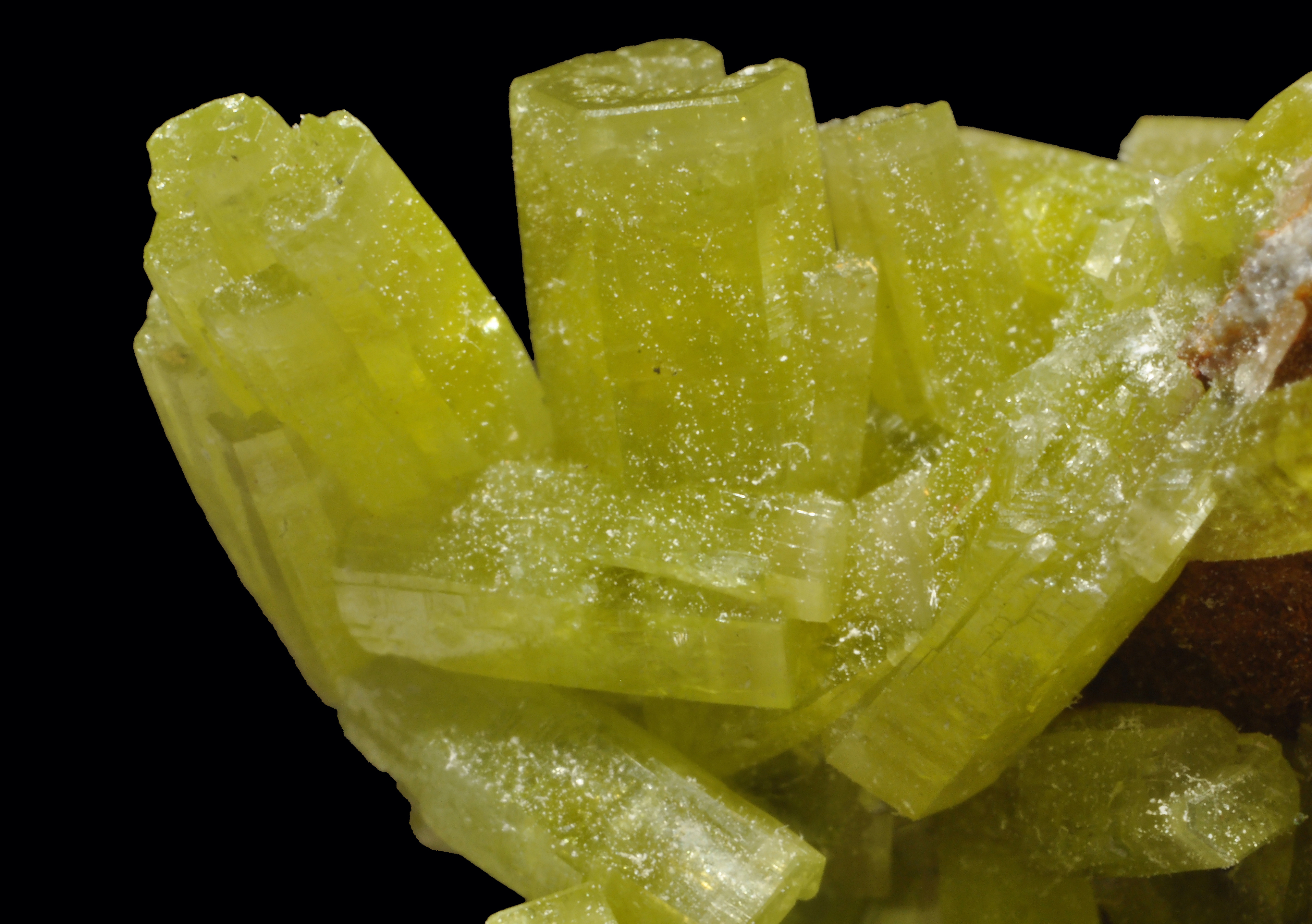
Photo: Wikimedia Commons
Search for specimens: View all specimens from Guilin, China
The collector material sold as Guilin comes chiefly from two related but distinct sources. The Daoping Mine in Gongcheng County and the Yangshuo Mine in Yangshuo County work the same hydrothermal Pb-Zn deposit across a county boundary; their underground workings have been interconnected since 2003, so post-connection labels are often more honestly understood as Daoping–Yangshuo unless a collector has unusually specific mine-side provenance. The deposit is hosted in limestone, sandstone, and shale of the Devonian Wuzhishan Formation, with local granitic and lamprophyre intrusions. Primary ore minerals include galena and sphalerite, with supergene lead minerals—above all pyromorphite and cerussite—developed in oxidized zones and cavities.
Daoping’s green pyromorphite was the great prize. The mine became widely known to collectors around the turn of the 21st century, with important production in the early 2000s and continuing waves of attractive material afterward. Specimens range from thumbnails of isolated, glassy green prisms to cabinet pieces with carpets of crystals on matrix. The best Daoping pieces have saturated, even color; undamaged lustrous terminations; and three-dimensional sprays or “pipe-organ” clusters rather than flat crusts. Labels using the older Tangping or Tang Ping spelling appear in the trade, but modern locality usage treats those as variants or misapplied names associated with the Daoping area.
Yangshuo material overlaps strongly in style because the orebody is connected, but dealer and collection records often use Yangshuo for specimens from the adjoining side of the operation. Bright pyromorphite on white calcite is a recognized Yangshuo look, and some early-production pieces from about 2002–2007 show small apple-green crystals scattered across contrasting white carbonate. Calcite itself is not the headline mineral here, but in the better combinations it provides the visual architecture: white to pale, lustrous or etched carbonate surfaces that make the green lead phosphate appear brighter and more sharply isolated.
Laohuan is the crucial correction in the Guilin story. The locality consists of artisanal adits and excavations on the slope of Laohu, “Old Tiger Hill,” at Haiyang Mountain in Gongcheng County, east of Guilin City and north of the Daoping–Yangshuo mine system. It was originally a low-grade lead-zinc-silver-barite working, but commercial ore mining ceased long ago. Once local miners realized that pyromorphite—and later plumbogummite replacing pyromorphite—could be sold as specimens, the economics shifted from ore to crystals. That shift is why Laohuan occupies a special place in Chinese mineral collecting: it has operated, at least intermittently, as a specimen mine rather than as an industrial mine with specimen recovery as a byproduct.
The Laohuan plumbogummite finds produced the locality’s most instantly recognizable specimens. The classic pieces are not merely blue crusts; they are replacement specimens. Pyromorphite formed first, commonly as yellow to green hexagonal prisms, and plumbogummite later coated, penetrated, and partly replaced it. Some specimens retain bright pyromorphite at terminations or inside broken crystals; others show botryoidal plumbogummite over a ghostly pyromorphite framework. Dealer records document important waves of material around 2014 and January 2015, including elongated and fanlike pyromorphite groups partly coated or replaced by intense sky-blue plumbogummite. Later pieces, including examples marketed in 2017, show that the area continued to yield pockets, but the original main tunnel area has been described as largely mined out, with future production dependent on new pockets in other directions.
Collecting access today should be considered closed to casual visitors. These are mines and artisanal workings in China, not public fee-collecting sites, and the specimen flow is controlled by local miners, dealers, and established market channels. For collectors, the practical issue is not planning a dig but reading labels critically. Green pyromorphite alone can reasonably be Daoping or Yangshuo depending on period and provenance. Blue plumbogummite after pyromorphite, especially material labeled Daoping or Yangshuo from the 2000s and 2010s, should be examined in light of the Laohuan attribution now accepted by many specialists.
Guilin pyromorphite is best known from the Daoping–Yangshuo Pb-Zn orebody, where it occurs as bright grass-green, lime-green, apple-green, yellow-green, and more rarely yellowish crystals in the oxidized lead zone; habits include short hexagonal prisms with pinacoid terminations, barrel-shaped crystals, skeletal and deeply hoppered terminations, doubly terminated prisms, parallel aggregates, divergent sprays, and compact drusy carpets on limonitic, quartz, baryte, calcite, or cerussite-bearing matrix. Typical crystals on good cabinet and miniature pieces are in the millimeter to roughly 1–2 cm range, while some Laohuan-associated replacement pieces preserve much larger pyromorphite crystal forms partly coated or replaced by plumbogummite, with dealer-documented crystals reaching several centimeters. The finest Guilin pyromorphites are judged by saturated even green color, sharp undamaged terminations, wet resinous luster, translucency when backlit, and sculptural three-dimensional growth rather than dull crusts or bruised crystal masses; association with pale matrix or blue plumbogummite can elevate the visual impact, but flat, abraded, or heavily iron-stained pieces are ordinary by comparison.
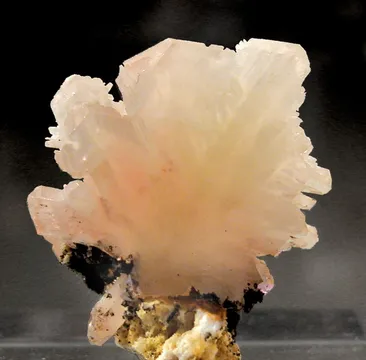
Calcite from Guilin is a supporting but locally important species in the Daoping–Yangshuo assemblage, occurring in the carbonate-hosted Pb-Zn system as white to pale matrix, massive or formless carbonate surfaces, and rarer lustrous crystal groups associated with pyromorphite, cerussite, gypsum, and the yellow cadmium sulfide hawleyite. Collector pieces described from Yangshuo show bright apple-green pyromorphite crystals, often only a few millimeters across, scattered on contrasting white calcite, a style valued for clean color separation and sculptural matrix rather than for calcite as the dominant display mineral. Unusual Guilin calcite specimens from Gongcheng have been noted for sharp, lustrous, doubly terminated crystals with quartz-like termination morphology and growth phantoms, while Daoping also produced rare quartz casts after dissolved calcite rhombs; the best calcite-associated Guilin pieces therefore succeed either as crisp, aesthetic pyromorphite-on-white-carbonate combinations or as uncommon calcite morphology from a locality collected mainly for lead phosphates.
Guilin plumbogummite is the Laohuan signature mineral: sky-blue, powder-blue, greenish-blue, gray-blue, and at times deep blue PbAl3(PO4)(PO3OH)(OH)6 occurring as botryoidal, crust-like, velvety, and pseudomorphic coatings on earlier pyromorphite. The most desirable specimens show clear evidence of replacement—blue plumbogummite mantling or partly replacing yellow to green pyromorphite prisms, with residual pyromorphite visible at broken ends, in crystal cores, or as contrasting clusters on the same matrix. Documented pieces range from thumbnails and miniatures of a few centimeters to large cabinet specimens over 10 cm, and some show fluorescence under ultraviolet light, with plumbogummite commonly responding blue to green depending on wavelength and residual pyromorphite giving yellow to orange accents. Quality depends on intense, even blue color, silky or waxy surface texture without scuffing, recognizable pyromorphite form, and strong color contrast; ordinary examples are thin blue crusts, rubbed botryoids with white abrasion points, or pieces so completely replaced that the original pyromorphite architecture is visually weak.
Other minerals documented from the Guilin collector district include galena, sphalerite, cerussite, chrome-bearing cerussite, quartz, baryte, malachite, hematite, goethite or limonite, dolomite, gypsum, dundasite, descloizite, hawleyite, willemite, and sparse wulfenite. Daoping is notable for its broader oxidized Pb-Zn suite, especially cerussite with pyromorphite and the rare occurrence of hawleyite on calcite-bearing limestone matrix. Within the wider Guilin administrative region, the Miaoershan or Ziyuan uranium ore field adds a very different rarity suite: parsonsite, kasolite, metazeunerite, widenmannite, uranospinite, and other secondary uranium minerals from Shazijiang-type material, along with primary uranium mineralization associated with quartz-calcite veins and granite-hosted systems. I found no well-supported mineral species for which the Guilin pyromorphite district itself is the type locality; its importance is instead specimen quality and the modern clarification of source localities.
The central authenticity issue for Guilin specimens is locality, not species. For green pyromorphite, Daoping, Yangshuo, Tangping, and broad “Guilin” labels all occur in the trade, and the underground connection between Daoping and Yangshuo since 2003 makes very precise post-2003 attribution difficult unless the specimen has first-hand documentation. For plumbogummite after pyromorphite, older Daoping or Yangshuo labels are especially suspect: much of the blue replacement material long sold under those names is now attributed to Laohuan or the Laohu/Haiyang Mountain area. A careful collector should preserve old labels but add a modern locality note rather than simply discard the historical label.
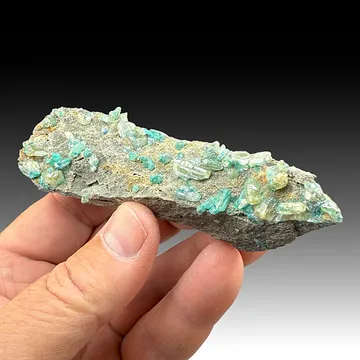
Species misidentification is less common on strong pieces because the color and habit are distinctive, but it does happen. Plumbogummite coatings can hide the underlying mineral, so analytical confirmation is desirable on expensive specimens, especially where the label promises a true pseudomorph after pyromorphite rather than a mere blue crust. Some dealers have supplied analyses for better Laohuan pieces; that documentation adds confidence. Blue-green coatings on damaged or incomplete pieces should not automatically be assumed to be plumbogummite without locality-consistent habit and, ideally, provenance.
Condition is a major value driver. Daoping pyromorphite crystals are dense and heavy for their size, but the terminations chip easily and the best luster is unforgiving under magnification. Look for bruised pinacoids, flattened spray tips, repaired clusters, and glue-darkened matrix contact points. Laohuan plumbogummite introduces another problem: velvety or botryoidal surfaces can scuff, leaving pale whitish spots that are often more distracting than small edge nicks on pyromorphite. Avoid unnecessary handling of the blue surfaces; support specimens from the matrix or base.
Fluorescence is real but variable. Many Guilin pyromorphite specimens show little to no fluorescence, while some plumbogummite-pyromorphite replacements from Laohuan show attractive multi-wavelength responses: plumbogummite may fluoresce blue or green, and residual pyromorphite may show yellow to orange accents. UV response should be treated as a bonus, not a guarantee, and it should not override normal judgments of color, form, and condition under white light.
Market availability is divided. Small Daoping-style pyromorphites remain obtainable, but choice early pieces with saturated color, sharp luster, and sculptural form have increasingly settled into collections. Laohuan plumbogummite specimens are actively traded, including thumbnails through cabinet pieces, but the strongest examples—clean blue replacement forms with visible yellow-green pyromorphite and minimal abrasion—are distinctly scarcer than the large number of mediocre blue crusts might suggest. As with many modern Chinese classics, the best buying strategy is patient selectivity: pay for form, color, and documentation, not merely for the word “Guilin” on the label.
The most memorable story from Guilin is a story of names. For years, the blue plumbogummite-after-pyromorphite specimens circulated as Daoping or Yangshuo, the names collectors already knew from the brilliant green pyromorphites that had made Guangxi famous. The specimens looked plausible enough: the same prefecture, the same lead-phosphate chemistry, the same broad mineral market channels. But the locality trail kept pointing away from the famous mines. Berthold Ottens had already argued that the material came from Laohu, and the later Mineralogical Record treatment fixed the source as Laohuan on Laohu, “Old Tiger Hill,” at Haiyang Mountain in Gongcheng County. In collector terms, that was a major correction: some of the world’s most recognizable modern plumbogummites were not Daoping specimens after all.
Laohuan itself has the atmosphere of a specimen locality that almost should not have happened. It was not a grand industrial mine built around spectacular ore. It was a collection of artisanal adits and hillside excavations in a low-grade lead-zinc-silver-barite occurrence. The ore was not rich enough to keep conventional mining alive, but the mountain had a second economy hidden inside it. Once local miners realized that crystal specimens could be worth more than low-grade ore, the purpose of the workings changed. They were no longer chasing metal; they were chasing pockets.
That transformation explains the odd status of Laohuan in modern Chinese collecting. China has produced countless great specimens from active industrial mines, but dedicated specimen mining is much less common. Laohuan became one of the rare Chinese localities worked essentially for collectors. The original adit eventually became largely exhausted, and miners opened many holes into the mountain, most now abandoned, a few worked intermittently when hope or rumor suggested another pocket might remain. The result is a locality with the intimacy of a hand-dug prospect and the international importance of a classic.
The Daoping story has its own rhythm. The vivid green pyromorphites that appeared around the early 2000s changed expectations for the species. Collectors who knew European and American classics suddenly had to make room for Chinese material that was not merely abundant, but beautiful: glassy green prisms, hoppered terminations, clustered sprays, and cabinet pieces with the kind of saturated apple color that photographs well and displays even better. The Daoping and Yangshuo workings were eventually connected underground, turning what dealers and collectors preferred to separate into a more complicated geological and mining reality. A label might say Daoping, a similar one might say Yangshuo, and after 2003 both could be honest approximations rather than precise statements.
A later generation of collectors has encountered Guilin through the blue pseudomorphs first. Under white light they are already dramatic—soft sky-blue over yellow-green lead phosphate—but under ultraviolet light some pieces become stranger still. Fluorescent-mineral collectors have documented plumbogummite responding blue to green depending on wavelength, with residual pyromorphite showing yellow to orange accents. In the best specimens, the light reveals the replacement process: not a uniform coating, but a mineralogical palimpsest, pyromorphite still glowing from inside the blue.