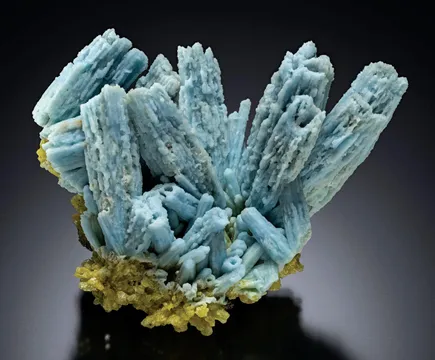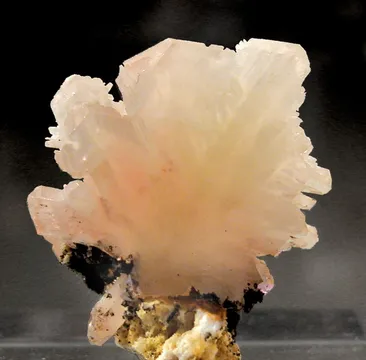
Hezhou, China — a premier locality for crystallized scorodite in a pyrite-rich gossan, with minerals of Guangxi’s Nanling belt; prized for sharp, lustrous crys…
Key facts
Hezhou occupies a remarkably mineralized corner of northeastern Guangxi, where two very different specimen stories meet. The collector’s Hezhou is best known for the 2008 Baishiding scorodite find: lustrous, dark steel-blue to blue-purple orthorhombic scorodite crystals scattered through sparkling pyrite-rich gossan and sulphide matrix, a style that gave China one of its few genuinely important crystallized scorodite occurrences. The geological Hezhou is broader. Around Pinggui, Zhongshan, Babu, and Zhaoping, the prefecture sits within the western Nanling metallogenic belt and the Guposhan–Huashan W-Sn district, a complex of granitic intrusions, Devonian carbonate and clastic rocks, skarn and quartz-sulphide veins, and oxidized zones that produced tin, tungsten, molybdenum, zinc, lead, antimony, iron, gold, and the secondary minerals collectors now recognize.
Regional View
Country View
The best Hezhou scorodites are not delicate pastel cabinet pieces; they are dense, heavy, sulphide-rich specimens in which the reward comes from close inspection and proper light. Many crystals appear nearly black in ordinary room light, but bright light can bring out blue, smoky blue, bluish purple, or greenish flashes along edges and broken internal reflections. Pyrite is not merely an accessory here: it forms much of the visual field, a glittering gold-brassy to limonitic substrate that can conceal and frame the scorodite at the same time. The most desirable pieces show individual, sharp, lustrous crystals rather than undifferentiated crusts, with crystals commonly in the millimeter to low-centimeter range and rare major crystals reported up to about 3 cm.

Photo: Wikimedia Commons
Hezhou is also represented in collector cabinets by uncommon zinc carbonates. The Xiafu dam construction site in Zhaoping County produced distinctive cadmian-yellow smithsonite, while the Muqiaomian Sn-Zn deposit in the Xinlu ore field records smithsonite, hydrozincite, sphalerite, pyrite, marcasite, goethite, hematite, malachite, fluorite, cassiterite, and sulphides in an oxidized skarn-to-vein environment. These zinc minerals broaden the locality beyond the famous Baishiding scorodite: Hezhou is best read not as a single mine, but as a prefecture-scale specimen label covering several productive ore systems in the Guposhan–Huashan and related districts.
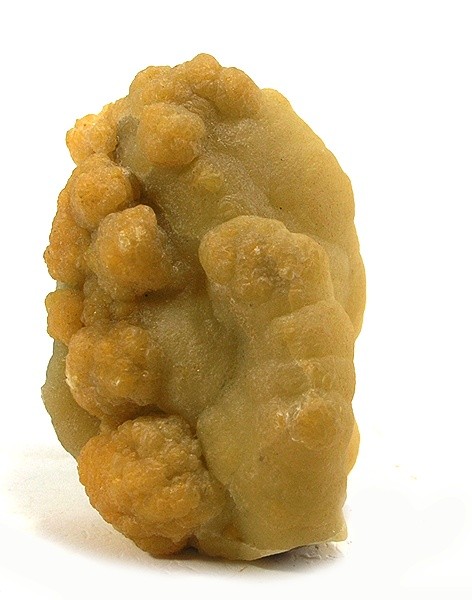
Photo: Wikimedia Commons
Search for specimens: View all specimens from Hezhou, China
Hezhou Prefecture lies in northeastern Guangxi, close to the Hunan and Guangdong borders, and its mineral localities fall mainly into the western Nanling Sn-W metallogenic province. The Guposhan–Huashan district is the essential geological frame for most of the region’s tin-tungsten-zinc mineralization. It is built around granitic to intermediate-felsic intrusions emplaced into older metasedimentary rocks and Paleozoic sedimentary successions that include Devonian carbonate rocks and clastic units. The result is a classic South China polymetallic environment: skarn near reactive carbonate contacts, quartz-sulphide veins and veinlets along faults and fractures, greisen- and vein-related W-Sn mineralization, and oxidized caps carrying secondary arsenates, carbonates, hydroxides, and iron oxides.
The Baishiding Mine in Babu District is the locality behind the famous scorodite-pyrite specimens. It is described as a small quartz-vein-type molybdenum deposit hosted in biotite monzogranite and epimetamorphic clastic rocks of the Guiling pluton area. The Baishiding orebodies occur as quartz-molybdenite veins, with a sulphide suite including molybdenite, pyrite, chalcopyrite, pyrrhotite, arsenopyrite, galena, sphalerite, and bismuthinite, with scheelite, calcite, muscovite-sericite, feldspar, amphibole-group minerals, titanite, apatite, and zircon also recorded. The molybdenite Re-Os and zircon SHRIMP U-Pb data are important historically because they indicate Silurian mineralization at about 424 Ma, making Baishiding stand out against the much better known Jurassic W-Sn events of the Nanling belt.
The scorodite specimens are secondary, arsenate-zone products tied to arsenic-bearing sulphide oxidation. In practice, the collector material came not as neat vein plates of isolated crystals but as pyrite-rich, oxidized sulphide masses, commonly with scorodite partly embedded in or draped over brassy pyrite and limonitic gossan. Dealer and museum records consistently point to a limited 2008 discovery, after which significant new supply appears to have been sparse. This explains the market character of the locality today: the best pieces circulate from older collections, and fresh production is not a reliable expectation.
The Pinggui and Guposhan Sn-polymetallic deposits represent a separate but related Hezhou story. The Xinlu ore field includes several named ore segments, including Dachong, Liuhe’ao, Muqiaomian, Baimianshan, and Shimen, arranged around the southern contact zone of the Guposhan granite and its vicinity. Published work on the Baimianshan Sn-Zn segment documents Devonian clastic rocks of the Xindu and Yujiang formations, Donggangling Formation carbonate rocks, upper Devonian Guilin and Rongxian formations, and Lower Carboniferous carbonates cut by NNW-, NW-, NE-, and EW-striking faults. NNW-striking faults control major ore segments; intermediate-felsic dikes occur along or across faults; and minor skarn plus fault-controlled oxidized orebodies crop out at the surface.
At Baimianshan, the main mineralization sequence is described in four stages: prograde skarn, retrograde skarn-sulphide, quartz-sulphide veins, and barren carbonate. The retrograde skarn-sulphide stage is the principal ore stage, with massive pyrrhotite and sphalerite, cassiterite, arsenian pyrite, epidote, and minor chalcopyrite. Later quartz-sulphide veins carry arsenopyrite, pyrite, quartz, sericite, and chlorite, and late pyrite-calcite veins cut the earlier assemblages. Cassiterite U-Pb dating from this system gives an age of 168.7 ± 1.3 Ma for Sn-Zn mineralization in the Baimianshan segment, fitting the broader Middle-Late Jurassic W-Sn mineralizing episode around Guposhan–Huashan.
The Muqiaomian Sn deposit, within the Xinlu ore field of the Guposhan Sn-polymetallic ore field, is the Hezhou locality most directly tied to smithsonite in the mine record. It is mineralogically a zinc-tin-sulphide system with arsenopyrite, cassiterite, chalcopyrite, pyrite, pyrrhotite, sphalerite var. marmatite, jamesonite, marcasite, quartz, calcite, fluorite, diopside, chlorite-group minerals, goethite, hematite, malachite, gypsum, hydrozincite, and smithsonite. It is classed in published Xinlu studies as transitional between proximal contact-zone deposits and more distal sediment-hosted deposits, a useful clue to why both skarn minerals and low-temperature oxidation minerals are present.
The Xiafu dam construction site in Zhaoping County is different again: a temporary construction-related occurrence rather than a traditional mine. Its collector importance rests on yellow smithsonite, some pieces reported as having an unusual cadmium-related color and, in at least one record, possible yellow greenockite inclusions that were not analyzed. Because construction-site occurrences are fleeting, Xiafu material should be treated as a closed or at least non-repeatable specimen source unless new verified field information emerges.
Mining access in Hezhou should be considered restricted. These are industrial mines, exploration targets, construction sites, and geologically hazardous altered ground, not public collecting localities. Any visit requires permission from landholders and mineral-rights operators, and underground workings, open pits, roadcuts, and dam or construction zones should not be entered casually. For collectors outside China, Hezhou is primarily a market locality: buy from dealers who can distinguish Baishiding scorodite, Muqiaomian zinc-tin material, Xiafu smithsonite, and broader “Hezhou” prefecture-label material.
Hezhou scorodite is the locality’s signature specimen mineral, chiefly from the Baishiding Mine, where the best pieces came from a limited 2008 find in pyrite-rich oxidized sulphide matrix. Crystals are orthorhombic, lustrous, and usually sharp, ranging from dense sparkles of a few millimeters to distinct crystals around 7 mm, 1.1–1.6 cm, and exceptionally larger individuals reported near 3 cm on small-cabinet matrix. The color is characteristically dark steel blue, smoky blue, blue-purple, or nearly black in ordinary light, with better blue and greenish tones visible at edges or under strong illumination. Good Hezhou pieces have separated, well-formed crystals with bright luster and visible geometry against golden pyrite or limonitic gossan; ordinary pieces are darker, more massive, or so pyrite-covered that the scorodite reads only as dull crust rather than distinct crystals.
Pyrite from Hezhou matters to collectors mostly as the essential matrix and visual counterpoint for Baishiding scorodite, though it is also a widespread ore mineral in the Pinggui and Guposhan systems. At Baishiding it occurs as brassy, metallic, granular to crystalline sulphide-rich matrix, sometimes sparkling so heavily that it can obscure the dark scorodite crystals embedded in it. In the Xinlu Sn-Zn system, pyrite appears in quartz-sulphide and late pyrite-calcite veins, where it replaces or cuts earlier pyrrhotite-sphalerite-cassiterite assemblages. The best Hezhou pyrite-bearing collector specimens are not sought for isolated pyrite cubes; they are judged by matrix architecture, fresh metallic contrast, lack of excessive limonite staining, and how well the pyrite frames rather than overwhelms the associated scorodite or zinc minerals.
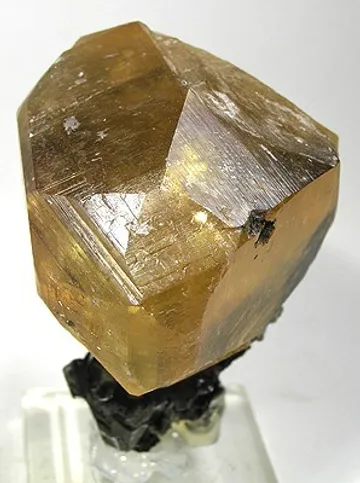
Hezhou smithsonite is recorded principally from the Muqiaomian Sn deposit in the Xinlu ore field and from the Xiafu dam construction site in Zhaoping County, with the latter producing the most visually memorable specimens: yellow to cadmian-yellow botryoidal and rounded smithsonite aggregates, including small-cabinet pieces around 7 cm. The Muqiaomian association places smithsonite in the oxidized zinc portion of a tin-zinc-polymetallic system with sphalerite, pyrite, pyrrhotite, marcasite, goethite, hematite, hydrozincite, malachite, fluorite, quartz, calcite, and cassiterite. Good Hezhou smithsonite is valued for saturated yellow color, lustrous or subtly translucent botryoidal surfaces, clean undamaged domes, and a confident Xiafu or Muqiaomian attribution; lesser examples are dull, chalky, poorly localized, or confused with other yellow Chinese zinc carbonates.
Other documented Hezhou minerals reflect the prefecture’s mixed tin-tungsten-molybdenum-zinc history. Baishiding adds molybdenite, arsenopyrite, chalcopyrite, pyrrhotite, scheelite, bismuthinite, galena, sphalerite, calcite, quartz, and alteration minerals. The Xinlu and Muqiaomian systems add cassiterite, jamesonite, marcasite, fluorite, diopside, hydrozincite, malachite, goethite, and hematite. Shanhu in Zhongshan County is known for W-Sn mineralization and collector rhodochrosite with fluorite, while the Zhaoping meteorite adds an entirely different mineralogical footnote: an IAB complex iron meteorite containing kamacite, taenite, troilite, schreibersite, cohenite, graphite, and unusual sarcopside inclusions. I have not found a verified IMA mineral species whose type locality is Hezhou; the locality’s importance is instead in notable Chinese scorodite, unusual yellow smithsonite, and well-studied Nanling Sn-W-Mo-Zn metallogeny.
Hezhou labels need careful reading. “Hezhou” alone is a prefecture-level label and may refer to Baishiding scorodite, Xiafu smithsonite, Muqiaomian zinc-tin material, Shanhu W-Sn specimens, or less precise regional material from Guangxi. For scorodite, the most desirable and best-documented label is Baishiding Mine, Babu District or older labels using Zhongshan Co. / Hezhou Prefecture language. Because Baishiding material has a distinctive look—dark blue to blue-purple scorodite on bright pyrite and limonitic gossan—misattribution is more likely than deliberate fabrication, but unlabeled dark arsenate crusts should not be accepted as Hezhou without provenance.
Condition is a real issue. Scorodite crystals can be sharp but small, and many good pieces have micro-roughness, bruised edges, or hidden contacts masked by sparkling pyrite. Strong magnification is useful, but do not over-penalize every tiny edge nick on an otherwise aesthetic Baishiding piece; the material is naturally crowded and matrix-heavy. More serious problems include broken main crystals, a dull black appearance with no visible crystal faces, and crumbly limonitic matrix that sheds. Scorodite is an arsenate, so collectors should handle it as a stable display mineral but avoid grinding, trimming without precautions, or generating dust; wash hands after handling and keep powdery fragments away from children and pets.
Smithsonite from Xiafu and Muqiaomian should be checked for locality precision and color plausibility. The yellow Xiafu pieces are attractive partly because the color is unusual for the locality and has been described as cadmium-influenced; however, yellow color alone is not proof of Xiafu origin, and Chinese yellow smithsonite has been sold from other provinces. Watch for labels that drift between “Hezhou,” “Zhaoping,” “Xiafu dam,” and generic “China.” Smithsonite is comparatively soft and botryoidal surfaces can abrade easily, so inspect high points, dome edges, and contact scars.
Market availability is limited but not impossible. Baishiding scorodite appears periodically from older dealer stock, auctions, and collection dispersals, with the strongest demand for rich miniatures and small-cabinet pieces showing distinct centimeter-scale crystals. Since the key find dates to 2008, these are now old-find specimens rather than regular production. Xiafu smithsonite is also sporadic, with construction-site material generally finite by nature. Hezhou pyrite as a standalone species is much less of a market category; its value is usually tied to the associated scorodite, smithsonite, or ore-suite context.
The Baishiding scorodite story is the kind collectors recognize instantly: one small find, a short burst of specimens, and then years of trying to locate comparable pieces. Around 2008, the lesser-known Baishiding molybdenum mine yielded dark, lustrous scorodite crystals on pyrite-rich matrix. The material did not arrive as glamorous, jewel-like sprays; it often looked almost black until a strong light revealed blue, purple, or smoky internal color. Some pieces were thumbnails glittering with hundreds of tiny crystals, while others carried discrete, sharp crystals around 1 cm or more. One photographed small-cabinet specimen, 7.9 x 5.0 x 4.4 cm, was notable for a fat scorodite crystal about 3 cm long embedded in the pyrite surface—an object easy for a camera to flatten, but startling once the eye separates the dark crystal from the brassy matrix.
The Xiafu smithsonite occurrence has a different rhythm: not a mine famous through decades of production, but a construction-site locality whose best specimens seem to have passed quickly into the mineral trade. The finest yellow smithsonites from the Xiafu dam construction site are rounded and botryoidal rather than sharply crystallized, with a warm cadmian-yellow tone that makes them immediately different from the blue-black Baishiding aesthetic. A well-known example measures 7.4 x 5.3 x 2.8 cm and was described as valuable not simply for being smithsonite, but for combining unusual yellow color with locality rarity. That is exactly the kind of occurrence that becomes harder to reconstruct with time: the name survives on labels, but the actual exposure may have existed only during a narrow window of construction.
Then there is Zhaoping, which belongs to Hezhou in geography but to the sky in origin. In June 1983 an iron meteorite was found at Zhaoping: an egg-shaped mass about 120 cm long and weighing roughly 2 tons. It is classified as an IAB complex iron, with coarse Widmanstätten patterns and numerous Neumann bands. Its primary mineral constituents include kamacite, taenite, troilite, schreibersite, and cohenite, and some samples show cohenite decomposed to graphite and low-nickel iron. For mineral collectors, the oddest detail is not the iron itself but the inclusions: Zhaoping contains unusual Mn-free sarcopside. It is a reminder that “Hezhou minerals” can mean skarn sulphides, secondary arsenates, yellow zinc carbonates, and, in one extraordinary case, a two-ton extraterrestrial metal mass.